

TL;DR:
- Canadian candy distribution faces challenges from climate, regulations, and demand seasonality.
- Modern logistics tools like real-time inventory management and demand forecasting enhance efficiency.
- Outsourcing packaging and quality control, along with process discipline, boosts retail success.
Streamline Candy Logistics in Canada: Strategies for Retailers
Most Canadian candy retailers assume that advanced logistics optimization is a game reserved for massive corporations with deep pockets. That assumption is costing real money. When Hershey cut $100M in inventory through smarter supply chain technology, they proved what’s possible when you stop guessing and start managing with precision. The same core principles behind that result, including real-time visibility, demand-driven ordering, and process discipline, apply directly to Canadian candy retailers of any size. This article breaks down the logistics challenges you face, the tools that work, and the practical steps you can take right now to reduce waste, protect margins, and scale more confidently.
Table of Contents
- Understanding logistics challenges for candy distribution in Canada
- Key components of an efficient candy supply chain
- Innovations in logistics: Tech and process improvements for candy
- Practical strategies for optimizing candy distribution
- Our view: What most candy retailers misunderstand about logistics
- Efficient candy logistics: Take your next step with Spaceman
- Frequently asked questions
Key Takeaways
| Point | Details |
|---|---|
| Leverage supply chain tech | Modern tools like real-time monitoring and forecasting boost efficiency and reduce inventory costs. |
| Address Canadian logistics challenges | Climate, regulations, and perishability must be considered in every logistics plan for candy products. |
| Implement process improvements | Use proven strategies like co-packing and private labeling to streamline candy distribution for retailers. |
| Focus on actionable steps | Prioritize forecasting, inventory control, and simple processes for the greatest impact on profits. |
Understanding logistics challenges for candy distribution in Canada
Canada is not a simple market to distribute candy in. The geography alone creates significant friction. You’re moving product across six time zones, through wildly different climate conditions, and into communities with very different buying patterns. That complexity compounds fast, especially when you’re working with products like freeze-dried candies that have specific storage needs, or private label products where brand consistency matters at every touchpoint.
Here’s what typically makes candy distribution difficult for Canadian retailers:
- Climate variability: Canada’s extreme temperature swings, from humid summers in Ontario to deep freezes in Alberta winters, can damage candy in transit or storage if packaging and temperature controls aren’t properly managed.
- Regional regulatory differences: Labeling requirements, bilingual packaging rules, and provincial food safety regulations vary across the country. Getting it wrong means chargebacks, returned shipments, or fines.
- Perishability and shelf life management: Even freeze-dried products, which have extended shelf lives, require consistent dry and cool storage. Any moisture exposure during transit can compromise the entire batch.
- Demand spikes and seasonality: Halloween, Valentine’s Day, Easter, and Christmas create sharp peaks in candy demand. Without proper forecasting, you’re either sitting on dead inventory or running out of your best sellers right when customers want them most.
- Private label complexity: When you’re managing your own branded product, you’re responsible for coordinating between manufacturers, packaging suppliers, and logistics providers. That’s more moving parts and more opportunities for things to go wrong.
These challenges aren’t unique to small operations. Industry giants manage them through significant investment in logistics technology. As a benchmark for logistics efficiency, Hershey’s results show what’s possible when technology and process align. The good news for Canadian candy businesses is that the technology gap between enterprise and small-to-mid size operators is closing faster than ever. Understanding the common candy distributor challenges in Canada is the first step toward building a distribution model that actually scales.
Statistic callout: According to industry supply chain research, poor inventory management is one of the top three cost drivers for food and confectionery retailers, with overstock and stockouts together eroding margins by 10 to 30 percent annually for businesses without real-time visibility tools.
The key insight here is that you don’t need to be Hershey to adopt Hershey-level thinking. You need to understand where your logistics are leaking money and apply targeted fixes.
Key components of an efficient candy supply chain
Building an efficient candy supply chain isn’t about having the most sophisticated technology. It’s about getting the fundamentals right across every stage of the process. Each stage creates opportunities to either save money or lose it. Here’s how the stages break down:
- Sourcing: Choosing suppliers who are reliable, quality-consistent, and flexible enough to respond to seasonal demand changes. For freeze-dried candy specifically, sourcing from a manufacturer who controls their own process gives you far more predictability than working through a broker.
- Warehousing: Storing product in conditions that protect quality. This means climate-controlled environments, organized inventory systems, and clear labeling for first-in, first-out (FIFO) rotation.
- Order management and picking: Accurate picking reduces errors, returns, and customer service headaches. Manual processes here are a major source of hidden cost for small and mid-size candy retailers.
- Transportation and delivery: Choosing carriers who understand food-grade requirements, have reliable tracking, and offer the flexibility you need during peak seasons.
- Returns and quality control: Having a clear process for managing damaged or expired product protects your brand reputation and your bottom line.
The biggest gap most Canadian candy retailers have is in the middle of this chain: order management and inventory visibility. That’s where real-time monitoring and decision-intelligence made the most measurable difference for large confectionery brands. Reviewing wholesale supply chain tips can help you identify which stage needs attention first.
| Logistics tool | Old approach | New approach |
|---|---|---|
| Inventory tracking | Manual spreadsheets | Cloud-based IMS with live updates |
| Demand forecasting | Gut-feel ordering | Data-driven forecast models |
| Order fulfillment | Paper pick lists | Barcode or RFID scanning |
| Supplier communication | Email and phone | Integrated supplier portals |
| Shipping visibility | Carrier website lookups | Real-time GPS tracking dashboards |
For retailers sourcing in volume, decisions about bulk candy sourcing directly affect how well your supply chain performs. Buying smart at the sourcing stage creates buffer room for the inevitable disruptions downstream.
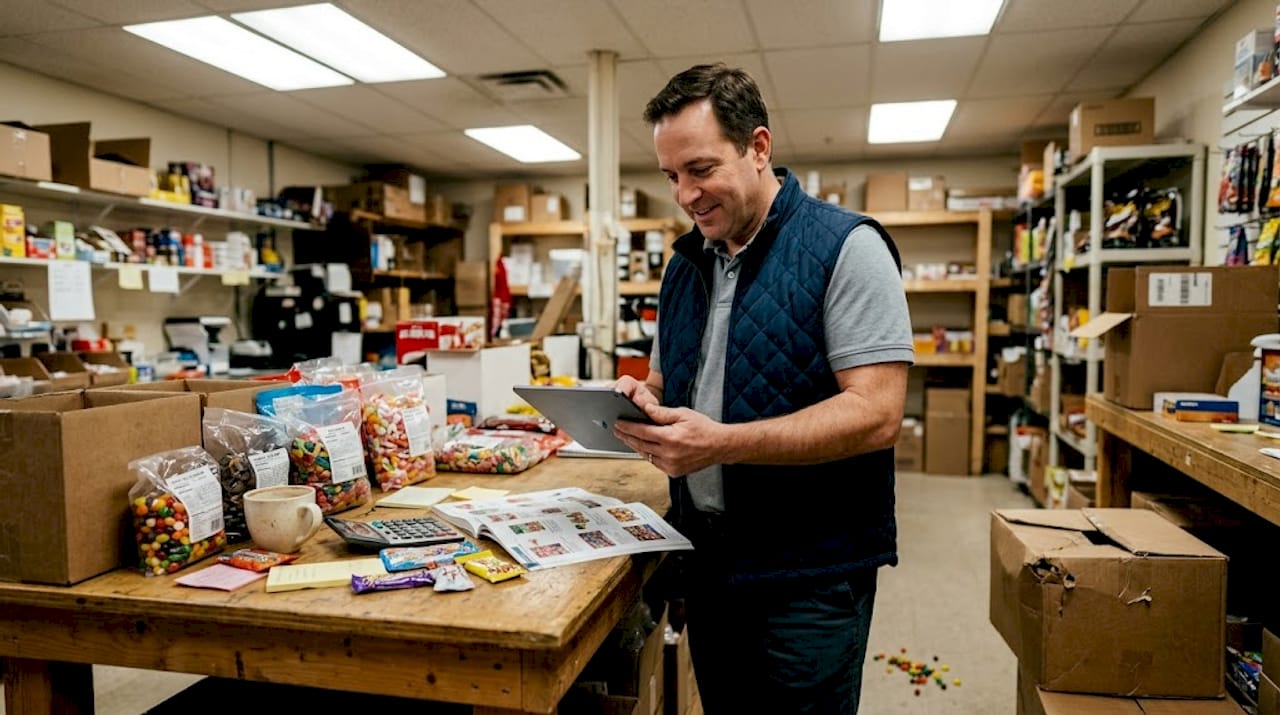
Pro Tip: Set a minimum reorder point for your top 20 percent of SKUs and automate purchase order triggers when inventory hits that threshold. This one change alone can eliminate the most common and costly stockouts without requiring you to overhaul your entire system.
Innovations in logistics: Tech and process improvements for candy
The technology landscape for logistics has changed significantly over the last five years. What was once only accessible to enterprise companies with large IT budgets is now available to small and mid-size businesses through affordable SaaS platforms and modular hardware. Canadian candy retailers who adopt even a fraction of these tools are seeing meaningful improvements in efficiency and cost control.
Here are the key technologies worth understanding:
- RFID (Radio Frequency Identification): RFID tags on pallets or cases allow automatic inventory scanning without manual barcode scans. In a busy warehouse, this reduces receiving time dramatically and virtually eliminates receiving errors.
- IoT sensors: Small, connected sensors placed in storage areas or transport vehicles monitor temperature and humidity in real time. For freeze-dried candy, which is moisture-sensitive, this kind of monitoring is not a luxury. It’s basic product protection.
- Inventory management software (IMS): Modern IMS platforms give you a live view of what you have, where it is, and when you need to reorder. The best ones integrate with your point-of-sale system and your e-commerce store, so your numbers stay accurate across every channel.
- Demand detection algorithms: These tools analyze your historical sales data alongside external signals like upcoming holidays, local events, and even weather patterns to predict what you’ll sell and when. This is exactly the type of supply chain decision-intelligence that drove major efficiency gains for leading confectionery brands.
| Metric | Without modern logistics tech | With modern logistics tech |
|---|---|---|
| Inventory accuracy | 70 to 80% | 95 to 99% |
| Order error rate | 3 to 5% | Under 1% |
| Stockout frequency | Weekly to monthly | Rare or seasonal only |
| Overstock carrying cost | High, unpredictable | Reduced by 20 to 40% |
For freeze-dried and private label candy specifically, process improvements matter as much as technology. Clear labeling on all inbound shipments, standardized storage zones by product type, and strict FIFO discipline protect quality without requiring any new technology at all. Practical guidance from a solid candy distribution guide can help you build those process foundations. Pairing good process with the right candy storage solutions gives your products the best chance of arriving in perfect condition every time.
Pro Tip: Start with an IMS before investing in RFID or IoT hardware. Software visibility is the foundation everything else builds on. If you don’t know what you have and where it is, adding more hardware just creates more complexity without clarity.
Practical strategies for optimizing candy distribution
Tech is only useful when paired with sharp operational habits. Here are the concrete strategies that consistently make the biggest difference for Canadian candy retailers looking to tighten their logistics without overhauling everything at once.
Demand planning before every major season. Pull your sales data from the previous year’s Halloween, Valentine’s Day, and Easter periods. Look at your top-selling SKUs and calculate how early your inventory ran out or how long overstock sat. Use that data to set order quantities for the upcoming season. This is free, requires no software, and can immediately reduce both lost sales and holding costs.
Standardize your packaging choices. Inconsistent packaging sizes create picking errors, increase shipping costs, and complicate labeling compliance. Standardizing packaging across your product line, especially for private label products, simplifies everything from storage to shipping to reordering. It also makes it easier to price your candy products profitably because your cost inputs become more predictable.
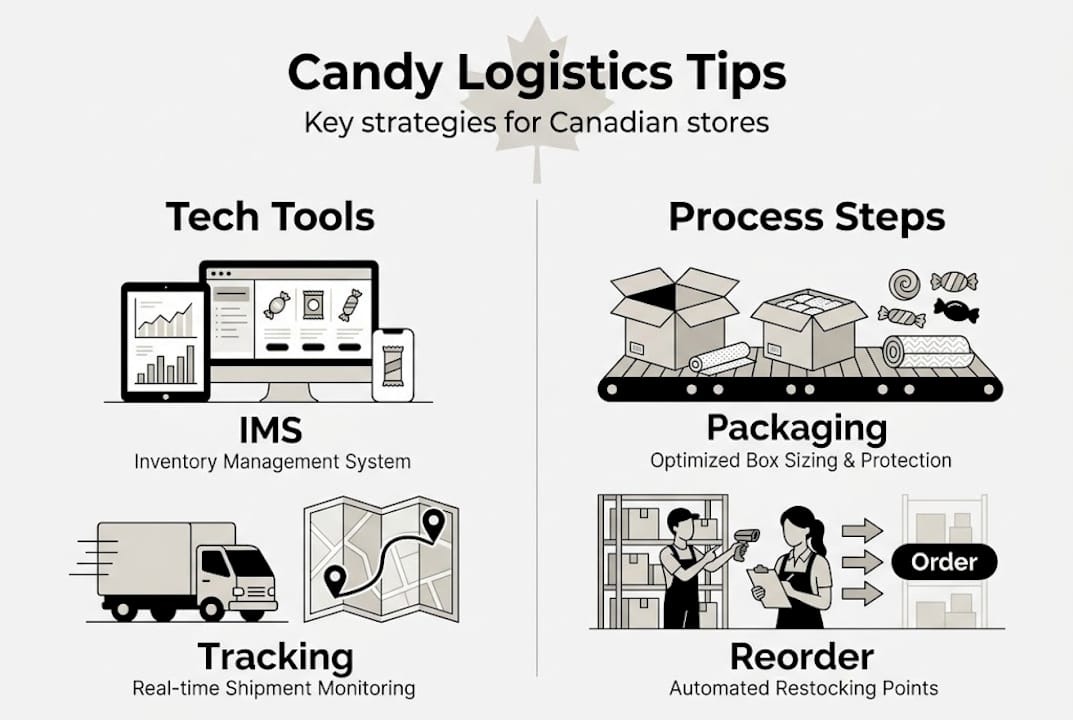
Outsource what you don’t control well. If packaging and bagging are slowing down your operation, or creating quality inconsistencies, that’s a strong signal to consider co-packing. Co-packing lets you hand off the physical packaging process to a specialized partner, freeing your team to focus on sales and customer relationships. Many Canadian retailers discover that outsourcing this step not only saves time but also reduces per-unit cost.
Leverage private labeling strategically. Private labeling is one of the most effective ways to increase margins while differentiating your product from generic alternatives. But it only works when your logistics support it. That means reliable restocking timelines, consistent packaging quality, and a supplier who understands your brand standards. Getting wholesale purchasing right from the start makes private label programs far more sustainable.
- Use rolling 90-day inventory reviews to catch slow-moving products before they become a markdown problem.
- Consolidate SKUs where possible. Every additional product variation adds complexity to your fulfillment process.
- Build a vendor scorecard. Track on-time delivery rates, fill rates, and quality rejection rates for every supplier you work with.
- Negotiate flexible minimum order quantities for seasonal products so you’re not locked into excess inventory when demand shifts.
“The businesses that win in candy distribution are not the ones with the most products. They’re the ones who know exactly what they have, exactly what they’ll sell, and exactly when to order more.”
Learning from Hershey’s logistics improvements doesn’t mean replicating their scale. It means adopting the same discipline of measurement, visibility, and process consistency that makes large operations work, and applying it at your level.
Pro Tip: If you’re managing both an in-store and an e-commerce channel, keep inventory counts unified in one system. Selling the same unit twice across two channels is one of the fastest ways to damage customer trust and create fulfillment chaos.
Our view: What most candy retailers misunderstand about logistics
Here’s something we see constantly: retailers chasing every new logistics solution without first mastering the basics. They invest in scanning technology before their warehouse is organized. They add SKUs before they’ve figured out how to move the ones they already carry. Then they wonder why efficiency isn’t improving.
The honest truth is that logistics excellence for candy distribution is 80 percent process discipline and 20 percent technology. Forecasting accuracy, inventory visibility, and consistent fulfillment practices matter far more than the brand of software you use. The retailers who get this right focus on three things: knowing what they have, knowing what they’ll sell, and knowing when to act on that information.
We’ve also seen retailers dramatically improve their results simply by outsourcing the parts of the operation they’re least equipped to handle. Co-packing and private labeling, done through the right partner, removes complexity and creates breathing room to focus on growth. Strategies like optimizing your candy displays become more impactful when your back-end logistics are solid enough to keep shelves consistently stocked. Don’t let perfect be the enemy of better. Start with what you can control today.
Efficient candy logistics: Take your next step with Spaceman
Putting these strategies into practice is a lot easier when you have the right partner behind you. Spaceman is a Canadian freeze-dried candy manufacturer and distributor offering private label and co-packing services designed specifically to simplify logistics for retailers like you. Whether you need help with packaging, consistent supply, or building out your own branded candy line, we’ve built our services around the real operational challenges Canadian retailers face.

Our co-packing and bagging services handle the complexity so you can focus on selling. We understand Canadian distribution, seasonal demand, and what it takes to keep product moving efficiently from our facility to your shelves. Browse our full range of candy products to see what’s available, or reach out directly to discuss a custom logistics and packaging solution built around your business needs.
Frequently asked questions
What logistics challenges are unique to candy distribution in Canada?
Climate extremes, bilingual labeling requirements, and regional regulatory differences make Canadian candy distribution distinctly complex, and those challenges are amplified for freeze-dried and private label products that require tighter storage and quality controls. Even large confectionery companies treat Canadian logistics efficiency as a continuous improvement priority.
How can technology improve candy logistics for small retailers?
Inventory management software, real-time tracking tools, and demand forecasting platforms give small retailers the same visibility advantages that enterprise brands use, and the inventory reduction results achieved through these tools are now accessible at a fraction of the cost compared to just five years ago.
What are freeze-dried candy logistics best practices?
Always store freeze-dried candy in a cool, dry environment, use moisture-barrier packaging, and implement FIFO inventory rotation. Supply chain tech like IoT humidity sensors can provide real-time alerts before storage conditions compromise your product.
How does co-packing help simplify candy distribution for retailers?
Co-packing allows you to outsource the packaging and assembly process to a specialized facility, which reduces labor costs, eliminates packaging errors, and frees your team to focus on sales growth and customer relationships.
What is private labeling in candy distribution?
Private labeling means selling a product manufactured by a supplier under your own brand name, which gives retailers stronger margins, greater brand differentiation, and more control over their product presentation without the capital investment of building a manufacturing operation.