

TL;DR:
- Freeze-dried Skittles undergo lyophilization, transforming them into crunchy, hollow spheres with intensified fruit flavor. The process involves freezing, vacuum removal of water through sublimation, and quick cycle times, making it suitable for small producers and home DIYers with expensive equipment. These candies offer a lighter texture, stronger taste, and audible crunch, making them popular on social media and viable for commercial sales.
Freeze-dried Skittles are defined as the original chewy candy transformed through lyophilization into light, hollow, crunchy spheres with dramatically amplified fruit flavor. The Skittles freeze dried experience strips every drop of moisture from the candy via sublimation, causing each piece to puff up and develop a shatter-like crunch that the original simply cannot match. TikTok candy creators and home producers using Harvest Right freeze dryers have pushed this trend into the mainstream, turning a $3 bag of Skittles into a genuinely new sensory event. If you have ever wondered what all the noise is about, this guide covers the science, the taste, the DIY process, and the business side.
How does the freeze drying process work for skittles?
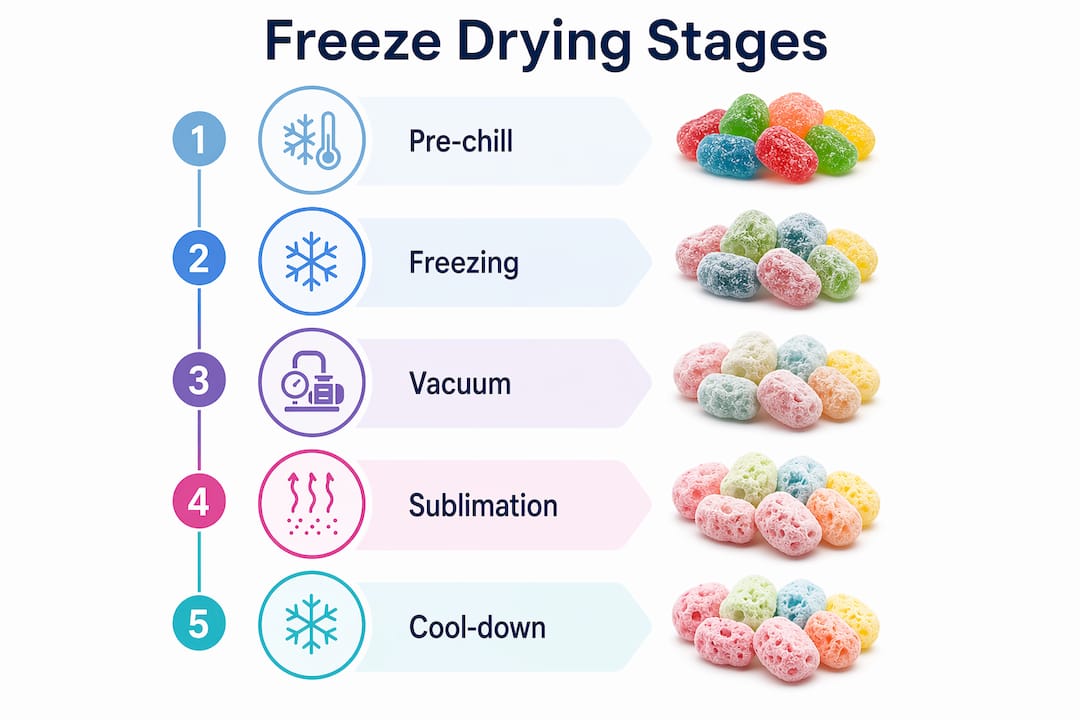
Lyophilization is the technical term for what most people call freeze drying. The process works in three stages: freezing the candy solid, dropping the chamber pressure with a vacuum pump, and then applying gentle heat so the ice converts directly to vapor without ever becoming liquid. That last step is sublimation, and it is the reason freeze drying removes all moisture, leaving the candy’s flavor molecules fully intact but its structure completely changed.
For Skittles specifically, the sugar and starch matrix expands as the water escapes. The result is a candy that has roughly doubled in size, feels almost weightless, and snaps apart with an audible crack. The fruit flavor you taste is the same as the original. It just hits harder because nothing is diluting it.
Here is a simplified look at the four core stages:
| Stage | What Happens | Why It Matters |
|---|---|---|
| Pre-chill | Skittles drop to around -20°F | Stabilizes structure before vacuum is applied |
| Freeze | Full crystallization of internal moisture | Locks candy shape and prevents collapse |
| Sublimation | Ice converts to vapor under vacuum | Removes all water without liquid phase |
| Post-processing | Candies acclimate in sealed chamber | Prevents immediate moisture reabsorption |
One detail that surprises most people: candy freeze drying runs in only a few hours, compared to the 13–35 hours typical for freeze-drying food like meat or vegetables. Skittles have relatively little water to begin with, so the cycle moves fast. That speed is a big reason small producers find the economics attractive.
Pro Tip: Never open the freeze dryer chamber while it is still warm. Let the machine complete its full cool-down cycle before cracking the lid. Premature exposure to room-humidity air is the number one cause of soft, chewy results when the goal was crispy.
How do freeze-dried skittles taste and feel vs. regular skittles?
The most immediate difference is texture. Regular Skittles push back. You chew through a dense, waxy shell and a chewy center. Freeze-dried Skittles do the opposite. They shatter with a crackle the moment you bite down, then dissolve almost instantly. The sound alone is part of the appeal, which explains why ASMR-style candy videos rack up millions of views.

Flavor intensity is the second major shift. Removing all moisture concentrates the fruit compounds in each piece. Strawberry tastes more like strawberry. Lime tastes sharper. The sweetness is still there, but it sits on top of a more defined fruit note rather than blending into a generic candy flavor. Many tasters describe the experience as eating a more honest version of the original.
Here is a direct comparison across the key sensory categories:
- Texture: Chewy and dense (original) vs. airy, hollow, and crunchy (freeze-dried)
- Flavor: Mild, blended sweetness (original) vs. concentrated, distinct fruit notes (freeze-dried)
- Mouthfeel: Slow dissolve with chewing effort (original) vs. instant shatter and fast melt (freeze-dried)
- Sound: Silent (original) vs. audible crackle and snap (freeze-dried)
- Appearance: Smooth, uniform spheres (original) vs. puffed, slightly irregular, matte surface (freeze-dried)
Users prefer freeze-dried Skittles for their lighter texture and intense fruit flavor, and a notable benefit is reduced jaw fatigue. That makes them genuinely more accessible for people who find chewy candy uncomfortable. It is a small detail that opens the product up to a wider audience than you might expect.
“The freeze-dried version tastes like someone turned up the volume on every flavor. It is the same song, just louder.”
Can you make freeze-dried skittles at home?
Yes, but the equipment requirement is real. True freeze drying requires a machine with a built-in vacuum pump. Home units start around $2,400, with the Harvest Right home freeze dryer being the most widely used option in the DIY candy community. There is no shortcut here. Dry ice, regular freezers, and dehydrators do not create the vacuum needed for sublimation. Without a vacuum pump, you get frozen or dried candy, not freeze-dried candy. The texture transformation simply does not happen.
If you have the machine, here is the process:
- Pre-chill your Skittles to around -20°F before loading. Pre-chilling stabilizes the candy’s internal structure and prevents the pieces from collapsing or melting when the vacuum kicks in.
- Load trays with a single layer. Space each Skittle so air can circulate around it. Overcrowding is the most common beginner mistake.
- Run the freeze drying cycle. For Skittles, expect a cycle of roughly 8–12 hours depending on your machine and batch size.
- Let the chamber equalize. Once the cycle ends, let the candies sit inside the sealed chamber until they reach room temperature before opening.
- Seal immediately. Transfer to airtight bags or containers with desiccant packets the moment you open the chamber.
Pro Tip: Spread Skittles in a single, even layer with no pieces touching. Uniform spacing on trays prevents uneven drying, where some pieces come out perfectly crispy and others stay chewy in the center.
The investment is significant, but if you plan to produce regularly or explore other freeze-dried snacks beyond Skittles, the machine pays for itself quickly. Many home producers start with Skittles precisely because the cycle is short and the results are immediately impressive.
What are the commercial economics of freeze-dried skittles?
The business case for freeze-dried candy is straightforward. Freeze drying can turn a $3 bag of Skittles into $15–20 worth of finished product. That margin is unusually strong for a food product, and the short cycle time means you can run multiple batches per day on a commercial machine.
Here is a comparison of the main equipment tiers:
| Machine Type | Approximate Cost | Batch Capacity | Best For |
|---|---|---|---|
| Home unit (Harvest Right small) | $2,400–$3,000 | 4–7 lbs per batch | Hobbyists, small-batch sellers |
| Home unit (Harvest Right large) | $4,000–$5,000 | 10–16 lbs per batch | Serious home producers |
| Commercial grade | $10,000+ | 50+ lbs per batch | Small business, wholesale |
Retail demand is growing. Freeze-dried candy has moved from a novelty item at farmers markets to a recognized product category in specialty food retail. Social media continues to drive discovery, with new buyers finding the product through taste test videos and unboxing content. Packaging matters enormously at this stage. Moisture-barrier bags with resealable zippers are the standard for maintaining crunch through shipping and shelf time. You can explore the retail benefits of freeze-dried candy in more depth if you are considering a commercial setup.
Pro Tip: Maximize tray efficiency by sorting Skittles by color before loading. Same-size pieces dry at the same rate, which means a more consistent final product and fewer rejects per batch.
How should you store freeze-dried skittles to keep them crunchy?
Freeze-dried Skittles are hygroscopic. That means they actively pull moisture from the surrounding air, and even a few minutes of exposure to a humid room will soften the crunch you worked to create. Candies must be sealed with desiccants immediately after the freeze drying cycle to prevent moisture reabsorption and loss of crispness.
Practical storage rules that actually work:
- Use airtight containers or resealable mylar bags with oxygen absorbers or silica gel desiccant packets inside.
- Never store freeze-dried Skittles in a bowl on the counter, even for a few hours.
- Keep containers away from heat sources. Warmth accelerates moisture migration through packaging seals.
- If you buy commercially produced freeze-dried Skittles, consume them within a few days of opening the bag.
- For creative use, try them as a topping on vanilla ice cream, crushed into a powder for cocktail rims, or mixed into trail mix for a flavor punch.
The crunch is the whole point. Protect it.
Key takeaways
The Skittles freeze dried experience delivers a fundamentally different candy by removing all moisture through lyophilization, concentrating flavor and replacing chew with an audible, satisfying crunch.
| Point | Details |
|---|---|
| Lyophilization transforms texture | Sublimation removes all moisture, puffing Skittles into hollow, crunchy spheres. |
| Flavor intensity increases | Removing water concentrates fruit compounds, making each flavor more distinct and bold. |
| Vacuum pump is non-negotiable | Home freeze dryers start around $2,400; dry ice and regular freezers cannot replicate the process. |
| Strong commercial margins | A $3 bag of Skittles can yield $15–20 in finished freeze-dried product. |
| Storage requires airtight sealing | Freeze-dried Skittles are hygroscopic and lose crunch within minutes of air exposure. |
Why the freeze-dried candy trend is more than a fad
Chadi’s take:
I have tasted a lot of freeze-dried candy at this point, and the thing that still gets me is the sound. You pick up a freeze-dried Skittle, bite down, and it cracks like a tiny piece of hard candy, then vanishes. That sensory contrast is genuinely surprising the first time, even when you know it is coming.
What I find interesting is that TikTok did not create this trend so much as reveal it. The product was always going to be compelling. Social media just gave it a stage where the crunch could be heard through a phone speaker. That audio element is why freeze-dried candy videos perform so well. You are not just watching someone eat. You are hearing something satisfying.
The future I see is not just Skittles. Producers are experimenting with gummy bears, sour worms, and even chocolate-coated candies. Each one behaves differently under vacuum, and that unpredictability is part of what keeps the category interesting for both producers and consumers. The emerging trends in freeze-dried sweets point toward more variety, not less.
My honest advice: if you are curious, buy a bag before you invest in a machine. The experience is real, and it is worth knowing whether you love it before spending $2,400 to make it yourself.
— Chadi
Ready to go further with freeze-dried candy?
Whether you want to taste the real thing or build a business around it, Space-man makes both easy. Space-man is a Canadian freeze-dried candy manufacturer offering everything from retail-ready product bundles to full private label and co-packing services for entrepreneurs who want their own branded line. If you are just starting out, the 40-bag variety starter pack is the fastest way to sample the range and understand what sells. For distributors ready to move volume, Space-man’s wholesale display kits put your product in front of customers at retail.

Space-man handles the production, packaging, and consistency so you can focus on growing your brand. Explore the full catalog at space-man.ca and see what is possible.
FAQ
What exactly are freeze-dried skittles?
Freeze-dried Skittles are the original candy processed through lyophilization to remove all internal moisture, resulting in puffed, hollow, crunchy spheres with more intense fruit flavor than the standard chewy version.
How long does it take to freeze dry skittles at home?
A typical home freeze dryer cycle for Skittles runs roughly 8–12 hours, which is significantly faster than freeze-drying most foods, which can take 13–35 hours.
Can you freeze dry skittles without a machine?
No. Dry ice and standard freezers cannot replicate the vacuum needed for sublimation. Without a dedicated freeze dryer with a vacuum pump, you will get frozen or sticky candy rather than the puffed, crunchy result.
Why do freeze-dried skittles taste stronger than regular ones?
Removing all moisture concentrates the fruit flavor compounds in each piece. With no water diluting the taste, every bite delivers a more defined, bolder version of each Skittles flavor.
How should you store freeze-dried skittles after opening?
Seal them immediately in an airtight container with desiccant packets. Freeze-dried Skittles are hygroscopic and will absorb ambient humidity within minutes, turning soft and losing their signature crunch.