

Standing out in the competitive Canadian candy and snack market can feel challenging, especially as consumers seek both variety and value. Private label partnerships now offer more than just extra product lines—they are a way for retailers to gain complete control, greater margins, and stronger customer loyalty with unique products that carry your name. By understanding how brand differentiation and direct manufacturing relationships work, you can build a product range that sets your store apart and drives lasting growth.
Table of Contents
- What Private Label Means For Retailers
- Types Of Private Label Partnerships In Candy
- How Private Label Drives Profit And Growth
- Branding, Quality, And Customer Loyalty Benefits
- Legal, Financial, And Operational Considerations
- Comparing Private Label To Branded Alternatives
Key Takeaways
| Point | Details |
|---|---|
| Strategic Brand Building | Private labels serve as important tools for retailers to cultivate brand loyalty and differentiate from competitors through unique offerings. |
| Higher Profit Margins | Retailers can achieve 10-30% higher profit margins with private label products compared to national brand reselling. |
| Emotional Consumer Connections | Successful private labels create emotional ties with consumers by offering high-quality products that reflect their values. |
| Partnership Models | Retailers should select partnership models based on financial resources, desired customization, and target market needs. |
What Private Label Means for Retailers
Private label represents a strategic approach where retailers create and sell products under their own brand name, distinct from traditional manufacturer brands. Retailer-owned brand strategies have evolved dramatically, transforming from budget alternatives to sophisticated brand-building tools.
These unique product lines offer retailers significant advantages across multiple business dimensions:
- Complete control over product design and quality
- Higher profit margins compared to reselling national brands
- Enhanced customer loyalty through exclusive offerings
- Direct relationship with product manufacturing and development
- Ability to differentiate from competitors
Modern private labels are no longer perceived as cheap alternatives but as premium strategic assets. Retailers strategically position these brands to create emotional connections with consumers, using tactics like prime shelf placement and targeted marketing campaigns.
Brand Differentiation becomes a critical outcome of private labeling. By developing unique products that cannot be found elsewhere, retailers can create compelling reasons for customers to choose their stores over competitors.
Private labels represent more than products - they’re a comprehensive business strategy for building consumer trust and market distinction.
Pro tip: Start with a small, focused private label product line that genuinely addresses a specific customer need in your market.
Types of Private Label Partnerships in Candy
In the candy industry, private label partnerships represent a sophisticated spectrum of collaborative manufacturing arrangements. Private label partnership strategies range from simple turnkey solutions to complex custom development models, offering retailers multiple approaches to product creation.
These partnership types can be categorized into three primary models:
- White Label Partnerships: Retailers purchase pre-existing candy products and rebrand them under their own label
- Custom Branding Partnerships: Manufacturers modify existing products with retailer-specific packaging and minor recipe adjustments
- Exclusive Manufacturing Partnerships: Retailers collaborate directly with manufacturers to develop unique candy recipes and packaging
Each partnership model offers distinct advantages and challenges. White label arrangements provide the lowest financial risk and fastest market entry, while exclusive manufacturing partnerships deliver maximum product differentiation but require substantial investment and ongoing collaboration.

Here is a comparison of private label partnership models in the candy industry:
| Partnership Model | Customization Level | Financial Investment | Speed to Market |
|---|---|---|---|
| White Label | Minimal (ready-made) | Lowest | Fastest |
| Custom Branding | Moderate (packaging tweak) | Medium | Moderate |
| Exclusive Manufacturing | High (unique recipes) | Substantial | Slowest |
Successful private label partnerships demand clear communication, aligned goals, and a shared commitment to product quality and innovation.
The selection of a partnership model depends on several critical factors:
- Available financial resources
- Desired level of product customization
- Manufacturing capabilities
- Target market expectations
- Long-term brand development strategy
Pro tip: Begin with a white label or custom branding partnership to minimize initial risk and gradually transition to more complex manufacturing relationships.
How Private Label Drives Profit and Growth
Private label strategies have transformed from simple cost-cutting measures to sophisticated profit generation mechanisms. Strategic brand development now represents a critical pathway for retailers to capture market share and enhance overall business profitability.
The profit and growth potential of private label strategies stems from multiple interconnected advantages:
- Higher profit margins compared to national brand reselling
- Greater control over product pricing and positioning
- Direct relationship with manufacturing processes
- Ability to quickly respond to consumer trends
- Enhanced customer loyalty through unique offerings
Modern retailers recognize that private label is not just about affordability, but about creating distinctive product experiences. By investing in quality, packaging, and targeted marketing, businesses can develop premium private label lines that command higher price points and attract discerning consumers.
Margin Enhancement becomes a fundamental driver of private label growth. Retailers can typically achieve 10-30% higher profit margins by developing their own branded products, eliminating intermediary markups and creating more direct value chains.
Private label success hinges on understanding consumer preferences and delivering consistent quality across product lines.
Key strategies for maximizing private label profitability include:
- Conduct thorough market research
- Invest in product quality
- Develop compelling packaging
- Create targeted marketing campaigns
- Continuously gather and incorporate consumer feedback
Pro tip: Start with a focused product range where you can demonstrate superior quality and gradually expand your private label portfolio based on consumer response.
Branding, Quality, and Customer Loyalty Benefits
Private label strategies have evolved from simple product alternatives to sophisticated brand-building mechanisms that directly impact customer loyalty. Strategic brand management now represents a critical pathway for creating emotional connections with consumers.
The core benefits of private label branding encompass multiple strategic dimensions:
- Enhanced consumer perception of retailer value
- Opportunity to create unique brand narratives
- Direct control over product quality and positioning
- Ability to develop targeted customer experiences
- Increased profit margins through differentiated offerings
Successful private label strategies recognize that modern consumers seek more than just affordable products. They want brands that reflect their values, deliver consistent quality, and provide unique experiences that national brands often cannot match.
Brand Differentiation emerges as a critical competitive advantage. By developing private label products with distinct identities, retailers can transform from mere product sellers to comprehensive brand experiences that foster deeper customer relationships.
Private labels succeed by creating emotional connections that transcend traditional transactional relationships.
Key strategies for building strong private label brands include:
- Develop a clear, authentic brand story
- Maintain consistent product quality
- Create visually compelling packaging
- Align brand messaging with target consumer values
- Continuously gather and incorporate customer feedback
Pro tip: Invest in understanding your target audience deeply and design private label products that genuinely solve their specific needs and preferences.
Legal, Financial, and Operational Considerations
Private label partnerships demand careful navigation of complex legal and financial landscapes. Manufacturing agreement frameworks are critical for establishing clear boundaries and expectations between retailers and manufacturers.
Key legal and financial considerations include:
- Intellectual property protection
- Quality control standards
- Contract duration and termination clauses
- Liability and risk allocation
- Pricing and margin negotiation strategies
- Confidentiality and proprietary information protection
Successful private label relationships require robust operational frameworks that balance risk management with strategic flexibility. Retailers must carefully evaluate potential manufacturing partners, examining their production capabilities, compliance standards, and alignment with brand values.
Contractual Clarity becomes paramount in preventing future disputes. Well-structured agreements should comprehensively address potential scenarios, including product performance, supply chain disruptions, and quality control mechanisms.
Effective private label partnerships are built on transparent communication, mutual trust, and clearly defined operational expectations.
Critical steps for establishing sound private label partnerships include:
- Conduct thorough due diligence on potential manufacturers
- Develop comprehensive written agreements
- Establish clear quality control protocols
- Create mechanisms for ongoing performance evaluation
- Build flexible contract structures
Pro tip: Invest in legal consultation to develop nuanced manufacturing agreements that protect your business interests while maintaining collaborative partnerships.
Comparing Private Label to Branded Alternatives
The landscape of consumer product competition has dramatically transformed with the evolution of private label offerings. Brand positioning strategies now reveal a nuanced marketplace where private labels challenge traditional national brands across multiple dimensions.
Key comparative dimensions between private label and branded alternatives include:
- Pricing strategies
- Perceived product quality
- Consumer emotional connection
- Innovation capabilities
- Marketing and brand equity
- Distribution and availability
Historically, national brands dominated through established reputation and emotional marketing. However, private labels have strategically disrupted this dynamic by offering comparable quality at more competitive price points, compelling consumers to reconsider traditional purchasing habits.
Market Positioning has become increasingly sophisticated. Private labels are no longer viewed as budget alternatives but as legitimate, high-quality product options that can compete directly with established national brands.
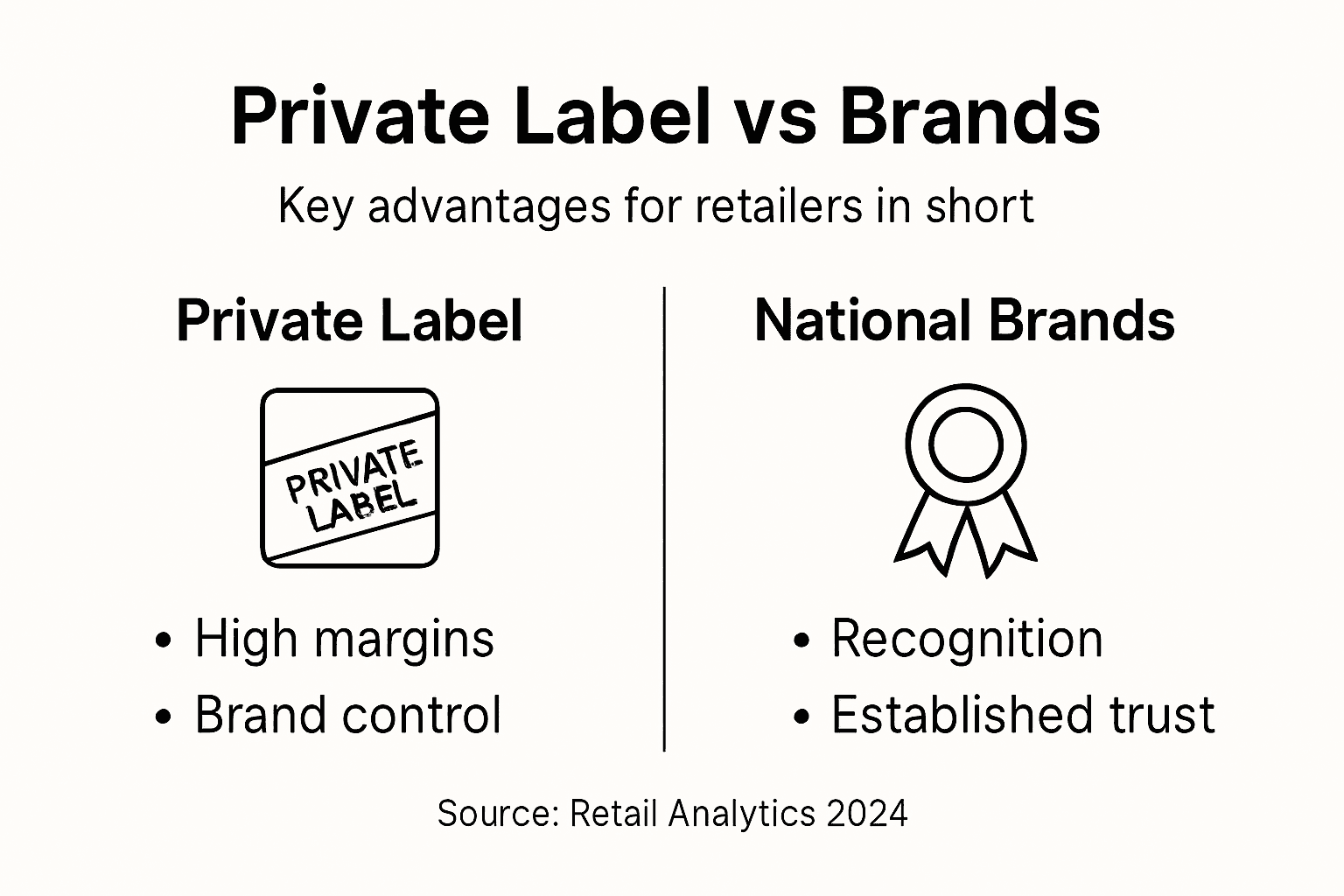
This table highlights how private label benefits compare to national brand reselling:
| Business Dimension | Private Label Approach | National Brand Reselling |
|---|---|---|
| Margin Potential | Typically 10-30% higher | Lower due to intermediary costs |
| Product Control | Full design and quality oversight | Limited to manufacturer offerings |
| Brand Differentiation | High; builds own brand experience | Relies on third-party reputation |
| Consumer Loyalty | Driven by exclusivity and uniqueness | Based on national brand strength |
Private label success hinges on delivering value that transcends mere price competition.
Critical factors retailers must evaluate when comparing private label to branded alternatives:
- Target consumer demographics
- Product category expectations
- Price sensitivity
- Brand loyalty potential
- Long-term profit margins
Pro tip: Develop private label products that strategically complement, rather than simply imitate, existing national brand offerings.
Elevate Your Retail Brand with Custom Private Label Solutions
The article highlights how private label strategies empower retailers with full control over product design, higher profit margins, and stronger customer loyalty. If you are facing challenges in finding the right manufacturing partner or want to differentiate your candy products with exclusive flavors and packaging, customized private label solutions are the key. At Space-Man, we specialize in freeze dried candy manufacturing, private labeling, and co-packing services tailored to help Canadian retailers build unique brand experiences that truly connect with your target market.
Discover how our expertise can help you launch a focused private label candy line that stands out in quality and innovation. Act now to secure a partnership that delivers not just superior products but also operational clarity and support. Visit Space-Man’s homepage to learn more about our private labeling opportunities and start transforming your business with a trusted Canadian freeze dried candy manufacturer and distributor.
Frequently Asked Questions
What are the main advantages of private label products for retailers?
Private label products provide retailers with complete control over product design and quality, higher profit margins, enhanced customer loyalty through exclusive offerings, and the ability to differentiate from competitors.
How do private label products compare to national brands?
Private labels often offer comparable quality to national brands at lower price points. They allow retailers to build their own brand experiences, which can foster stronger consumer loyalty compared to relying on third-party brand reputations.
What types of private label partnerships exist for retailers?
Retailers can engage in three primary models of private label partnerships: white label partnerships, which involve selling pre-existing products under their brand; custom branding partnerships, which modify existing products for specific packaging; and exclusive manufacturing partnerships that create unique products and recipes.
How can retailers maximize the profitability of their private label offerings?
Retailers can maximize profitability by conducting thorough market research, investing in product quality, developing compelling packaging, creating targeted marketing campaigns, and continuously incorporating consumer feedback.
Recommended
- Understanding the Benefits of Private Labeling – Spaceman
- How to Start Private Label: Build Your Own Brand Today – Spaceman
- Private Label Pharmacy: Unlocking Retail Brand Power – Spaceman
- Private Label Products: Boosting Retail Appeal in Canada – Spaceman
- Why Shop Luxury Online: Authenticity, Savings, and Convenience
- Psychology of Colors Marketing: Boosting Retail Impact - seo analytic