

TL;DR:
- Pharmacy candy merchandising uses strategic placement and seasonal planning to boost impulse sales and customer loyalty. High-converting locations include checkout counters, prescription windows, and high-traffic displays, with frequent SKU rotation. Specialty candy with high margins and private labels outperform commodity brands, and cross-merchandising enhances basket size through solution-based displays.
Pharmacy candy merchandising is the strategic arrangement and seasonal planning of candy displays in pharmacies, designed to maximize impulse sales and enhance customer experience. Unlike a grocery store or big-box retailer, a pharmacy offers a captive audience: people waiting for prescriptions, picking up vitamins, or grabbing a quick health item. That wait time is pure opportunity. The right candy display strategies, from seasonal theming to smart cross-merchandising, can turn a routine pharmacy visit into a higher-value transaction every single time.
1. Best candy display locations in pharmacies
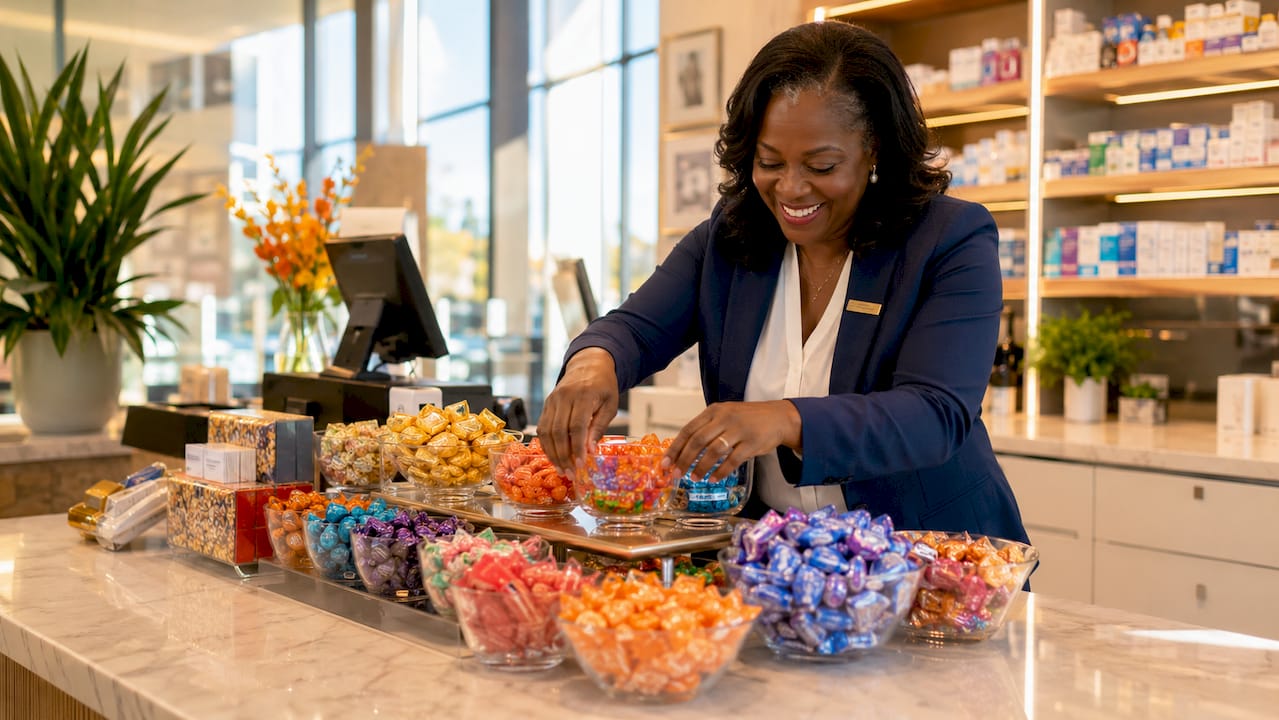
The checkout counter and prescription pickup window are the two highest-converting spots for candy placement in any pharmacy. Customers waiting at these locations have idle hands and a few minutes to browse, and impulse items placed here convert that dwell time directly into additional purchases. These are not accidental sales. They are engineered ones.
Beyond the counter, endcaps and freestanding island displays in high-traffic aisles catch attention from multiple angles. A well-placed endcap near the vitamin section, for example, pulls double duty: it grabs foot traffic from the main aisle, and it sits close to shoppers already in a health-focused mindset.
Key locations to prioritize:
- Checkout counters: Single-serve and grab-and-go formats work best here.
- Prescription pickup windows: Small, low-price-point candy drives quick decisions.
- Endcaps: Use these for seasonal or themed candy that needs visual impact.
- Island displays: Great for specialty or premium candy that benefits from 360-degree visibility.
- Near the pharmacy waiting area: Shoppers sitting down are more likely to browse nearby displays.
Pro Tip: Rotate SKUs weekly at checkout to prevent display fatigue. A shopper who visits twice a week will stop noticing a static display within days.
2. How to use seasonal candy merchandising year-round
Seasonal candy merchandising is the practice of timing themed candy displays to align with holidays and cultural moments throughout the year. The goal is to keep displays feeling fresh without rebuilding them from scratch every month.
The timing rule is simple: plan themed displays 4–6 weeks before major holidays. That window covers Valentine’s Day in february, Easter in spring, Halloween in october, and Christmas in december. Halloween candy alone accounts for 65% of US annual candy sales in october. Missing that window by even a week is a costly mistake.
One underused tactic is the seasonal shape transition. Heart-shaped candy for Valentine’s Day and sports-themed candy in spring signal gift readiness to shoppers without requiring a full display overhaul. The shape does the communicating. You just need to stock it.
For inventory planning, use the Count-Back Method:
- Set your target in-store display date.
- Subtract shipping and transit time.
- Subtract production or co-packing lead time.
- Subtract customs clearance if importing.
- That final date is your order deadline.
The Count-Back Method eliminates the guesswork that leads to stock outs during peak selling periods. It works for any holiday, and it scales whether you are ordering 50 units or 5,000.
| Holiday | Display launch | Order deadline (approx.) |
|---|---|---|
| Valentine’s Day | Early january | Late november |
| Easter | Late february | Early january |
| Halloween | Early september | Mid-july |
| Christmas | Early november | Early september |
Pro Tip: Pair seasonal candy with related pharmacy products on the same display. Cough drops near cold-season candy, or vitamin C gummies next to holiday gift candy, reinforce the health-and-treat combination that pharmacy shoppers already expect.
3. Specialty candy vs. commodity candy: what to stock
Commodity candy, meaning the standard national brands found at every grocery store and gas station, is a losing game for independent pharmacies. You cannot out-price Walmart or Costco on a bag of name-brand gummies. The better play is to offer specialty candy that big-box stores simply do not carry.
Specialty options include nostalgia brands, rare imports, and unique formats like freeze-dried candy. These products give shoppers a reason to buy from you specifically, not just because you happen to be nearby. That distinction builds repeat visits and genuine customer loyalty.
A practical way to structure your candy section:
- Premium tier: Artisan chocolates, imported confections, freeze-dried candy novelties. Higher margin, lower volume.
- Mid-tier: Branded novelty candy, seasonal exclusives, private label options. Balanced margin and volume.
- Impulse tier: Low-cost single-serve items at checkout. High volume, quick decisions.
The three-tier endcap strategy groups all three price points on a single display. It addresses every shopper budget in one fixture, which is why it consistently outperforms single-tier displays.
| Candy type | Margin potential | Differentiation | Best placement |
|---|---|---|---|
| Commodity (national brands) | Low | None | Avoid or minimize |
| Specialty/nostalgia | High | Strong | Endcaps, island displays |
| Freeze-dried candy | High | Very strong | Checkout, endcaps |
| Private label | Very high | Strongest | Anywhere |
Private label candy is the highest-margin option available to pharmacy retailers. Space-man offers private label candy packaging and co-packing services, which means you can stock a product that carries your store’s brand and cannot be price-compared anywhere else.
4. Cross-merchandising candy with health products
Cross-merchandising is the practice of placing complementary products together to create a solution-based shopping experience. In a pharmacy, this approach is natural because shoppers already come in with a health need in mind. Grouping complementary items encourages higher basket sizes without requiring any extra selling effort from staff.
The most effective pairings connect candy to a health context:
- Honey-menthol drops near cold remedies: Shoppers buying cough syrup will grab throat drops without a second thought.
- Vitamin C gummies near immune supplements: The line between candy and supplement is blurry here, and that works in your favor.
- Sugar-free candy near diabetic care products: A thoughtful placement that serves a specific patient need.
- Gift candy near greeting cards or flowers: Turns a routine pharmacy visit into a one-stop gift run.
Successful independent pharmacies organize front-end inventory around patient needs and symptom-based groupings rather than brand categories. That logic applies directly to candy placement. When a shopper picks up allergy medication and spots honey-lemon drops two feet away, the second purchase feels obvious, not pushed.
Visual merchandising reinforces the connection. Use shelf talkers, small signs, or color-coded tags to signal that products belong together. A simple “Feel better faster” sign above a cold remedy and candy grouping does more work than a full endcap redesign.
5. Candy rack design and SKU rotation
A well-designed candy rack for pharmacies does three things: it holds product securely, it faces product forward at eye level, and it makes restocking fast. Wire racks, pegboard displays, and countertop spinner units all work depending on the location and available floor space.
Eye level is buy level. Place your highest-margin candy at eye level for adults (roughly 54–60 inches from the floor) and lower-cost impulse items at the checkout counter where children can see them. That is not an accident in well-run retail. It is a deliberate placement decision.
SKU rotation is the other half of rack management. Rotating impulse SKUs weekly at checkout and high-traffic zones prevents shopper fatigue and keeps repeat customers engaged. A customer who visits your pharmacy three times a week will notice a new product. They will not notice a static display they have already mentally filed away.
Pro Tip: Keep a simple rotation calendar. Assign each checkout SKU a four-week cycle, and note which products sold out fastest. That data tells you what to reorder and what to retire.
Key takeaways
Effective pharmacy candy merchandising combines smart placement, seasonal timing, and a curated specialty assortment to drive impulse sales and build customer loyalty.
| Point | Details |
|---|---|
| Prime placement drives impulse sales | Checkout counters and prescription windows convert dwell time into purchases. |
| Seasonal timing is non-negotiable | Launch themed displays 4–6 weeks before holidays and use the Count-Back Method to avoid stock outs. |
| Specialty beats commodity | Freeze-dried candy, nostalgia brands, and private label options outperform national brands on margin and differentiation. |
| Cross-merchandising raises basket size | Pair therapeutic candy with related health products to create solution-based displays. |
| SKU rotation sustains shopper interest | Rotate checkout SKUs weekly to prevent display fatigue and encourage repeat impulse purchases. |
What I have learned about candy placement in pharmacies
Pharmacy owners often underestimate how much the front end of their store can do. Most of the attention goes to the dispensary, and the candy aisle gets treated like an afterthought. That is a missed opportunity, and I have seen it play out in store after store.
The single biggest shift I have observed is when a retailer stops thinking about candy as a category and starts thinking about it as a placement problem. Where is the customer standing? What are they waiting for? What is within arm’s reach? Those three questions answer most of your merchandising decisions before you even look at a planogram.
I am also a firm believer in testing new formats before committing to a full assortment change. Freeze-dried candy, for example, is a format that many pharmacy buyers have not tried yet. It is visually distinctive, it carries a strong margin, and it genuinely surprises shoppers who have never seen it. That surprise is worth something. It creates a moment of engagement that a standard chocolate bar never will.
The retailers who do this well are not the ones with the biggest budgets. They are the ones who pay attention to their own customers, rotate their displays consistently, and are willing to swap out a slow seller without sentiment. Candy merchandising rewards curiosity and punishes complacency.
— Chadi
How Space-man can support your pharmacy candy program
Space-man specializes in freeze-dried candy manufacturing, distribution, and private label services across Canada, and the product line is built for exactly the kind of specialty placement described in this article.

If you are looking to add a high-margin, visually distinctive candy option to your pharmacy front end, Space-man’s display kit options are designed for retail settings with limited floor space. For pharmacies that want to go further, Space-man’s private label and co-packing services let you stock a branded product that no competitor can price-match. That is the kind of differentiation that turns a candy rack into a genuine revenue driver.
FAQ
What is pharmacy candy merchandising?
Pharmacy candy merchandising is the planned placement, rotation, and seasonal theming of candy displays in a pharmacy to increase impulse purchases and customer engagement. It treats candy as a front-end revenue category rather than a filler product.
Where should candy be placed in a pharmacy?
Checkout counters and prescription pickup windows are the highest-converting locations. Endcaps and island displays in high-traffic aisles are strong secondary placements for seasonal or specialty candy.
How often should pharmacy candy displays be rotated?
Rotating checkout SKUs weekly prevents display fatigue and keeps repeat customers engaged. Seasonal displays should be refreshed 4–6 weeks before each major holiday.
What types of candy sell best in pharmacies?
Specialty and therapeutic candy, including honey-menthol drops, vitamin C gummies, sugar-free options, and freeze-dried candy novelties, outperform commodity national brands on both margin and differentiation.
What is the Count-Back Method for candy ordering?
The Count-Back Method calculates your order deadline by working backward from your target in-store display date, accounting for production, shipping, and customs lead times to prevent stock outs during peak seasons.