

Check the serving size first, then calories, then the %DV column, then the ingredient list, in that exact order. Anything else is guesswork. A printable one-page PDF cheat-sheet can walk you through those four checkpoints, flag common sugar aliases, and give you a quick “buy or skip” gut check right there in the aisle.
TL;DR:
- Always verify the serving size and servings per container before interpreting any nutrition information to avoid multiplying errors.
- Check the percent Daily Value for nutrients, aiming for 20% or more in fiber, vitamin D, calcium, iron, and potassium, and 5% or less in saturated fat, sodium, and added sugars.
- Review the ingredient list for sugar aliases like high-fructose corn syrup and “ose” suffixes, especially if sugar content seems hidden in the nutrition panel.
- Be cautious of labels promising low fat, high fiber, or other health claims by cross-checking actual grams and %DV, as marketing can be misleading.
- Recognize that label formats differ internationally, so compare products carefully, noting whether values are per serving or per 100 grams to ensure accurate comparison.
Table of Contents
- What each part of a nutrition facts label actually means
- The five-step checklist to read any label in under a minute
- How do you spot hidden sugar in the ingredient list?
- Red flags and the two-line trick experienced label readers use
- Space-man’s guide to reading labels the right way
- Are ‘organic’, ‘non-gmo’, and ‘gluten-free’ labels the same thing?
- What do ‘low fat’ and ‘high fiber’ actually mean on a label?
- Do nutrition labels look the same in every country?
- How do you compare two similar products fast?
- Where to verify the details yourself
- What most people get wrong about reading labels
- Sources
What each part of a nutrition facts label actually means
Every Nutrition Facts panel is built the same way, and once you know the anatomy, the numbers stop feeling like a foreign language.
Start with serving size and servings per container, sitting right at the top. This is the single most skipped step, and it wrecks more diets than any actual food choice. If a bag of chips lists 15 chips as one serving and the bag holds 3 servings, eating half the bag means tripling every number on that label. The National Institute on Aging points out that calories and nutrients apply only to the listed serving, so you have to do the multiplication yourself if you eat more.
Calories come next, and they’re just a measure of energy. As a rough guide: Calories per serving can be considered low, moderate, or high based on common rough guidelines. But calories per serving and calories per package are two very different numbers, and manufacturers know most people only glance at the first one.
Then there’s %DV, the percent Daily Value column, which is where most of the real decision-making happens. It’s based on a 2,000-calorie reference diet, and the FDA’s rule of thumb is simple: 5% DV or less is generally considered low, and 20% DV or more is considered high. That one rule alone will change how you shop.
Nutrients split into two camps:
- Limit these: saturated fat, trans fat, sodium, added sugars. All four are tied to heart disease, high blood pressure, or excess calorie intake.
- Seek more of these: fiber, vitamin D, calcium, iron, and potassium. Most people fall short on these, and the FDA specifically calls out higher %DV numbers here as a good sign.
The five-step checklist to read any label in under a minute
You don’t need a nutrition degree to shop smart. You need a repeatable sequence. Here’s the one we’d stick in your back pocket (or, more usefully, on a laminated card in your grocery bag):
- Confirm the serving size and servings per container. If you know you’ll eat two servings, do the math on calories, sodium, and sugar before you even check %DV.
- Check calories, adjusted for what you’ll actually eat. Use the rough thresholds: 40 low, 100 moderate, 400+ high, then multiply if needed.
- Scan the %DV column for your priority nutrients. Look for 20% or more on fiber, vitamin D, calcium, iron, and potassium; look for 5% or less on saturated fat, sodium, and added sugars.
- Read the ingredient list, not just the front of the box. Confirm the product’s actual base and watch for sugar synonyms hiding in plain sight.
- Pick the winner. Between two similar products, favor the one with better %DV on nutrients you want, worse %DV on nutrients you’re avoiding, or fewer servings packed with less of what you’re trying to limit.
Run this sequence enough times and it stops feeling like homework. It becomes a five-second scan, which is really the whole point of keeping a printable version handy instead of trying to remember all this while your cart is blocking the cereal aisle.
How do you spot hidden sugar in the ingredient list?
Ingredients are listed by weight, heaviest first, which means the first two or three items tell you almost everything about what you’re actually eating. Harvard’s Nutrition Source puts it plainly: if sugar, oil, or refined flour shows up in that top slot, the product is built around it, no matter what the front of the package claims.
Sugar is sneaky because it hides under a lot of aliases. Watch for:
- High-fructose corn syrup
- Evaporated cane juice
- Fruit juice concentrate
- Dextrose, maltose, or rice syrup
- Anything ending in “ose”
Seeing two or more of these near the top of an ingredient list is a strong signal of high added sugar, even when the nutrition panel doesn’t look alarming at first glance. Harvard’s research on added sugar backs this up directly.
One more wrinkle: labels are allowed to round small amounts down, so something with 0.4 grams of trans fat can legally say “0g.” That’s why the ingredient list sometimes tells a more honest story than the numbers above it, especially if you’re managing a low-sodium or low-protein diet where every gram counts.
Pro Tip: If you’re shopping for a specific medical diet, don’t rely on the rounded numbers alone. Cross-check the ingredient list, and when in doubt, run it past a registered dietitian.
Red flags and the two-line trick experienced label readers use
A few warning signs mean it’s worth putting the product back on the shelf, or at least reading further before it goes in your cart:
- A suspiciously tiny serving size (a classic trick to make calories and sugar look lower than they really are)
- Dual-column labels that confuse “per serving” with “per package” at a glance
- Multiple sugar synonyms clustered near the top of the ingredient list
- High %DV sodium, especially anything approaching 20% or more in a single serving, worth watching against the roughly 2,300 mg daily sodium limit most adults should stay under
- “0g trans fat” on the front, with “partially hydrogenated oil” sitting in the ingredients
Pro Tip: Short on time? Match serving sizes on two products, then compare just two things: the %DV on your one “avoid” nutrient and the %DV on your one “seek” nutrient. Whichever product wins both usually wins overall.
Space-man’s guide to reading labels the right way
Chadi covers food labeling and packaging regulation regularly on the Space-man blog, and this piece pulls straight from that same practical, no-fluff approach. As a company that manufactures, packages, and private-labels consumer goods across Canada, Space-man deals with nutrition panels on a daily basis, not as an academic exercise.
The printable PDF cheat-sheet built around this article includes:
- A one-page checklist walking through serving size, calories, %DV, and ingredients in order
- A quick-reference 5%/20% guide for judging any nutrient at a glance
- A list of common sugar synonyms to scan for
- A reminder that ingredient order equals weight order
- Blank space to jot notes while comparing two products side by side
Print it, fold it into your wallet, or just save it to your phone’s photos app for quick reference on why order freshly prepared meals. Either way, it does the thinking for you before you’re three items deep into an aisle comparison.
Are ‘organic’, ‘non-gmo’, and ‘gluten-free’ labels the same thing?
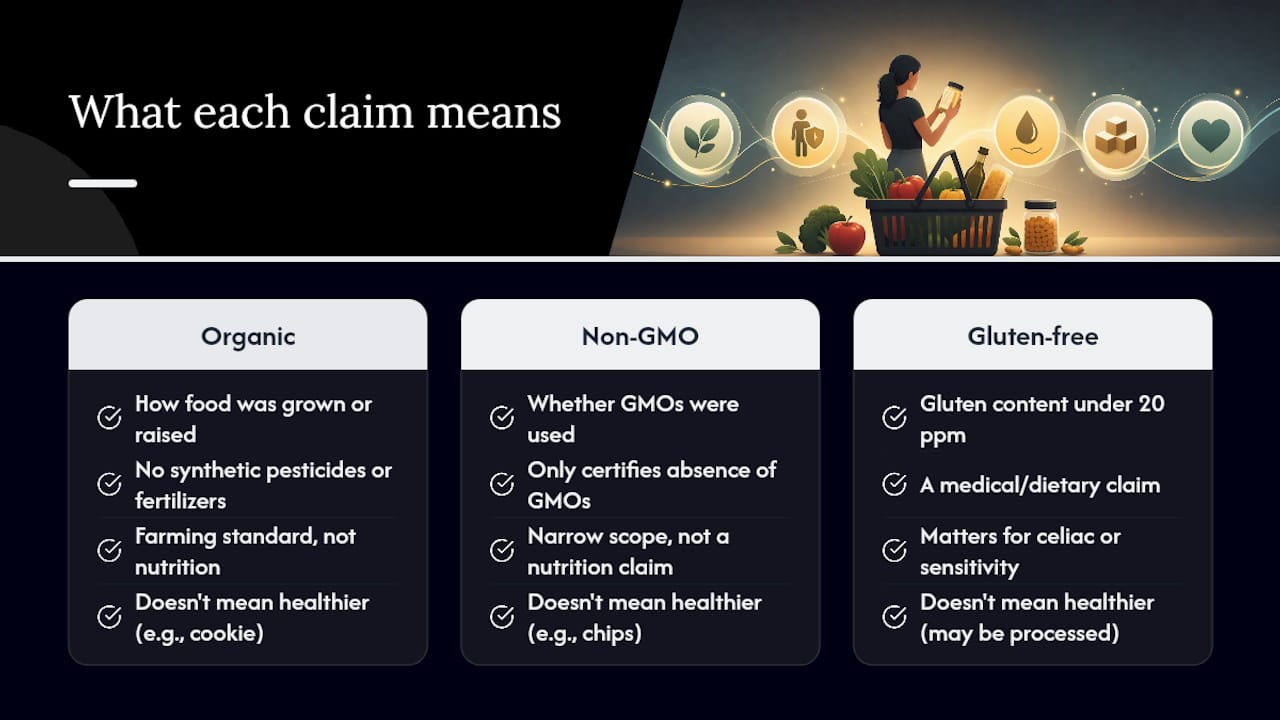
No, and mixing them up is one of the most common label-reading mistakes. Each claim answers a completely different question, and none of them automatically means “healthier.”
Organic refers to how the food was grown or raised: no synthetic pesticides, no conventional fertilizers, no genetically modified organisms, and specific rules around animal welfare and antibiotic use. It’s a farming standard, not a nutrition standard. An organic cookie is still a cookie.
Non-GMO is narrower. It only certifies that the product wasn’t made using genetically modified organisms. A non-GMO potato chip can still be fried in oil and loaded with sodium; the label says nothing about fat, sugar, or calories.
Gluten-free is a medical and dietary claim, not an environmental or health one. It means the product contains less than 20 parts per million of gluten, which matters enormously if you have celiac disease or a gluten sensitivity, and matters not at all if you don’t. Plenty of gluten-free snacks are just as processed and sugar-heavy as their gluten-containing counterparts.
The takeaway: these three claims can appear on the same package and still tell you nothing about calories, sodium, or added sugar. Harvard’s food label guide makes this same point: always verify a front-of-package claim by flipping to the actual Nutrition Facts panel and ingredient list before assuming it means “better for you.”
What do ‘low fat’ and ‘high fiber’ actually mean on a label?
These aren’t marketing fluff. They’re regulated terms with specific numeric thresholds behind them, which most shoppers never learn.
“Low fat,” “fat free,” “high fiber,” “good source of fiber,” “low sodium,” and “reduced sodium” are regulated terms with specific numeric thresholds per serving that shoppers should verify on the label.
The trap is in words like “reduced” and “light.” They’re comparative, not absolute. “Reduced sugar” ice cream can still be loaded with sugar; it’s just less than the full-sugar version. Same with “light” olive oil, which usually refers to flavor or color, not calories.
Here’s the practical rule: any time you see a bold claim on the front of a package, treat it as a prompt to check the panel, not as the final answer. If a bag of freeze-dried candy claims “low fat,” verify it against the actual grams listed, then check whether sugar or sodium quietly picked up the slack. Claims are legally accurate but often selectively chosen to highlight one flattering number while ignoring three others.
Do nutrition labels look the same in every country?
Not even close, and this trips up plenty of shoppers who compare imported products against domestic ones without realizing the formats don’t match.
The U.S. Nutrition Facts label uses %DV based on a 2,000-calorie diet, along with the serving size and per-container breakdown discussed earlier. Canada’s Nutrition Facts table looks visually similar but uses its own %DV reference values, which occasionally differ from U.S. figures for the same nutrient. The European Union favors a “Nutrition Declaration” typically shown per 100 grams or 100 milliliters, alongside a “traffic light” color system in some countries (red, amber, green) to flag high, medium, or low levels of fat, sugar, and salt at a glance.
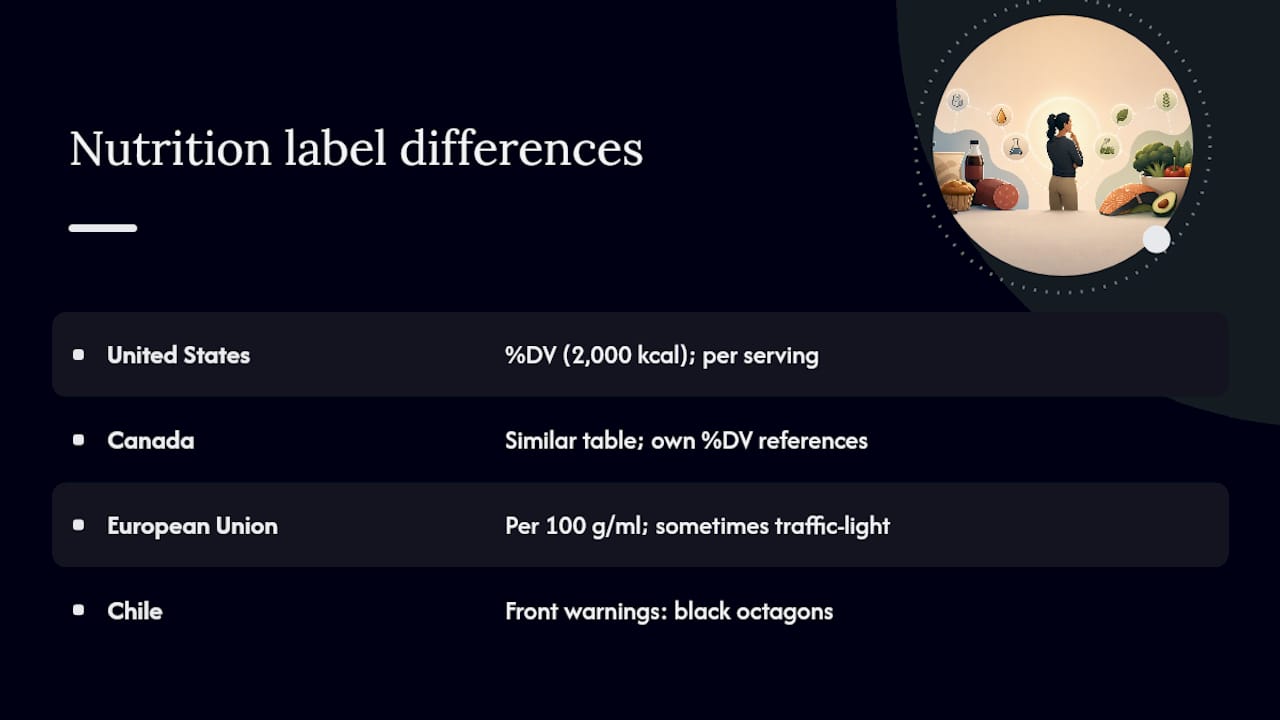
Some countries also use front-of-package summary systems, like Chile’s black warning octagons for products high in sugar, sodium, or saturated fat, a much blunter approach than the more detailed back-of-package panels used in North America.
If you’re comparing an imported snack to a domestic one, don’t assume the numbers are apples to apples. Check whether the panel is per serving or per 100 grams, since that single difference can make an imported product look deceptively lower or higher in calories than it really is.
How do you compare two similar products fast?
Side-by-side comparisons fall apart the moment the two products use different serving sizes, which happens more often than you’d think, even within the same product category.
Match the serving sizes first. If one granola bar lists a 40-gram serving and the other lists 28 grams, you’re not comparing calories, you’re comparing two different amounts of food. Adjust one number so both products are measured on the same basis before you look at anything else.
Once serving sizes line up, lean on %DV rather than raw grams. It’s faster and it’s designed exactly for this kind of comparison, since it already accounts for how much of your daily nutrient budget a single serving eats into.
Then apply the same five-step workflow from earlier: check %DV on the nutrients to limit, check %DV on the nutrients to seek, and scan both ingredient lists for where sugar and sodium fall in the order. A product with fewer sugar synonyms near the top of its ingredient list is usually the better pick, even if its front-of-package marketing looks less impressive.
For a real-world example of this exact comparison process applied to candy and snack products, Space-man’s guide to reading nutrition labels for smarter candy choices walks through it with actual product labels side by side.
Where to verify the details yourself
The FDA’s Nutrition Facts Label guide is the definitive source for official %DV rules. The CDC’s label guidance offers practical, consumer-friendly heuristics. MedlinePlus covers sodium and blood pressure in plain language, and Harvard’s Nutrition Source breaks down ingredient science and added sugar in more depth than any package ever will.
What most people get wrong about reading labels
Most advice on this topic treats label reading like a math problem. It isn’t. It’s a filtering problem, and the goal is speed, not precision. Nobody’s calculating exact macros standing in the cereal aisle, and pretending otherwise is why so many people give up on reading labels altogether.
The conventional wisdom oversells calorie counting and undersells the ingredient list, which is honestly backwards. Calories tell you almost nothing about quality. Two products with identical calorie counts can have wildly different sugar sources, sodium loads, and fiber content. If you only have ten seconds, skip straight to %DV and the first three ingredients. That combination tells you more than the calorie count ever will.
What we’d prioritize first, always: serving size accuracy. Get that wrong and every other number on the label is meaningless for your actual portion. A printable cheat-sheet works precisely because it forces that first checkpoint before your eyes jump to the bigger, bolder calorie number up top, which is exactly where most labels want your attention to land first.
— Chadi
Sources
- How to Understand and Use the Nutrition Facts Label | FDA
- Salt in diet - MedlinePlus Medical Encyclopedia
- Processed foods and food labels | The Nutrition Source, Harvard T.H. Chan School of Public Health
- How to read food and beverage labels | National Institute on Aging (NIA)