

You can’t permanently stop shrinkage on 4C hair without changing the curl pattern itself, but you can reliably manage and reduce it. The playbook is simple: moisturize while hair is damp, seal that moisture in, and dry your hair while it’s held in a stretched position using methods like banding, threading, twist-outs, or a low-heat root stretch.
TL;DR:
- Moisturize damp hair with a measured amount of leave-in and seal with natural relief ingredients to prevent buildup and stiffness.
- Use gentle, full-dry stretching techniques such as banding, threading, or roller sets on completely dry hair to avoid undoing the stretch.
- Protect your stretched style overnight by pineappleing and sleeping on satin or silk to reduce moisture loss and friction.
- Avoid frequent high-heat styling and always use a heat protectant when heat stretching, working on the lowest effective temperature in short, controlled bursts.
- Build a two-cycle testing routine to fine-tune your product amounts, tension, and drying methods before making routine changes.
Table of Contents
- Why Does 4C Hair Shrink So Much?
- What Actually Reduces Shrinkage Risk?
- How Do You Stretch 4C Hair Without Heat Damage?
- Protecting Your Stretch Overnight and Through Humid Weather
- When Heat Helps and When It Hurts
- Build a Two-Cycle Test to Find What Actually Works for You
- Your Wash Day Checklist for Managing Shrinkage
- Stop Fighting Your Curl Pattern
- A Sweeter Kind of Shrinkage Worth Knowing About
- Sources
- FAQ
Why Does 4C Hair Shrink So Much?
Shrinkage happens because coiled hair acts like a spring. When water leaves the strand, the coil contracts back toward its natural curl pattern, and the tighter the coil, the more dramatic that contraction looks. Type 4C hair has the tightest coil pattern of all the hair types, which is exactly why it shows the most visible shrinkage of any texture, sometimes pulling strands up to most of their length shorter than their stretched length. That’s not a flaw. It’s a sign your hair still has elasticity, the ability to stretch and bounce back without snapping.
Porosity and humidity play a role too. Hair that absorbs and releases moisture quickly tends to shrink faster and more visibly, especially in humid weather when strands pull ambient moisture from the air and curl right back up. A dedicated 4C hair care guide recommends building your routine around what you actually observe (your scalp condition, how your sections behave, how you dry your hair) rather than assuming everything about your texture from a type label.
There’s a difference worth knowing early:
- Healthy shrinkage reverts. Wash it, and it springs right back to its coiled state, ready to stretch again next time.
- Heat-damaged hair stops reverting. Sections stay elongated even after washing, which is a sign the curl pattern itself has changed, not just the moisture level.
That distinction matters for everything that follows in this guide.
What Actually Reduces Shrinkage Risk?
Before you touch a single stretching technique, the basics have to be solid, because no method holds a stretch on hair that’s tangled, dry, or coated in six different products fighting each other.
- Cleanse with your scalp in mind. Focus shampoo at the roots where oil and buildup actually collect, and let the suds rinse down the length rather than scrubbing the ends directly.
- Condition with enough slip to comb through. A conditioner with real slip does double duty: it detangles and it hydrates, so you’re not fighting knots on dry, brittle strands later.
- Detangle in sections, ends first. Working from the tips upward, in small sections, keeps breakage low and preserves the length you’re trying to retain in the first place.
- Apply leave-in on damp hair, then seal using product formulations designed with natural relief ingredients and benefits that help retain moisture. Damp hair takes in product better than dry hair. Follow the leave-in with a light oil or cream to seal that moisture in before it evaporates.
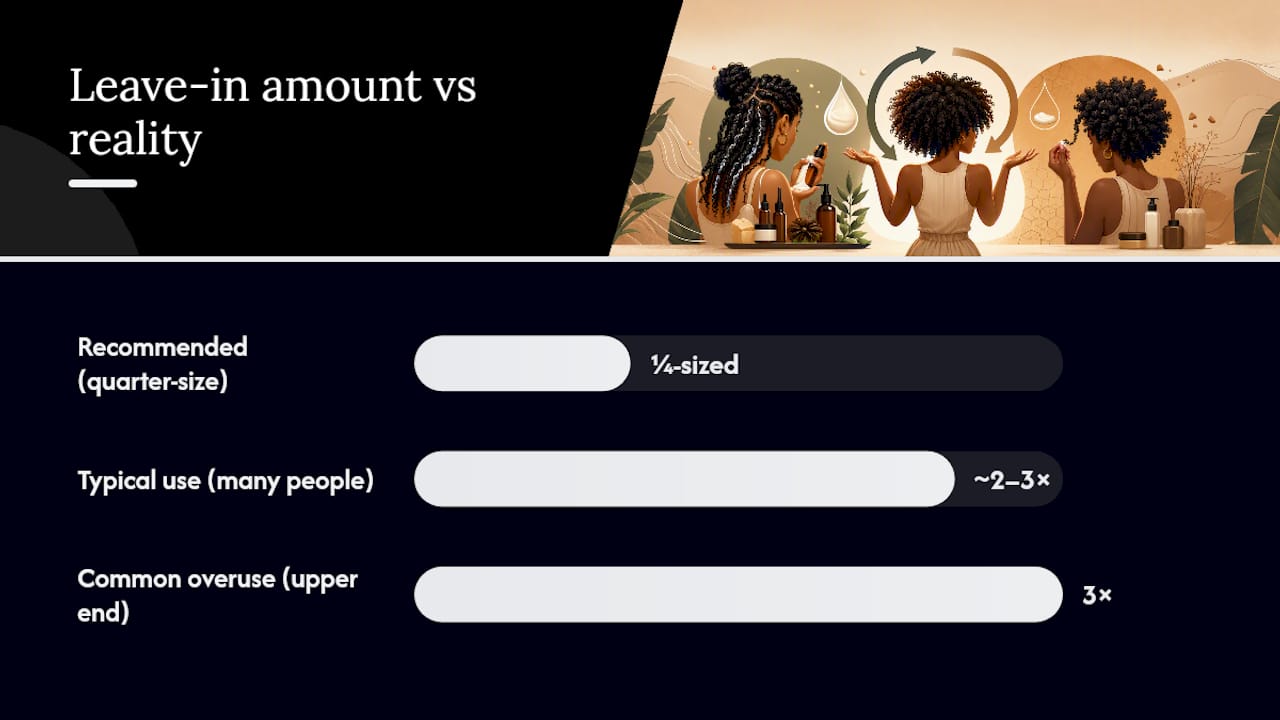
- Pick one leave-on product and measure it. A quarter-sized amount, consistently, beats guessing every wash day.
The single biggest mistake people make here is layering. Piling on cream, then oil, then gel, then butter feels productive, but it usually just leads to buildup, stiffness, and hair that refuses to hold a smooth stretch. InStyle’s guidance on 4C hair points to consistent moisture and deep conditioning, not more product, as the real driver of flexible, stretch-friendly hair.
Pro Tip: Weigh out your leave-in and oil once with a kitchen scale so you know what “one scoop” actually looks like. Most people use two to three times more product than they think.
How Do You Stretch 4C Hair Without Heat Damage?
Every reliable stretching method shares one mechanism: you hold damp hair elongated and let it dry completely before releasing it. There’s no shortcut around that. According to CurlCentric’s breakdown of shrinkage prevention, the methods below differ in technique, but not in principle.
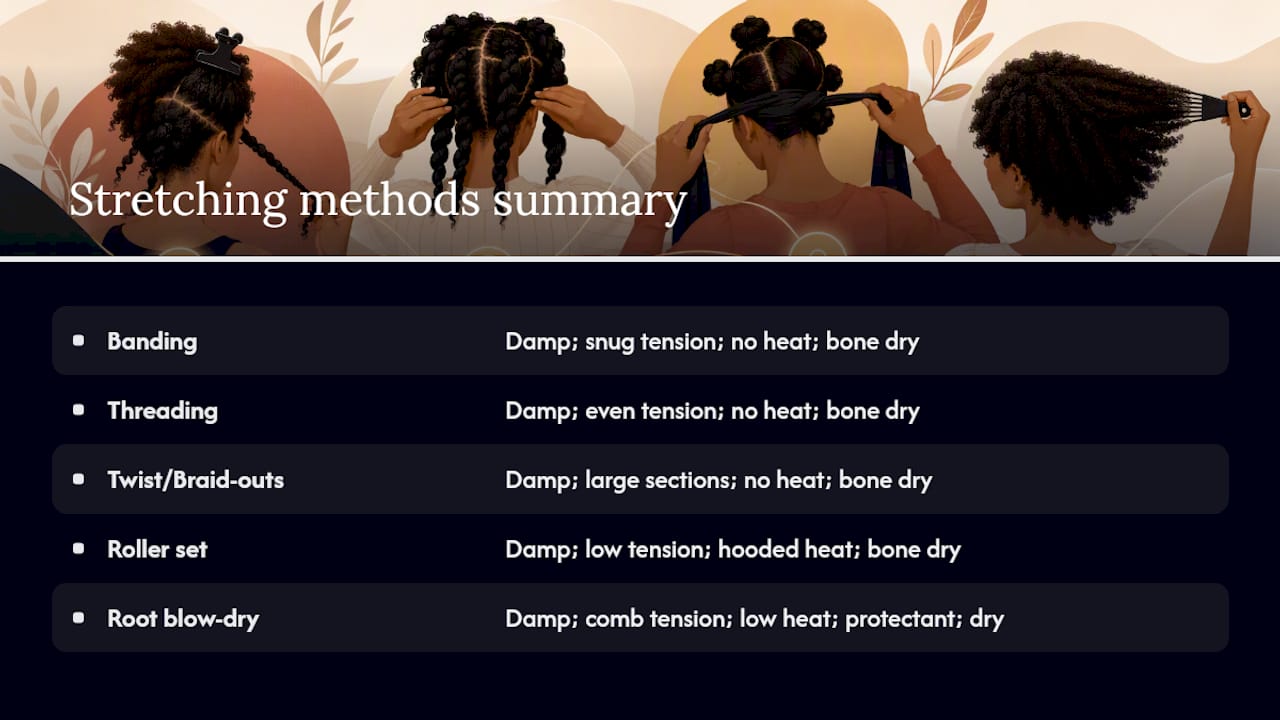
Banding. Work on damp, fully detangled hair. Place soft, seamless hair bands every 1 to 2 inches down each section, from root to tip. Keep tension snug, never tight enough to tug at your scalp. Leave the bands in until hair is completely dry, then remove them gently, section by section.
African threading. Wrap thread around each section from root to tip, which distributes tension more evenly across the strand than banding does. Haircode’s comparison of stretching techniques notes that threading tends to produce a more uniform stretch, though it takes real practice and considerably more time to install than banding.
Twist-outs and braid-outs. Bigger sections give you more shrinkage relief but a slightly less defined curl. Fewer, larger twists also install faster, which matters if you’re doing this on a weeknight. Whichever size you choose, the hair has to be bone dry before you take it down.
Roller sets under a hooded dryer. This gives you a smooth, even stretch with less manual tension than banding or threading. A hooded dryer’s indirect heat is gentler on the cuticle than a direct blow dryer, making it one of the lower-risk heat-assisted options.
Root blow-drying with a comb attachment. Use the lowest heat setting that still gets the job done, apply a heat protectant first, and work in short bursts rather than dragging the dryer slowly over one section. The tension from the comb is doing most of the stretching work here, not the heat itself.
Across every method, the takedown rule is the same: rushing it undoes the entire point. Pulling a twist-out or banded section apart while it’s even slightly damp lets the coil snap right back, and that’s the single most common reason people feel like stretching “doesn’t work” for them.
Protecting Your Stretch Overnight and Through Humid Weather
A style you stretched all afternoon can shrink back in an hour if you sleep on cotton or skip protection entirely. A few habits make the difference between a stretch that lasts three days and one that’s gone by morning.
- Pineapple your hair by gathering it loosely at the top of your head with a soft scrunchie. If your hair’s too short for one big pineapple, try two or three smaller ones spaced around your head, or use loose banding instead.
- Sleep on satin or silk, whether that’s a bonnet, a scarf, or a pillowcase. Cotton pulls moisture out of hair and creates friction that roughs up the cuticle overnight.
- Rotate where you tie or secure your hair. Using the exact same spot near your edges every single night is a slow, quiet way to thin them out. InStyle’s reporting backs this up as standard advice across natural hair care.
- Use anti-humidity sprays sparingly, with realistic expectations. They slow how fast your hair pulls moisture from the air, but they don’t stop it. Nothing does, not permanently.
One myth worth clearing up here: glycerin, a common ingredient in moisturizers, can actually pull extra moisture into your hair on humid days, which sometimes increases shrinkage rather than preventing it. Edge Naturale’s guidance on shrinkage myths flags this as one of the more common product missteps in 4C routines.
When Heat Helps and When It Hurts
Heat stretches hair by temporarily loosening the hydrogen bonds in the protein structure. Used carefully, that’s a useful tool. Used repeatedly at high temperatures, it starts to permanently alter those bonds, and that change doesn’t reverse with a wash.
A few rules keep heat in the “helpful” category rather than the “damaging” one:
- Always apply a heat protectant before any dryer or hot comb touches your hair.
- Use the lowest temperature that actually gets the stretch you need. Higher heat isn’t a shortcut, it’s a risk.
- Let the comb attachment’s tension do the work; the heat is a supporting actor, not the main event.
- Work in short passes, and never go over the same section repeatedly in one session.
- Space out heat-stretching sessions rather than reaching for the blow dryer every single wash day.
Pro Tip: If a section of hair stops springing back after a wash, even after a full moisturizing routine, that’s your cue to back off heat entirely for a while, not add more protectant and try again.
Watch for these red flags: sections that no longer revert to their coily state after washing, texture that feels limp or overly soft compared to the rest of your hair, and a noticeable jump in breakage or shed hair around wherever you apply heat most. Any of those means it’s time to dial back, not push through.
Build a Two-Cycle Test to Find What Actually Works for You
Guessing your way through product and method choices wastes time and money. Running a short, structured test doesn’t.
Over two wash cycles, log the following:
- Scalp comfort during and after installing your stretch method.
- Your section map (size and number of sections used).
- Exact product amounts applied at each step.
- Install time and takedown time.
- Knots, tangles, or shed hair noticed during detangling.
- Drying method used and total drying time.
Comparing two cycles side by side tells you more than any single “does this product work” guess ever could.
| Symptom you notice | Likely cause | What to change |
|---|---|---|
| Hair feels stiff or coated | Too many layered products | Strip back to shampoo, conditioner, one measured leave-in |
| Persistent tangling, mid-shaft knots | Detangling too roughly or too infrequently | Detangle in smaller sections, ends first, more often |
| Scalp pain during wear | Bands or sections too tight | Loosen tension, extend time between reinstalls |
| Shrinks back within hours | Style not fully dry before takedown | Extend drying time or switch to hooded dryer |
If tangling or scalp pain doesn’t ease up after adjusting tension and product amounts, that’s a signal to get a professional’s hands on a removal rather than muscling through it yourself.
Your Wash Day Checklist for Managing Shrinkage
Keep this sequence in mind every wash day: prep and detangle, cleanse at the scalp, condition with slip, apply leave-in and seal on damp hair, choose one stretch method, dry fully, then protect overnight.
- Detangle ends first, in sections, before you add any water.
- Cleanse at the scalp, condition with real slip.
- Apply leave-in and seal while hair is still damp, not dry.
- Choose one stretching method and commit to it for the full cycle.
- Confirm hair is completely dry before any takedown.
- Protect with satin or silk overnight, every night.
| Check before you finish | Why it matters |
|---|---|
| No scalp pain, sores, or numbness | Tension has crossed from “snug” into “harmful” |
| Hair fully dry before takedown | Damp takedown undoes the entire stretch |
| Only one leave-on product used | Prevents buildup that stiffens the stretch |
Run this routine for two full cycles before judging whether a change worked. One good wash day doesn’t prove anything; two consistent ones start to.
Stop Fighting Your Curl Pattern
Shrinkage isn’t a problem to solve once and for all. It’s a characteristic of healthy, elastic 4C hair, and plenty of days, a shrunken 'fro is the actual style, not a failure to stretch it. The goal isn’t beating your curl pattern into submission. It’s building a routine comfortable enough that you’ll actually repeat it, and testing one change at a time instead of overhauling everything after a single bad wash day. Watch your results over a couple of cycles before you decide what’s working. Instant judgments about “this doesn’t work” are usually judgments made too early.
— Chadi
A Sweeter Kind of Shrinkage Worth Knowing About
Here’s an honest disclosure: This company makes freeze-dried candy, chocolate, and ice cream sandwiches, plus co-packing and private-label services for other brands. We are not a hair care company, and we are not about to pretend otherwise.

But “shrinkage” turns out to be a word we think about a lot too, just in a completely different context: managing shrinkage in retail inventory is a real problem for anyone running physical products, and it’s a topic our blog covers alongside our regular content. If freeze-dried treats sound more appealing than hair products right now (no judgment, wash day is exhausting), browse our freeze dried candy and treats collection for something to snack on while your twist-out sets. And if you’re a business owner curious about private labeling or co-packing for your own product line, our packaging and manufacturing services page has the details.
Sources
- 4C hair care guide: wash day, moisture & styling | Hair Types
- The Truth About 4C Hair Shrinkage, Strength, and Styling | InStyle
- Why does 4C hair shrink? How to prevent shrinkage on 4C hair | CurlCentric
- 4C girls: What actually stops shrinkage (and what doesn’t) | Edge Naturale
FAQ
Does 4C Hair Have the Most Shrinkage?
Yes. Type 4C has the tightest coil pattern of the standard hair type classifications, which means it typically shows the most dramatic visible shrinkage compared to looser curl and coil patterns, according to Hair Types’ 4C care guide. That tightness is also what gives 4C hair its characteristic elasticity and bounce.
What Causes Afro-Textured Hair to Shrink?
Shrinkage happens when moisture leaves the strand and the coil contracts back toward its natural spring shape. Humidity, porosity, and how the hair was dried all influence how dramatic that contraction looks day to day.
What Hair Type Has the Worst Shrinkage?
Type 4C generally shows the most pronounced shrinkage of any hair type, sometimes shortening the visible length by a significant margin compared to its stretched state. It’s considered a normal, healthy trait of that coil pattern rather than a sign of damage.
Can You Reverse Hair Shrinkage?
You can temporarily reverse the visible effect through stretching methods like banding, threading, twist-outs, or roller sets, all of which work by drying hair while it’s held elongated. You can’t permanently eliminate shrinkage without altering the curl pattern itself, and doing that through repeated heat use risks damage that doesn’t reverse.