

To stop product loss, prioritize converting high-value surplus into freeze-dried ingredients, seal them in nitrogen-flushed high-barrier pouches, and hand off high-variability multipacks to a co-packer. Those three moves address moisture, oxidation, and assembly waste at the same time. Start small, measure shrink and water activity, and scale only what the pilot proves.
TL;DR:
- Pilot freeze-drying on high-value SKUs with improved texture benefits and water activity below 12% to ensure shelf stability and prevent microbial growth.
- Use high-barrier packaging sealed with nitrogen or vacuum, and incorporate oxygen scavengers to protect freeze-dried products from rehydration and oxidation.
- Outsource multipack assembly to specialized co-packers to reduce waste, improve quality control, and free up production capacity for core manufacturing.
- Invest in small-scale pilots and measure shrink, yield, and water activity before scaling, especially if demand predictability is uncertain or supply costs are high.
- Accurate demand forecasting using SKU-level sales data and smaller, more frequent batches minimizes overproduction and reduces spoilage and unsold inventory.
Table of Contents
- Quick Action Checklist for Cutting Food Waste in Restaurants and Manufacturing Lines
- How Does Freeze-Drying Actually Prevent Spoilage?
- What Packaging Stops Freeze-Dried Products From Going Bad Again?
- Should You Outsource Secondary Packing to a Co-Packer?
- Is the Capital Cost of Freeze-Drying Worth It?
- What Does a Realistic Pilot-to-Scale Roadmap Look Like?
- Where Does Most Product Loss Actually Start on the Line?
- How Should You Forecast Demand to Avoid Overproduction?
- How Do You Get Staff to Actually Care About Waste Reduction?
- How Does FIFO Inventory Management Cut Perishable Waste?
- What Are Compliant Ways to Donate or Reuse Surplus Product?
- Can Menu and Packaging Design Reduce Waste on the Retail Side?
- The Gap Between Freeze-Drying’s Promise and Its Practical Payoff
- How Space-man Helps You Turn Surplus Into Shelf-Stable Product
- Sources
- FAQ
Quick Action Checklist for Cutting Food Waste in Restaurants and Manufacturing Lines
Before you touch a freeze-dryer, do the boring math. Most product loss traces back to two things: nobody mapped where the surplus actually comes from, and packaging decisions got made on gut feel instead of data.
Here’s the sequence that works:
- Map your surplus streams. Track dry-matter content and volume by SKU for at least two weeks before committing to anything.
- Pick one to three pilot SKUs. Choose items with high value per kilogram, ones where the freeze-dried texture genuinely improves the product (think berries, chocolate inclusions, marshmallow pieces).
- Order sample packaging. Get high-barrier pouches and oxygen scavengers in small quantities to test before a full production run.
- Run a small trial. Either freeze-dry in-house on a limited batch or partner with a co-packer for a short test run.
- Track the numbers. Shrink rate, yield, oxygen levels, and water activity (aw) readings tell you if the pilot actually worked.
Pro Tip: Don’t pilot your cheapest SKU just because it’s low risk. Pilot the one where freeze-drying adds the most value per unit, even if it feels riskier. A failed pilot on a $2 item teaches you nothing useful about whether the process is worth scaling.
How Does Freeze-Drying Actually Prevent Spoilage?
Freeze-drying works through sublimation. Water goes from solid ice directly to vapor without ever passing through a liquid phase, which is the entire reason the process protects texture, color, and flavor better than heat-based drying methods do. Convective drying pushes moisture out with heat, which cooks delicate compounds along the way. Freeze-drying skips that damage almost entirely.
For shelf stability, the target is moisture content under roughly 12%, or a water activity level low enough to stop microbial growth and enzymatic browning, according to a review of industrial food byproduct management. Hit that threshold and you’ve effectively removed the two things that cause spoilage in the first place: available water for microbes and the chemical reactions that need moisture to proceed.
The process also holds onto polyphenols and antioxidant compounds far better than conventional drying, which matters if you’re marketing a premium snack line built on nutritional claims, according to research on freeze-dried horticultural crop remains.
- Sublimation preserves cell structure, so rehydrated or as-is texture stays closer to the original product
- Low processing temperatures protect heat-sensitive flavor compounds and colors
- Nutrient retention is measurably higher than spray drying or extrusion
The catch is throughput and cost. Freeze-drying takes longer and burns more energy per unit than convective methods, according to a review of freeze-drying technology in food processing. That’s where hybrid pretreatments come in.
Statistic Callout: Hybrid approaches combining mild dehydration, ultrasound, or infrared pretreatment with freeze-drying can cut processing time and energy use by roughly 30 to 40 percent, according to a review of freeze-drying innovations. That gap is exactly what makes freeze-drying viable at commercial scale instead of just lab scale.
What Packaging Stops Freeze-Dried Products From Going Bad Again?
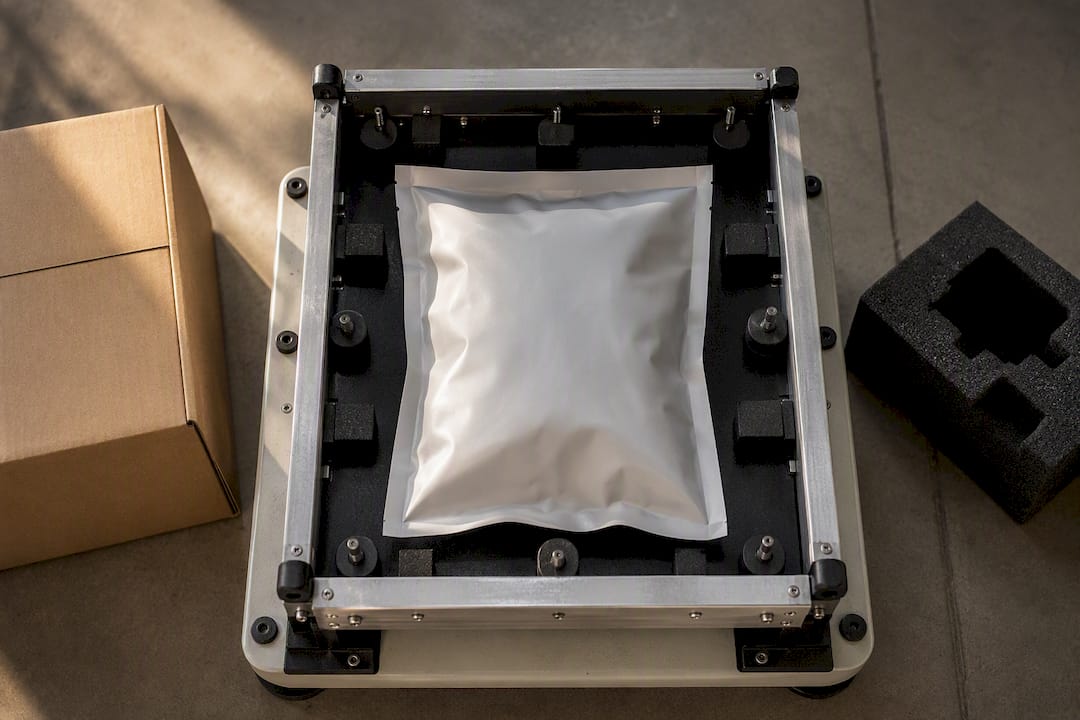
Freeze-dried product is hygroscopic, meaning it pulls moisture out of the air almost as fast as you removed it in the dryer. Get the packaging wrong and you undo weeks of processing work in a matter of days on a warehouse shelf.
The baseline protocol looks like this:
- Use high-barrier films, such as aluminum foil laminates, that block both oxygen and moisture vapor transmission
- Flush with nitrogen or vacuum seal immediately after drying, since every minute of open-air exposure invites rehydration
- Add oxygen scavengers or use modified atmosphere packaging (MAP) to strip residual oxygen from the sealed pack
- Control headspace volume and use desiccant packets for products with especially delicate cell structure
- Test packaged oxygen levels and water activity on a rolling schedule, not just at time of packing
Post-dry handling requires the same discipline as the drying step itself, according to the same freeze-drying review that covers sublimation mechanics. Oxidation and moisture pickup don’t wait for a convenient time to happen. They start the second the product leaves a controlled atmosphere.
Fragility is the other half of the equation, and it’s the part manufacturers underestimate. Vacuum-puffed candies and freeze-dried inclusions turn brittle and crush easily during transport, which means your packaging design has to account for physical protection as much as barrier properties, according to BBC reporting on vacuum-puffed candy production.
Pro Tip: Run a shake test before you finalize any pouch design. Ship a sample case across the country and open it cold. If half your product is powder by the time it arrives, no barrier film in the world is going to save that SKU.
Should You Outsource Secondary Packing to a Co-Packer?
Assembly work, not the core drying or manufacturing step, is where a surprising amount of waste actually happens. Multipacks, variety bundles, and seasonal gift sets require constant line changeovers, and every changeover is an opportunity for mispacks, damaged units, and retailer chargebacks.
Outsourcing that high-variability work to a co-packer solves a problem that in-house teams rarely solve well, because the equipment and labor needed for short, frequent runs sit idle most of the time on a dedicated line. Many brands discover that secondary packaging and multipack assembly generate a disproportionate share of scrap, and handing that work to a specialist eliminates the variable-driven waste while your core production line stays focused on what it does best.
The operational payoff shows up in a few concrete places:
- Recovered floor space that would otherwise sit under idle secondary-pack equipment
- Redeployed labor that shifts from repetitive assembly to higher-value production tasks
- Fewer quality failures, since dedicated co-packing lines run tighter QA than a secondary line bolted onto a primary production floor
Outsourcing contract packaging tends to deliver returns well beyond the simple per-unit cost comparison once you factor in reduced chargebacks and freed capacity, according to industry analysis of contract packaging ROI.
When you’re vetting a co-packer, look past price per unit. Ask about their QA metrics, whether they offer digital shop-floor visibility (real-time stock and production tracking cuts material obsolescence and waste, according to industry coverage of co-packing technology), and how fast they can ramp a new SKU from sample to full run.
Is the Capital Cost of Freeze-Drying Worth It?
This is the question that stalls most freeze-drying decisions, and it should. The honest answer depends heavily on your scale and your electricity contract.
Published economic modeling puts capex for a freeze-drying operation in the range of €5 to €8 million, based on a life-cycle and discounted cash-flow appraisal of food surplus upcycling. That number sounds brutal until you see how it plays out across scale.
- Large, vertically integrated operations can show a positive net present value because fixed costs spread across enough volume
- Small and mid-scale operations often show a negative NPV unless feedstock cost and finished-product pricing line up favorably
- Environmental footprint swings dramatically with the carbon intensity of the electricity feeding the dryer, since freeze-drying is an energy-hungry process by nature
Statistic Callout: That same modeling shows freeze-drying’s environmental footprint drops sharply under low-carbon electricity scenarios, which means your regional grid mix is a genuine input into the ROI decision, not just a sustainability talking point.
For a rough pilot ROI model, plug in: feedstock cost per kilogram of surplus, expected yield loss during drying, packaging cost per unit, energy cost per batch, and projected sell price for the finished freeze-dried product. If the math doesn’t clear breakeven within a defined batch count, that’s your signal to lean on co-packing or a toll-processing arrangement instead of buying equipment outright. Operators weighing this tradeoff against broader sustainability goals can find useful framing in this operator guide to sustainability in food services.
What Does a Realistic Pilot-to-Scale Roadmap Look Like?
Nobody should go from zero to a full production line in one leap. The sequence that actually works spans three phases.
- Design the pilot (weeks 1 to 4). Select one to three SKUs, run small batch sizes, finalize packaging specs, and start accelerated shelf-life testing alongside basic sensory checks.
- Run and measure (weeks 4 to 12). Track shrink rate, finished yield, oxygen readings inside the sealed pack, water activity, rework incidents, and any retailer chargebacks tied to the pilot run.
- Decide and scale (months 3 to 12). Use the pilot’s per-unit cost data to decide between building in-house capacity or continuing with a co-packer, and evaluate whether hybrid pretreatment technology is worth adopting to cut energy and time costs.
The build-versus-co-pack decision usually comes down to volume predictability. If demand for the SKU is steady and high enough to keep a dryer running near capacity, ownership starts to make sense. If demand is seasonal or you’re still validating market fit, staying with a co-packer keeps your capital exposure low while you gather more data.
Pro Tip: Set your KPI thresholds before the pilot starts, not after you see the results. It’s too easy to rationalize a mediocre shrink rate once you’re emotionally invested in a technology you just spent money testing.
Where Does Most Product Loss Actually Start on the Line?
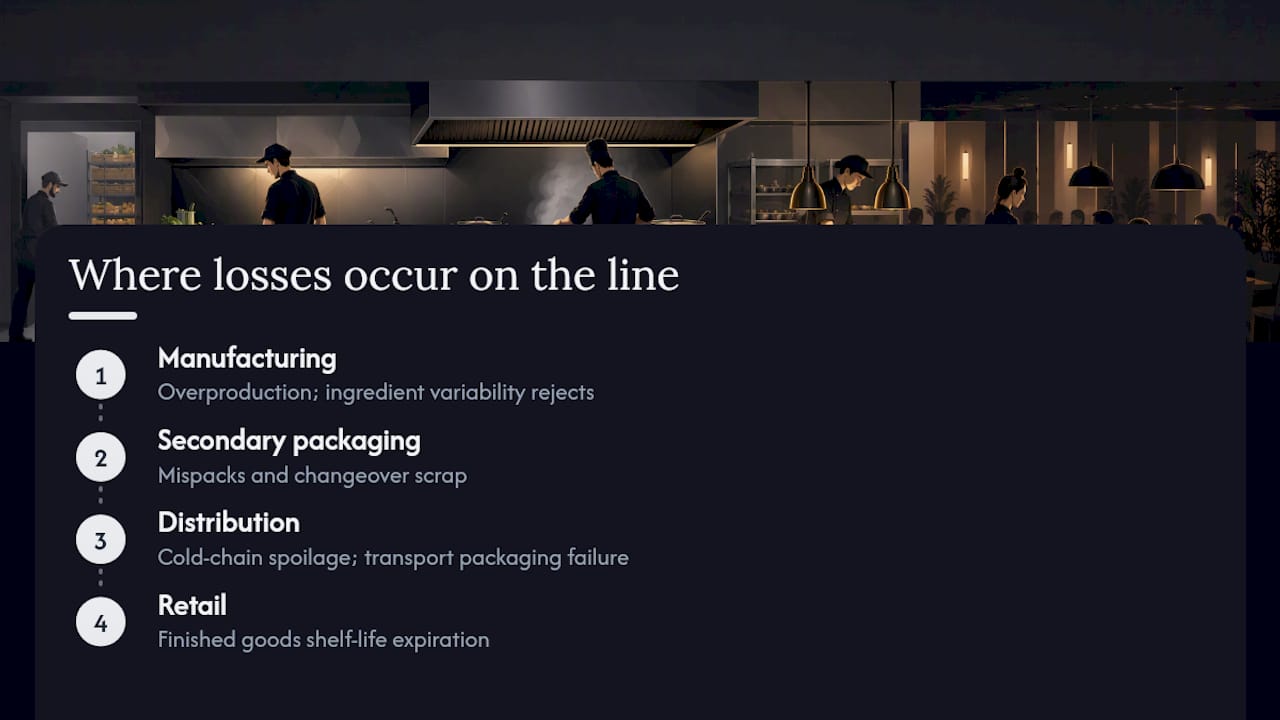
Product loss in manufacturing and retail snack operations rarely comes from one dramatic failure. It comes from a handful of recurring, unglamorous sources that compound over a production year.
Overproduction against inaccurate demand forecasts sits at the top of the list, followed by spoilage from inconsistent cold-chain handling between receiving and processing. Ingredient variability, particularly with fresh fruit, dairy inclusions, or seasonal produce destined for a snack line, causes rejected batches when moisture content or ripeness falls outside spec. Packaging failures during transport, whether from inadequate barrier protection or physical crushing, turn a perfectly good product into a return or a write-off after it already left the facility.
Secondary packaging and assembly operations, as covered earlier, generate their own separate waste stream through mispacks and changeover scrap. And then there’s the quieter category: shelf-life expiration on finished goods sitting in distribution, which usually points back to a packaging or moisture-control decision made months earlier during production.
Mapping these sources by SKU and by production stage, rather than treating “waste” as one lump category, is what makes the rest of this playbook actionable. A brand that doesn’t know whether its losses come from overproduction, spoilage, or packaging failure ends up throwing freeze-drying capex at a problem that a $2 change in pouch material would have solved.
How Should You Forecast Demand to Avoid Overproduction?
Overproduction is the single most preventable driver of product loss, and it’s almost always a forecasting problem dressed up as a manufacturing problem. If you’re running batches based on last year’s seasonal average without adjusting for current retail sell-through data, you’re building in waste before the first unit even hits the line.
Start with SKU-level sales velocity data pulled directly from retail and distributor partners, not just your own shipment numbers. Shipment volume tells you what left your warehouse; it doesn’t tell you what actually sold off a shelf. The gap between those two numbers is often where hidden overproduction hides.
Portion and batch-size control matters just as much as the forecast itself. Smaller, more frequent production runs reduce the risk of a bad forecast turning into a warehouse full of unsold inventory, even though they cost more per unit in labor and changeover time. That tradeoff is worth it for high-value or perishable SKUs where the cost of unsold stock outweighs the cost of extra changeovers.
Build in a feedback loop: compare actual sell-through against your forecast every production cycle, and adjust the next batch size accordingly rather than waiting for a quarterly review. This is exactly where a step-by-step approach to reducing food waste through better operational habits pays off, since forecasting discipline compounds over each cycle rather than delivering one big fix.
How Do You Get Staff to Actually Care About Waste Reduction?
Training programs fail when they’re a one-time orientation slide deck that nobody references again. Waste reduction sticks when it’s built into daily routines and tied to something staff can see and measure themselves.
The most effective approach ties specific, visible metrics to specific roles. A line worker doesn’t need to understand your full LCA model. They need to know that catching a moisture-spec deviation before it goes into the dryer saves an entire batch, and they need a fast, simple way to flag it when they see it.
Practical elements that make training programs work:
- Short, role-specific modules instead of one long general session that tries to cover everything at once
- Visible tracking boards on the floor showing shrink rate or rework incidents by shift, so staff see the impact of their own work
- Small incentive structures tied to hitting waste-reduction targets, even informal ones like recognition at a shift meeting
- A clear reporting channel for flagging packaging or ingredient issues before they become full-batch losses
Engagement matters more than the training content itself. A crew that feels ownership over their line’s waste numbers will catch problems a supervisor walking the floor once a day never will.
How Does FIFO Inventory Management Cut Perishable Waste?
First-in-first-out rotation sounds basic, and it is. It’s also one of the most under-enforced practices in manufacturing and retail snack operations, mostly because it requires consistent labeling discipline that erodes over time without active management.
The mechanics are simple: every lot gets a receipt date, older stock moves to the front of storage and gets pulled first, and nothing new gets stocked in front of older inventory regardless of how convenient that placement is in the moment. The failure point is almost always convenience. Someone restocks a shelf from the back because it’s faster, and three months later you find expired product buried behind fresh stock.
For perishable ingredients feeding a freeze-dry or snack production line, FIFO discipline needs to extend beyond raw ingredients to finished goods sitting in distribution. A batch of freeze-dried product with a six-month shelf life doesn’t help you if it sits in a warehouse for four months before shipping.
Digital inventory tracking removes most of the human error from this equation. Barcode or lot-based scanning systems flag aging stock automatically instead of relying on someone remembering to check dates manually. Pair that with accurate storage guidance specific to your product category, since freeze-dried goods, fresh produce, and dairy inclusions all have different tolerance windows before quality drops noticeably.
What Are Compliant Ways to Donate or Reuse Surplus Product?
Surplus that can’t be sold at full price doesn’t have to become a total loss, provided you build donation and reuse into your standard operating procedure rather than treating it as an occasional favor to a local food bank.
Food safety regulations governing donation vary by jurisdiction, so the first step is confirming your local and national requirements around temperature logs, labeling, and liability protections before you commit to a donation partnership. Most jurisdictions offer some form of liability protection for good-faith donations of safe, properly handled product, but the specifics differ enough that you need to verify your own region’s rules rather than assume broad coverage.
Beyond formal donation, surplus that’s cosmetically imperfect but still safe and high quality has a second life as a reprocessed ingredient. Off-spec fruit pieces, slightly irregular chocolate inclusions, or marshmallow trim are often exactly the kind of feedstock worth diverting into a freeze-dried snack line instead of scrapping outright. That reuse pathway turns a write-off into a lower-cost input for a premium product.
Documentation matters as much as the policy itself. Keep clear records of what was donated or diverted, when, and under what safety checks, both for regulatory compliance and because it gives you real data on how much value you’re recovering from surplus each quarter instead of a vague sense that “we donate sometimes.”
Can Menu and Packaging Design Reduce Waste on the Retail Side?
Waste reduction doesn’t stop at the production line. How a product is presented and sold to the end customer shapes how much of it actually gets used versus discarded.
For manufacturers and private-label brands, this shows up most clearly in portion sizing and pack format decisions. Offering a smaller, resealable pack size alongside a bulk format lets retail customers buy closer to what they’ll actually consume, which cuts down on partial-use waste sitting in a pantry. Resealable high-barrier pouches, the same packaging discipline covered earlier for protecting freeze-dried product quality, do double duty here by extending usable life after the package is first opened.
Surplus-driven specials work on the B2B side too. If a production run generates slightly higher yield than a retail order calls for, packaging that surplus as a limited-run or seasonal variety pack turns an inventory management headache into a sellable product rather than a write-off. Retail and foodservice partners increasingly respond well to transparent “surplus special” framing, since it signals sustainable production practices without requiring the customer to compromise on quality.
Clear labeling that communicates shelf life, storage instructions, and use-by guidance also reduces waste indirectly. Customers who understand exactly how long a freeze-dried product stays fresh after opening are far less likely to discard it prematurely out of uncertainty.
The Gap Between Freeze-Drying’s Promise and Its Practical Payoff
Most manufacturers hear “freeze-drying” and picture a silver-bullet fix for spoilage. It isn’t one. It’s a genuinely powerful tool that gets misapplied constantly, usually by brands that skip the packaging discipline and treat the dryer as the finish line instead of the midpoint.
The real leverage isn’t the drying technology itself. It’s the combination: sublimation to lock in quality, barrier packaging to keep it locked in, and selective co-packing so you’re not sinking capital into equipment that sits idle nine months a year. Brands that treat these as three separate decisions instead of one integrated system are the ones who end up with expensive dryers and disappointing shelf-life results.
Start with a small pilot, measure obsessively, and let the co-packing route absorb your variability while you validate the economics.
— Chadi
How Space-man Helps You Turn Surplus Into Shelf-Stable Product
Freeze-dried candy, chocolate, marshmallow, and ice cream sandwich production services in Canada are offered, alongside private-label, co-packing, and packaging support for manufacturers looking to avoid large capital expenditures on unproven SKUs. Instead of building your own freeze-drying line and hoping the volume shows up, you get access to established drying capacity, private-label formulation support, and packaging trials, including high-barrier pouch testing, without the equipment risk sitting on your balance sheet.

If your team is sitting on high-value surplus that’s currently getting written off, or you’re evaluating whether secondary packaging is quietly draining margin, a sample run is the fastest way to get a real answer instead of a projection. Reach out through Space-man’s private-label, co-packing, and packaging services page to request a pilot batch or a packaging sample run and see the yield and shelf-life numbers for your own SKU before committing to anything bigger.
Sources
- Technological Innovations in Freeze Drying: Enhancing Efficiency, Sustainability, and Food Quality
- Advancing industrial food byproduct management: strategies, technologies, and progress in waste reduction
FAQ
How Much Does Hybrid Pretreatment Reduce Freeze-Drying Costs?
Hybrid pretreatments combining mild dehydration or ultrasound with freeze-drying can cut processing time and energy use by roughly 30 to 40 percent, which meaningfully improves the economics of smaller production runs.
Is Co-Packing Cheaper Than Buying Freeze-Drying Equipment?
For most small and mid-scale operations, yes, largely because published capex modeling puts freeze-drying equipment in the €5 to €8 million range, while co-packing shifts that capital risk onto a partner who already has the equipment running near capacity.
Can Space-Man Help With a Small Packaging Pilot Before a Full Production Run?
Yes. Space-man’s private-label and co-packing services support sample and pilot runs, letting manufacturers test high-barrier packaging and freeze-dried formats on a small SKU before committing to full-scale production.
What’s the Fastest Way to Start Reducing Product Loss This Quarter?
Map your surplus streams by SKU, pick one or two high-value items for a packaging or freeze-dry pilot, and track shrink rate and water activity from day one rather than waiting for a full quarter of data before acting.