

TL;DR:
- Freeze-dried foods stored properly can last between 10 and 25 years due to their low water activity. Proper packaging, cool dark storage, and careful handling after opening are essential to maximize shelf life and nutritional quality. While they remain safe for decades, nutrient loss, especially vitamin C, requires supplementation during long-term storage.
You pull a bag of freeze-dried strawberries from the back of your pantry shelf. The best-by date is faded, but you vaguely remember buying it years ago. Is it trash or totally fine? That moment of uncertainty is exactly why understanding freeze-dried food shelf life matters, whether you are building an emergency food supply, stocking up to save money, or just trying to reduce waste. The claims out there range from 10 years to 25 years to even longer, and sorting fact from marketing takes some digging. This guide covers what the research actually says, how storage conditions affect longevity, and what you can realistically expect from your food years down the road.
Table of Contents
- How freeze-drying works and why it matters for shelf life
- How long can you store freeze dried food safely?
- Maximizing shelf life: The right way to store freeze dried food
- What about nutrition and taste after years in storage?
- The real secret to long-term food storage success
- Explore freeze dried options for your storage plan
- Frequently asked questions
Key Takeaways
| Point | Details |
|---|---|
| Decades-long safety | Freeze-dried food can stay safe for 10–25 years if stored in airtight, moisture-proof packaging in cool, dark, dry places. |
| Proper storage matters | Packaging and storage conditions directly impact shelf life and food quality. |
| Nutrition declines over time | Vitamins, especially vitamin C, degrade even if food remains safe and edible after several years. |
| Rotate for best results | Plan to rotate freeze-dried food every few years for best taste and nutrition. |
How freeze-drying works and why it matters for shelf life
Freeze-drying is not just dehydration with a fancier name. The process is fundamentally different, and that difference is precisely what makes the shelf life so impressive.
Here is how it works: food is frozen solid, then placed in a vacuum chamber. Under very low pressure, the ice in the food converts directly from solid to vapor without passing through a liquid stage. This is called sublimation. The result is food that retains its original shape, color, and most of its nutritional structure, but has had nearly all of its moisture removed.
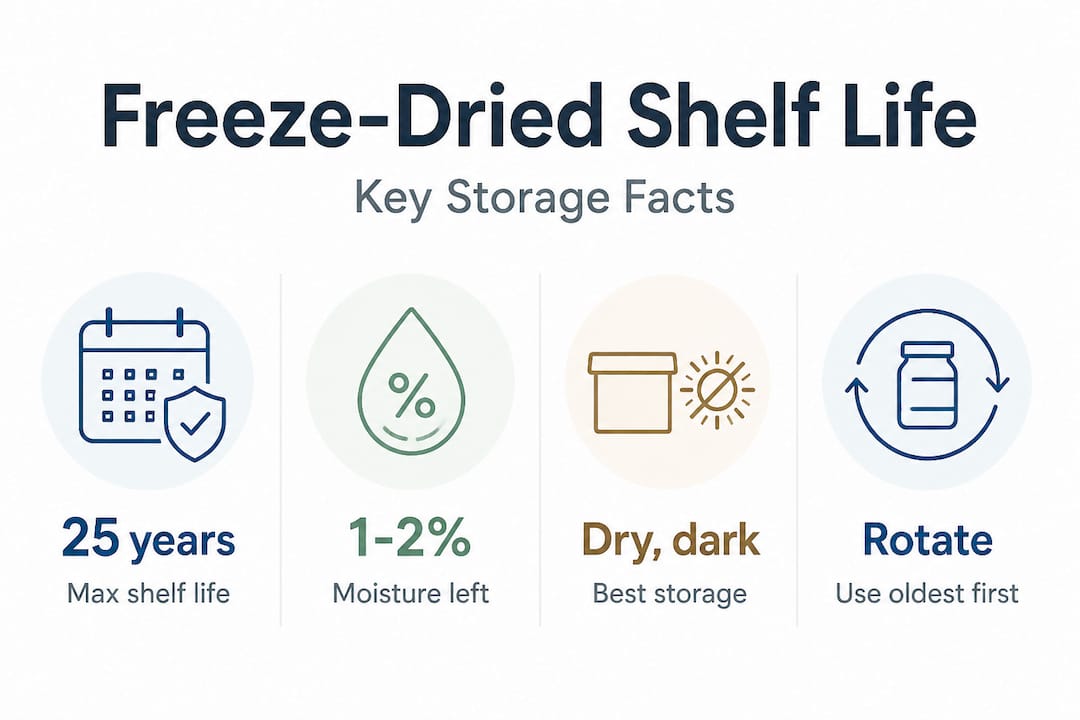
The key factor behind long shelf life is something called water activity. Water activity measures how much “free” water is available in a food for bacteria, molds, and yeasts to use. Standard fresh food has high water activity. Freeze-dried food does not. Low water activity prevents microbial growth, keeping the food shelf-stable without refrigeration. Most well-processed freeze-dried products land in the 0.08 to 0.33 water activity range, far below the threshold where bacteria can survive and multiply.
Compare that to other preservation methods:
| Method | Typical shelf life | Moisture removed | Flavor/texture retention |
|---|---|---|---|
| Freeze-drying | 10 to 25 years | 98 to 99% | Excellent |
| Dehydration | 1 to 4 years | 70 to 90% | Moderate |
| Canning | 2 to 5 years | None | Low to moderate |
| Freezing | 1 to 3 years | None | Good when fresh |
The data is clear: freeze-drying outperforms every other common preservation method for shelf life. If you are curious about applying this at home, understanding freeze drying meat at home is a great place to start building a well-rounded long-term storage plan.
Key reasons freeze-drying wins for long-term storage:
- Nearly complete moisture removal prevents spoilage organisms from surviving
- Lightweight and compact product is easy to store in bulk
- Minimal chemical changes during processing preserve flavor and color better than heat-based methods
- No refrigeration required once sealed
“Freeze-drying greatly lowers water activity, making microbial growth difficult. This is a key reason freeze-dried foods have long stability when protected from rehydration or moisture uptake.” — Utah State University Extension
How long can you store freeze dried food safely?
Now that you understand why freeze-drying works so well, here is what real-world shelf life looks like under various conditions.
Commercially packaged freeze-dried foods can remain safe and high quality for roughly 10 to 15 years, and sometimes up to 25 years when stored in airtight, moisture-proof packaging kept in cool, dark, dry conditions. That is the benchmark for well-sealed, professionally processed product. Home-packed freeze-dried food typically falls in the 10 to 15 year range because of variation in processing equipment and packaging consistency.
The range is wide for good reason. Several variables determine whether your supply lands closer to 10 years or 25 years:
- Packaging type: Mylar bags with oxygen absorbers are the gold standard. They block light, minimize oxygen exposure, and resist moisture. Standard zip-lock bags or thin plastic will not come close to those numbers.
- Storage temperature: Heat accelerates chemical reactions that degrade food. Storing food at 70°F (21°C) or below is ideal. Every 10 degrees of additional heat roughly doubles the rate of quality loss.
- Light exposure: UV light breaks down fats and vitamins. Opaque packaging or a dark storage area is essential.
- Moisture exposure: Any moisture intrusion can restart water activity and allow spoilage. This is why opened packaging needs to be handled carefully.
- Oxygen levels: Even small amounts of residual oxygen contribute to oxidation and off-flavors over time.
Shelf life comparison by product type:
| Product type | Sealed commercial packaging | Home-packed | After opening |
|---|---|---|---|
| Freeze-dried fruits | 15 to 25 years | 10 to 15 years | 2 to 4 weeks |
| Freeze-dried vegetables | 15 to 25 years | 10 to 15 years | 2 to 4 weeks |
| Freeze-dried meats | 10 to 15 years | 5 to 10 years | 1 to 2 weeks |
| Freeze-dried candy/snacks | 1 to 3 years (varies) | 6 to 12 months | Days to weeks |
It is worth knowing the difference between “safe to eat” and “best quality.” A freeze-dried food may be technically safe to consume after 20 years in good storage, but that does not mean it will taste the way it did when you first packed it. Flavor, texture, and nutritional content all degrade over time, just more slowly than with other preservation methods. For a detailed breakdown by product, the freeze-dried food shelf life breakdown and the freeze-dried snack shelf life guide are worth reading if you are stocking specific items.
Pro Tip: Label every sealed package with the date it was packed and the contents. A simple piece of masking tape and a permanent marker will save you a lot of guesswork when you are cycling through your stock years later.
Maximizing shelf life: The right way to store freeze dried food
To get those impressive shelf life numbers, your storage technique has to be consistent. Good freeze-dried food stored poorly will underperform. Here is how to do it right.
Packaging best practices:
- Use Mylar bags that are at least 4 to 5 mil thick for barrier protection against oxygen and moisture
- Add oxygen absorbers rated for the container size (typically 300 to 2,000 cc depending on volume)
- Heat-seal the Mylar bag rather than just folding the top over
- Consider double-sealing or placing Mylar bags inside food-grade plastic buckets with airtight lids for additional protection
Storage environment rules:
Airtight, moisture-proof packaging is only half the equation. Where you store your food matters just as much. Aim for a cool, dark, and dry location. Basements often work well in Canada, though you need to watch for humidity fluctuations during summer. Avoid storage near furnaces, hot water heaters, or exterior walls that experience significant temperature swings.
Things to avoid:
- Garages or sheds where temperatures can spike above 85°F (30°C) in summer
- Areas with high humidity or risk of flooding
- Near windows or under fluorescent lights
- On concrete floors without a moisture barrier beneath the containers
After opening a package:
Once you open a sealed container, the clock restarts. Oxygen and humidity enter immediately. Transfer any unused freeze-dried food into a smaller airtight container, press out as much air as possible, and use within a few weeks. For comprehensive techniques, the guides on storing freeze-dried goods and storing freeze-dried foods go into detail on the best containers and methods.
Pro Tip: Store your food in smaller portions rather than one large bulk container. This way, you only expose what you need and keep the rest sealed for maximum freshness.
Common storage mistakes to avoid:
- Packing food while it still has residual warmth or moisture after freeze-drying
- Using containers that were not completely dry before sealing
- Storing food in cardboard boxes that can absorb humidity
- Skipping oxygen absorbers to cut costs (this shortens shelf life significantly)
- Relying on manufacturer best-by dates without checking storage conditions
What about nutrition and taste after years in storage?
Even the safest, most carefully stored foods are not immune to change over time. This is where the marketing reality gap tends to show up.
Freeze-dried food can remain microbiologically safe for decades, but the nutritional content is a different story. Nutrient degradation occurs over time even when food is technically safe to eat. Vitamin C is the most vulnerable, with significant losses possible within the first 1 to 3 years of storage. Other water-soluble B vitamins follow a similar pattern, though more slowly. Fat-soluble vitamins (A, D, E, K) tend to hold up better.
What this means practically:
- A freeze-dried vegetable stored for 15 years may still be safe and flavorful, but its vitamin C content could be dramatically lower than fresh
- People relying solely on long-stored freeze-dried food during an extended emergency may need to plan for supplemental vitamins
- Minerals and macronutrients (protein, carbohydrates, fiber) tend to stay more stable over time
“Nutrient degradation can occur even when food remains safe. Sensitive vitamins like vitamin C can decline significantly within 1 to 3 years of storage.” — Utah State University Extension
Taste and texture also shift over long storage periods. Freeze-dried food rehydrated from a 20-year-old supply will not taste like a product opened within the first year or two. Common changes include:
- Loss of crunch in snack-style products
- Slight off-flavors from oxidation, especially in products with higher fat content
- Color changes, particularly in fruits and vegetables high in anthocyanins or carotenoids
- Harder or tougher texture after rehydration compared to fresh products
For fruits specifically, understanding how storage affects both taste and nutritional integrity is worth exploring through the freeze-dried fruit shelf life resource, which covers common fruits and their expected changes over time.
The real secret to long-term food storage success
Here is an honest perspective on what most freeze-dried food guides skip over entirely.
The phrase “25-year shelf life” makes a great headline. And technically, it is achievable under ideal conditions. But most people read that number and assume it means 25 years of nutritious, great-tasting meals waiting in their basement. The reality is more nuanced, and planning around the nuance is what separates people who actually use their food storage from those who open it in an emergency and are disappointed.
The biggest mistake we see is treating freeze-dried food as a “set it and forget it” solution. You buy a supply, stack it in a corner, and assume everything is fine for two decades. But then you never rotate it, never check packaging integrity, and never account for the slow vitamin loss happening even in perfect conditions. When you actually need that food, you are eating something that is safe but nutritionally incomplete.
Real food storage success looks like this: you buy quality freeze-dried products with solid packaging, you store them properly, but you also rotate your supply every few years. You supplement your emergency food plan with shelf-stable vitamin C and B-complex vitamins. You build in variety so that if you ever do need to rely on your supply for weeks at a time, you are not eating the same three items on repeat.
Good organization and labeling beat bulk stockpiling every time. Knowing what you have, how old it is, and when to rotate makes a practical plan instead of just a pile of supplies. Take a look at resources on maximizing freeze-dried fruit shelf life for a good example of how thinking systematically about a single product category can change how you approach storage overall.
Freeze-dried food is genuinely excellent for long-term storage. The science backs it up. But it works best as part of a thoughtful plan rather than a standalone solution.
Explore freeze dried options for your storage plan
Building a reliable food storage plan starts with choosing products you can trust. Whether you are stocking up for emergencies, adding convenient long-shelf-life snacks to your pantry, or simply trying freeze-dried foods for the first time, having access to quality options makes all the difference.

At Space-Man, we make and distribute freeze-dried candy and snacks right here in Canada. Our freeze-dried candy bundles are a fun starting point if you want to explore the format, and our freeze-dried candy starter pack is perfect for stocking up with variety. If you are a business looking to create your own branded line or need bagging and packaging support, our private label and packaging solutions give you a full-service option backed by Canadian manufacturing expertise.
Frequently asked questions
What is the maximum shelf life of freeze-dried food?
With ideal packaging and storage conditions, some commercial freeze-dried foods can remain safe for up to 25 years when sealed in airtight, moisture-proof packaging and kept in a cool, dark, dry environment.
Does freeze-dried food lose nutrition over time?
Yes, sensitive nutrients like vitamin C decline significantly within the first 1 to 3 years of storage, even when the food remains safe to eat. Plan to supplement your long-term supply with vitamins if you are storing food for extended emergencies.
Can you eat freeze-dried food past its best-by date?
Freeze-dried food may still be safe past the best-by date if it has been stored correctly in sealed, moisture-proof packaging, but expect some reduction in both taste and nutritional value compared to when it was first packed.
What is the best way to store freeze-dried food at home?
Store freeze-dried food in Mylar bags with oxygen absorbers, heat-sealed and placed in airtight containers, in a cool, dark, and dry location. This combination gives you the best chance of reaching the 10 to 25-year range for shelf life.