

TL;DR:
- Freeze drying removes moisture through sublimation, preserving nutrients, texture, and flavor in food products. The process involves three stages: initial freezing, primary sublimation drying, and secondary desorption drying, all controlled by precise temperature and pressure settings. Proper sanitation and packaging are essential to ensure product quality, safety, and extended shelf life for small businesses and consumers alike.
If you’ve ever bitten into a crunchy, melt-in-your-mouth piece of freeze dried fruit or candy and wondered how that magic happens, you’re not alone. Understanding how do freeze dryers work is genuinely useful knowledge, whether you’re a curious foodie, a home preserver, or a small business owner looking to get into the freeze dried food market. The process is rooted in a surprisingly elegant piece of physics called sublimation, and the results speak for themselves. food that retains up to 97% of its nutrients, original texture, and full flavor. This guide covers every stage from component to finished product.
Table of Contents
- Key takeaways
- How freeze dryers work: the essential components
- The three phases of the freeze drying process
- Common challenges and best practices
- Applications and real-world benefits
- My honest take on freeze drying
- Ready to take freeze drying further?
- FAQ
Key takeaways
| Point | Details |
|---|---|
| Sublimation is the core mechanism | Freeze dryers remove moisture by converting ice directly to vapor, skipping the liquid phase entirely. |
| Three phases define the process | Freezing, primary drying (sublimation), and secondary drying each play a distinct role in moisture removal. |
| Temperature and vacuum are everything | Keeping precise control over pressure and heat prevents product collapse and guarantees quality output. |
| Freeze drying does not sterilize | Bacteria survive the process, so proper sanitation and oxygen-barrier packaging are non-negotiable. |
| Environment affects performance | Operating a freeze dryer outside the 45°F to 80°F ambient range strains equipment and reduces efficiency. |
How freeze dryers work: the essential components
Before walking through the freeze drying process step by step, it helps to know what you’re actually working with. A freeze dryer is not a fancy refrigerator. It’s a system of precisely coordinated components that control temperature, pressure, and vapor flow simultaneously.
| Component | Role |
|---|---|
| Freezing chamber | Holds the product on shelves; temperature is controlled during all phases |
| Vacuum pump | Reduces chamber pressure to near-vacuum, enabling sublimation |
| Condenser (cold trap) | Captures water vapor leaving the product, preventing it from reaching the pump |
| Heated shelves | Supply low, controlled heat to drive sublimation without melting the product |
| Control system | Monitors and adjusts temperature and pressure throughout the cycle |
The relationship between the vacuum pump and the condenser is where freeze dryer technology really shines. The pump creates the low-pressure environment needed for sublimation to happen, and the condenser (operating at temperatures between -50°C and -80°C) acts as a cold trap, pulling vapor away from the product and solidifying it before it ever reaches the pump. This keeps the vacuum stable and protects the equipment.
Typical operating conditions run with vacuum at 0.1 to 1.0 hPa, shelf temperatures ranging from -10°C to +30°C depending on the phase, and full cycles that can stretch from 24 to 48 hours or more. That might sound like a long time, but the payoff in product quality and shelf life makes it worthwhile.
Pro Tip: When learning how to use a freeze dryer for the first time, run a test batch with a small, uniform portion of food before committing to a full load. This helps you understand how your specific machine behaves before risking a larger batch.
The three phases of the freeze drying process
This is where freeze dryer principles really come to life. The whole process moves through three distinct stages, and each one matters. Rushing or mismanaging any phase leads to a compromised product.
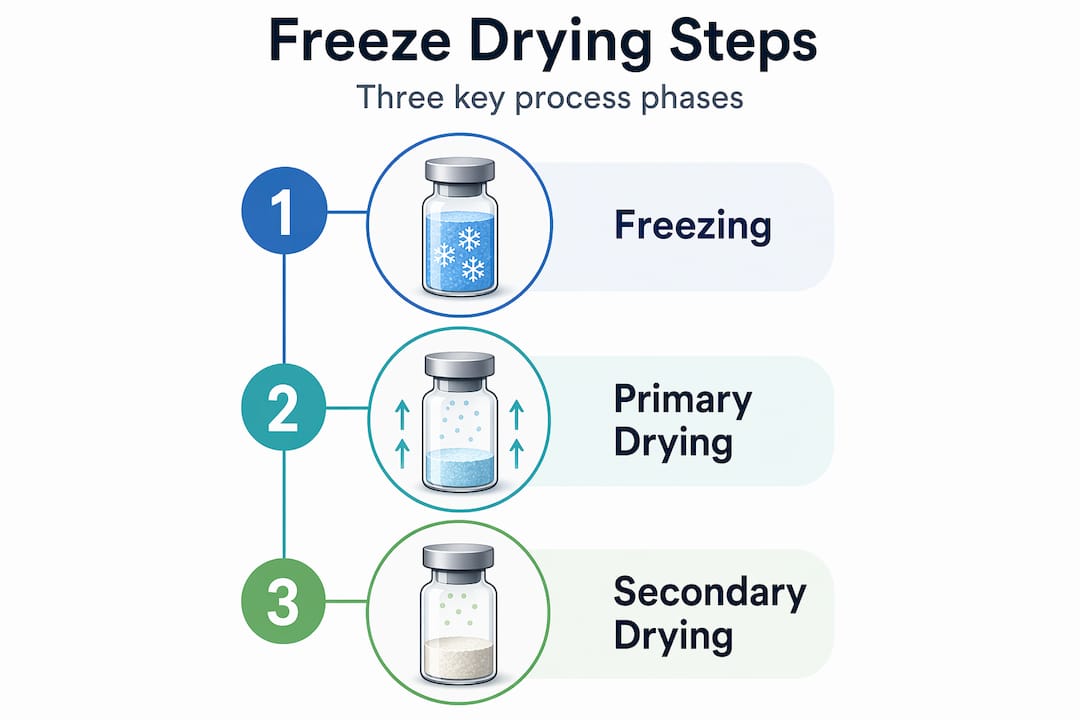
Phase 1: initial freezing
The first job is to freeze the product solid, and not just barely frozen. For sublimation to work correctly, the product needs to reach below its eutectic temperature, the point at which all the water in the material has solidified. For most food products, that means freezing to between -30°C and -50°C.
The rate of freezing also matters. Slow freezing creates larger ice crystals, which can rupture cell walls and affect texture on rehydration. Faster freezing creates smaller, more uniform crystals that preserve the product’s structure better. For small businesses focused on quality, this is a detail worth paying attention to from day one.
Phase 2: primary drying (sublimation)
Once the product is fully frozen, the vacuum pump reduces chamber pressure to near-vacuum and the shelves begin to apply gentle, controlled heat. At this low pressure, the ice in the product does something unusual. It skips the liquid phase entirely and converts directly into water vapor. That vapor flows toward the condenser, which is much colder, and gets captured there as ice.
This is the longest and most critical phase. Primary drying removes roughly 90 to 95% of the product’s water content. The key risk here is overheating. If the shelf temperature climbs too high, the product temperature can exceed its collapse temperature and the internal structure literally falls apart, leaving you with a dense, shrunken mass instead of a light, porous product.
Advanced monitoring methods like TDLAS (tunable diode laser absorption spectroscopy) can detect precise drying end-points to avoid under or over-drying, though most small-scale machines rely on time and temperature profiles instead.
Phase 3: secondary drying (desorption)
After primary drying, a small amount of water is still chemically bound to the product. This water won’t sublimate; it requires a different approach. In secondary drying, the shelf temperature is raised to around 20°C to 40°C under vacuum to break those molecular bonds and remove the remaining moisture through desorption.
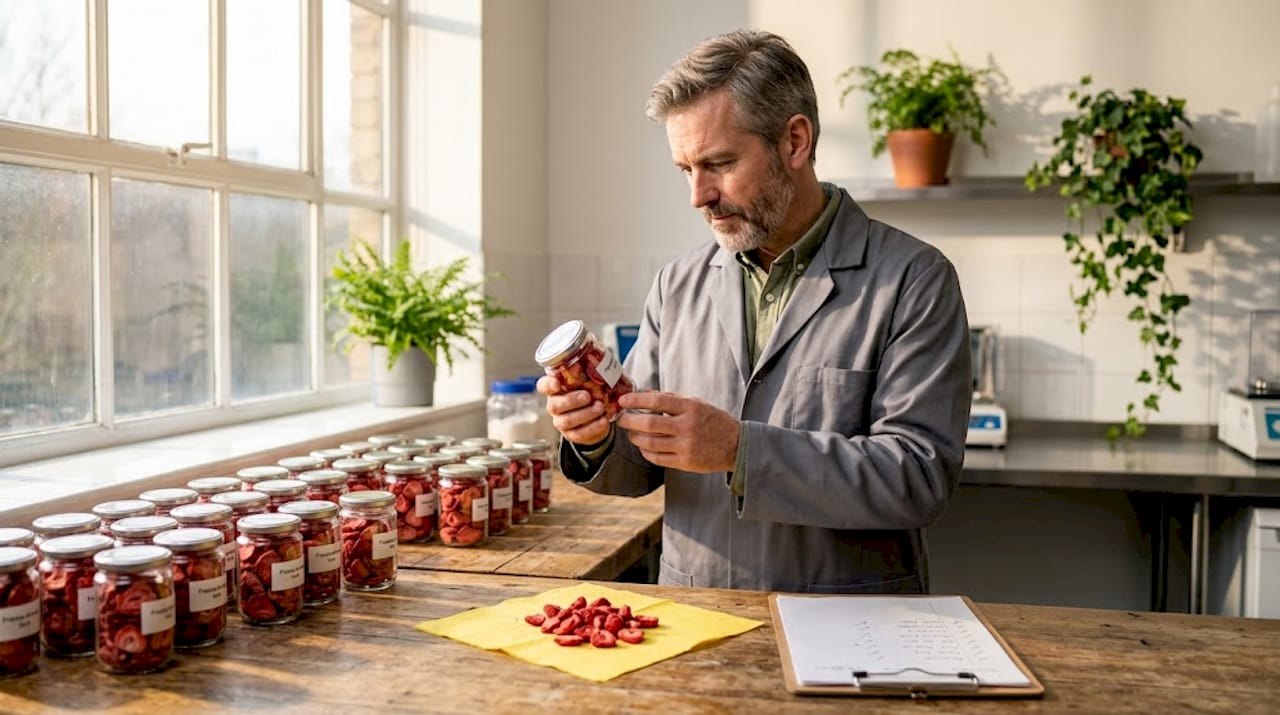
This phase is shorter than primary drying, but skipping it or cutting it short leaves residual moisture in the product that shortens shelf life and can cause quality issues over time. The final moisture content of a well-executed freeze dried product is typically below 2%, which is what enables those remarkable shelf lives measured in years, not weeks.
Common challenges and best practices
Knowing the theory is one thing. Knowing where things actually go wrong is where experience pays off. Here are the most common issues and how to handle them.
- Product collapse: This happens when the product temperature exceeds the collapse temperature during primary drying. Use thermal analysis data for your specific product to set safe drying profiles, and never rush the heating ramp.
- Vacuum disruption: Non-condensable gases can accumulate in the system and block vapor flow to the condenser, slowing sublimation and reducing product quality. Regular maintenance and checking seal integrity prevents this.
- Portion sizing: Uneven or oversized portions extend cycle times and create inconsistent drying. Uniform, thinner slices dry faster and more evenly across the whole batch. Load uniformity significantly affects cycle time.
- Sanitation gaps: Freeze drying does not sterilize food. Bacteria survive the process and can reactivate when the product is rehydrated. Clean all surfaces, tools, and the chamber thoroughly before every run.
- Packaging delays: Freeze dried products are highly hygroscopic, meaning they absorb moisture from the air almost immediately once the chamber is opened. Seal product in oxygen-barrier packaging like thick Mylar bags with oxygen absorbers as quickly as possible after the cycle completes.
- Operating environment: Home and commercial freeze dryers perform best between 45°F and 80°F ambient temperature. A hot garage in summer or a cold basement in winter will degrade performance and strain the compressor.
Pro Tip: Use thick Mylar bags without windows for long-term storage. Windowed bags let in more air and moisture, which defeats the entire purpose of freeze drying in the first place.
Applications and real-world benefits
So what does all this machinery and process control actually get you? Quite a lot, as it turns out. Freeze drying has advantages over other preservation methods that go well beyond just “longer shelf life.”
When it comes to nutrition and quality, sublimation preserves nutrients and texture far better than hot-air drying or dehydration, which use heat that degrades vitamins and changes cell structure. Freeze dried food genuinely tastes and looks more like the original than food dried by conventional methods.
Here is a quick comparison:
| Method | Nutrient retention | Texture | Shelf life | Rehydration quality |
|---|---|---|---|---|
| Freeze drying | Up to 97% | Excellent | 10 to 25 years | Near-original |
| Hot-air drying | 60 to 80% | Chewy, shrunken | 1 to 4 years | Poor to moderate |
| Freeze (standard) | 85 to 95% | Good | 1 to 2 years | Good |
| Canning | 60 to 80% | Soft | 2 to 5 years | N/A |
Common applications for individuals and small businesses include:
- Freeze dried fruits, vegetables, and herbs for long-term pantry storage
- Lightweight, shelf-stable meals for camping, hiking, and emergency preparedness
- Freeze dried candy and snacks for retail, gifting, and novelty markets
- Pet food and treats with minimal additives
- Culinary ingredients like powdered dairy, eggs, or seasonings
For small business owners, the advantages of freeze drying for snacks extend into branding territory too. Products that look vibrant, taste fresh, and carry a multi-year shelf life are genuinely easier to sell and differentiate in a crowded market.
One practical consideration worth mentioning: freeze drying is energy intensive. It runs continuously for 24 to 48-plus hours per cycle. Factor that cost into your pricing model early, especially if you are running a home setup or a small commercial operation.
My honest take on freeze drying
I’ve worked with freeze dryers long enough to have a few opinions that run counter to what most beginner guides will tell you.
The biggest mistake I see from people getting started is treating freeze drying like an automatic, set-it-and-forget-it process. The machine handles the mechanics, sure. But understanding what’s actually happening inside the chamber, and why temperature control during primary drying is so critical, is what separates good product from great product. I’ve seen beautiful batches of food come out looking perfect on the outside and be structurally compromised on the inside because someone bumped the shelf temperature up to try to cut cycle time.
My other strong opinion: sanitation gets underestimated constantly. People invest in expensive equipment and quality ingredients, then skip a thorough wipe-down of the chamber between runs. Freeze drying preserves everything, including the bacteria you do not want. Taking that extra 20 minutes before every batch is not optional.
The last thing I’ll say is about packaging. I’ve seen people go through a perfect 36-hour cycle, pull out excellent product, and then leave it sitting out on a tray for an hour before sealing it. Moisture reabsorption is fast. Have your bags open, oxygen absorbers ready, and seal within minutes of unloading. Learning how to store freeze dried goods properly is just as important as running the machine correctly.
— Chadi
Ready to take freeze drying further?
Understanding how freeze dryers work is the foundation. What you do with that knowledge, especially if you’re building a product-based business, is where things get exciting.

At Space-man, we work with small businesses and entrepreneurs who want to bring freeze dried products to market without having to own and operate all the equipment themselves. Our private label, co-packing, and packaging services are designed specifically for that gap. We handle the freeze drying, bagging, and branding so you can focus on selling. Whether you need oxygen-barrier packaging that actually protects your product’s shelf life, a co-pack run for retail distribution, or a private label line that looks premium on the shelf, Space-man can put it together for you. Reach out and let’s talk about what your product needs.
FAQ
What does “sublimation” mean in freeze drying?
Sublimation is the process of converting ice directly into water vapor without passing through a liquid state. Freeze dryers use low pressure and controlled heat to trigger this in frozen food, which removes moisture while preserving the product’s structure, color, and nutrients.
How long does a freeze drying cycle take?
Most freeze drying cycles run between 24 and 48 hours, depending on the product, load size, and moisture content. Dense or high-moisture foods like fruits take longer than lean proteins or herbs.
Does freeze drying kill bacteria?
No. Freeze drying preserves bacteria rather than destroying them. Bacteria can reactivate when the product is rehydrated, which is why proper sanitation before and after each run, and sealed oxygen-barrier packaging, are critical safety steps.
What foods work best in a freeze dryer?
Fruits, vegetables, dairy, eggs, cooked meats, candy, and herbs all freeze dry well. High-fat or high-sugar foods can present challenges with cycle times and shelf stability, so start with lower-fat items while you learn your machine.
How is freeze drying different from dehydrating?
Dehydrators use heat and airflow to evaporate moisture through the liquid phase, which degrades nutrients and texture. Freeze drying uses sublimation at low temperatures, preserving up to 97% of nutrients and producing a product that rehydrates much closer to its original state.