

Yes, private-label freeze-dried candy is the right route for retail and gifting projects. Start by locking your product format and lead times with a vetted co-packer before you touch a design file or talk to a printer.
For a quick scoping check, confirm these four things first:
- Product format: Which candy types you want (gummies, taffy, chocolate-coated, etc.) and whether you need custom flavor development or can work from existing SKUs
- Target MOQ: How many units you need for the launch window, since this determines partner type
- Packaging format: High-barrier resealable pouch, display rack, gift box, or a bundle
- Launch window: Your hard ship date, counted backward from the marketing event
Get those four answers before any other conversation. Everything else, including cost, compliance, and design, flows from them.
Key Takeaways
Launching a private-label freeze-dried edible gift line requires locking format, partner type, and compliance documentation before production begins, not after.
| Point | Details |
|---|---|
| Lock format and lead time first | Confirm candy type, MOQ, packaging format, and launch window before any other step. |
| Choose ODM vs. manufacturer early | ODM partners develop the recipe with you; pure manufacturers need a finished spec from day one. |
| Compliance is non-negotiable | Require FDA-compliant labels, allergen declarations, heavy-metal CoAs, and facility registration before bulk runs. |
| Pilot with stock packaging | Use stock-pack formats to reduce MOQ and validate sales velocity before investing in custom print tooling. |
| Space-man as a starting point | Space-man offers private-label, co-packing, and display kit services for retailers and gift brands ready to launch. |
Table of Contents
- What does the private-label process actually look like?
- How do you choose the right manufacturer?
- What U.S. compliance requirements apply to packaged edible gifts?
- What packaging formats work for freeze-dried edible gifts?
- What QC tests should you require before accepting production?
- How should you budget for a private-label edible gift launch?
- What needs sign-off before bulk production starts?
- What most brands get wrong about the supply chain
- Space-man makes private-label freeze-dried gifts straightforward
- Useful sources and where to check the rules
What does the private-label process actually look like?
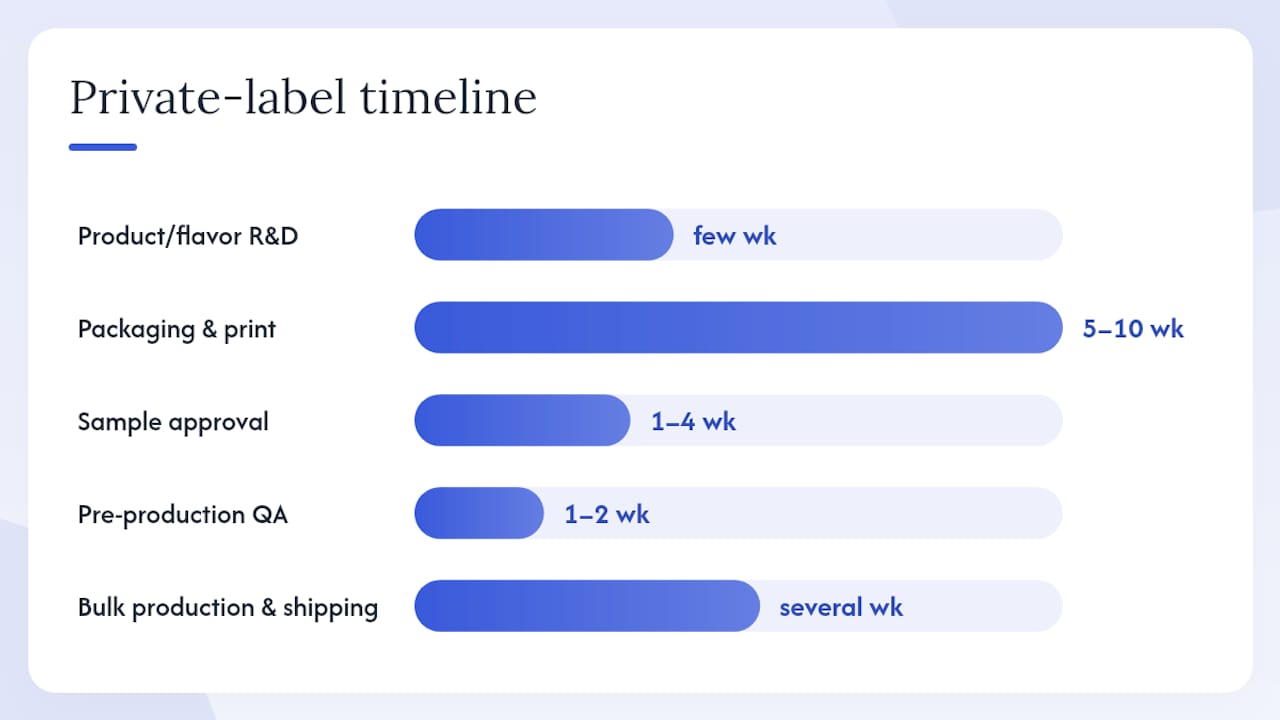
The standard end-to-end flow runs through five stages. Packaging is almost always the critical path, not production.
- Product/flavor selection and R&D: Choose candy types, confirm freeze-dry suitability, and finalize flavor profile; this step typically lasts a few weeks. ODM partners handle recipe development; pure manufacturers expect a finished spec.
- Packaging design and regulatory review (3–6 weeks): Artwork creation, Nutrition Facts panel, allergen declarations, color additive naming, and label compliance check against the FDA Food Labeling Guide.pdf). Print runs add another 2–4 weeks on top.
- Sample approval (1–4 weeks): Physical samples reviewed for taste, texture, and label accuracy. Budget for at least one revision loop.
- Pre-production QA: Incoming material CoAs, allergen controls, and final spec sign-off before bulk run begins; typically requires about one to two weeks.
- Bulk production and shipping: Production and shipping times vary with volume; allow several weeks plus additional time for customs clearance for imported goods.
For a small-volume launch, a realistic minimum timeline from first conversation to product in hand is generally two months or more. Mid-volume custom-print runs often require several additional weeks. If you’re working with a foreign supplier, add time for FDA facility registration and FSVP importer verification. Plan for that early, not after samples are approved.
How do you choose the right manufacturer?
The first decision is ODM versus pure manufacturer. An ODM partner develops the product with you, handles recipe testing, and often manages packaging graphics. A pure manufacturer expects you to arrive with a finished formulation and spec sheet. Knowing which you need determines your budget and timeline before you send a single inquiry.
Checklist for qualifying a partner:
- Holds HACCP, BRCGS, or ISO22000 certification (ask for current certificates, not just a claim)
- Freeze-drying is in-house, not outsourced to a third party
- Has in-house packaging and graphics resources to reduce misbranding risk
- Can show export experience and FSVP-compliant documentation for U.S. imports
- Offers a clear sample policy with defined turnaround times
- Provides batch CoAs covering heavy metals and microbiology
- Has flexible MOQ options, including stock-packaging formats for lower-volume pilots
On the import side, any foreign facility shipping food to the U.S. must be registered with the FDA and designate a U.S. Agent. Confirm that registration before you sign anything. A Customs hold on your first shipment is an expensive lesson.
Pro Tip: Run a small pilot using the manufacturer’s stock packaging before committing to a custom print run. It cuts MOQ, gets product to market faster, and lets you validate sales velocity before you spend on tooling and custom artwork.
What U.S. compliance requirements apply to packaged edible gifts?
Non-negotiable before production starts. Get these confirmed in writing.
Label requirements (per the FDA Food Labeling Guide):
- Nutrition Facts panel with RACC-appropriate serving sizes for candy
- Full allergen declarations, including sesame (added to the major allergen list under FASTER Act)
- Correct color additive naming (e.g., “FD&C Red No. 40,” not a generic “artificial color”)
- Net weight, ingredient list, and manufacturer/distributor name and address
Safety and testing requirements:
- FDA facility registration for all production sites; FSVP responsibility sits with the U.S. importer
- Heavy-metal testing on finished product and incoming ingredients, with CoAs on file
- The FDA’s lead guidance for candy specifically addresses lead levels in candy products and warns against lead-containing inks on packaging wrappers that contact food
- Pasteurization or supplier guarantees for eggs, nuts, and dairy ingredients per the FDA Miscellaneous Food Products Inspection Guide
- Third-party audit reports and microbiology CoAs for each production lot
Statistic callout: The FDA’s lead guidance for candy sets specific action-level thresholds and explicitly flags lead-based inks on candy packaging as a contamination risk. Specify ink restrictions in your packaging contract, not just in conversation.
What packaging formats work for freeze-dried edible gifts?
Two priorities drive every packaging decision: barrier performance to protect the crunch, and gift-appropriate presentation that fits your channel.
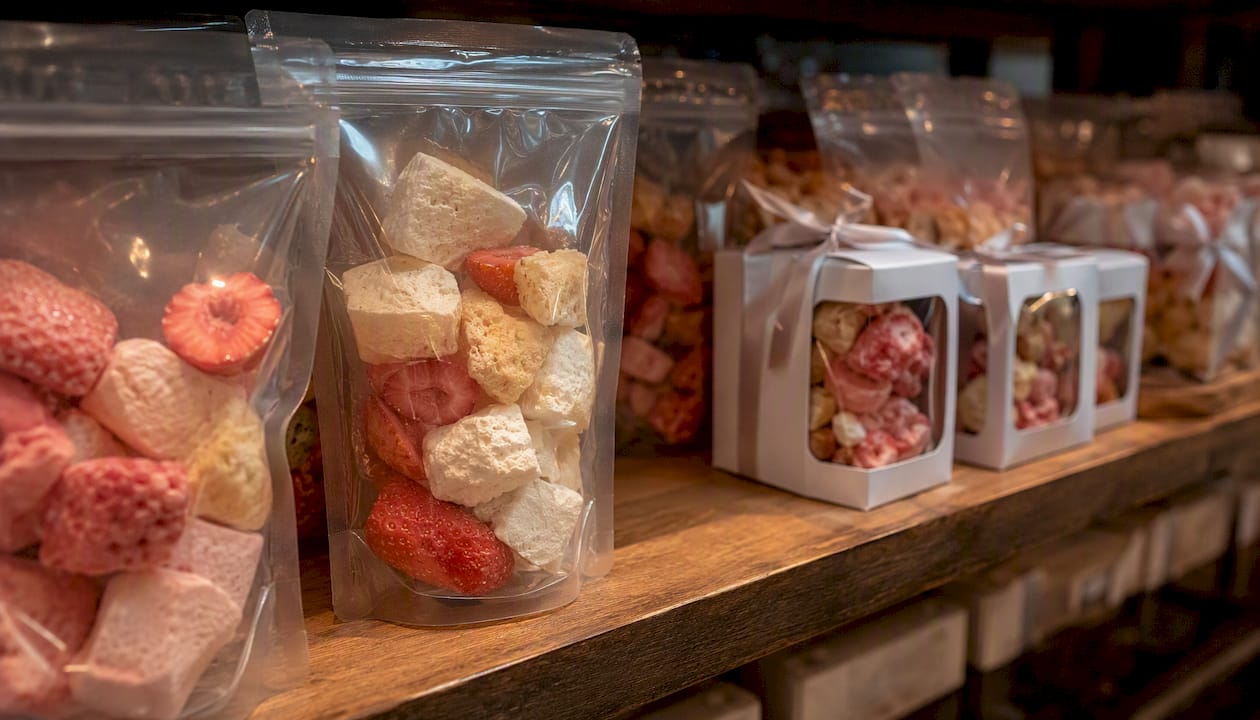
Freeze-dried candy is hygroscopic. Expose it to moisture and it goes from satisfying crunch to sad chew within hours. That means your packaging spec needs to include a low-permeability barrier, not just a pretty bag. Packaging choices also affect shelf life and retail acceptance in ways that show up at the buyer meeting, not just in the lab.
Format options by channel:
- Retail shelf: High-barrier resealable pouches, custom-printed with full label compliance
- Gift sets: Multi-pack bundles in rigid gift boxes with inner barrier bags; premium gift wrapping techniques from adjacent categories translate well here
- Display racks: Pre-filled display kits for impulse placement at checkout or event tables
- Event/corporate gifting: Branded sticker-over-stock-bag options for fast turnaround and lower MOQ
Custom-printed runs increase both MOQ and lead time. Stock packaging with branded stickers gets product to market faster and at lower cost, which is why the pilot approach from the previous section matters so much for retailers adding freeze-dried candy to their assortment.
Pro Tip: Specify target shelf-life performance (e.g., 12 months at ambient conditions) in the contract and require material permeability test results before approving the packaging spec. A supplier who can’t provide that data is a risk.
What QC tests should you require before accepting production?
Require these before any bulk shipment leaves the facility.
- Incoming material CoAs: Heavy metals, allergen controls, and microbiology for key ingredients
- In-process checks: Moisture content and texture verification during freeze-dry cycles
- Finished product testing: Microbial testing (Salmonella for chocolate-coated or nut-containing products), heavy metals, and moisture/permeability checks per the FDA Inspection Guide
- Accelerated shelf-life or stability testing to validate barrier decisions before committing to a packaging format
- Batch CoA, production logs, and corrective-action history retained for traceability
Third-party lab reports carry more weight than supplier self-testing. For high-volume or retail-chain buyers, a third-party audit report from a recognized body (SGS, Intertek, Bureau Veritas) is worth requesting before the first bulk run.
How should you budget for a private-label edible gift launch?
Five cost buckets cover the full picture. Which ones dominate depends on your volume and packaging choices.
- Ingredients and production: The largest variable cost; scales with volume and candy type
- Packaging and print setup: Custom printing adds tooling and plate fees; stock packaging eliminates them
- Testing and certification: CoAs, third-party lab tests, and audit fees; budget these as fixed costs per launch, not per unit
- Freight and duty: Factor in customs clearance time and fees for imported goods; domestic suppliers simplify this considerably
- Marketing and distribution: Launch assets, trade show samples, and slotting fees if you’re going into retail chains
MOQ is often negotiable when you use stock packaging or the manufacturer’s preprinted formats. Custom tooling and full custom printing are the primary drivers of higher MOQ and longer lead times. The practical move is to stage costs: run a stock-pack pilot to prove the SKU, then invest in custom packaging once velocity justifies it.
Pro Tip: Build a 15–20% buffer into your freight and duty estimate. Customs delays and fuel surcharges have a way of showing up at the worst possible moment, usually right before your peak holiday window.
What needs sign-off before bulk production starts?
Production should not start until these are in hand, in writing.
- Approved artwork proof with all label elements confirmed (Nutrition Facts, allergens, color additives, net weight)
- Nutrition and allergen label proof reviewed against the FDA Food Labeling Guide
- Sample CoA covering heavy metals and microbiology
- Packaging permeability test results confirming barrier spec
- Signed QA acceptance form from both parties
- Production schedule with confirmed ship date
- Logistics ETA aligned to your marketing calendar, with buffer for customs
On the calendar side: if your target event is a holiday window (Christmas, Valentine’s Day), count backward from the retail floor date. Add shipping transit time, customs clearance, and a two-week buffer for surprises. Most stockouts during peak promotions trace back to production slots booked too late, not to manufacturing problems.
Retain samples and full traceability documentation for at least one production lot. If a quality issue surfaces after launch, that paperwork is the difference between a fast resolution and a costly recall.
What most brands get wrong about the supply chain
The single most expensive mistake in private-label edible gifts is treating production as something you schedule after marketing is done. By the time the campaign brief is approved, the packaging is designed, and the budget is signed off, the manufacturer’s production slots for the peak season are already full.
Book your production slot before the artwork is finished. Confirm your U.S. Agent registration for any foreign partner before samples are even requested. And require a CoA for every lot, not just the first one. A supplier who provides CoAs only on request is telling you something about their QA culture.
Label reprints are the other silent killer. One wrong allergen declaration or a missing color additive name means a reprint, a delay, and potentially a Customs hold. Retailers with in-house graphics teams and verified label templates avoid this almost entirely. Everyone else learns it the hard way.
Space-man makes private-label freeze-dried gifts straightforward
Space-man is a freeze-dried candy manufacturer and co-packer offering private-label, co-packing, and packaging services for retailers, gift brands, and event planners who want a finished, shelf-ready product without building their own production line.
Services include private-label production, co-packing, packaging design, retail display kits, and starter packs for buyers who want to test market response before committing to a full custom run. The 72-bag retail display kit is a practical starting point for retailers planning floor placement, and the 40-bag starter pack works well for sampling and trade show demos.
To request samples, view starter packs, or discuss a private-label project, visit the Space-man services page and start a conversation.
Useful sources and where to check the rules
- FDA Guidance: Lead in Candy: Action-level thresholds and packaging ink restrictions for candy products
- FDA: How to Start a Food Business: Step-by-step registration and labeling checklist for new food businesses
- FDA Food Facility Registration: U.S. Agent requirements and registration obligations for foreign manufacturers
- FDA Miscellaneous Food Products Inspection Guide: Ingredient treatment expectations and raw material controls for confectionery
- Space-man private-label and co-packing services: Reference pages for production, packaging, and service offerings
Keep CoAs, third-party audit reports, and packaging permeability results in your procurement files for every production lot. If a compliance question arises post-launch, that documentation is your first line of defense.