

TL;DR:
- Green packaging claims must be verifiable and aligned with actual collection and processing infrastructure to avoid legal and environmental issues. Transitioning effectively requires starting with a baseline assessment, right-sizing packaging, and ensuring operational compatibility, not just switching to greener materials. Regulatory laws like SB 54, SB 343, and EU PPWR now hold businesses accountable for genuine sustainability claims, making transparency essential.
Slapping a leaf logo on your box does not make it green. With regulations tightening in 2026 and consumers getting sharper about greenwashing, the gap between packaging that looks sustainable and packaging that is sustainable has never mattered more. Green packaging solutions now carry real legal weight, not just marketing value. California’s SB 54 and SB 343, along with the EU’s PPWR, are holding businesses to a higher standard. This guide cuts through the confusion and gives you a clear, practical path to packaging choices that hold up under scrutiny.
Table of Contents
- Key Takeaways
- Green Packaging Solutions That Actually Work
- Regulations reshaping packaging compliance
- How to transition to greener packaging
- Balancing sustainability with business realities
- My honest take on the green packaging shift
- How Space-man supports your green packaging goals
- FAQ
Key Takeaways
| Point | Details |
|---|---|
| Not all green claims are equal | Regulatory laws now require verifiable proof that packaging is collected, processed, and has an end market. |
| Material choice drives impact | Paper, compostables, and recycle-ready plastics each have distinct trade-offs you need to match to your supply chain. |
| Compliance is no longer optional | California SB 54 and SB 343 expose businesses to private litigation if recyclability claims cannot be substantiated. |
| Start with a baseline assessment | Measuring your current packaging footprint before switching materials prevents costly missteps and wasted spend. |
| Operations must support the switch | Green materials that cannot run on your existing equipment will stall faster than they go green. |
Green Packaging Solutions That Actually Work
Not all environmentally friendly packaging is created equal. Before you can pick the right material, you need to understand what each category actually offers and where it falls short.
Paper-based packaging
Paper remains one of the most accessible environmental packaging solutions available. Nearly 79% of U.S. households have curbside access to paper recycling, and paper can be recycled up to seven times before fiber degradation becomes a problem. The catch is that coatings, adhesives, and inks can compromise repulpability, which is the ability of paper packaging to break down properly during the recycling process. A paper mailer coated with non-repulpable laminate is not actually recyclable in practice, even if it looks like paper.
ECOVA is a strong example of paper-based packaging done right. It uses patented heat-sealable technology that is certified Plastic Free and compatible with existing form-fill-seal (FFS) equipment, so you are not buying new machinery to go green. That combination of verified recyclability and operational compatibility is exactly the standard worth chasing.
Compostable and plant-based options
Mycelium and molded-fiber packaging can break down in roughly 30 to 45 days under proper home-composting conditions. These plant-based packaging alternatives score high on environmental impact but require a realistic composting infrastructure in your customer’s community. If your buyers toss packaging into the regular bin, compostable products end up in landfill where they decompose very slowly, often releasing methane in the process.

Pro Tip: Before committing to compostable packaging products, verify your customer base has access to municipal or home composting. Compostable materials only deliver their environmental benefit when they actually get composted.
Recyclable plastics
Recyclable plastics, often called recycle-ready plastics, are not the same as recycled-content plastics. Recycle-ready means the format is designed to be recyclable. Recycled-content means it already contains recovered material. Amcor’s PP Revolution line, for example, replaces traditional polystyrene with recycle-ready material compatible with current filling technology. This matters because consumer-facing recyclability claims on non-compliant packaging now carry legal risk.
Transport packaging alternatives
In 2026, Hugo Beck and Mondi launched the Paper S sleeve wrapper, which replaces plastic shrink film and excess cardboard in transport packaging using an overlap kraft paper technology. Green shipping solutions at the logistics level are often overlooked, but transport packaging is where significant plastic waste originates. Small changes here can move sustainability metrics meaningfully.
| Material | Recyclability | Compostability | Operational Fit | Cost Range |
|---|---|---|---|---|
| Repulpable paper | High | Low | High (FFS compatible) | Low to mid |
| Molded fiber | Low to moderate | High | Moderate | Mid |
| Mycelium | Low | High | Low | High |
| Recycle-ready plastics | High | None | High | Low to mid |
| Kraft paper sleeves | High | Moderate | High | Low |
Regulations reshaping packaging compliance
Here is where things get serious fast. Regulations are no longer a future concern. They are in effect right now, and the penalties for getting it wrong go beyond a fine.
California’s SB 54 requires 100% recyclable or compostable packaging starting May 1, 2026, along with a 25% reduction in single-use plastic by 2032. Producer responsibility for packaging waste now falls squarely on brands and manufacturers, not just waste facilities. That is a fundamental shift in who is accountable.
SB 343, California’s “Truth in Recycling” law, goes further. Packaging with recyclability claims must meet strict standards for collection, processing, and end-market demand by October 2026. Noncompliance opens the door to private litigation. That means a competitor or consumer group can sue you, not just a regulator. The bar for slapping a “recyclable” label on your packaging just got significantly higher.
Compliance with Truth in Recycling laws requires documented evidence that packaging materials are actually collected, processed by capable facilities, and have a genuine end-market. A sincere belief that your packaging “should be recyclable” is not a legal defense.
Meanwhile, the EU PPWR takes effect in August 2026, mandating packaging designed for recycling at scale. Recyclability performance grades and lifecycle requirements now apply to anything entering the EU market, with obligations increasing through 2038. If any portion of your distribution touches Europe, this is not optional reading.
Key things to audit right now:
- Review every recyclability or compostability claim on your current packaging
- Confirm that your claims align with actual collection and processing infrastructure in your markets
- Document your evidence trail. Material certifications, third-party test results, and facility confirmations all count
- Check whether Extended Producer Responsibility (EPR) fees apply to your packaging category in your operating jurisdictions
- Flag any packaging that carries the chasing-arrows symbol without meeting SB 343’s substantiation standard
Pro Tip: Work with your packaging supplier to get written confirmation that materials meet How2Recycle or equivalent third-party standards. That documentation is your first line of defense if a claim gets challenged.
How to transition to greener packaging
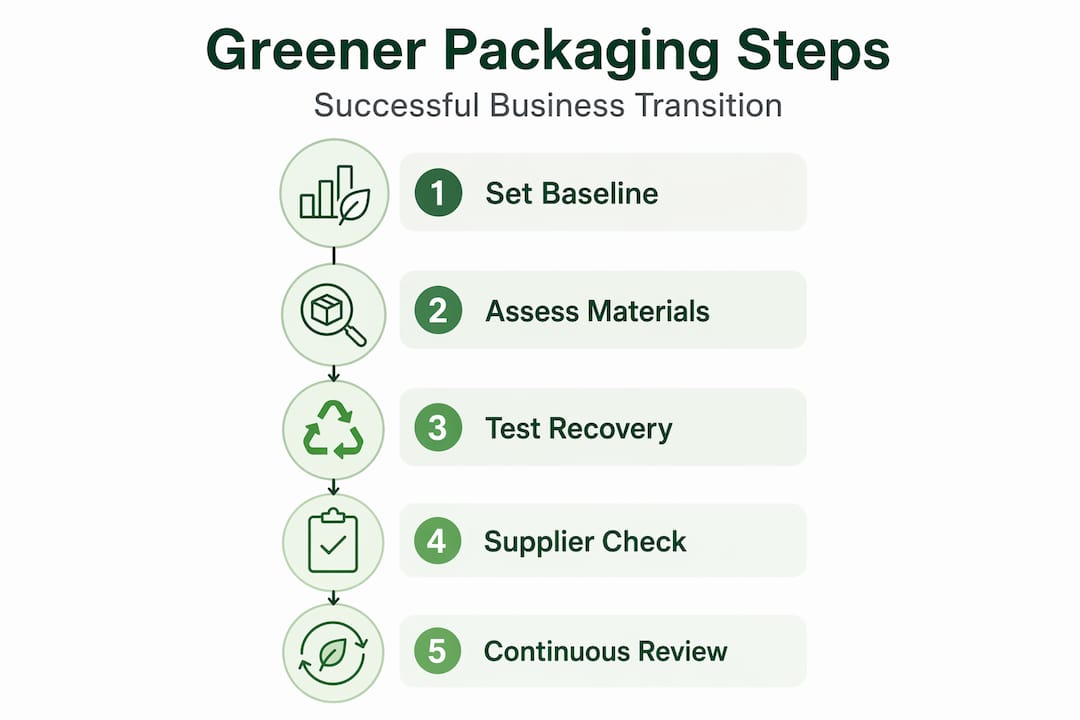
The biggest mistake businesses make when switching to greener options is skipping the baseline. You cannot make smart material choices if you do not know what you are currently using, how much of it, and what happens to it after it leaves your facility.
DHL recommends starting with a packaging baseline assessment, which means cataloging material types, identifying void space, and right-sizing boxes before choosing new materials. Eliminating unnecessary packaging layers is often faster and cheaper than switching materials entirely. It also reduces your shipping volume, which lowers cost and carbon footprint at the same time.
Here is a practical transition checklist:
- Audit your current packaging inventory: list every material, format, and supplier
- Measure void fill ratios and identify where packaging is oversized for product dimensions
- Map which of your packaging claims (if any) could face scrutiny under SB 343 or PPWR
- Research local and regional recycling and composting infrastructure for your primary markets
- Request material certifications from suppliers (How2Recycle, FBA Tier 1, Certified Plastic Free, etc.)
- Run a pilot on one SKU before committing to a full line transition
- Test new materials on your existing equipment before ordering at volume
- Update packaging claims and labels to reflect verified recyclability or compostability
Choosing packaging that fits existing recovery systems is one of the most impactful decisions you can make. A material that is technically compostable but unavailable for collection in 90% of your markets delivers very little real-world benefit. Alignment between your packaging choice and actual local infrastructure is what separates green packaging that performs from green packaging that only looks good in a press release.
For deeper context on how these transitions work in food and consumer goods specifically, the sustainability in food packaging breakdown covers additional material and regulatory considerations worth reviewing.
Balancing sustainability with business realities
Being green matters. Not going out of business also matters. The good news is these goals are not in conflict, as long as you build sustainability choices around your operational realities.
Runnability is a term you will hear from packaging engineers, and it deserves attention. If a new paper-based material cannot run on your existing fill-seal equipment without constant jams or adjustments, you are not saving money or the planet. The operational compatibility of heat-sealable paper with current FFS lines is precisely why solutions like ECOVA matter. You get the environmental benefit without retooling your production floor.
Consider these factors before committing to a new green material:
- Barrier performance: Does the material protect against moisture, oxygen, and light to the standard your product requires? A compostable bag that lets your product go stale in two weeks is not a win.
- Shelf appeal: Consumers associate certain finishes and structures with quality. Test consumer perception before scaling, especially in retail environments.
- Supplier reliability: Green materials from single-source suppliers introduce supply chain risk. Confirm redundancy or backup sourcing before you fully transition a high-volume SKU.
- Certification credibility: Third-party certification programs like How2Recycle carry real consumer trust. Self-declared green claims carry very little.
Pro Tip: Ask potential packaging suppliers for case studies from businesses in your product category specifically. A material that works beautifully for dry goods may underperform with high-moisture or high-fat products.
Emerging solutions worth watching include heat-sealable kraft papers that combine strength, print quality, and recyclability, making them realistic candidates for products that previously required plastic film.
My honest take on the green packaging shift
I’ve watched businesses spend real money on packaging overhauls that delivered more press releases than environmental benefit. What I’ve learned is that chasing the newest, most buzzworthy material often backfires. Mycelium packaging is genuinely exciting. So is mushroom-based foam. But if your production line cannot run it and your customers throw it in the trash, the environmental math does not work.
In my experience, the businesses that make the most meaningful progress start boring. They right-size their boxes. They remove unnecessary inner packaging. They switch to paper tape from plastic tape. These changes are not glamorous, but they are verifiable, immediate, and operationally sound.
What often gets overlooked is consumer behavior. You can design the most compostable packaging in the world, and if the label does not clearly communicate how to dispose of it, most people will just bin it. Disposal instructions are as much a part of your green packaging strategy as the material itself.
The regulations are tightening, and that is actually a good thing. It forces the conversation away from marketing claims and toward operational accountability. My advice is to get ahead of SB 343 and PPWR compliance now. Document everything. And stop calling packaging recyclable unless you can prove it end-to-end.
— Chadi
How Space-man supports your green packaging goals

Making the switch to credible green packaging requires more than picking a new material. It requires a partner who understands both the sustainability requirements and the operational realities of consumer goods packaging. Space-man offers private label and co-packing services built for businesses that need customized, compliant packaging without the headache of managing it from scratch. From material selection to production line compatibility, the team works with you on formats that meet your sustainability targets and hold up under regulatory scrutiny. If you are ready to move from intention to execution, Space-man is set up to help you get there efficiently. Explore what environmentally friendly packaging can look like for your specific products and volume requirements.
FAQ
What is green packaging?
Green packaging refers to packaging designed to minimize environmental impact through recyclable packaging materials, compostable construction, or reduced material use. It is verified through collection and processing infrastructure, not just material claims.
What are the main benefits of sustainable packaging?
The benefits of sustainable packaging include reduced material waste, lower shipping costs through right-sizing, regulatory compliance, and stronger consumer trust. Brands with credible green claims also face lower legal exposure under emerging Truth in Recycling laws.
Is compostable packaging better than recyclable packaging?
Neither is universally better. Compostable packaging requires local composting access to deliver its benefit, while recyclable packaging depends on functioning collection and end-market systems. Choosing packaging that aligns with your customers’ actual disposal options matters more than the material category itself.
How does California SB 343 affect packaging labels?
SB 343 requires businesses to substantiate any recyclability claim with documented evidence that the packaging is collected, processed by capable facilities, and has a verified end-market. Noncompliant labels can trigger private litigation, not just regulatory penalties.
What should I do first when transitioning to green packaging?
Start with a baseline packaging audit. Catalog every material, identify oversized formats, and review existing claims before choosing new materials. This prevents expensive transitions to materials that do not fit your operations or your customers’ local waste infrastructure.