

TL;DR:
- Freeze drying, also known as lyophilization, is a preservation process that removes water from frozen products through sublimation, bypassing the liquid phase. This method significantly extends shelf life, preserves nutrients and flavor, and is used across industries like food, pharmaceuticals, and biotech. Its effectiveness depends on precise control of freezing, vacuum, and drying conditions, and it typically requires higher energy input than dehydration.
Most people assume freeze drying is just a fancy way of saying “frozen food.” It isn’t. The freeze dry definition involves something far more precise: a preservation process called lyophilization, where water is removed from frozen material through sublimation, turning ice directly into vapor without ever passing through a liquid state. This distinction matters enormously for food preservation, product development, and pharmaceutical manufacturing. Understanding how freeze drying actually works, and what it can and can’t do, gives you a serious edge whether you’re a curious home user or a professional scaling a food business.
Table of Contents
- Key Takeaways
- The Freeze Dry Definition: Process Explained
- Why freeze drying produces superior results
- Freeze drying applications across industries
- Challenges and misconceptions worth knowing
- Practical guidance on how to freeze dry well
- My take on freeze drying after years in the business
- Scale your freeze-dried food business with Space-man
- FAQ
Key Takeaways
| Point | Details |
|---|---|
| Freeze drying is sublimation | Water is removed as vapor directly from ice, preserving structure, flavor, and nutrition far better than heat drying. |
| Shelf life is dramatically longer | Properly freeze-dried food stored in sealed packaging can last up to 25 years versus under a year for dehydrated food. |
| Not all foods are ideal candidates | High-fat and high-sugar foods present real processing challenges and require extra care in packaging and storage. |
| Applications span multiple industries | Freeze drying technology is used in food production, pharmaceuticals, and emerging industrial automation sectors. |
| Packaging determines final quality | Freeze-dried products absorb moisture rapidly if not sealed immediately in moisture-proof, oxygen-free containers. |
The Freeze Dry Definition: Process Explained
At its core, the freeze dry definition is this: a dehydration process in which a product is first frozen solid, then subjected to a high vacuum that causes the frozen water to sublimate directly from ice to vapor, bypassing the liquid phase entirely. The scientific term is lyophilization, and it has been used in pharmaceutical and food applications for decades.
Here is how the process unfolds in three distinct phases.
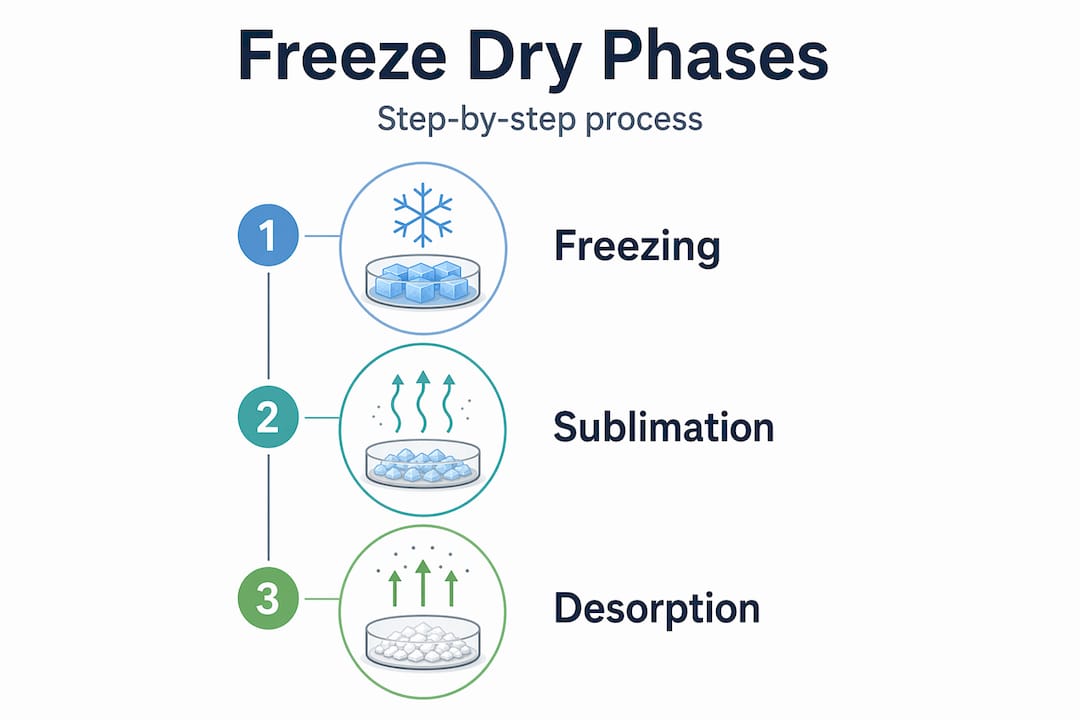
Phase 1: Freezing. The product is cooled to temperatures typically between -30°F and -50°F. Freezing must be thorough and relatively fast to form small, uniform ice crystals that will sublimate cleanly without rupturing cell walls. Slow freezing creates large crystals that can damage texture.
Phase 2: Primary drying (sublimation). The chamber is placed under high vacuum and temperature is carefully raised. The frozen water converts directly to vapor and is pulled out of the product. This phase removes the bulk of moisture. One critical control point here: temperature must stay below the product’s collapse temperature, otherwise the structure melts and degrades irreversibly.
Phase 3: Secondary drying (desorption). Even after sublimation, some water molecules remain chemically bound to the product. Temperature is raised further under vacuum to remove this residual moisture. Insufficient secondary drying shortens shelf life even when the product looks and feels completely dry on the surface.
Pro Tip: Never judge a freeze-dried product as “done” by feel alone. Residual bound water is invisible to the touch but devastating to shelf life.
| Feature | Freeze Drying | Conventional Dehydration |
|---|---|---|
| Water removal rate | Up to 98% | 80–90% |
| Temperature used | Below freezing through sublimation | High heat (120°F–160°F+) |
| Shelf life potential | Up to 25 years | 4 months to 1 year |
| Texture after rehydration | Near-original | Shrunken, leathery |
| Nutrient retention | Very high | Moderate to low |
| Equipment cost | High | Low to moderate |
The table above makes clear why freeze drying occupies a premium tier in preservation. It is not just a matter of removing more water. It is about how that water is removed and what remains when it is gone.
Why freeze drying produces superior results
The benefits of freeze drying go well beyond shelf life numbers. Because the process never exposes food to significant heat, vitamins and phytochemicals are preserved far more completely than in conventional heat drying. Color, aroma, and taste remain remarkably close to the fresh product. That is why freeze-dried strawberries still look red and smell like strawberries, while dehydrated ones often look brown and taste flat.
Here are the core advantages worth knowing:
- Shelf life. Proper storage extends shelf life to 25 years for many foods, far exceeding dehydration’s ceiling of roughly one year.
- Rehydration. The porous structure left behind after sublimation allows water to re-enter quickly and evenly. Freeze-dried food rehydrates in minutes with near-original texture and appearance.
- Minimal shrinkage. Unlike dehydrated products that collapse and shrink dramatically, freeze-dried items retain their original shape and volume.
- No additives required. The process itself is the preservative. No sulfites, no heat treatment, no chemical intervention needed to achieve long shelf stability.
- Pharmaceutical-grade stability. Freeze drying is the go-to method for stabilizing heat-sensitive drugs and vaccines, precisely because it avoids thermal degradation.
Pro Tip: If you are evaluating freeze-dried food for retail or wholesale, rehydration quality is your best quick test. A well-processed product should reconstitute within two to three minutes in room-temperature water and show no mushiness.
The energy cost is the real trade-off. Freeze drying uses significantly more electricity than conventional dehydration because of the vacuum system and the extended cycle times, which typically run 4 to 12 hours depending on product density and moisture content. For premium food products and pharmaceuticals, that cost is justified. For bulk commodity processing where texture is not critical, it may not be.

Freeze drying applications across industries
The freeze dried food definition gets most of the public attention, but the technology reaches much further than your pantry.
- Food industry. Fruits, vegetables, cooked meats, complete meals, herbs, dairy, and specialty products like gourmet mushroom blends all benefit from freeze drying. Nearly any food can be processed this way, though results vary by fat and sugar content. Freeze-dried candy, for instance, has become a booming category because the sublimation process transforms the texture into something genuinely different and crunchy.
- Pharmaceuticals and biologics. Freeze drying is considered critical technology for stabilizing vaccines and heat-labile drugs. Without it, many biologics would have storage windows measured in days rather than years. The FDA actively supports smarter freeze-drying controls in pharmaceutical manufacturing.
- Home and small business use. Countertop and mid-scale freeze dryers are now accessible to small-batch food producers and serious home preservers. If you want to explore freeze drying at home, the learning curve is manageable, though the equipment investment is real.
- Industrial and research sectors. The global freeze drying services market was valued at $577 million in 2025 and is projected to reach $8.47 billion by 2034. AI-driven process controls, continuous manufacturing, and automation are reshaping what freeze drying technology can do at scale.
The food and biopharma sectors are not growing in parallel by accident. Both demand preservation without compromise, and freeze drying delivers that at a level no other method currently matches.
Challenges and misconceptions worth knowing
Freeze drying has a reputation for being nearly magical, which sets up some real disappointments when people encounter its limitations for the first time.
Common pitfalls and realities:
- High fat and high sugar foods are problematic. Fatty or sugary products risk structural collapse or rancidity during drying and storage. Avocado, fatty meats, and heavily sweetened items need extra processing care and shorter storage targets.
- Freeze drying is not freezing. Frozen food still contains all its water. Freeze-dried food has had up to 98% of its water removed. These are fundamentally different states with completely different storage requirements.
- Freeze drying is not dehydrating. Users often confuse the two, but freeze-drying’s sublimation process outperforms dehydration on texture, nutrient retention, and shelf life by a significant margin.
- Packaging failure ruins everything. Freeze-dried products are hygroscopic, meaning they pull moisture from the air aggressively. If not sealed immediately in moisture-proof packaging with oxygen absorbers, quality degrades rapidly, sometimes within hours.
- Energy cost is not trivial. A home freeze dryer running a standard cycle can use as much electricity as a full-size refrigerator running continuously for several days. Budget accordingly.
The process complexity is also worth acknowledging honestly. Getting the drying cycle right requires understanding your specific product’s collapse temperature, its moisture profile, and its rehydration behavior. This is where professional co-packing and manufacturing partnerships earn their value.
Practical guidance on how to freeze dry well
Whether you are exploring how to freeze dry at home or evaluating commercial production, the principles that determine quality are consistent.
- Choose equipment matched to your volume. A home unit handles two to eight trays per batch. Commercial systems scale to hundreds of kilograms per cycle. If you want an overview of home freeze dryer options before committing, that is time well spent.
- Control your freezing speed. Rapid pre-freezing before loading protects cellular structure and improves sublimation efficiency.
- Know your product’s limits. Test runs with small batches reveal texture and structural behavior before committing large quantities.
- Package immediately after the cycle. Time between the dryer opening and final sealing should be measured in minutes, not hours.
- Store in cool, dark conditions. Even perfectly packaged freeze-dried food benefits from stable, low-temperature storage. For detailed guidance on maximizing storage life, the specifics matter.
- Evaluate against alternatives honestly. If budget or texture requirements allow for dehydration, a freeze dryer versus dehydrator comparison will clarify which method actually fits your goals.
My take on freeze drying after years in the business
I have watched a lot of people come into freeze drying expecting a silver bullet and walk away frustrated because they underestimated what the process actually demands. The science is elegant. The execution requires discipline.
What I’ve learned is that freeze drying sits at an intersection of chemistry, engineering, and patience that most how-to articles never fully acknowledge. The collapse temperature concept alone trips up more first-time operators than any equipment malfunction ever could. I’ve seen batches of beautifully prepared product turn into unusable mush simply because primary drying temperature crept two degrees too high.
My honest view on the future of freeze drying technology: AI-driven process controls are going to change things meaningfully. Right now, a lot of the art in commercial freeze drying lives in the operator’s head. When real-time sensors and adaptive algorithms take over cycle management, consistency will improve dramatically, and smaller operators will benefit most.
What I’d push back on is the idea that freeze drying is universally the best choice. For certain products and certain budgets, a well-run dehydration operation is more practical and nearly as effective. The decision should be driven by what your product needs and what your customer will pay for, not by the prestige of the technology.
— Chadi
Scale your freeze-dried food business with Space-man

If you’ve built a solid understanding of freeze drying and you’re thinking about how to turn that knowledge into a real product line, Space-man is set up to help you move fast. As a Canadian freeze-dried candy manufacturer with full private label and co-packing services, Space-man handles production, packaging, and distribution so you can focus on your brand. Whether you need branded packaging, wholesale starter kits, or a retail-ready display solution, the infrastructure is already in place. For businesses ready to enter the freeze-dried candy market without building a production facility, Space-man’s expertise covers the entire chain from processing to shelf.
FAQ
What is the freeze dry definition in simple terms?
Freeze drying is a preservation method that removes water from a frozen product through sublimation, where ice converts directly to vapor under vacuum without passing through a liquid phase. This protects texture, flavor, and nutrients far better than conventional drying methods.
How is freeze drying different from dehydrating?
Freeze drying removes up to 98% of water through sublimation at low temperatures, while dehydration uses heat to evaporate water and typically removes 80 to 90%. Freeze-dried food rehydrates better, lasts longer, and retains more nutritional value.
What foods are not suitable for freeze drying?
High-fat and high-sugar foods present the biggest challenges. Items like avocado, fatty cuts of meat, and heavily sweetened products are prone to structural collapse or rancidity during the drying or storage process.
How long does freeze-dried food last?
When sealed in moisture-proof packaging with oxygen absorbers and stored in cool, stable conditions, freeze-dried food can last up to 25 years. Conventional dehydrated food typically has a shelf life of four months to one year.
What are the main freeze drying applications outside of food?
Pharmaceuticals rely heavily on freeze drying to stabilize heat-sensitive vaccines, antibiotics, and biologics. Research, biotechnology, and industrial sectors also use freeze drying technology for preserving enzymes, cultures, and specialty materials.