

TL;DR:
- Not all eco-friendly packaging performs equally, and choosing the wrong type can increase waste and compliance risks.
- Regulations like the EU PPWR and UK rules coming into effect in 2026 require businesses to meet strict recyclability, recycled content, and reporting standards.
Not all eco-friendly packaging is created equal. That’s the misconception that keeps costing retail and food businesses real money. Switching to what looks green on paper without understanding the actual recovery infrastructure, material science, or regulatory requirements can land you in compliance trouble and, ironically, create more landfill waste. This guide cuts through the noise on eco pack solutions so you can make decisions that hold up under scrutiny, satisfy increasingly informed consumers, and keep you on the right side of 2026’s evolving regulations.
Table of Contents
- Key takeaways
- Eco pack solutions: what the types actually mean
- The 2026 regulatory shift you cannot afford to miss
- Practical strategies to adopt eco pack solutions
- What consumers and the market actually expect
- My honest take on where most businesses go wrong
- Space-man’s packaging services for growing businesses
- FAQ
Key takeaways
| Point | Details |
|---|---|
| Not all eco materials perform equally | Compostable, recyclable, and biodegradable packaging each have specific use cases and infrastructure requirements. |
| 2026 brings binding regulations | The EU PPWR applies from August 2026, with mandatory recyclability grades and recycled content targets businesses must meet. |
| Design simplicity pays off | Switching to mono-material packaging can improve recovery rates by 30 to 50% and reduce compliance fees. |
| Compostable is often the wrong default | Less than 15% of compostable packaging is accepted by industrial composting facilities in many regions. |
| Data centralization is not optional | Managing supplier documentation and packaging data in one place is the fastest way to survive a compliance audit. |
Eco pack solutions: what the types actually mean
The terminology gets slippery fast. “Biodegradable,” “compostable,” “recyclable,” and “reusable” are often used interchangeably in marketing, but they mean very different things operationally. Getting this wrong does not just embarrass your brand. It wastes money and, in some cases, actively harms recycling streams.
Here is a plain-language breakdown of each category and where each one actually makes sense:
- Recyclable packaging is made from materials that can be collected, sorted, and reprocessed in existing curbside or drop-off systems. Think cardboard, aluminum, glass, and certain plastics labeled 1 or 2. This is the most practical default for most retail and food applications because it aligns with how the majority of consumers actually dispose of packaging.
- Biodegradable pack materials break down naturally over time, but “over time” can mean decades without the right conditions. There is no universal certification for this label, which makes it one of the most misused claims in the category.
- Compostable packaging breaks down into nutrient-rich material, but only under specific heat and humidity conditions found in industrial composting facilities. Fewer than 15% of compostable packaging materials are accepted by industrial composting facilities in many regions. If your customer throws it in a green bin that gets sent to a facility not equipped for it, it ends up in landfill, same as conventional plastic.
- Reusable packaging has the lowest per-use environmental footprint over time but requires reverse logistics infrastructure and consumer behavioral change. It works well in closed-loop systems like meal kit delivery or brewery bottle returns.
For most businesses in retail and food, curbside recyclable packaging aligns far better with actual consumer disposal habits than compostable alternatives that require industrial facilities most neighborhoods do not have.
Pro Tip: When reviewing eco-conscious shipping supplies from a supplier, always ask for third-party verification of recyclability claims. “Designed to be recyclable” is not the same as “accepted in standard recycling programs.”
Compostable materials do have a legitimate home. Food-soiled waste, such as greasy pizza boxes or used coffee cups, cannot enter most recycling streams anyway. That is where compostable foodservice items make genuine sense. Outside of those applications, the infrastructure simply is not there yet for compostable packaging to be a reliable sustainability strategy.
The 2026 regulatory shift you cannot afford to miss
If your business sells into European markets or you source from suppliers who do, 2026 is a significant year. The EU Packaging and Packaging Waste Regulation (PPWR) applies from August 12, 2026, requiring all packaging placed on the EU market to meet minimum recyclability standards, restrict harmful substances, and phase in mandatory recycled content requirements.
Here is a snapshot of what the PPWR requires and when:
| Requirement | Target | Deadline |
|---|---|---|
| Minimum recyclability grade | Grade C or higher, 70% of packaging | By 2030 |
| Recycled plastic content (minimum) | 10 to 35% depending on packaging type | By 2030 |
| Recycled plastic content (increased) | 25 to 65% depending on packaging type | By 2040 |
| Transport packaging reuse targets | 70% reuse rate | By 2040 |
For businesses in the UK, a different but equally binding set of rules already applies. UK’s Simpler Recycling requires businesses with 10 or more full-time employees to separate dry recyclables and food waste. Mandatory separation started March 31, 2025, for larger businesses and extends to micro-businesses by March 31, 2027.
The financial risk of ignoring this is specific. Non-compliance with Simpler Recycling can trigger a £118 per hour cost recovery charge from the Environment Agency for any regulatory investigation work tied to your business. The Environment Agency conducts active compliance checks, so this is not a theoretical threat.
Then there is the eco-modulation element of Extended Producer Responsibility (EPR) schemes. Harder-to-recycle packaging, like multi-layer composites or mixed-material films, can attract fees up to three times the standard EPR rate. Missing reporting deadlines can trigger backdated fines and, in some jurisdictions, suspension from markets entirely.
Pro Tip: Map every packaging format your business uses against its EPR category before your next reporting cycle. Identifying one or two hard-to-recycle formats early gives you time to redesign before the financial penalties kick in.
Practical strategies to adopt eco pack solutions
Knowing the rules is one thing. Implementing packaging changes without disrupting your supply chain or blowing your budget requires a methodical approach. Here is a sequence that actually works:
- Audit your current packaging mix. List every material type, weight, and format you use. Categorize each one by recyclability grade, EPR category, and any known compliance gaps. This baseline is your starting point for everything else.
- Engage suppliers for documentation. Many packaging suppliers will not volunteer compliance data unless you ask directly. Request material data sheets, recyclability test results, and recycled content certificates for every item in your catalog. Centralized digital platforms designed for PPWR compliance make managing this documentation far more efficient than spreadsheets.
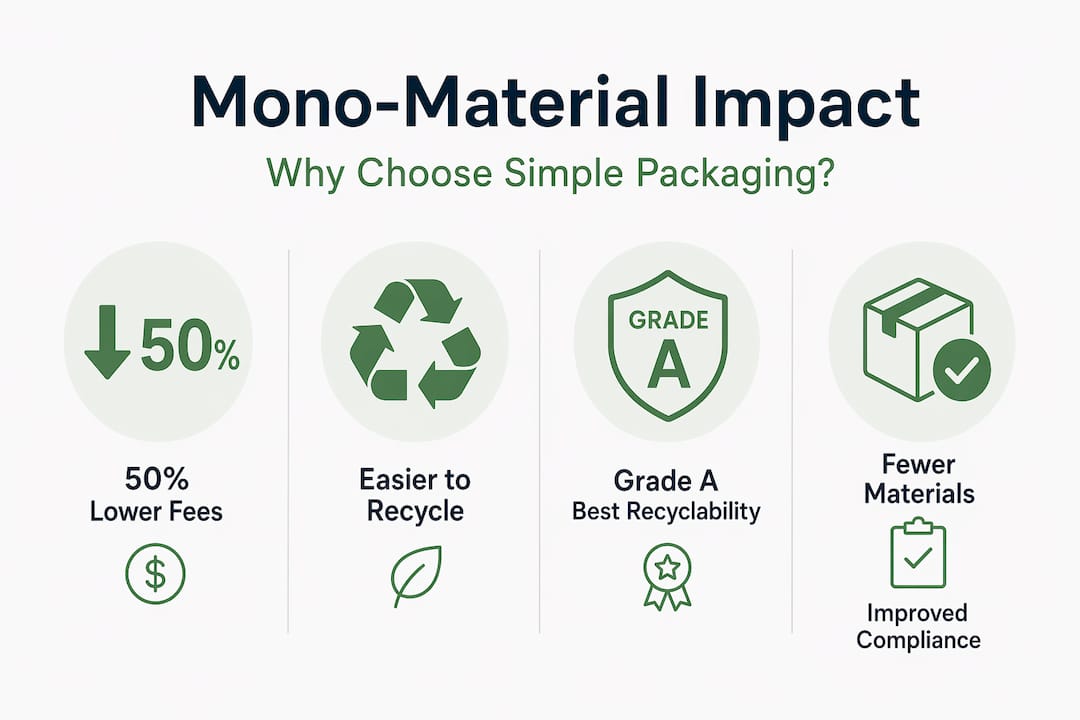
- Prioritize mono-material designs. Switching to mono-material packaging can boost recovery rates by 30 to 50% and meaningfully reduce eco-modulation compliance costs. Multi-layer laminates are increasingly penalized, and the simplification process often reduces material costs too.
- Balance food safety with sustainability. This is where food businesses often get stuck. Some barrier requirements that protect product freshness do conflict with recyclability. Work with your packaging engineer and supplier to find certified alternatives. Recyclable packaging with sufficient moisture or oxygen barriers exists. It may cost slightly more upfront but it is almost always cheaper than EPR penalties.
- Choose verified recyclable over compostable where industrial composting infrastructure is not available in your primary markets. For understanding your full range of environmentally safe packing options, resources on sustainable packaging choices can help you compare certified options side by side.
- Leverage eco-modulation actively. Do not just avoid penalties. Use the EPR fee structure as a design guide. Formats that score well on recyclability grades can actually reduce your annual EPR contributions, making the business case for sustainable packaging redesigns much easier to present internally.
Pro Tip: Ask your EPR compliance consultant to model the fee difference between your current packaging mix and a redesigned mono-material alternative. The cost savings often pay for the redesign within two reporting cycles.
There is also an often-overlooked opportunity in reducing packaging waste through right-sizing. Oversized boxes with excessive void fill inflate your EPR contribution by total weight, so eliminating unnecessary material is simultaneously a sustainability win and a cost reduction.

What consumers and the market actually expect
Consumer expectations around eco pack solutions have matured significantly. It is no longer enough to slap a leaf logo on your box and call it green. Shoppers, particularly in the 25 to 44 age bracket that drives most retail and food e-commerce spending, are getting better at spotting greenwashing. And regulators are cracking down on vague environmental claims with new labeling and substantiation requirements.
The market is shifting toward what actually works within existing recovery systems. Industry leaders now prioritize packaging with verifiable post-consumer recycled content over trend-driven materials that look sustainable but lack the recovery infrastructure to back up the claim.
A few trends shaping buyer and consumer behavior in 2026:
- QR codes on packaging that link to verified sustainability data are gaining adoption. They allow brands to show real-time recycling instructions, material composition, and carbon footprint information without cluttering the physical label.
- Eco-labels with third-party certification carry significantly more weight than brand self-declarations. Certifications like How2Recycle, PEFC, and FSC are increasingly used as purchase decision signals by both B2B buyers and consumers.
- Transparency over perfection. Brands that communicate their packaging improvement roadmap honestly, including what they have not solved yet, build more consumer trust than those who claim full sustainability with no supporting data.
- Eco-conscious packaging for food retail is particularly effective as a differentiation tool in crowded snack and specialty food categories where consumers scan shelves quickly and packaging is a primary communication channel.
The key insight here is that using recycled plastic in packaging is projected to halve plastic waste and reduce new plastic production by 44%, while cutting greenhouse emissions by 17%. That is a claim that comes with real numbers, the kind that resonate in both marketing and procurement conversations.
My honest take on where most businesses go wrong
I have seen a lot of businesses make the same expensive mistake. They come in excited about compostable packaging. It sounds great in a pitch deck, it photographs well for social, and it feels like a genuine commitment to sustainability. The problem is that without confirmed access to industrial composting in their core markets, that packaging is almost certainly going straight to landfill.
What I have found consistently is that the businesses that make real progress on sustainability are not the ones chasing the most impressive-sounding materials. They are the ones who do the unglamorous work first. Auditing what they already use. Simplifying their material mix. Building supplier relationships where documentation actually flows. Designing packaging that fits the recovery systems their customers actually have access to.
The regulatory complexity of PPWR and Simpler Recycling genuinely intimidates people, and I get it. But in my experience, the businesses that centralize their packaging data early, before the audit letters arrive, navigate this far more calmly than those scrambling to pull records together under pressure.
My honest advice? Stop optimizing for what packaging looks like in a press release and start optimizing for what happens to it after the customer throws it away. That is where the real environmental impact is. And increasingly, that is exactly what regulators and consumers are checking.
— Chadi
Space-man’s packaging services for growing businesses
If you are rethinking your packaging mix and need a partner who actually understands the operational side of eco-friendly implementation, Space-man offers more than just freeze dried products.

Space-man provides private label, co-packing, and packaging services specifically designed for retail and food businesses navigating compliance and sustainability demands. Whether you need custom sustainable packaging for a product launch, co-packing support to scale efficiently, or bagging and labeling services that meet 2026 regulatory standards, the Space-man team has the infrastructure to make it happen. Reach out to discuss what your packaging needs look like and how we can help you get there without the guesswork.
FAQ
What are eco pack solutions?
Eco pack solutions are packaging approaches that reduce environmental impact through recyclable, biodegradable, compostable, or reusable materials aligned with existing recovery infrastructure. The most effective solutions match material choice to what consumers can actually recycle or compost in their area.
Is compostable packaging always better than recyclable?
No. Compostable packaging requires industrial composting facilities, which are unavailable in most regions. Recyclable packaging is typically the more practical and impactful choice because it works within standard curbside collection systems that most consumers have access to.
What does the EU PPWR require by 2026?
The EU PPWR, applying from August 12, 2026, requires all packaging on the EU market to achieve a minimum recyclability grade, limit harmful substances, and meet mandatory recycled plastic content minimums of 10 to 35% by 2030, rising to 25 to 65% by 2040.
How can mono-material packaging reduce compliance costs?
Mono-material packaging is easier to recycle and scores higher on recyclability grades used in EPR eco-modulation fee calculations. Switching from multi-layer composites to mono-material designs can improve recovery rates by 30 to 50% and lower annual EPR contributions.
What is the penalty for not complying with UK Simpler Recycling?
Businesses with 10 or more full-time employees that fail to separate dry recyclables and food waste face a £118 per hour cost recovery charge from the UK Environment Agency for any regulatory investigation work tied to non-compliance.