

For most small-to-medium bakeries, the right starting point is a private-label co-packer or a low-MOQ custom online printer that guarantees FDA-compliant materials, food-safe interior inks, and a sample-first proofing workflow. Before placing any bulk order, request a single printed prototype and confirm in writing that all interior surfaces meet FDA food-contact requirements.
Here is a quick shortlist to orient your search:
- Private-label co-packer (e.g., Space-man): Best if you want turnkey packaging with design support, co-packing, and a managed sample workflow. Low friction, food-safe by default.
- Low-MOQ custom online printer (e.g., Stompstickers, Noissue, BoxAndWrap): Best for bakeries that need 50–500 units with full-color branding and fast turnaround. You handle the design file; they print and ship.
- High-volume wholesale printer: Best for established bakeries ordering 1,000+ units per SKU where per-unit cost matters most. Longer lead times and higher tooling costs upfront.
Your immediate next step: order a single structural sample (plain, no print) to confirm dimensions fit your actual product, then order one printed prototype before approving bulk production.
Key Takeaways
The most reliable path to custom baking boxes that are food-safe, on-brand, and production-ready is a sample-first workflow with a supplier who confirms FDA-compliant materials in writing before bulk approval.
| Point | Details |
|---|---|
| Start with a structural sample | Order a plain sample first to confirm dimensions fit your actual product before any print investment. |
| Require FDA food-contact compliance | Get a written statement confirming interior inks and paperboard meet 21 CFR food-contact requirements. |
| Match thickness to product weight | Use 14pt for single cookies and pastries; 18–24pt for medium to large cakes and multi-item assortments. |
| Budget for a printed prototype | A printed prototype ($25–$100) prevents costly bulk errors in color, fit, and finish. |
| Space-man for turnkey packaging | Space-man’s private-label and co-packing services cover design, food-safe materials, and sample coordination in one place. |
Table of Contents
- What do custom baking boxes typically cost and how do suppliers compare?
- How do you choose the right custom baking box for your bakery?
- What food-safe materials and finishes should you require in the U.S.?
- How do you design bakery boxes and get a proof you can trust?
- What does the ordering process look like from start to finish?
- Why should you always test a physical sample before bulk production?
- What box styles and sizes work best for cakes, cupcakes, and pastries?
- What the sample-first approach actually costs you (and what skipping it costs more)
- Space-man’s private-label and co-packing services for bakery packaging
- Sources
What do custom baking boxes typically cost and how do suppliers compare?
Supplier type shapes almost everything: price per unit, minimum order quantity, lead time, and how much design hand-holding you get. The table below maps the three main categories against the dimensions that matter most for a bakery buyer.
| Dimension | Private-label co-packer (Space-man) | Low-MOQ custom online printer | High-volume wholesale printer |
|---|---|---|---|
| Best for | Bakeries wanting turnkey food-safe packaging with co-packing support | Bakeries needing 50–500 branded units fast | High-volume bakeries ordering 1,000+ units per SKU |
| Pricing & MOQ | Quote-based; low MOQ for samples; contact for production minimums | Typically priced per unit at lower minimum order quantities; MOQs generally allow small batches | Lower per-unit price available for large volume orders; tooling fees may apply |
| Materials & thickness | SBS, kraft, recycled paperboard; 14–24pt available | SBS or kraft; 14–18pt standard | SBS, coated paperboard; 14–24pt; custom caliper on request |
| Finishes | Matte/gloss laminate, aqueous coating, spot UV, foil, embossing | Matte/gloss, aqueous coating, window cutouts | Full range: foil, embossing, spot UV, soft-touch laminate |
| Design support | Design consultation, dieline templates, 3D mockup | Online 3D design tool, free dielines, template library | Dielines provided; design services extra |
| Sample availability | Yes, structural and printed samples available | Yes, single-unit samples or sample kits | Sample kits available; fees vary |
| Lead time | Varies by order; confirm at quote stage | 7–15 business days production; add transit | 15–30 business days production; add transit |
| Food-safety / certifications | FDA-compliant materials; food-safe inks on request | Food-safe inks available; confirm per supplier | FDA-compliant available; verify per supplier |
| Sustainability | Recycled content, FSC-certified options | FSC-certified kraft, recycled options at Noissue | FSC options available; verify per supplier |
Many suppliers now offer free online 3D design tools and downloadable dielines, which means you don’t need an in-house designer to get a professional-looking proof before bulk production.
Pro Tip: When comparing MOQ tiers, a supplier that charges $3.00/unit at 100 units but includes a free printed sample is often cheaper total than a supplier at $2.00/unit with a 500-unit minimum and a $75 sample fee. Run the math on total first-order cost, not just unit price.
How do you choose the right custom baking box for your bakery?
Start with four variables: product fragility, order volume, budget, and brand goals. A bakery selling delicate macarons at a farmers market has completely different needs than one shipping tiered wedding cakes across three states.
Match your situation to a supplier type:
- Fragile or irregularly shaped items (tiered cakes, cream-filled pastries) need thicker stock (18–24pt) and structural inserts. A private-label co-packer with food-service packaging experience is the safer call.
- Standard cupcakes, cookies, and brownies in moderate volumes (100–500 units) fit the low-MOQ online printer model well.
- High-volume commodity items (plain pastry boxes, bakery window boxes) are where wholesale pricing pays off.
Packaging also functions as a direct branding and marketing tool — your logo, color palette, and contact information on every box turn each delivery into a repeat-purchase prompt.
Questions to ask every supplier before signing off:
- What paperboard stock and thickness (pt) do you use for this box style?
- Are interior inks water-based or soy-based and food-safe for direct product contact?
- What is your exact MOQ for printed production runs?
- Do you offer a plain structural sample and a printed prototype before bulk?
- What print method do you use (digital, offset, flexo)?
- What proof types do you provide (PDF, dieline overlay, physical sample)?
- What are your production-only lead times, separate from transit?
- Are there tooling or die-cutting charges, and are they one-time or recurring?
- What are your payment terms and deposit requirements?
Red flags that should make you walk away:
- No sample option at any price
- Interior ink certification is vague or missing entirely
- MOQ and turnaround times are not stated in writing
- Evasive answers about food-contact material compliance
- FSC or recycled-content claims with no documentation to back them
When budget is tight and a full custom print run isn’t feasible yet, custom rubber stamps on plain kraft boxes are a legitimate low-cost personalization tactic that many SMB bakeries use to bridge the gap.
What food-safe materials and finishes should you require in the U.S.?
The non-negotiable starting point: require FDA-compliant paperboard and food-safe inks on any surface that may contact your product. The FDA regulates food-contact materials under 21 CFR, and your supplier should be able to provide a written statement confirming compliance. If they can’t, that’s a hard stop.
Paperboard stocks and thickness
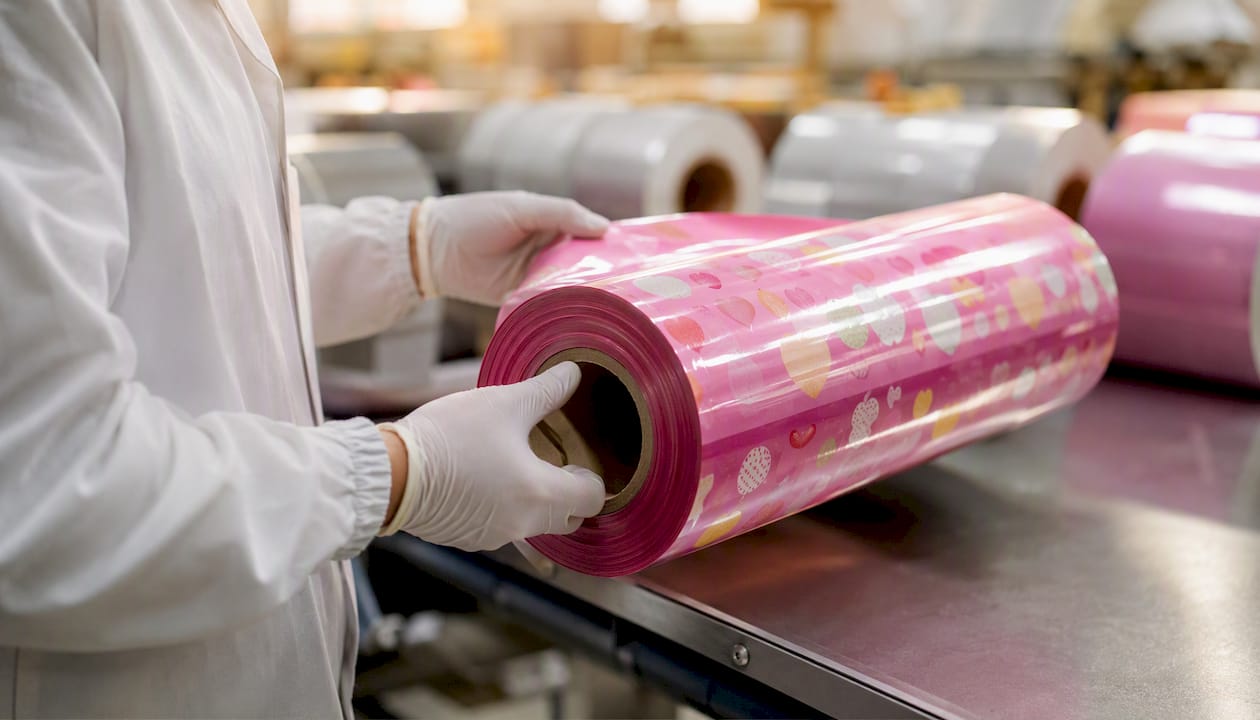
The two most common stocks for bakery boxes are SBS (solid bleached sulfate) and kraft paperboard. SBS gives you a bright white surface ideal for full-color printing. Kraft has a natural brown look that reads as artisan and pairs well with eco-friendly positioning. For recycled content, look for PCW (post-consumer waste) paperboard and ask for FSC certification documentation.
Thickness is measured in points (pt). Here is a practical guide:
Finishes and coatings
Aqueous coatings are water-based, food-safe, and the standard choice for exterior surfaces. They add a light gloss or matte finish and improve moisture resistance. Moisture-resistant coatings are worth specifying for items like cream-filled pastries or anything going into a refrigerated display.
Avoid full-surface interior printing unless you have confirmed in writing that the inks are water-based or soy-based and food-safe. Spot UV, foil stamping, and embossing are exterior-only finishes and should never appear on interior food-contact surfaces. Choosing the right finish depends on whether you’re prioritizing shelf presence or moisture protection — you rarely get both at maximum from a single coating.
For baked goods that need airflow (artisan breads, certain pastries), look for vented or breathable box structures rather than fully sealed designs that trap condensation.
Safety checklist to include in every supplier quote:
- Written food-contact compliance statement (21 CFR reference)
- Interior ink certification (water-based or soy-based, food-safe)
- Lot traceability for paperboard stock
- Physical sample showing interior surface before bulk approval
Pro Tip: Ask for a sample of the interior surface specifically — not just the exterior printed proof. Run a damp paper towel across it. If ink transfers, the coating or ink type is wrong for food contact.
How do you design bakery boxes and get a proof you can trust?
Request dielines and a 3D digital mockup before approving anything for bulk. Digital mockups catch obvious layout problems, but a physical structural sample is what catches dimensional errors — especially for tiered cakes or boxes with inserts. Relying solely on a screen preview has burned more than a few bakeries when the actual box arrived 2cm too narrow for their product.
Design file specs to provide your supplier:
- File format: PDF, AI, or EPS (vector); TIFF at 300 DPI minimum for raster elements
- Color profile: CMYK for standard printing; include Pantone (PMS) codes if brand color accuracy is critical
- Bleed: minimum 0.125 inches beyond the cut line
- Safe area: keep all critical text and logos at least 0.125 inches inside the trim line
- Fonts: outline all fonts before exporting to avoid substitution errors
- Logos: vector format only; no low-resolution JPEGs
Proof types, ranked by reliability:
- Physical structural sample (plain): Confirms dimensions, fold quality, and insert fit with your actual product. Gold standard.
- Printed physical prototype: Confirms color accuracy, registration, and finish. Order this before bulk.
- PDF proof with dieline overlay: Catches layout and bleed errors. Fast and cheap, but tells you nothing about fit or color fidelity on the actual stock.
Many suppliers now offer free 3D design tools online, which lowers the barrier for bakeries without a graphic designer on staff. Cross-industry branding examples from food entrepreneurs are also worth studying for layout inspiration — the principles of logo placement, color contrast, and contact information hierarchy translate directly to bakery box design.
For low-budget personalization before you commit to a full print run, creative food packaging ideas like custom tissue paper, sticker seals, and branded inserts can add brand presence to plain boxes at a fraction of the cost.
What does the ordering process look like from start to finish?
Short answer: plain structural sample first, then printed prototype, then final proof approval, then production order with deposit. Skipping any of those steps is where costly mistakes happen.
- Request a plain structural sample. Confirm dimensions fit your actual product before any print investment. Check lid fit, insert clearances, and base rigidity.
- Submit your design files. Provide print-ready artwork per the supplier’s spec sheet (see design checklist above). Request a PDF proof with dieline overlay.
- Approve the PDF proof. Check bleed, safe areas, text accuracy, and logo placement.
- Order a printed prototype. One unit at full print spec. Confirm color accuracy, finish quality, and interior surface safety.
- Approve the final proof in writing. Email confirmation with the proof version number. This protects you if production deviates.
- Place the production order and pay the deposit. Most suppliers require 50% upfront; confirm terms before signing.
- Confirm production lead time in writing, separate from transit. Add transit time and any holiday-season buffer on top.
Typical timelines to plan around: plain structural samples often ship within 5–10 business days. Printed prototypes typically take 7–15 business days production-only. Full production runs range from 15–30 business days depending on volume and complexity. Supplier-quoted lead times almost always reflect production only — transit adds 3–10 business days domestically, more for overseas production.
If you need expedited production, ask for it explicitly in writing and get a confirmed date, not just “we’ll try to rush it.”
Why should you always test a physical sample before bulk production?
Because a box that looks perfect in a 3D mockup can still be 5mm too short for your actual cake, have a lid that pops open under light pressure, or have an interior coating that smells faintly of solvent. None of those problems show up on a screen.
The three most important tests on any physical sample:
- Fit test: Place your actual product inside. Check clearance on all sides, lid closure under light pressure, and whether inserts or dividers hold items securely without crushing.
- Drop/stack test: Stack two filled boxes and apply moderate downward pressure. Drop a single filled box from counter height (roughly 36 inches). If the base buckles or the lid pops, the stock is too light.
- Interior-ink food-contact check: Wipe the interior surface with a damp cloth. No ink transfer. No chemical smell. If either occurs, reject the sample and request a food-safe ink certification before proceeding.
Full sample checklist:
- Measure all interior dimensions against your product (length, width, height with lid closed)
- Check lid fit: snug but not so tight it requires force to open
- Test insert and divider fit with actual product loaded
- For moist items (cream cakes, fruit tarts): leave a filled box sealed for 2 hours and check for condensation buildup or softening of the base
- For refrigerated items: run a 4-hour refrigeration test and check for moisture absorption and structural integrity
- Check glue strength at all seams under light stress
- Confirm closure security (tuck-end, magnetic, ribbon tie) holds during simulated transport
For multi-item assortment boxes with tray inserts or compartments, test each compartment individually with the heaviest item you plan to pack. A compartment that holds a macaron fine may collapse under a dense brownie.
What box styles and sizes work best for cakes, cupcakes, and pastries?
The bakery packaging market has settled on a handful of reliable structures, each suited to a specific product type.
Cake boxes come in two main constructions: the classic auto-bottom (or crash-lock) base with a separate lid, and the one-piece tuck-top. Auto-bottom boxes assemble faster and hold their shape better under weight, making them the standard for layer cakes. Common sizes run from 6×6×4 inches for a single-layer 6-inch cake up to 14×14×6 inches for large tiered cakes. Cake boxes for events and gifting often use a windowed lid panel and a ribbon closure for presentation.
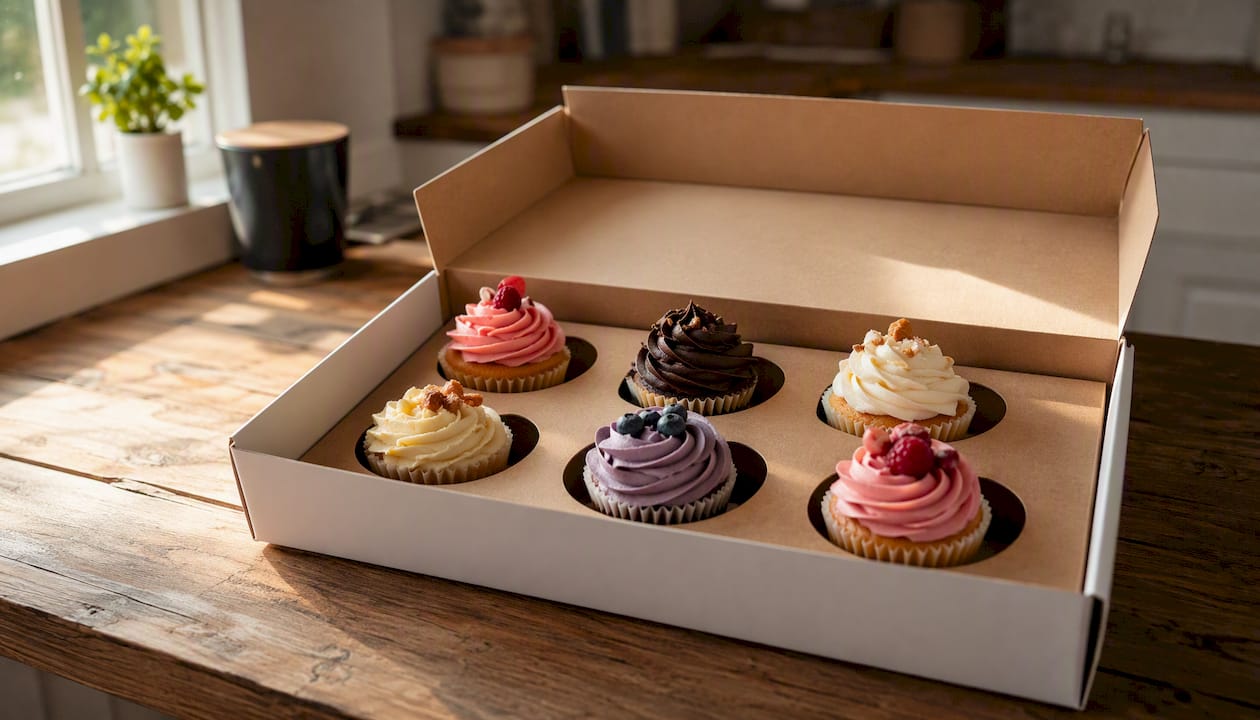
Cupcake boxes almost always include a cardboard or plastic insert with pre-cut circles to hold each cupcake upright. Standard configurations are 1, 2, 4, 6, and 12 count. A 4-count box typically measures around 10×7×4 inches; a 12-count runs closer to 14×10×4 inches. The insert is what prevents the frosting from touching the lid, so always test the insert height against your tallest frosting swirl.
Pastry and bakery window boxes use a clear PET or acetate window panel on the lid or front face, letting the product sell itself. These work well for croissants, danishes, and decorated cookies. Sizes vary widely, but a standard half-dozen cookie box runs roughly 9×6×3 inches.
Bakery gift boxes are typically rigid or semi-rigid, often with a magnetic closure or ribbon, and sized for assortments. These are where premium finishes like foil stamping and soft-touch laminate pay off most visibly.
For fragile items like macarons or decorated sugar cookies, look for boxes with individual cavity inserts rather than a flat base. The insert does the structural work; the box just needs to close cleanly and look good.
What the sample-first approach actually costs you (and what skipping it costs more)
Most bakeries that skip the prototype step do it to save $30–$80 and two weeks. Then they receive 500 boxes that are 3mm too short for their signature layer cake, and the math changes fast. A printed prototype typically costs $25–$100 depending on the supplier and box complexity. That is the cheapest insurance in your production budget.
The private-label co-packer model makes the most sense when you want someone else to manage the food-safety compliance, design coordination, and sample workflow. The low-MOQ online printer model makes sense when you have print-ready files, a clear spec, and a product that fits standard box dimensions. Neither is universally better. The question is how much of the process you want to own.
One thing that gets underestimated: the interior of the box matters as much as the exterior. A beautiful printed exterior with an uncertified interior ink is a liability, not a marketing asset. Always ask for the interior food-contact statement before you approve any proof.
Space-man’s private-label and co-packing services for bakery packaging
Space-man offers private-label, co-packing, and packaging services built around the same food-safe, sample-first workflow this guide recommends. If you want a partner who handles material sourcing, food-contact compliance, and design coordination rather than managing three separate vendors yourself, that’s the practical case for working with Space-man.
The process starts with a quote request where you share your product dimensions, target volume, and branding goals. From there, Space-man coordinates structural samples, printed prototypes, and production with FDA-compliant materials and food-safe inks confirmed at the outset. No guessing about interior ink certification. No chasing three vendors for one order.
To get started, visit the Space-man packaging services page and request a quote with your product specs and target volume.
Sources
The following resources back key technical points in this guide and are worth bookmarking for deeper reference:
- Business branding with stamps: Practical steps for small businesses – Stamp Design 4U
- Examples of Custom Coffee Branding for Entrepreneurs – The Flaming Bean Roastery