

The right snack co-packer is the one that has already made something like your product, has room on its line for your volume, can show you its food-safety paperwork, and will put the terms in writing. Everything else is a detail. At Spaceman we make freeze dried candy in Canada and run private label, co-packing and pouch packaging for dry, shelf-stable foods, so this is the checklist we would hand a friend about to shop for a partner.
TL;DR
- A co-packer makes and/or packages food for you to sell under your name. Some only pack, others handle formulation, production, packaging and labelling.
- Judge them on product fit, capacity, food-safety programs, insurance and references, not on the first quote.
- Ask for a sample and visit the plant before you sign anything.
- Price per unit is only half the story: setup fees, minimums, packaging overage and freight decide your real cost.
- Put quantity, quality, price and timing in a written agreement drafted with a lawyer.
Table of Contents
- What a snack co-packer actually does
- Step 1: Write a one-page brief before you call anyone
- Step 2: Check whether they can handle your product
- Step 3: Inspect the facility and the paperwork
- Step 4: Get labelling responsibility straight
- Step 5: Understand the real cost
- Step 6: Put it in writing
- Step 7: Run a pilot, then keep watching
- Where we fit
- Our perspective
- FAQ
- Sources
What a snack co-packer actually does
According to the Government of Manitoba’s co-packer guide, a co-packer manufactures and packages food for other companies to sell. Some facilities only do packaging, while others help with the whole path of formulation, production, packaging and labelling. Typical services include dry and liquid products, ingredient pre-blends, labelling, and recipe conversion. Most offer a no-cost first consultation, so use it.
Why bother? The same guide frames co-packing as a way to put your money into management and marketing instead of equipment and plant infrastructure. For a candy shop launching its own bagged line, or a distributor adding a house brand, that is the whole appeal: you keep the brand, someone else keeps the machines running.
First decide which of three jobs you need:
- Packing only: you already have the product and need it pouched, sealed and labelled.
- Manufacturing to your recipe: the co-packer produces, then packs.
- Development plus production: you have an idea and need help turning it into something repeatable.
Knowing which one you are shopping for narrows the field fast, because many facilities do only one or two.
Step 1: Write a one-page brief before you call anyone
Co-packers deliver to a specification. Alberta’s guide makes the point that if you do not develop and understand your spec, you are relying on someone else’s standards. So write it down first: ingredients, pack sizes, pouch or container type, target shelf life, allergens, and how many units you expect to sell in the first year.
That last number matters more than people think. The University of Arkansas extension guide notes that smaller co-packers are often the better choice for startups, because big plants set minimum batch sizes that can exceed a new brand’s first-year sales. It also suggests having samples in alternate sizes or containers ready for stability testing, and checking that the co-packer can process them.
The Oregon Department of Agriculture goes a step further and recommends turning the brief into a written request for proposal: company profile, certification and food-safety requirements, ingredient and packaging lists with suppliers, forecasts, process flow, storage and shipping needs, insurance requirements and the KPIs you will track. Send the same document to every candidate and the proposals become comparable.
Step 2: Check whether they can handle your product
Perennia, Atlantic Canada’s agri-food development organization, publishes a co-packer evaluation checklist. Its fit questions are simple and worth copying:
- Do they make a similar product already?
- Do they have temporary or ongoing spare capacity?
- Do they have the food-grade equipment your product needs?
- Is production automated or manual?
- What other services do they offer?
One trap: a recipe that works in a small kitchen batch may need adjusting at volume or to suit the plant’s equipment, as Manitoba’s guide warns. A co-packer with experience in your product category spots that early. For dry goods such as candy, chocolate bites, nuts, granola, trail mix, coffee beans or spices, look for a plant whose pouching line is built for exactly those formats. Packaging is where many snack launches stumble, so ask to see the pouches they run, not a slide about them.
If you are also comparing containers and storage formats for bulk dry goods while you scope the project, a look at transparent food storage containers for grains can help you picture how dry ingredients are held before packing.
Step 3: Inspect the facility and the paperwork
Perennia’s list of questions for the plant is the best short audit we know of. Ask:
- Does the facility meet government requirements, and which food-safety or quality programs and certifications does it hold?
- Does it keep written GMP (good manufacturing practice) records, monitor critical control points, and have an allergen control plan?
- Is any service or storage subcontracted, and how is that controlled?
- Has it had a recall in the last five years?
- Does it carry $5M commercial general liability insurance including product liability?
Then go see it. A site visit shows condition and cleanliness, staff training and food-safety controls, and can reveal hazards a co-packer has not declared. Manitoba also advises asking for references and having them make a sample before you sign a manufacturing contract.
If certifications are new to you, our guide to snack food certifications in Canada explains the common ones, and our food safety in candy manufacturing piece covers the compliance side.
Step 4: Get labelling responsibility straight
Using a co-packer does not move the legal responsibility off your shoulders. Three Canadian points to settle in writing:
Who is named on the pack. A CFIA question report published by the AFPA (November 2024) confirms that prepackaged foods must show the name and principal place of business of whoever manufactured, packaged or labelled the food, or the person it was done for. A small company using a co-packer can use “prepared for” wording, and the principal place of business should be the company that takes legal ownership in a complaint or recall.
Truthful labels. The Safe Food for Canadians Regulations prohibit labelling that is false, misleading or deceptive, including net-quantity claims, with tolerances in Schedule 4. Ask how the co-packer verifies fill weights.
Front-of-package nutrition symbol. Health Canada’s labelling guide says the transition period ended December 31, 2025, so from January 1, 2026 regulated parties must comply, though stock made or packaged before that date can stay on shelves. The symbol is triggered at 15% of daily value generally, and 10% for foods with a reference amount of 30 g or 30 mL or less. Whoever designs your label needs to check your product against those thresholds.
For more, see our guides on food labelling in Canada and candy packaging regulations.
Step 5: Understand the real cost
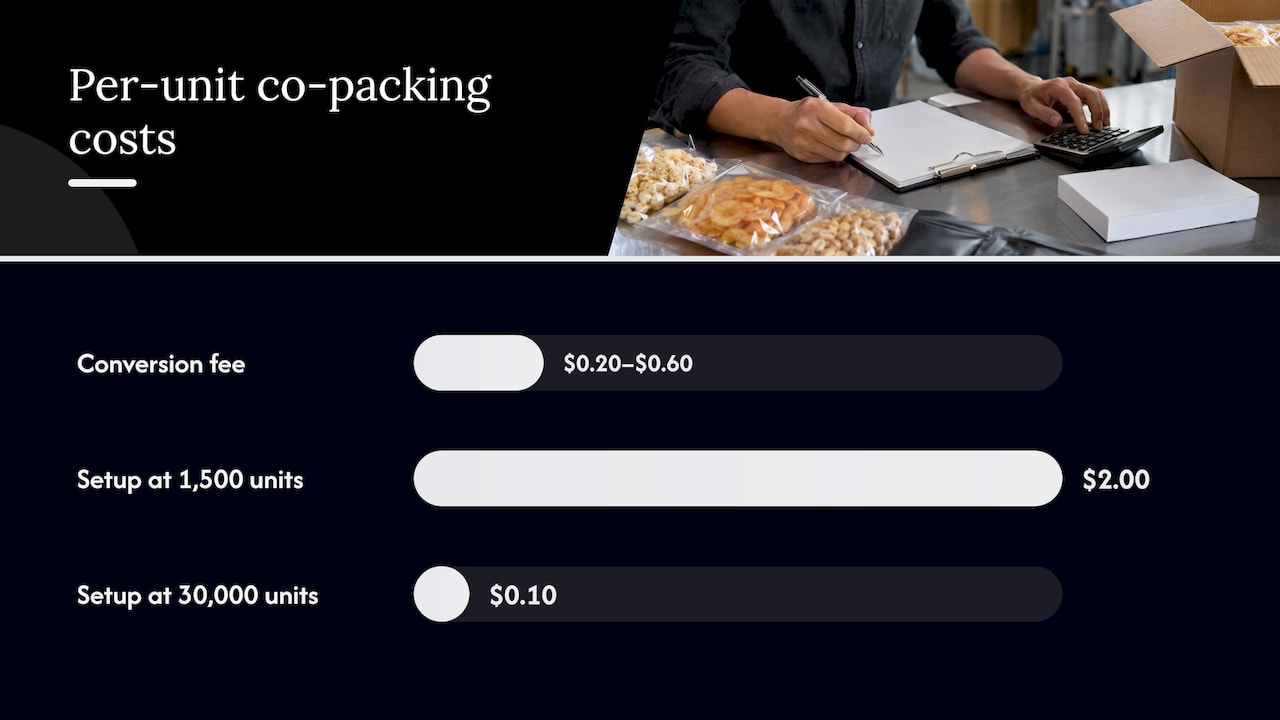
Quotes look friendlier than invoices. One recent cost guide for first-time co-packer users (October 2026) puts first-run conversion fees for a simple shelf-stable product at roughly $0.20 to $0.60 per unit, plus a setup charge near $2,000 per run, with a 30% to 50% deposit at booking. It reports minimums commonly between 5,000 and 50,000 units per SKU, with specialty small-batch operators accepting 500 to 3,000 units at higher unit prices. Treat those as ballpark figures from one source, not a price list, and get your own quotes.
The useful lesson is how to compare. Ask every candidate to quote at the run size you will really order, because a fixed setup fee behaves very differently at different volumes:
| Setup fee | Run size | Setup cost per unit |
|---|---|---|
| $3,000 | 1,500 units | $2.00 |
| $3,000 | 30,000 units | $0.10 |
Also ask about the costs that show up after the quote: packaging overage (line losses, so ask the percentage), leftover materials from supplier minimums, per-unit fee creep and separate freight. Plan on around three months from order to shelf once label printing, the run and shipping are stacked.
And settle who buys ingredients. The Arkansas authors note that co-packers who source ingredients themselves are often cheaper because they buy in bulk, but that also means you must agree up front on ingredient quality and brands.
Step 6: Put it in writing
Alberta’s guide lists five core elements for a co-packing contract:
- The parties (companies, not individuals).
- The quantity to be produced.
- The quality, including recipe and required ingredient brands.
- The price, per unit or per hour, with payment deadlines and method.
- The periods in which the work must be completed.
Add insurance. Manitoba advises getting a certificate of insurance, being named as an additional insured, confirming your packaging and product are covered while in the co-packer’s care, and having a lawyer draft the agreement. The same guide recommends advice from an accountant and an insurer. One more point from SecureCPG’s liability analysis: a co-packer’s liability policy generally covers its own facility and negligence, not your recall costs, so talk to your insurer about recall coverage and a vendor liability rider before you sign.
Alberta also lists the realities to plan for: less control over the product, dependence on the co-packer’s schedule, limits set by their equipment, possible competing products in the same plant, and confidentiality, since you share formulas, volumes and pricing. A confidentiality clause is your friend.
Step 7: Run a pilot, then keep watching
The Oregon guidance is worth following to the letter: attend the pilot run and the first commercial run, ask for a production report after each (material usage, quality and food-safety test results, units produced), hold a regular monthly check-in, and visit at least once a year to review your KPIs. Good co-packing is a relationship, not a vending machine.
Where we fit
If your product is a dry, shelf-stable food, this is our home turf. Spaceman is a Canadian freeze dried candy maker, and our core focus is contract manufacturing, bulk freeze drying and pouch packaging for dry goods such as nuts, seeds, candy, chocolate bites, protein bites, granola, trail mix, coffee beans, legumes and spices. Our products are manufactured in Canada with attention to food safety and compliance with Canadian regulations.
We offer dry food co-packing, pouch packaging, commercial freeze drying, confectionery and chocolate, private label and food manufacturing on one services page. Pricing is not published, so tell us your product, pack format and expected volumes and we will take it from there.
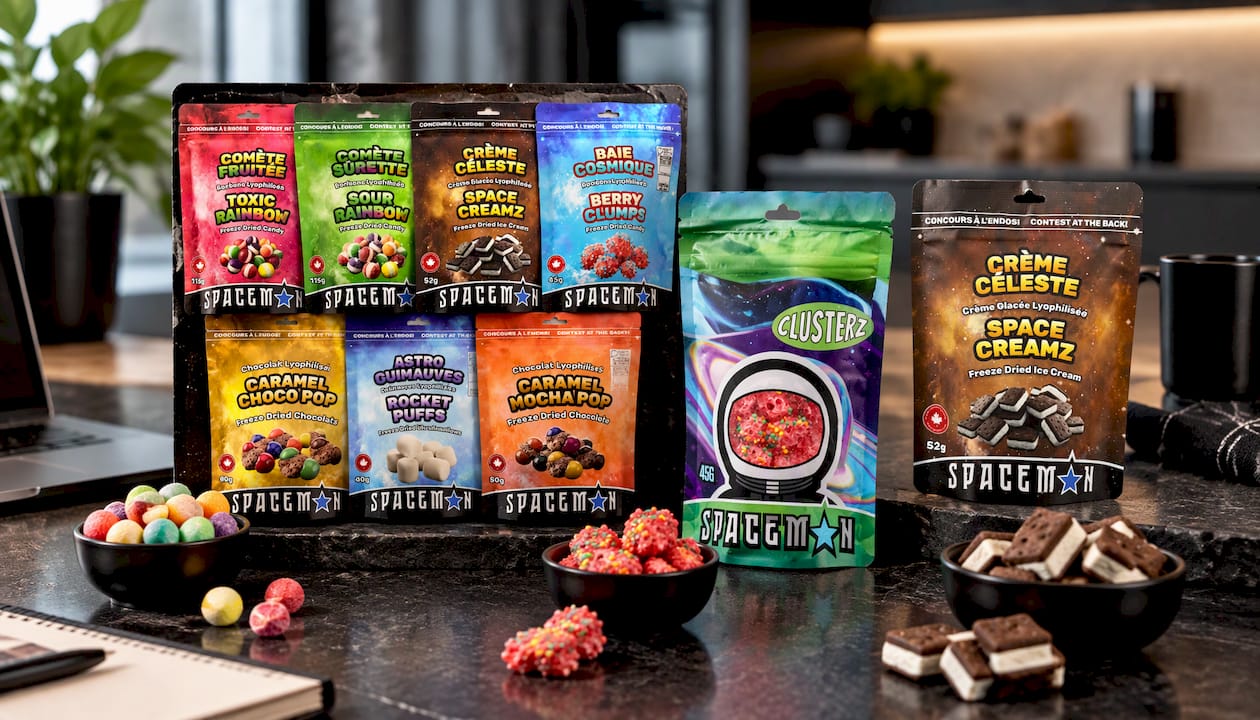
Want to taste our work first? Browse our freeze dried candy and treats. For a broader primer, our article on co-packing in Canada for entrepreneurs is a good next read.
Our perspective
Most launches that go sideways did not fail on flavour. They failed on a vague brief and a handshake. We would rather you arrive with a clear spec, a realistic first-run size and a list of tough questions, because that is the customer we can serve best.
Dry, shelf-stable foods reward a specialist. When one team handles freeze drying, pouching and packaging for dry goods, your product has fewer hand-offs and fewer places to get lost on its way to the shelf. That is why we built our contract manufacturing around it.
And yes, a co-packer should be a little bit nerdy about pouches. Ours are.
Chadi
FAQ
What is the difference between a co-packer and a private label supplier?
A co-packer makes or packs a product to your specification and you own the recipe and brand. Private label usually means putting your brand on a product the supplier already makes. Many Canadian facilities, including ours, offer both.
Do I need a visit before choosing a co-packer?
Yes. A site visit shows cleanliness, staff training, equipment and food-safety controls, and it can surface hazards that were not mentioned in the sales conversation. Ask for a sample first, as Manitoba’s guide suggests.
How many units do I need for a first run?
It depends on the plant. One 2026 cost guide reports minimums of 5,000 to 50,000 units per SKU at typical co-packers and 500 to 3,000 at small-batch specialists. Smaller operators often suit a new brand better.
Who is responsible if something goes wrong with the product?
The company named on the label that takes legal ownership is the contact for complaints and recalls, so your contract and insurance need to reflect that. Have a lawyer and your insurer review both before you sign.
Sources
- Using a Co-Packer, Government of Manitoba
- Choosing and Using a Co-Packer, University of Arkansas
- Expert article on co-packers, Oregon Department of Agriculture
- Co-packer evaluation checklist, Perennia
- CFIA questions and answers, AFPA
- Safe Food for Canadians Regulations
- Front-of-package nutrition symbol labelling guide, Health Canada
- Using a Co-Packer for the First Time: What It Costs
- Co-packer risk: who’s liable