

TL;DR:
- Canadian freeze-dried candy makers can enter the U.S. market faster by registering with the FDA and ensuring label compliance. Private labeling and co-packing reduce risks while establishing retail-ready packaging formats are crucial for U.S. shelf entry. Working with experienced customs brokers and testing production at scale help overcome regulatory and quality hurdles efficiently.
Yes, a Canadian freeze-dried candy maker can sell into the U.S. market, and the path is more straightforward than most people expect. The fastest compliant route: register your facility with the FDA, get your nutrition and allergen labeling U.S.-ready, and pair a licensed customs broker with either a U.S. 3PL or a cross-border e-commerce setup. That’s your minimum viable export stack. Private-label and co-packing arrangements cut the capital risk further, letting you test U.S. demand before committing to full production runs. The upside is real, and the regulatory lift is manageable if you tackle it in the right order.
Table of Contents
- Is your candy shoppe Canada operation ready to export?
- What U.S. regulations actually require before you export
- Private label, co-packing, and packaging formats that work
- Cross-border shipping and fulfillment options
- Where to sell in the U.S. and how to price it
- How to vet a co-packer or private-label partner
- Realistic timeline from first sample to U.S. shelf
- Key Takeaways
- What the export plan gets wrong (and what actually matters)
- Space-man makes the Canada-to-U.S. launch faster
- Useful sources and further reading
Is your candy shoppe Canada operation ready to export?
Run through this before you spend a dollar on U.S. marketing:
- FDA facility registration completed (free, done online at FDA.gov)
- Nutrition Facts panel formatted to U.S. FDA specs (not Health Canada’s)
- Allergen declaration uses U.S. “Contains:” format (FALCPA-compliant)
- English-only labeling confirmed for all retail-facing packaging
- Licensed customs broker identified and briefed on your HTS codes
- Commercial invoice template ready with country of origin, unit values, and HS codes
- USD price sheet prepared with landed-cost estimates baked in
- MOQs and lead times confirmed with your co-packer or internal production team
- Business insurance covers cross-border commercial shipments
- EDI or order management system can handle U.S. buyer purchase orders
Pro Tip: File FDA Prior Notice before every single shipment, not just the first one. Skipping it on a reorder is the most common reason Canadian food products get held at the border. Set a calendar reminder tied to your ship date.
What U.S. regulations actually require before you export
These steps are non-negotiable. No U.S. retailer or distributor will accept your product without them, and CBP (U.S. Customs and Border Protection) can refuse entry if any are missing.
FDA facility registration is the starting point. Any facility that manufactures, processes, packs, or holds food for U.S. consumption must register under the Bioterrorism Act. Registration is free and renews every two years during the October–December window.
Labeling is where most Canadian exporters trip up. The U.S. Nutrition Facts panel has different serving-size rules, different daily value percentages, and a mandatory “Added Sugars” line that Health Canada’s format does not require. Your ingredient list must follow U.S. descending-weight order, and allergens must appear in a “Contains:” statement or be parenthetically declared inline. Every label must be in English; bilingual is fine, but English cannot be subordinate.
Customs mechanics require a licensed customs broker who knows food imports. You’ll need a complete commercial invoice (unit price, total value, country of origin, HTS code), a packing list, and FDA Prior Notice filed through the FDA’s Prior Notice System Interface (PNSI) before the shipment arrives at the U.S. port of entry. Duties on most confectionery from Canada are low or zero under CUSMA/USMCA, but your broker will confirm the exact rate for your HTS code.
Pro Tip: Ask your label designer to run a mock panel through FDA’s nutrition label formatting guidelines before printing. A serving-size mismatch between your panel and your net-weight declaration is the single most common labeling rejection at U.S. retail.
Private label, co-packing, and packaging formats that work
Private label and co-packing are often the fastest routes to U.S. shelf presence because they let you move product under a buyer’s brand without building a second production line. For freeze-dried candy specifically, the format decisions matter as much as the product itself.
Packaging formats that move in U.S. retail:
- Resealable flat-bottom pouches with a clear window (barrier film with oxygen scavenger for shelf-life protection)
- Small multi-bag starter packs (4–6 units) for impulse and gifting sections
- Counter display rack kits pre-loaded with bags, ready for immediate retail placement
Freeze-dried candy is moisture-sensitive, so barrier film selection is critical. Look for packaging with an oxygen transmission rate (OTR) suited to a 12-month shelf life. Tamper-evident seals are increasingly expected by U.S. retail buyers. For flexible packaging specs, barrier film solutions designed for moisture-sensitive products translate well to freeze-dried confectionery.
Typical co-pack minimum order quantities for specialty candy start at a few hundred units per SKU for a first run, with lead times often spanning several weeks once artwork is approved. A pilot private-label run at the lower MOQ lets you test one U.S. channel before scaling.
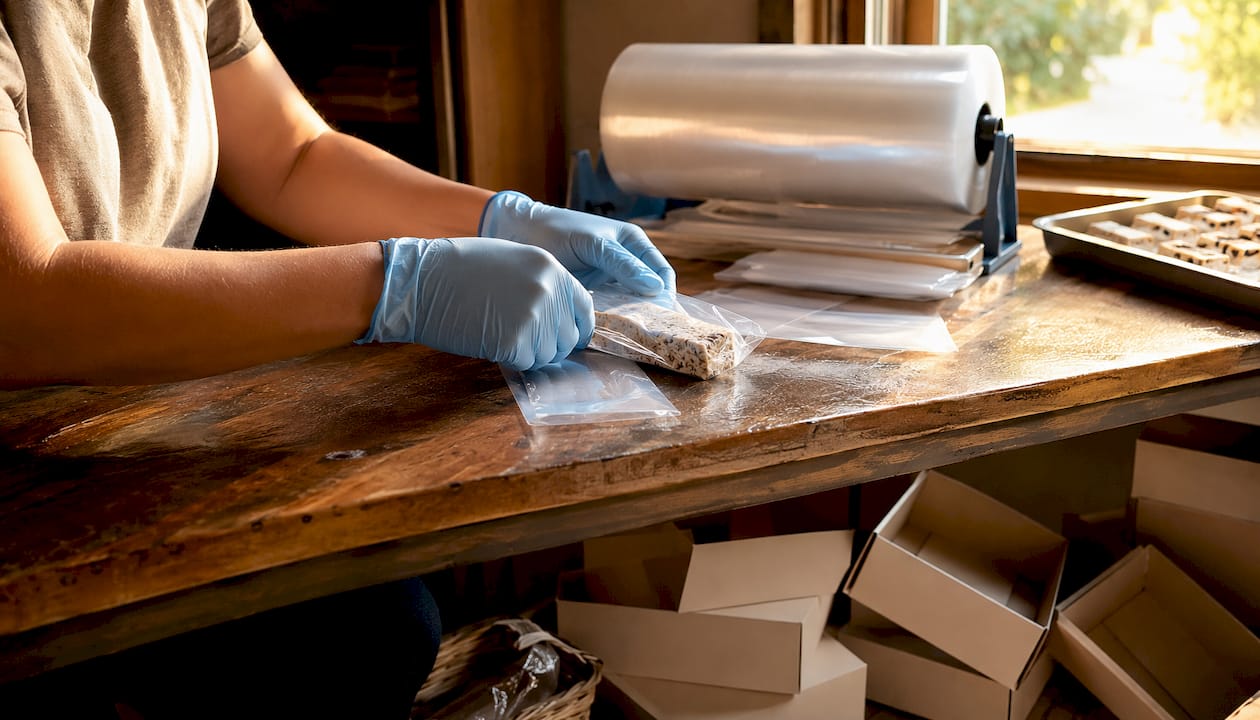
Pro Tip: Structure your pilot run around one SKU in one channel. A single 500-unit private-label bag in a regional gift shop tells you more about U.S. demand than a spreadsheet model ever will.
Cross-border shipping and fulfillment options
Use a licensed customs broker and either a U.S. 3PL or CBP pre-clearance to avoid delays. Those two elements together eliminate most of the friction that stalls first-time Canadian food exporters.
Three practical fulfillment flows:
- Direct cross-border DTC: Ship individual orders from Canada via Canada Post Tracked Packet USA or UPS/FedEx cross-border. Fastest to launch, highest per-unit shipping cost, and customs clearance happens per-shipment.
- Bulk LTL to a U.S. 3PL: Ship a pallet or LTL load to a U.S. fulfillment center, clear customs once, and let the 3PL handle domestic pick-and-pack. Lower per-unit cost at volume, 2–5 business days to U.S. customers.
- Bonded warehouse entry: Defer duty payment until product is withdrawn for sale. Useful if you’re building inventory ahead of a retail launch and want to manage cash flow.
Transit times from Southern Ontario to a Midwest U.S. 3PL typically run 2–3 business days by LTL. West Coast delivery adds 1–2 days. Temperature isn’t a concern for freeze-dried candy the way it is for chocolate, but humidity exposure during transit can degrade product if packaging isn’t sealed properly.
Documentation checklist for every shipment: commercial invoice, packing list, bill of lading, FDA Prior Notice confirmation number, and CUSMA certificate of origin (if claiming preferential duty treatment).
Where to sell in the U.S. and how to price it
Choose your channel before you build your price sheet. DTC e-commerce and corporate gifting tolerate a higher per-unit landed cost; retail wholesale does not.
Go-to-market channels for freeze-dried candy:
- DTC e-commerce: Highest margin per unit, but customer acquisition costs are real. Works well for branded SKUs with a strong social presence.
- Specialty retail and gift shops: Easier buyer conversations than grocery. Display rack kits (pre-loaded, ready to place) are a strong door-opener.
- Corporate gifting: Branded customization, logo packaging, and bespoke assortments command premium pricing and generate repeatable orders. Candy margin strategies for corporate channels are worth modeling separately from retail.
- Event catering and wholesale: Lower per-unit margin but higher volume; useful for smoothing seasonal peaks.
Sample landed-cost build (per bag, illustrative):
Invoice in USD. Build a 3–5% FX buffer into your price sheet and review it quarterly. Net-30 is standard for U.S. wholesale buyers; DTC is payment-at-checkout.
How to vet a co-packer or private-label partner
Focus on three must-have proofs: regulatory compliance records (HACCP documentation or GFSI/BRC certification), demonstrated freeze-dried handling experience, and consistent lead-time performance.
Questions to ask every candidate:
- Can you provide your current FDA facility registration number?
- Do you have HACCP or GFSI/BRC certification? Can I see the most recent audit?
- What’s your experience with freeze-dried products specifically?
- What are your MOQs, and what’s your average lead time from artwork approval to ship?
- How do you handle a product recall, and who carries liability?
- Can you provide traceability records to raw-material lot level?
Red flags that disqualify a partner: no FDA registration, inability to share QC audit results, vague answers about temperature and humidity handling during production, and no written recall procedure. For a deeper supplier selection framework, the criteria translate directly to co-packer vetting.
Pro Tip: Request a small trial run before signing any volume commitment. A 200-unit test batch with full QC documentation tells you more about a partner’s reliability than any sales call.
Realistic timeline from first sample to U.S. shelf
A practical timeline to first U.S. sale can generally fall within a few months if regulatory work and co-packer selection run concurrently.
| Milestone | Estimated Duration |
|---|---|
| FDA facility registration | 1–2 weeks |
| Label design and U.S. compliance review | 2–3 weeks |
| Packaging film approval / tooling | 1–2 weeks |
| Co-pack production run | 3–5 weeks |
| Customs clearance and transit to 3PL | 1–2 weeks |
| 3PL onboarding and inventory receiving | 1 week |
| Total (parallel tasks) | 8–14 weeks |
Starting a specialty candy operation from scratch carries real capital requirements. Renovation and equipment costs for converting a production space can run into significant upfront investment, which is one reason co-packing is attractive for market-entry: you’re paying for capacity, not building it.
Key Takeaways
A Canadian freeze-dried candy maker can reach U.S. retail in 8–14 weeks by running FDA registration, label compliance, and co-packer selection simultaneously.
| Point | Details |
|---|---|
| FDA registration first | Register your facility at FDA.gov before any other step — it unlocks everything downstream. |
| Label compliance is the bottleneck | U.S. Nutrition Facts panel and FALCPA allergen format differ from Health Canada’s; fix this early. |
| Co-packing cuts entry risk | Pilot runs at a minimum of 500 units let you test U.S. demand before committing to full production. |
| Customs broker is non-negotiable | File FDA Prior Notice on every shipment and pair your broker with a U.S. 3PL for smooth delivery. |
| Space-man as your launch partner | Space-man offers private-label runs, co-packing, and retail display kits built for freeze-dried candy. |
What the export plan gets wrong (and what actually matters)
Most export guides treat compliance as the hard part. It isn’t. The FDA registration is a form. The label is a design project. The customs broker is a phone call. What actually slows Canadian freeze-dried candy makers down is production consistency at scale.
Freeze-drying is unforgiving. A batch that works perfectly at 50 units can fail texture and moisture specs at 500 units if the cycle parameters aren’t locked. Before you commit to a U.S. buyer’s purchase order, run your production process at the volume you’re promising, not the volume you tested at. Staff training and repeated trial runs are the real timeline risk, not paperwork.
The second underestimated cost is packaging. Barrier film that works for Canadian retail may not meet the shelf-life expectations of a U.S. distributor who wants 12–18 months. That’s a packaging spec conversation to have before you print 10,000 labels.
The businesses that enter the U.S. market cleanly are the ones that treat the pilot run as a real stress test, not a formality.
Space-man makes the Canada-to-U.S. launch faster
If you’re a Canadian freeze-dried candy manufacturer ready to move into U.S. retail or wholesale, Space-man removes the two biggest friction points: label-ready packaging and minimum-order flexibility. Space-man offers private-label and co-packing services designed specifically for freeze-dried candy, with retail-ready bag formats and display kit options that land on a U.S. shelf without extra merchandising work.
The 72-bag display kit is built for distributors placing product in U.S. specialty retail, and the 40-bag starter pack gives you a low-risk entry point to test a new account. Request a quote directly at space-man.ca to get lead times and MOQ details for your specific SKU needs.
Useful sources and further reading
- FDA Food Facility Registration — The starting point for any Canadian food exporter. Register your facility, file Prior Notice, and access labeling guidance all from FDA.gov.
- CUSMA/USMCA Tariff Tool (Canada Border Services Agency) — Confirm preferential duty rates for your HTS codes under the Canada-U.S.-Mexico Agreement.
- Space-man private-label and co-packing services — Capability overview for freeze-dried candy manufacturers looking for label-ready packaging and co-pack runs.
- Space-man wholesale supply chain guide — Covers supply-chain strategies and distributor logistics for Canadian candy operations.
- Impacked packaging markets — Packaging partner with flexible barrier film solutions relevant to freeze-dried confectionery shelf-life requirements.
- Von Schweets Treat Shop — Founder account of startup capital, renovation timelines, and supplier selection for a specialty candy operation.
- Space-man candy distributor challenges guide — Operational challenges and solutions for Canadian distributors moving into new markets.