

Freeze-dried candy is quietly reshaping how Canadian retailers think about their bulk candy sections, and most store owners are still catching up. Fueled by viral TikTok content and growing consumer curiosity, this category is moving fast. Yet many retailers still source from legacy suppliers without checking certifications, exploring private label options, or understanding what separates a reliable wholesale partner from a risky one. This guide breaks down everything you need to know about sourcing bulk candy in Canada, from evaluating suppliers and comparing product types to building a smarter inventory strategy and launching your own branded line.
Table of Contents
- Understanding the bulk candy landscape in Canada
- How to evaluate and select bulk candy suppliers
- Freeze-dried vs regular candy: What every retailer should know
- Private label and display solutions: Branding and sales growth
- Smart inventory and seasonal strategies for maximum ROI
- Why most retailers underutilize freeze-dried and private label opportunities
- Source smarter: Start with trusted Canadian wholesale and private label options
- Frequently asked questions
Key Takeaways
| Point | Details |
|---|---|
| Freeze-dried is rising | Freeze-dried candy’s demand is booming in Canadian retail thanks to viral trends and unique appeal. |
| Certifications matter | Partnering with BRCGS-certified suppliers ensures product safety and market compliance. |
| Private label boosts margins | Branding your own candy lines and using display solutions can increase customer loyalty and profits. |
| Smart inventory wins | Success hinges on planning for seasonal spikes and keeping products trending for each sales cycle. |
Understanding the bulk candy landscape in Canada
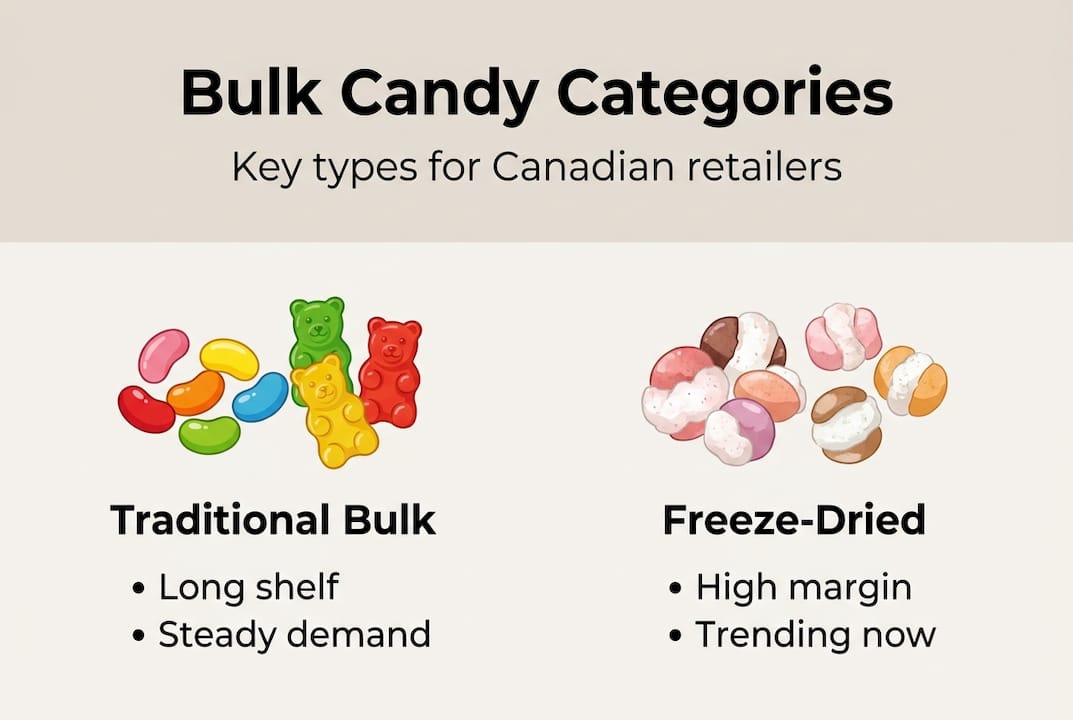
The Canadian bulk candy market is broader than most retailers realize. It spans three main categories: traditional bulk candy (gummies, hard candy, chocolates), novelty and seasonal items, and the fast-growing freeze-dried segment. Each category serves a different shopper and requires a different sourcing approach.
Freeze-dried candy has seen rapid market growth in Canada, driven largely by social media virality and a consumer appetite for new textures and flavors. Understanding bulk freeze dried candy basics is now a practical necessity for any retailer who wants to stay competitive on the shelf.
Key bulk candy categories for Canadian retailers:
- Traditional bulk candy: Gummies, licorice, hard candy, chocolates. High volume, lower margins, well-established supply chains.
- Novelty and seasonal candy: Themed items for Halloween, Valentine’s Day, and holidays. Strong impulse-buy potential.
- Freeze-dried candy: Crunchy, lightweight, longer shelf life, higher price point, and strong viral demand.
| Category | Avg. shelf life | Margin potential | Trend momentum |
|---|---|---|---|
| Traditional bulk | 6 to 12 months | Moderate | Stable |
| Novelty/seasonal | 3 to 9 months | Moderate to high | Seasonal spikes |
| Freeze-dried | 12 to 24 months | High | Rapidly growing |
On the compliance side, Canadian retailers must ensure their suppliers meet food safety standards. BRCGS certification (Brand Reputation through Compliance Global Standards) is the gold standard. It signals that a manufacturer follows rigorous food safety protocols, which matters both for your customers and for any future private label work you pursue.
Pro Tip: Track Google Trends and TikTok hashtags for candy-related spikes before placing large orders. Viral products can sell out in days. Knowing what’s trending two to four weeks ahead gives you a real edge when learning how to source bulk candy strategically.
How to evaluate and select bulk candy suppliers
Not all wholesale candy suppliers are built the same. The difference between a great supplier and a problematic one often comes down to a handful of criteria that are easy to overlook when you’re focused on price alone.
Here’s a step-by-step approach to vetting any supplier before you commit:
- Verify food safety certification. BRCGS-certified suppliers are the benchmark for freeze-dried and specialty candy. Ask for documentation upfront.
- Assess inventory depth. Can they fulfill consistent reorders? Stockouts hurt your shelf presence and customer trust.
- Review logistics and lead times. Domestic Canadian suppliers typically offer faster turnaround and lower shipping risk than overseas alternatives.
- Ask about private label and co-packing. If you plan to build a brand, confirm whether the supplier offers custom packaging, labeling, and minimum order flexibility.
- Test customer service. Send a detailed inquiry and measure response time and quality. A slow or vague reply is a red flag.
For a deeper breakdown of what to ask before signing any agreement, the wholesale candy purchasing tips guide covers the key negotiation points most retailers miss.
| Attribute | Traditional candy supplier | Freeze-dried specialist |
|---|---|---|
| Certification | Varies | BRCGS preferred |
| MOQ (minimum order) | Often high volume | More flexible options |
| Private label | Rarely offered | Increasingly available |
| Shelf life support | Standard | Extended (12 to 24 months) |
| Trend alignment | Stable | High |
Use this supplier selection guide as a reference when comparing multiple partners side by side.
Pro Tip: Negotiate seasonal flexibility into your contract. Ask for lower minimums during off-peak months and the ability to scale up quickly for Halloween or Valentine’s Day without penalty.
Freeze-dried vs regular candy: What every retailer should know
If you’ve never stocked freeze-dried candy before, the differences go well beyond texture. From a retail operations standpoint, these two product types behave very differently on the shelf and in the hands of your customers.
Freeze-dried candy advantages for retailers:
- Longer shelf life (often 12 to 24 months vs. 6 to 12 for traditional)
- Lighter weight means lower shipping costs per unit
- Higher perceived value supports a premium price point
- Strong viral and social media pull drives repeat foot traffic
- Novelty factor appeals to gift shoppers and trend-driven buyers
Regular bulk candy strengths:
- Broad consumer familiarity and consistent demand
- Lower entry price point for budget-conscious shoppers
- Established supply chains and predictable reorder cycles
The emerging demand for freeze-dried options in Canadian retail is real and measurable. Food industry analysts have tracked double-digit growth in this category over recent years, and Canadian retailers who stocked early are already seeing strong turns.
| Factor | Freeze-dried candy | Regular bulk candy |
|---|---|---|
| Shelf life | 12 to 24 months | 6 to 12 months |
| Price point | Premium | Standard |
| Target shopper | Trend followers, gift buyers | Families, everyday shoppers |
| Viral potential | Very high | Low |
| Margin | Higher | Moderate |
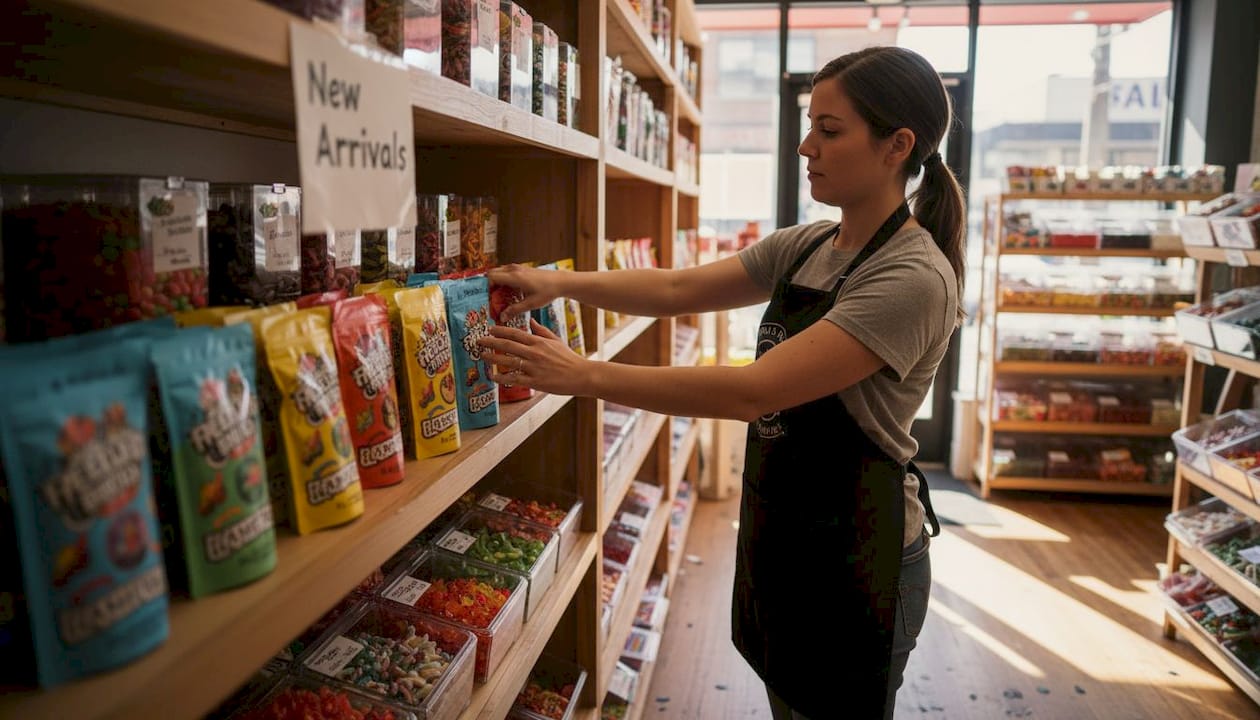
For a side-by-side breakdown of specific products, the freeze-dried vs regular candy comparison is worth reviewing before you finalize your product mix. Grocery stores in particular are finding that a curated freeze-dried section drives incremental sales without cannibalizing existing candy revenue. The best freeze dried candy for grocery stores breakdown can help you identify which SKUs perform best in that retail environment.
The smartest move is to carry both. Use traditional candy for volume and everyday traffic, and position freeze-dried as a premium, trend-forward section that earns higher margins and social media attention.
Private label and display solutions: Branding and sales growth
Once you have a solid product mix, the next lever is branding. Private labeling lets you put your store’s name on a product that someone else manufactures, giving you the margin benefits of a house brand without the production overhead.
Here’s how the private label process typically works for Canadian retailers:
- Choose your products. Select which freeze-dried or bulk candy SKUs you want to brand.
- Work with a supplier on packaging. Private labeling is available through select Canadian suppliers who handle design, printing, and compliance labeling.
- Set your minimum order quantities. Most suppliers have MOQ thresholds. Negotiate based on your volume and storage capacity.
- Review label compliance. Canadian bilingual labeling requirements apply. Confirm your supplier handles this or factor it into your workflow.
- Launch with display support. Pair your private label products with shelf-ready display kits for maximum visual impact at point of sale.
“Your packaging is your silent salesperson. A well-designed private label product on a clean display rack sells itself before a customer even picks it up.”
Display solutions like pre-packed shelf-ready kits and impulse-buy counter displays are underused by most independent retailers. They reduce the time your staff spends restocking and create a consistent, professional look that builds brand trust. For sourcing guidance, the wholesale freeze dried candy sourcing resource walks through how to connect display strategy with your buying plan.
Pro Tip: Invest in your display setup before your first private label order arrives. A product that lands on a disorganized shelf loses half its impact immediately. Retailers who boost sales with freeze dried candy consistently credit strong display placement as a key driver.
Smart inventory and seasonal strategies for maximum ROI
Great products and strong branding only pay off if your inventory is in the right place at the right time. Bulk candy retail has clear seasonal rhythms, and freeze-dried adds a viral unpredictability layer that requires a slightly different approach.
Key seasonal peaks for Canadian candy retailers:
- Halloween: The single largest candy sales event. Stock up 6 to 8 weeks early.
- Valentine’s Day: Strong demand for novelty and gift-packaged candy.
- Back to school: Lunchbox-friendly formats and smaller pack sizes move well.
- Easter and Christmas: Traditional candy dominates, but freeze-dried gift packs are gaining ground.
- Viral moments: TikTok trends can spike demand for specific SKUs with almost no warning.
Retailers capturing demand by tracking viral and seasonal spikes are outperforming those who rely on static reorder schedules. The candy category, especially freeze-dried, rewards agility.
Candy sales in Canada see significant seasonal lifts during major holidays, with Halloween alone accounting for a disproportionate share of annual volume for many retailers. Planning your open-to-buy budget around these windows is not optional. It’s the difference between capturing margin and leaving it on the table.
Use your prior year’s sales data as a baseline, then layer in trend signals from social media and your supplier’s sell-through reports. The freeze dried candy bulk guide includes a practical framework for building a seasonal buying calendar that works for both traditional and freeze-dried inventory.
Lean on supplier minimums to reduce risk during slower periods. A smaller, more frequent order cadence is often smarter than one large annual buy, especially for trend-sensitive SKUs.
Why most retailers underutilize freeze-dried and private label opportunities
Here’s the uncomfortable truth: most Canadian retailers know freeze-dried candy is trending, but they still treat it as a side experiment rather than a core category. The reason is usually inertia, not ignorance.
Conventional retail wisdom says stick with what sells. Legacy bulk candy has decades of proven velocity, and the idea of committing shelf space and budget to something newer feels risky. But that logic is exactly what keeps most retailers one step behind.
The freeze-dried market is still emerging, which means the number of established, certified suppliers is still limited compared to traditional candy. That’s not a warning sign. That’s a window. Retailers who move now, test SKUs, build supplier relationships, and invest in private label branding are positioning themselves as category leaders before the mainstream wave fully arrives.
The same applies to private label. Most independent retailers assume it’s only for large chains. It’s not. The wholesale freeze dried candy guide shows that smaller retailers can access private label programs with reasonable minimums and build real brand equity in their local markets. The retailers who educate themselves and act now will be the ones with loyal, repeat customers when this category reaches full maturity.
Source smarter: Start with trusted Canadian wholesale and private label options
If this guide has made one thing clear, it’s that the retailers who win in bulk candy are the ones who treat sourcing as a strategy, not just a transaction.
At Spaceman, we manufacture and distribute freeze-dried candy across Canada, and we offer private label co-packing services designed specifically for retailers who want to build their own brand without building a factory. Our 72-bag display kit gives you a shelf-ready solution that drives impulse purchases from day one. If you’re just getting started, the freeze dried candy starter pack is a low-risk way to test the category with your customers before scaling up. Let’s build something worth stocking.
Frequently asked questions
What certifications should I look for in a bulk candy supplier?
Look for BRCGS certification as the primary food safety benchmark, along with any provincial or federal compliance documentation relevant to Canadian retail standards.
How do seasonality and trends affect bulk candy inventory planning?
Viral and seasonal spikes can double or triple demand for specific SKUs almost overnight, so building a flexible buying calendar around key events like Halloween and Valentine’s Day is essential.
Are freeze-dried candies more profitable for retailers than regular ones?
Freeze-dried candy typically supports a higher retail margin because of its novelty, longer shelf life, and strong consumer demand driven by social media trends.
Can small retailers access private label or custom-branded candy?
Yes. Private labeling is available through select Canadian suppliers with minimums that work for independent and mid-size retailers, not just large chains.
What makes freeze-dried candy different from regular bulk candy?
Freeze-dried candy is lighter, crunchier, and has a significantly longer shelf life, and its TikTok-driven popularity makes it a strong draw for trend-conscious shoppers that traditional bulk candy simply cannot replicate.