

TL;DR:
- Understanding the full supply chain helps retailers negotiate better and plan inventory effectively.
- Specialty suppliers like freeze-dried candy offer differentiation, higher margins, and market appeal.
- Diversifying suppliers and monitoring commodity prices protect margins from price volatility and disruptions.
Canada’s candy manufacturing sector is valued at $1.6 billion in 2026, growing at a 6.5% CAGR, yet most retail store owners treat bulk candy procurement like a simple reorder task. It isn’t. The supplier you choose directly shapes your margins, your shelf variety, and whether your store can keep pace with fast-moving trends like freeze-dried candy. This article breaks down how Canadian bulk candy supply chains actually work, who the key players are, what risks can erode your profits, and how to build a smart, flexible sourcing strategy that keeps your store competitive.
Table of Contents
- How bulk candy supply chains work in Canada
- Key players: Suppliers, distributors, and the rise of freeze-dried candy
- Navigating price volatility and supply risks
- How to choose and work with bulk candy suppliers
- A smarter way to think about bulk candy supply chains
- Grow your candy selection with trusted Canadian suppliers
- Frequently asked questions
Key Takeaways
| Point | Details |
|---|---|
| Know your supply chain | Work with trusted distributors who match your store’s size and product needs. |
| Diverse sourcing pays | Mix national distributors with regional freeze-dried candy suppliers to diversify risk and boost appeal. |
| Monitor market trends | Stay on top of commodity price shifts, tariffs, and viral flavors to keep your shelves competitive. |
| Test before scaling | Start with small orders of new products to manage inventory and reduce financial risks. |
How bulk candy supply chains work in Canada
With the market’s scale established, let’s unpack how Canadian bulk candy reaches your store shelves. The supply chain runs in a fairly predictable sequence: manufacturers produce at scale, wholesalers and distributors aggregate inventory, and retail stores receive and sell the product. Simple in theory, but each layer introduces variables that affect your cost, lead time, and product availability.
At the manufacturing end, you have large multinationals like Mars and Mondelez. These companies produce the household names your customers recognize and expect. They supply Canadian wholesalers and distributors like Candyville, which operates nationwide warehouses, charges no minimum order, and offers free shipping on orders over $450. That kind of flexibility is significant for smaller retail operations that can’t absorb a 500-unit minimum.
Here’s a simplified look at how the supply chain layers connect:
| Layer | Role | Retail impact |
|---|---|---|
| Manufacturer | Produces candy at scale | Sets baseline cost and SKU availability |
| National distributor | Aggregates brands, manages logistics | Pricing tiers, variety, shipping speed |
| Regional wholesaler | Serves local markets, specialty items | Lower MOQs, faster local delivery |
| Retail store | Sells direct to consumer | Margin, product mix, trend responsiveness |
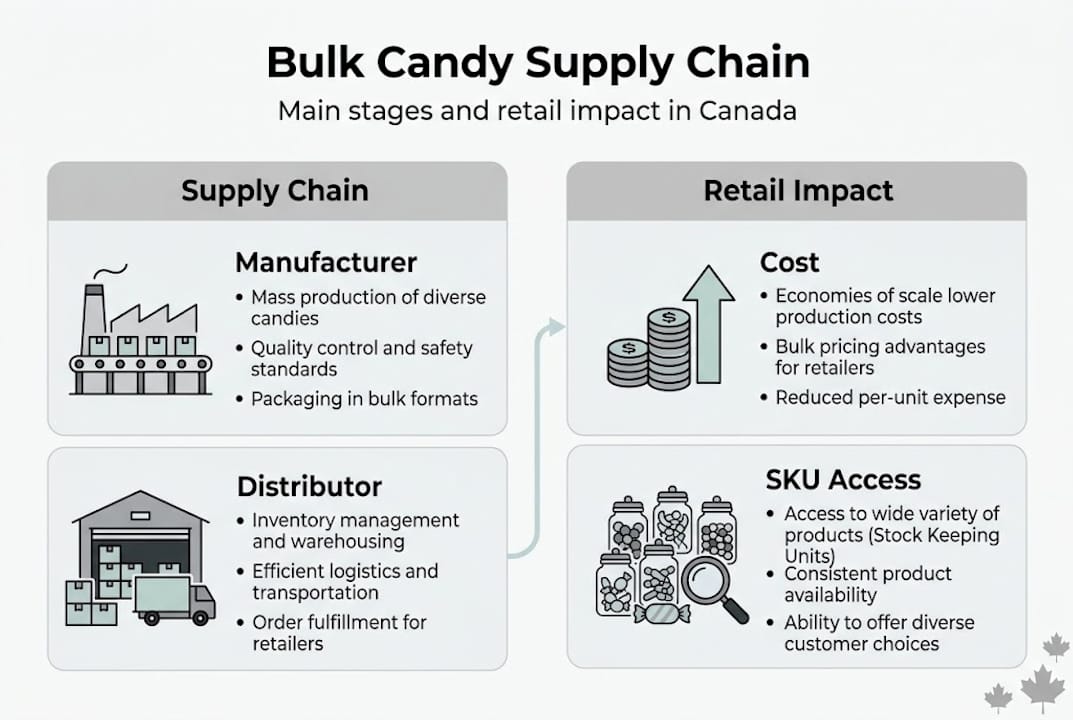
What makes regional warehousing and tiered pricing particularly valuable is the reduction in shipping time and cost. A warehouse in Ontario serves Toronto retailers far faster than a U.S.-based drop shipper. That speed advantage translates directly into lower carrying costs and fewer out-of-stock situations.
A few things every retailer should understand about this chain:
- Upstream commodity costs (cocoa, sugar, corn syrup) ripple downstream to your invoice within weeks
- Tariff changes on U.S.-branded imports can spike costs without warning
- MOQ flexibility determines whether you can test new products without overcommitting capital
- Shipping zones affect how quickly you can restock fast-selling items
Reading the bulk candy wholesale guide gives you a solid foundation for understanding these dynamics. And if you’re still comparing supplier types, choosing candy distributors in Canada walks you through the decision criteria step by step.
A key insight: Retailers who understand the full supply chain, not just the price on an invoice, are far better equipped to negotiate, plan inventory, and stay ahead of disruptions.
Key players: Suppliers, distributors, and the rise of freeze-dried candy
Understanding the supply chain basics sets the stage to explore who’s who and how emerging specialists change the game. The Canadian bulk candy market has traditionally been dominated by national distributors handling mass-market brands. That’s shifting fast.
Established distributors bring reliable logistics, broad brand portfolios, and volume pricing. They’re your go-to for core SKUs that drive consistent traffic. But they rarely carry the products that generate social media buzz or give your store a reason for customers to return out of curiosity.
That’s where specialty suppliers come in. Freeze-dried candy specialists like CandyFrost, Puffy Stuff, MyChillChew, and Cail’s Candy Corner have carved out a growing niche supplying regional Canadian retailers. These suppliers offer something national distributors can’t: differentiation. And freeze-dried candies have strong viral appeal, with shoppers actively seeking out their unique crunch and intense flavor profile.

Here’s a side-by-side comparison to help you think about which supplier type fits your store:
| Supplier type | MOQ | Product variety | Logistics | Differentiation |
|---|---|---|---|---|
| National distributor | Low to medium | Very broad | Reliable, fast | Low |
| Regional wholesaler | Low | Moderate | Good for local | Medium |
| Freeze-dried specialist | Very low | Narrow but unique | Varies | Very high |
Key advantages of working with freeze-dried specialists:
- Unique shelf presence that mass-market products can’t replicate
- Higher retail margins because novelty commands a price premium
- Low entry risk with small minimum orders to test demand
- Social media-driven demand that pulls customers in before you even advertise
If you’re curious about sourcing options, where to buy freeze-dried candy in Canada covers the landscape in detail. And if you want the business case spelled out clearly, why freeze-dried is smart for retailers makes a compelling argument backed by real margin data.
Pro Tip: Launch freeze-dried candy with a low-MOQ supplier first. You get to validate customer demand in your specific market before placing a larger wholesale order, and you protect your cash flow in the process.
Navigating price volatility and supply risks
Knowing your best suppliers is half the battle. Now, here’s how to shield your margins from industry shocks.
Cocoa and sugar are the two biggest commodity inputs in candy production. When their prices spike, candy manufacturers absorb some of the hit, but not all of it. The rest gets passed down the chain to you. Cocoa price shocks and U.S.-Canada tariffs of 25% and higher have prompted supply reroutes, inventory lags, and sudden cost jumps that smaller retailers are rarely prepared for.
The compounding effect is real. A tariff on U.S.-branded imports raises your cost. A cocoa shortage delays production. Both happen at the same time, and suddenly your bestselling bar is out of stock and costs 18% more when it comes back. That scenario is not hypothetical. It happened across multiple Canadian retail categories in recent years.
Here’s how to protect yourself:
- Use distributors with regional Canadian warehousing to reduce exposure to cross-border shipping delays
- Monitor commodity price indexes for cocoa and sugar quarterly, not annually
- Lock in tiered bulk pricing before seasonal demand peaks (Halloween, Valentine’s Day, Easter)
- Diversify across at least two supplier types so a single disruption doesn’t empty your shelves
- Keep a 3 to 4 week safety stock on your top 10 fastest-moving SKUs
“Retailers who rely on a single supplier or a single product category are building their business on a single point of failure. Diversification is not just smart strategy, it’s basic supply chain hygiene.”
The candy distribution guide goes deeper into the logistics side of managing these risks, including how to evaluate a distributor’s warehousing and fulfillment capabilities before you commit.
Pro Tip: Mixing national brands with regional and freeze-dried suppliers is an effective hedge. If tariffs hit U.S.-branded chocolate, your freeze-dried line (sourced from a Canadian manufacturer) keeps your margins stable while national brands recover.
How to choose and work with bulk candy suppliers
With risks and opportunities in mind, use this methodical approach to build the supplier relationships that will help your retail business thrive.
Retailers who succeed prioritize distributors for selection and import breadth, then layer in regional freeze-dried specialists for unique draws. Flexible ordering and monitoring of tariffs and costs are what separate retailers who grow from those who just survive. Here’s a practical step-by-step framework:
- Define your product mix goals. Know what percentage of your candy shelf you want in mass-market vs. specialty. This determines how many supplier relationships you actually need.
- Check MOQs against your sales velocity. If a product doesn’t turn over in 6 weeks, the MOQ is probably too high for your current stage.
- Evaluate shipping geography. A supplier based in Alberta may not be the right fit for a Toronto retailer if lead times are unpredictable.
- Assess quality controls. Ask specifically about expiry management, batch tracking, and return policies for damaged goods.
- Compare cost structures at multiple volume levels. The price break at 50 units vs. 200 units tells you whether the supplier rewards loyalty or just size.
- Test before scaling. Place a trial order of any new SKU, especially in a new category like freeze-dried candy, before locking in a recurring order.
- Negotiate payment terms. Net-30 terms can be a game-changer for small retailers managing cash flow between restocks.
Once you’ve identified strong candidates, build the relationship actively. Visit trade shows where suppliers exhibit, ask for trend reports, and let your rep know what’s selling. Good suppliers will alert you to incoming price changes or new products before they hit the market publicly.
Exploring the freeze-dried wholesale opportunity is worth doing before your competition does. The window to differentiate with this category is open now, but it won’t stay open forever as more retailers catch on.
Pro Tip: When launching freeze-dried candy, treat the first order as a paid learning experience. Set a small display, track sell-through rate weekly, and use that data to justify a larger reorder with better terms.
A smarter way to think about bulk candy supply chains
Now that you have a practical toolkit, here’s a different perspective grounded in industry shifts we’ve seen firsthand.
Most retailers default to the lowest-cost supplier and call it good procurement. That approach works until it doesn’t. The problem isn’t the logic. Controlling cost is obviously important. The problem is that lowest-unit-cost thinking anchors your entire shelf strategy to whatever your cheapest supplier happens to carry. Your product mix becomes reactive, not intentional.
The retailers we see building real loyalty and stronger margins are doing something different. They treat their supplier network as a strategic asset, not just a cost center. They mix one or two national distributors for volume and reliability with one or two specialty suppliers for novelty and margin. They use that mix to build a shelf that looks curated, not generic.
Freeze-dried candy is a perfect example of this. Yes, unit cost is higher than a standard gummy. But the retail price is higher too, the customer excitement is real, and the repeat purchase rate from curious shoppers is strong. Retailers who boost sales with bulk freeze-dried candy aren’t just adding a SKU. They’re adding a reason for customers to choose their store over the one down the street.
Agility beats price. Every time.
Grow your candy selection with trusted Canadian suppliers
If you’re ready to apply these strategies in your own store, check out these exclusive supplier options tailored for Canadian retailers.
At Spaceman, we manufacture and distribute freeze-dried candy in Canada, and we’ve built our wholesale program specifically around the realities small and mid-size retailers face. You don’t need a massive order to get started.

Our starter pack for freeze-dried candy gives you 40 bags of assorted flavors to test in your store before committing to larger volumes. If you’re ready to go bigger, our 72-bag display kit comes with a full retail display rack, making it easy to create an eye-catching in-store section. We also offer private label and co-packing services, so you can build your own brand on top of our production capability.
Frequently asked questions
Who are the best bulk candy suppliers for small Canadian retailers?
Candyville is a leading national distributor with no minimum orders, and CandyFrost specializes in freeze-dried candy wholesale across Canada, making both strong options for smaller stores needing flexibility.
How do commodity prices affect bulk candy supply in Canada?
Cocoa price shocks and sugar cost spikes push manufacturers to raise wholesale prices, which can lead to inventory gaps and margin compression for retailers within weeks of a commodity move.
What advantages does freeze-dried candy offer versus regular bulk candy?
Freeze-dried candies carry higher retail margins, have an extended shelf life compared to many traditional candy formats, and tap into a viral novelty trend that drives customer curiosity and repeat visits.
What’s the best way to manage cost risks in bulk candy procurement?
Using tiered pricing and flexible orders from multiple supplier types, combined with small trial orders for new SKUs, gives retailers the best protection against price spikes and inventory surprises.