

TL;DR:
- Freeze dried food retains most of its vitamins and nutrients even after 25 years when stored properly. It preserves cellular structure through sublimation, making it shelf-stable, lightweight, and ideal for various uses. Proper storage at consistent cool temperatures ensures long-term freshness, making it a practical investment for Canadians’ everyday needs and emergency preparedness.
Freeze-dried food that sits in your pantry for 25 years and still delivers most of its original vitamins sounds too good to be true. It isn’t. The benefits of freeze dried food go far beyond emergency preparedness, and most Canadians are only scratching the surface of what this preservation method can do. Whether you love freeze dried candy, prioritize clean nutrition, or just want a snack that doesn’t expire before you remember to eat it, this guide covers the real science, honest storage advice, and practical reasons to stock up.
Table of Contents
- How freeze drying works to preserve food
- Nutritional advantages of freeze dried foods
- Shelf life and storage: how freeze dried food stays fresh
- Benefits of freeze dried food for different consumer types
- Comparing freeze drying with other preservation methods
- Why freeze dried food could be your pantry’s MVP in Canada
- Explore Canadian freeze dried food solutions with Spaceman
- Frequently asked questions
Key Takeaways
| Point | Details |
|---|---|
| Long shelf life | Freeze dried foods can last 25 to 30 years when stored properly in cool, dark, oxygen-free conditions. |
| Superior nutrient retention | Freeze drying preserves 90–97% of vitamins and minerals, outperforming heat-based preservation methods. |
| Lightweight and convenient | Removing 98–99% moisture makes freeze dried food 70–90% lighter for easy storage and transport. |
| Versatile for consumers | Freeze dried food suits candy lovers, health-conscious snackers, and convenience seekers alike. |
| Storage matters | Maintaining proper packaging and temperature is key to maximizing freeze dried food quality and safety. |
How freeze drying works to preserve food
Freeze drying is not complicated once you understand one key step: sublimation. The food is frozen solid first, then placed inside a vacuum chamber where the pressure drops so low that ice converts directly into vapor without ever becoming liquid. No heat. No cell-damaging steam. Just moisture leaving the food quietly and cleanly.
That low-temperature vacuum process is what makes freeze drying exceptional. Heat-based methods like canning and dehydrating can break down enzymes, shrink cell walls, and cook away flavor. Freeze drying sidesteps all of that. The cellular structure stays almost completely intact, which is why freeze dried strawberries taste like strawberries and not like strawberry-flavored cardboard.
The result is a porous, lightweight food product that removes 98-99% of moisture through sublimation, preserving cellular structure and nutrients better than heat-based drying. That drastic moisture reduction drops what food scientists call water activity (the available moisture that bacteria and mold need to grow) to levels where spoilage becomes nearly impossible.
Key steps in the freeze-drying process:
- Food is flash-frozen to temperatures as low as -40°F
- Vacuum chamber lowers pressure to allow sublimation
- A condenser captures the released water vapor
- The result is shelf-stable food with original shape, color, and flavor
For more on keeping your freeze dried products in peak condition, explore these freeze dried food storage tips once you’ve chosen your products.
Nutritional advantages of freeze dried foods
Heat is the enemy of vitamins. Canning reaches temperatures above 212°F, and even standard dehydrating operates between 130°F and 160°F. Both destroy significant amounts of heat-sensitive nutrients, particularly vitamin C and B vitamins. Freeze drying operates well below freezing for most of the process, which is why the nutritional profile of the original food stays remarkably close to fresh.

Freeze drying retains 90-97% of most nutrients, including vitamin C, B vitamins, and minerals, better than heat drying methods. Proteins and minerals are especially stable because they are not heat-sensitive to begin with, meaning freeze dried meat, beans, and dairy retain their full nutritional value with almost no loss.
Nutrients that survive freeze drying exceptionally well:
- Vitamin C (often reduced significantly in canning)
- B vitamins including folate and B6
- Minerals: iron, calcium, potassium, and magnesium
- Enzymes that aid digestion (heat kills most of these in other methods)
- Antioxidants like lycopene in tomatoes and anthocyanins in berries
This is what makes freeze dried food genuinely good for you, not just convenient. If you’re health-conscious, the difference between a freeze dried blueberry and a canned blueberry is not subtle. The texture, the color, and the nutrient content all tell a different story.
Pro Tip: When buying freeze dried snacks, check that the product was freeze dried at the source rather than dehydrated. Labeling matters. Dehydrated and freeze dried are not interchangeable terms, even though some manufacturers use them loosely. Learn more about real freeze dried snack benefits before your next purchase.
Shelf life and storage: how freeze dried food stays fresh
Twenty-five to thirty years of shelf life sounds extreme until you understand what makes it possible. Freeze dried food stored under ideal conditions can last 25 to 30 years unopened. That figure depends entirely on getting storage right, and most people underestimate how much temperature alone can shorten that window.
Every 10°F rise in storage temperature can cut shelf life roughly in half. A product rated for 25 years at 55°F might last only 12 years at 65°F and far less if stored in a warm garage or near a furnace. This is especially relevant for Canadian homes where temperatures can fluctuate seasonally in uninsulated storage areas.
Ideal storage conditions for freeze dried food:
- Temperature: 50 to 60°F consistently (never above 70°F)
- Darkness: UV light degrades both nutrients and packaging
- Humidity: below 15% relative humidity
- Oxygen: use Mylar bags or cans with oxygen absorbers to eliminate air exposure
- Packaging integrity: once sealed packaging is broken, oxidation begins immediately
| Storage condition | Optimal range | Impact if ignored |
|---|---|---|
| Temperature | 50 to 60°F | Shelf life can halve with each 10°F rise |
| Humidity | Below 15% RH | Moisture rehydrates product and enables mold |
| Light exposure | None | Degrades vitamins and packaging over time |
| Oxygen level | Near zero (with absorbers) | Oxidation causes rancidity and nutrient loss |
| Packaging seal | Airtight and intact | Any breach restarts the spoilage clock |
Pro Tip: Mylar bags with oxygen absorbers inside rigid food-grade containers give you a double layer of protection. The Mylar blocks moisture and light while the oxygen absorber keeps internal oxygen at near-zero levels.
Dig into the details of freeze dried food shelf life to understand exactly how to manage your long-term storage in a Canadian climate.
Benefits of freeze dried food for different consumer types
Freeze dried food is not a single product for a single person. It serves candy lovers, outdoor adventurers, health-focused snackers, and emergency preparedness households in genuinely different ways. The common thread is that this preservation method delivers on taste, nutrition, and convenience simultaneously.
Dry fruits can be eaten crunchy without rehydration, making freeze dried candy convenient and safe. That crunch is the reason freeze dried candy has become its own cultural phenomenon. The texture transformation is dramatic: a gummy candy becomes airy and crisp, a chocolate-covered treat gets a new crunch without losing its flavor. No refrigeration. No sticky wrappers. Just intense flavor in a light, shelf-stable package.
Top 5 benefits by consumer type:
- Candy enthusiasts: Intense flavor concentration, satisfying crunch, and no melting or stickiness make freeze dried candy a genuinely unique snacking experience.
- Health-conscious snackers: Near-complete nutrient retention means you’re eating real food with real vitamins, not a processed approximation.
- Convenience seekers: Most freeze dried meals rehydrate in 5 to 10 minutes with hot water, making meal prep faster than many “quick” recipes.
- Outdoor and hiking consumers: Weight reduction of up to 90% compared to fresh food means more calories per ounce in your pack, no cooling required.
- Emergency preparedness households: A 25-year shelf life with no refrigeration means your freeze dried food reserve is always ready, whether you need it or not.
Everyday uses of freeze dried meals and snacks:
- Trail mix additions (freeze dried berries, peas, corn)
- Smoothie boosters without needing frozen fruit
- Camping and hiking meals
- School and office snacks that need no prep
- Long-term emergency food storage for Canadian households
Check out proper freeze dried candy storage to keep your treats in peak condition between snacking sessions.
Comparing freeze drying with other preservation methods
The freeze drying benefits become even clearer when you put them directly next to competing methods. Dehydrating is the most common comparison, and on the surface they seem similar. Both remove moisture. But the difference in how much moisture is removed and how it’s removed changes everything downstream.
Freeze drying offers longer shelf life, better nutrient retention, and lighter weight than dehydrated or canned foods. Dehydrating removes 90 to 95% of moisture versus 98 to 99% for freeze drying. That 4 to 9% difference sounds small but it’s the gap between a 2-year shelf life and a 25-year one.
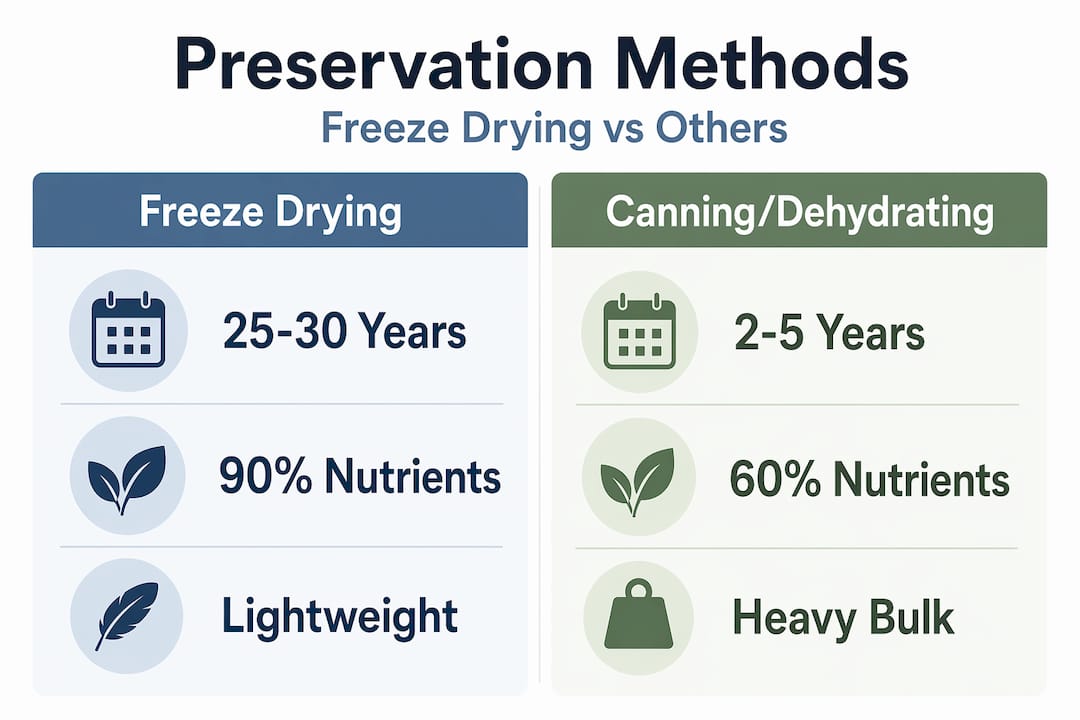
| Method | Moisture removed | Shelf life | Nutrient retention | Weight reduction |
|---|---|---|---|---|
| Freeze drying | 98 to 99% | 20 to 30 years | 90 to 97% | Up to 90% |
| Dehydrating | 90 to 95% | 1 to 3 years | 60 to 80% | 70 to 80% |
| Canning | Varies | 2 to 5 years | 40 to 70% | None |
| Freezing | 0% (water retained) | 1 to 3 years | 85 to 95% | None |
Where freeze drying wins outright:
- Long-term storage without power dependency (unlike freezing)
- Portability and weight for hiking, travel, and emergency kits
- Taste and texture closest to fresh food after rehydration
- Nutrient density for health-focused consumers
Pro Tip: Think of freeze drying as your long-term foundation and dehydrating or freezing as your short-term rotation. Use freeze dried products for anything you want to store beyond two years or carry on a trip. For what you’ll eat within months, other methods work fine and cost less.
For more context on how long different products last, the freeze dried food shelf life information page breaks it down by product type.
Why freeze dried food could be your pantry’s MVP in Canada
Here’s the perspective most articles skip: freeze dried food is not just for survivalists or outdoor enthusiasts. It’s genuinely one of the smartest everyday food investments a Canadian household can make.
Think about what you actually throw out each week. Berries that went soft. Herbs that wilted. Leftovers that got forgotten. Freeze dried versions of those same foods sit in your pantry for years, taste almost exactly like fresh, and cost you nothing in waste. That’s not a luxury product. That’s a practical answer to a very real problem.
The Canadian climate actually works in your favor here. Basements and cold storage rooms in Canadian homes maintain temperatures naturally in that 50 to 60°F sweet spot for a good portion of the year. You don’t need specialized equipment. You need a dark shelf, a sealed container, and the discipline not to store food next to your furnace. Follow these freeze dried food storage best practices and you’ll get the full benefit of that multi-decade shelf life.
The bigger mindset shift is thinking of freeze dried food as an ingredient, not just a finished product. Add freeze dried corn to soups. Use freeze dried strawberries in baking. Mix freeze dried candy into a snack mix for a texture contrast that nothing else delivers. The uses of freeze dried meals and snacks extend well beyond camping and crisis planning.
Cost is the honest objection. Freeze dried food costs more upfront than fresh or canned alternatives. But when you factor in zero spoilage, no refrigeration costs, and the nutritional density you’re preserving, the value calculation shifts significantly. For Canadians navigating food prices that keep climbing, buying freeze dried in bulk is one of the few food decisions that actually gets cheaper over time as your stockpile grows.
Explore Canadian freeze dried food solutions with Spaceman
You now know exactly what freeze dried food can do and how to store it right. The next step is sourcing products you can actually trust.

At Spaceman, we manufacture and distribute freeze dried candy across Canada, and we’re built to serve more than just individual snackers. Whether you’re a retailer looking for consistent product quality or a brand ready to scale with co-packing and packaging services, we handle the production and packaging side so you can focus on selling. Private labeling, bagging, and custom packaging are all on the table. If you’re ready to bring freeze dried products into your business or build your own line, start with our wholesale application and let’s talk.
Frequently asked questions
How long can freeze dried food last if stored properly?
Freeze dried food can last 25 to 30 years unopened when stored in cool, dark, oxygen-free packaging below 70°F. Temperature consistency is the single most important factor in hitting that maximum shelf life.
Does freeze drying preserve vitamins better than other methods?
Yes. Freeze drying retains 90-97% of most vitamins and minerals, outperforming canning and dehydrating, which use heat that degrades heat-sensitive nutrients like vitamin C and B vitamins.
Do freeze dried fruits need to be rehydrated before eating?
No. Freeze dried fruits are safe to eat crunchy straight from the bag. Their water activity is so low that bacteria and mold cannot grow, making them shelf-stable and snack-ready without any prep.
What storage conditions maximize freeze dried food shelf life?
Store in airtight Mylar bags or sealed cans with oxygen absorbers, at 50 to 60°F, away from light and humidity. Ideal conditions include temperatures below 70°F, less than 15% humidity, and zero light exposure to preserve both nutrients and packaging integrity.
Is freeze dried food a good option for emergency preparedness in Canada?
Absolutely. Freeze dried food offers portable nutrition with long shelf life requiring no refrigeration, which makes it one of the most practical choices for Canadian emergency kits, especially given our seasonal power outage risks and wide temperature swings.