

TL;DR:
- Choosing the right freeze dryer depends on condenser capacity, vacuum system depth, shelf temperature accuracy, and build quality. Proper sizing for batch volume, automation features, and infrastructure requirements are critical for consistent, scalable production. Focusing on core specifications and total ownership costs ensures reliable performance and long-term success.
What to look for in a freeze dryer comes down to four core performance factors: condenser capacity, vacuum system depth, shelf temperature precision, and build quality. Get these right, and you get consistent product, predictable cycles, and a machine that earns its keep. Get them wrong, and you get failed batches, expensive repairs, and a very frustrating Tuesday. This guide breaks down every critical specification and operational factor you need to evaluate before buying, whether you’re preserving food at scale or launching a freeze-dried product line.
What to look for in a freeze dryer: technical specs that actually matter
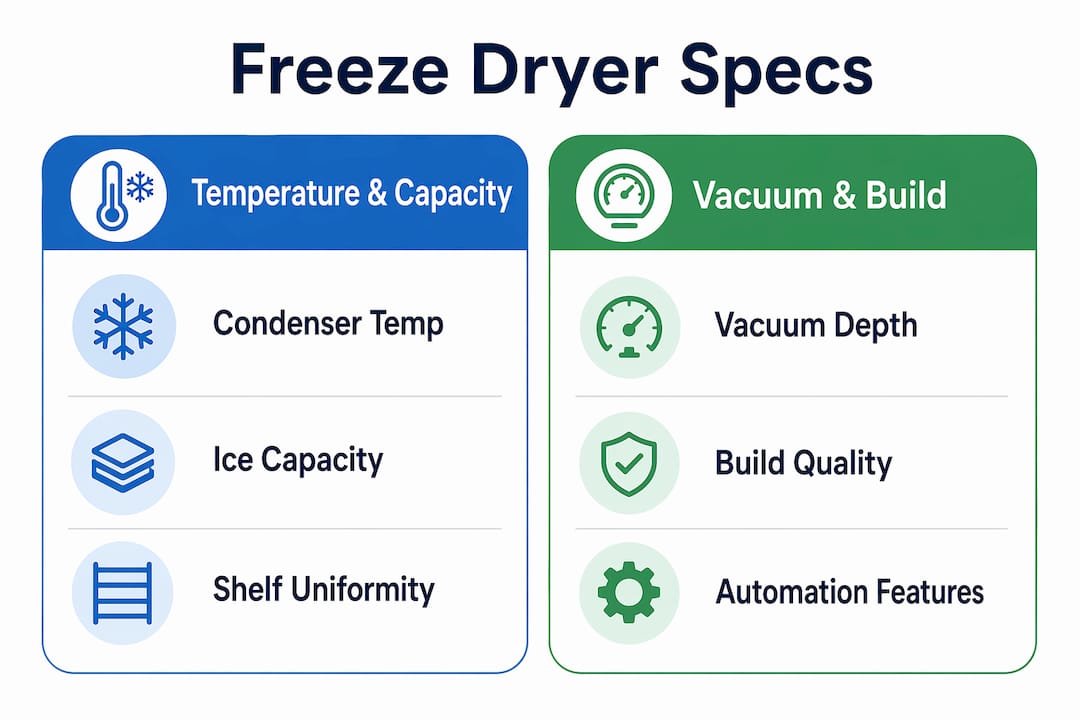
The specs that separate a reliable freeze dryer from a costly disappointment are condenser temperature, vacuum depth, shelf temperature uniformity, and construction quality. These are not marketing numbers. They are the mechanical conditions that determine whether your product comes out right or gets ruined mid-cycle.
Condenser temperature and ice capacity
Industry standards require condenser temperatures of at least -50°C to capture sublimated vapor effectively, with -80°C or lower preferred for products with low eutectic points like certain dairy or pharmaceutical items. That gap between -50°C and -80°C is not trivial. A condenser running at -55°C will struggle with high-moisture products and slow your cycles significantly.
Ice capacity is equally critical. Undersized condenser capacity causes cycle failure by failing to match the water content of your batch, leading to premature defrost and interrupted production runs. Always size your condenser to handle the full water load of your largest planned batch, not your average one.
Vacuum system performance
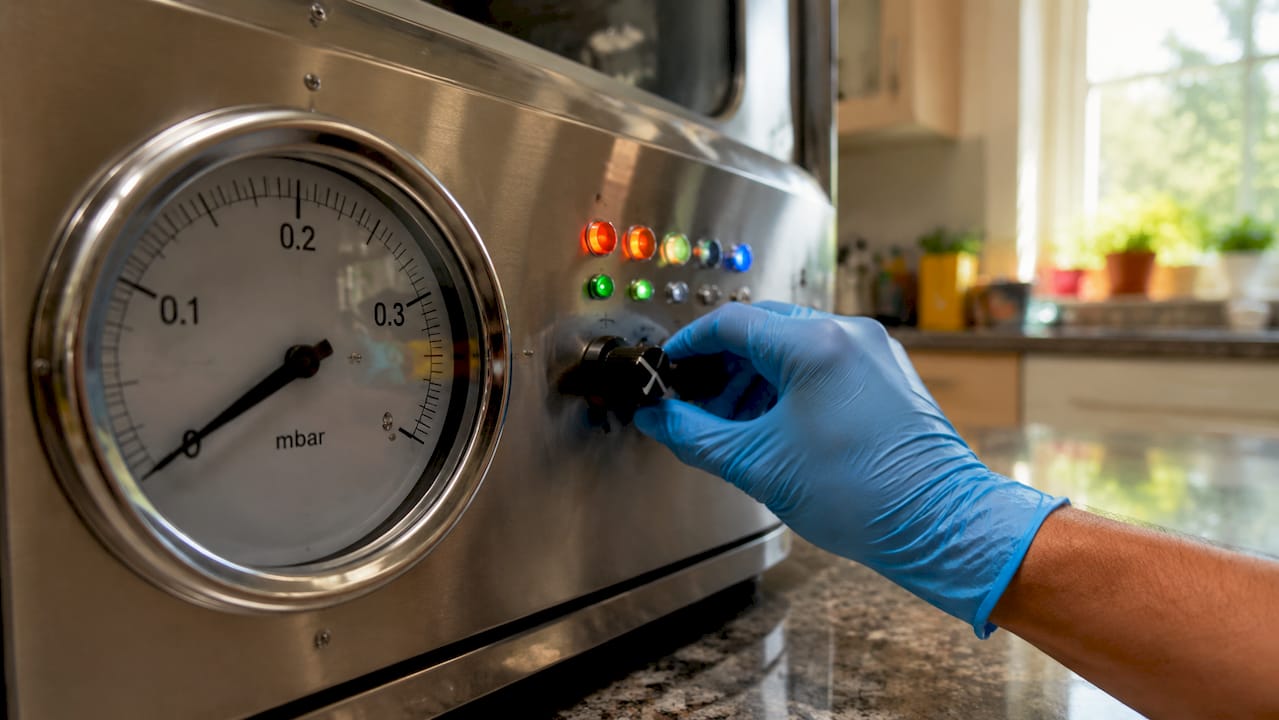
Commercial freeze dryers must achieve vacuum levels below 0.1 mbar (10 Pa) for efficient sublimation and consistent output. A weak vacuum means slower drying, uneven moisture removal, and product that does not meet shelf-stability standards. Oil-sealed rotary vane pumps are the industry standard for achieving and holding these depths reliably.
Shelf temperature uniformity
Shelf temperature precision of ±0.5–1°C is the benchmark for high-volume production. Uneven shelf heating creates hot and cold zones, which means some product over-dries while other sections remain too moist. For candy, fruit, or any product with tight moisture specs, this variability kills consistency.
Pro Tip: Ask vendors for actual shelf temperature mapping data, not just rated specs. A machine rated at ±2°C might perform at ±4°C under real load conditions.
Build quality and door seals
Stainless steel construction is non-negotiable for any food-grade application. It resists corrosion, cleans easily, and holds up under repeated thermal cycling. Door seal quality matters just as much. A degraded door gasket bleeds vacuum, extends cycle times, and eventually causes cycle failure. Check seal material, replacement cost, and how often the manufacturer recommends swapping them.
| Specification | Entry-Level Units | Commercial Grade |
|---|---|---|
| Condenser temperature | -45°C to -50°C | -60°C to -80°C |
| Vacuum depth | 0.1–0.5 mbar | Below 0.1 mbar |
| Shelf temp uniformity | ±2–4°C | ±0.5–1°C |
| Construction | Painted steel or aluminum | Stainless steel |
| Ice capacity | 2–6 kg | 10–100+ kg |
How does batch size and scaling affect freeze dryer choice?
Batch size planning is where most buyers make their first mistake. They size the machine to their current output and then outgrow it within a year. A better approach is to plan for where you want to be in 24 months, then work backward to the right machine.
Fresh food loses 60–90% of its weight during freeze drying due to water removal. That means producing 5 kg of finished product requires raw input capacity of 15–50 kg, depending on the product. This ratio is the single most important number in your batch size calculation. Ignore it, and your machine will be undersized from day one.
Key factors to evaluate when matching machine size to your operation:
- Raw input vs. finished output ratio. Calculate your target finished weight, then multiply by 3–10x to get your required raw input capacity per cycle.
- Cycle time and daily throughput. A single freeze dry cycle runs 20–40 hours for most food products. If you need 50 kg of finished product per day, you need multiple chambers or a very large single unit.
- Condenser ice capacity per cycle. This number must exceed the total water weight your batch will release. Undersize it and you risk mid-cycle failure.
- Power and facility requirements. Commercial units typically require 208–480V three-phase power, dedicated cooling water lines, and ventilated mechanical rooms. Confirm your facility can support the machine before you buy it.
- Modularity for future growth. Modular systems that allow future capacity increases add measurable value within 12–24 months post-purchase. Look for manufacturers who offer add-on shelf trays, secondary chambers, or stackable units.
Harvest Right is a well-known name in the prosumer and small commercial space, offering units with 4–10 shelf trays suited to small-batch food businesses. For larger commercial operations, manufacturers like Millrock Technology and Telstar offer fully scalable industrial systems with modular configurations.
What role does automation play in freeze dryer selection?
Automation is not a luxury feature for commercial freeze drying. It is the difference between repeatable product and batch-to-batch guesswork. For high-volume production, shelf temperature precision and recipe automation matter more than raw throughput numbers. A machine that runs the right cycle every time beats a faster machine that needs constant babysitting.
Here is what modern automation features actually deliver:
- Recipe storage and programmable ramp profiles. You set the freeze, primary drying, and secondary drying parameters once, save them as a named recipe, and run them identically every cycle. This removes operator error from the equation entirely.
- Real-time monitoring and remote access. IoT-connected units let you check cycle status, chamber pressure, and shelf temperature from a phone or tablet. You catch problems before they become failed batches.
- Data logging for quality assurance. Every cycle generates a timestamped record of temperature, pressure, and duration. This data is required for regulatory compliance in pharmaceutical applications and is increasingly expected in premium food production.
- Alarm and fault notification systems. Automated alerts for vacuum loss, temperature deviation, or power interruption let you respond immediately rather than discovering a problem 12 hours later.
Pro Tip: If you are producing for retail or co-packing clients, data logs are your proof of process. Clients increasingly ask for cycle records as part of quality documentation. A machine without logging capability puts you at a disadvantage.
Basic entry-level units from brands like Harvest Right offer minimal automation, typically a simple controller with preset programs. Commercial and industrial machines from manufacturers like SP Scientific or Labconco include full PLC controls, recipe libraries, and data export capabilities. The gap in capability is significant, and so is the price.
What maintenance costs and infrastructure should buyers plan for?
Owning a freeze dryer is not just a capital expense. It is an ongoing operational commitment. Buyers who ignore total cost of ownership often get a nasty surprise six months in.
Here are the five infrastructure and maintenance factors you must plan for before purchase:
-
Vacuum pump rebuild intervals. Vacuum pumps are the most common failure point in any freeze dryer. Oil-sealed rotary vane pumps require regular oil changes and periodic rebuilds. Rebuild costs vary by pump size but can run several hundred to a few thousand dollars per service. Factor this into your annual operating budget.
-
Energy consumption. Commercial freeze dryers are power-hungry. A mid-sized commercial unit running 24-hour cycles can consume 15–30 kWh per cycle. At scale, electricity becomes one of your largest variable costs. Ask for the machine’s rated power draw and calculate your monthly energy cost before signing anything.
-
Cooling water requirements. Many commercial condensers require a continuous supply of cooling water or a dedicated chiller system. Chiller units add capital cost and require their own maintenance schedule.
-
Electrical infrastructure. Quality laboratory and industrial systems start above $16,500, and infrastructure costs raise total setup expenses by 20–50%. Three-phase power installation, dedicated circuits, and facility modifications are real costs that do not appear on the machine’s price tag.
-
Space and ventilation. Commercial units generate significant heat from compressors and vacuum pumps. A poorly ventilated room raises ambient temperature, reduces condenser efficiency, and shortens equipment life. Plan for adequate airflow and, in some cases, dedicated HVAC.
A solid freeze dryer buying guide will always include total cost of ownership alongside purchase price. If a vendor only talks about the sticker price, ask harder questions.
Key takeaways
Condenser capacity, vacuum depth, and shelf temperature uniformity are the three specifications that determine whether a freeze dryer delivers consistent, sellable product at scale.
| Point | Details |
|---|---|
| Condenser temperature matters most | Target -50°C minimum, -80°C for sensitive or high-moisture products. |
| Size for raw input, not finished output | Fresh product loses 60–90% of weight; plan machine capacity accordingly. |
| Automation drives consistency | Recipe storage and data logging reduce batch variation and support quality documentation. |
| Vacuum pump is your biggest maintenance cost | Budget for regular oil changes and rebuild intervals from day one. |
| Infrastructure adds 20–50% to setup cost | Electrical, cooling, and ventilation requirements are real costs, not afterthoughts. |
My honest take on choosing the right freeze dryer
I have seen buyers obsess over shelf count and chamber volume while completely ignoring condenser capacity and vacuum pump quality. That is backwards. A large chamber with a weak condenser is like a big kitchen with a broken oven. The size is irrelevant if the core mechanism cannot perform.
The spec I would never compromise on is condenser temperature. If a machine cannot reliably hit -60°C or lower, it will struggle with anything beyond the simplest, lowest-moisture products. Candy, fruit, and meat all have enough water content to expose a weak condenser fast.
On scalability, I would always push buyers toward modular systems, even if they feel like overkill today. The cost of replacing a machine you outgrew in 18 months is far higher than buying slightly more capacity upfront. And if you are producing for retail or co-packing clients, data logging is not optional. It is the paper trail that protects you when a client questions your process.
The buyers who get this right treat the freeze dryer as infrastructure, not equipment. They plan for the pump rebuilds, the energy bills, and the facility upgrades before the machine arrives. The ones who do not are usually the ones calling vendors with complaints six months later.
— Chadi
See freeze drying quality in action with Space-man
Understanding what makes a great freeze dryer is one thing. Seeing the results in a finished product is another. Space-man uses commercial-grade freeze drying to produce candy with the texture, flavor, and shelf stability that retailers and distributors expect. Every batch runs on precise cycle parameters, which is exactly why the product is consistent enough to private label and co-pack at scale.

If you are a distributor, retailer, or brand looking to add freeze-dried candy to your lineup without investing in your own equipment, Space-man’s private label and co-packing services are built for that. You get the product quality that comes from a well-run freeze drying operation, without the capital cost of owning one.
FAQ
What condenser temperature should a freeze dryer have?
A freeze dryer should have a condenser temperature of at least -50°C for general food products, with -80°C preferred for sensitive or high-moisture items. Lower condenser temperatures capture sublimated vapor more effectively and reduce cycle times.
How do I calculate the right batch size for a freeze dryer?
Fresh food loses 60–90% of its weight during freeze drying, so your machine must handle 3–10 times the weight of your intended finished output. Calculate your target finished product weight first, then multiply to find the required raw input capacity per cycle.
What vacuum level does a commercial freeze dryer need?
Commercial freeze dryers require vacuum levels below 0.1 mbar (10 Pa) for efficient sublimation. Systems that cannot reach or hold this depth produce inconsistent results and longer cycle times.
Is automation worth the extra cost in a freeze dryer?
Yes, for any production operation running repeated cycles. Recipe storage and data logging reduce batch variation, support quality documentation, and remove operator error from the process entirely.
What is the biggest hidden cost of owning a freeze dryer?
Vacuum pump maintenance is the most common and underestimated ongoing cost. Oil-sealed rotary vane pumps require regular oil changes and periodic rebuilds, and infrastructure upgrades like three-phase power and cooling systems can add 20–50% to your total setup cost beyond the machine’s purchase price.