

A food label’s Nutrition Facts panel names serving size, servings per container, calories, mandatory nutrients like fat, sodium, and sugar, the Percent Daily Value column, an ingredients list ordered by weight, and allergen declarations. Formats shift depending on the country and the product, but that panel, not the marketing claims splashed across the front of the box, is the one place with legally required, standardized information. If you want the real story on what you are eating, this is where you look first.
TL;DR:
- Serving size impacts all nutrient and calorie calculations, and eating multiple servings means significantly increasing intake beyond listed amounts.
- Dual-column labels are common for large packaging, requiring careful comparison per serving or per 100 grams for accurate product evaluation.
- The % Daily Value standard offers a quick way to assess nutrient levels, but actual sodium and added sugar content can be more meaningful for health management.
- Ingredient lists in descending weight order reveal whether sugar or salt are major components, and allergen declarations are mandatory for the nine major allergens.
- Front-of-package claims are voluntary marketing tools that often exaggerate or omit information, so always verify with the regulated Nutrition Facts and ingredients list.
Table of Contents
- What’s on a Nutrition Facts Label, and Where Do I Find Each Part?
- Why Does Serving Size Change Everything on the Label?
- What Do the Calorie and Macronutrient Lines Actually Mean?
- Which Vitamins and Minerals Are Required, and What Does %DV Mean?
- How Do I Read the Ingredients List and Spot Allergens?
- Are Front-of-Package Claims the Same as Nutrition Facts?
- How Can I Use Labels to Compare Products in the Store?
- Why Labels Differ Between Manufacturers (a Behind-the-Scenes View)
- What Do Expiration and Best-By Dates Actually Tell You?
- What Do Recycling Symbols and Sustainability Claims Really Mean?
- What Are the Rules for Country of Origin Labeling?
- What Do “Organic” and “Non-GMO” Labels Actually Certify?
- A Few Honest Thoughts on Building the Label-Reading Habit
- Need Help Meeting Labeling Requirements for Your Own Product?
- Where to Check the Official Rules Yourself
- Sources
- FAQ
What’s on a Nutrition Facts Label, and Where Do I Find Each Part?
The panel reads top to bottom in a specific order, and once you know the layout, scanning it takes seconds. The top block covers serving size and servings per container, the number that quietly changes every other figure below it. Right under that sits calories, printed larger than anything else because regulators want it to be the first thing your eye catches.
The middle chunk is the nutrient rundown: total fat, saturated fat, trans fat, cholesterol, sodium, total carbohydrate, dietary fiber, total sugars, added sugars, and protein, each with its own line and its own %DV column running down the right side. Below that, vitamin D, calcium, iron, and potassium get their required lines. A footnote at the bottom explains what %DV even means.
Some packages carry two side-by-side columns instead of one. That’s dual-column labeling, and it shows up when a product could reasonably be eaten in one sitting even though it technically holds multiple servings, think a large bag of chips or a pint of ice cream. Required nutrients and formatting rules also shift by country and by product category, so a label from a Canadian producer won’t look identical to one from a U.S. manufacturer.
Why Does Serving Size Change Everything on the Label?
Serving size is the number every other line on the label depends on, and it’s also the one most people skip past. It’s set to reflect how people actually eat a food, not how much a nutritionist thinks you should eat, which is a distinction that trips up a lot of shoppers expecting the label to hand them a recommendation.
If a bag lists a serving size of 15 chips and you eat 45, you’re consuming three servings’ worth of every nutrient, not one. That means tripling the calories, the sodium, the sugar, all of it. Here’s the quick version of how to actually use this:
- Check servings per container before you check anything else on the label.
- Multiply calories and nutrients by however many servings you actually eat.
- Watch for dual-column labels; they’ve already done the multiplication for a full package.
- When comparing two products, standardize on the same basis, either per serving or per 100 grams, so you’re not comparing a small portion of one product to a large portion of another.
Label serving sizes were updated to better match typical consumption, but that update doesn’t stop anyone from eating two or three servings in one sitting.
What Do the Calorie and Macronutrient Lines Actually Mean?
Calories measure the energy in one serving, and just like every other number on the panel, that figure needs to be scaled if you eat more than the listed amount. Below calories, the fat breakdown splits into total fat, saturated fat, and trans fat, and the split matters because saturated and trans fats carry more cardiovascular risk than unsaturated fat, even though they all count toward the same total.
Total carbohydrate is the umbrella category, and it includes both dietary fiber and total sugars underneath it. Fiber doesn’t spike blood sugar the way sugar does, which is why splitting the two out separately actually helps you plan meals instead of just totaling a scary-looking carb number.
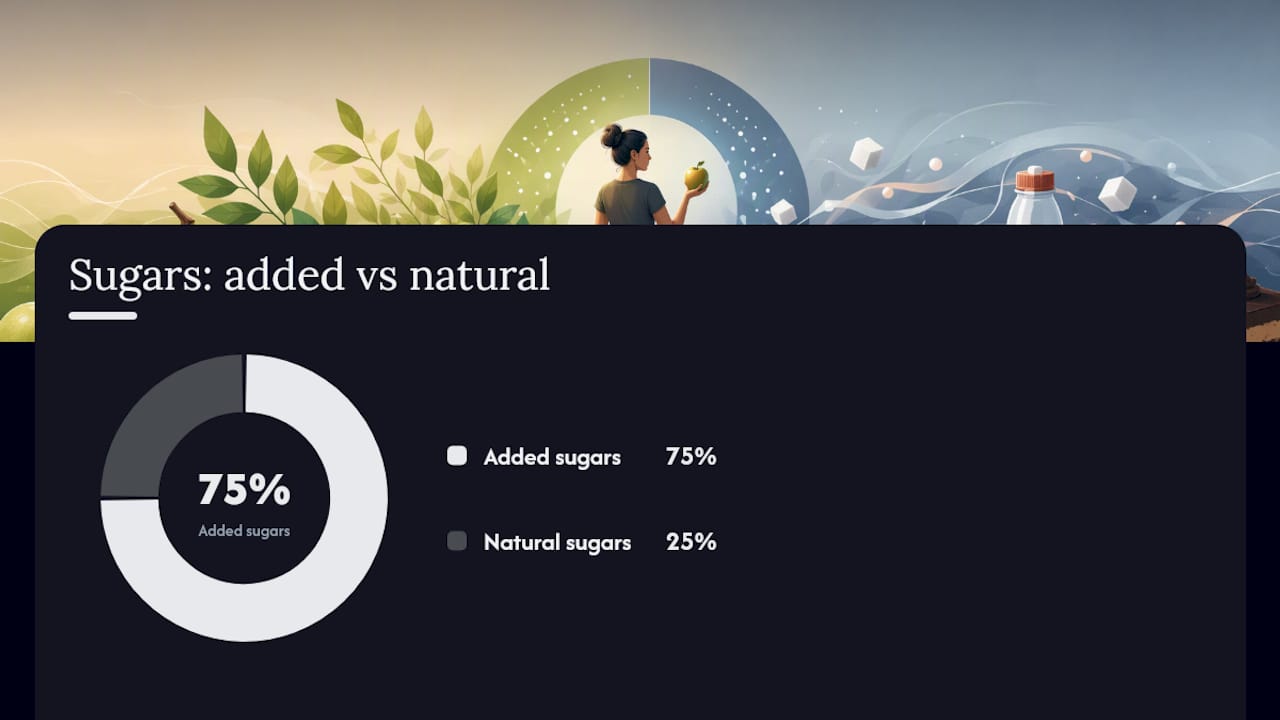
Added sugars get their own line beneath total sugars, and that distinction exists on purpose: it was added to the label specifically to separate sugar that occurs naturally in something like fruit or milk from sugar poured in during processing. A plain yogurt might show 12 grams of total sugars and 0 grams of added sugars. A flavored version of the same yogurt might show 12 grams total and 9 of those added.
- Total fat, saturated fat, trans fat: track saturated and trans fat closely; total fat matters less for most diet goals.
- Total carbohydrate: includes fiber and sugars, so don’t panic at the top-line number alone.
- Added sugars: the number to watch if you’re managing weight, blood sugar, or general diet quality.
- Protein: listed by weight, but its %DV is rarely printed because protein needs vary so much person to person.
Pro Tip: If a label’s added sugars line looks suspiciously low, flip to the ingredients list. Sugar hiding under names like cane syrup, dextrose, or maltose still counts, it just isn’t obvious from the Nutrition Facts panel alone.
Which Vitamins and Minerals Are Required, and What Does %DV Mean?
U.S. labels are required to list exactly four micronutrients: vitamin D, calcium, iron, and potassium. Everything else, vitamin C, magnesium, B vitamins, is voluntary, so a package that highlights them is choosing to, often because it’s a selling point worth advertising.
The Percent Daily Value column tells you how much of a day’s worth of a nutrient one serving provides, based on a 2,000-calorie reference diet. That reference doesn’t apply exactly to everyone, but it gives you a consistent yardstick across products.
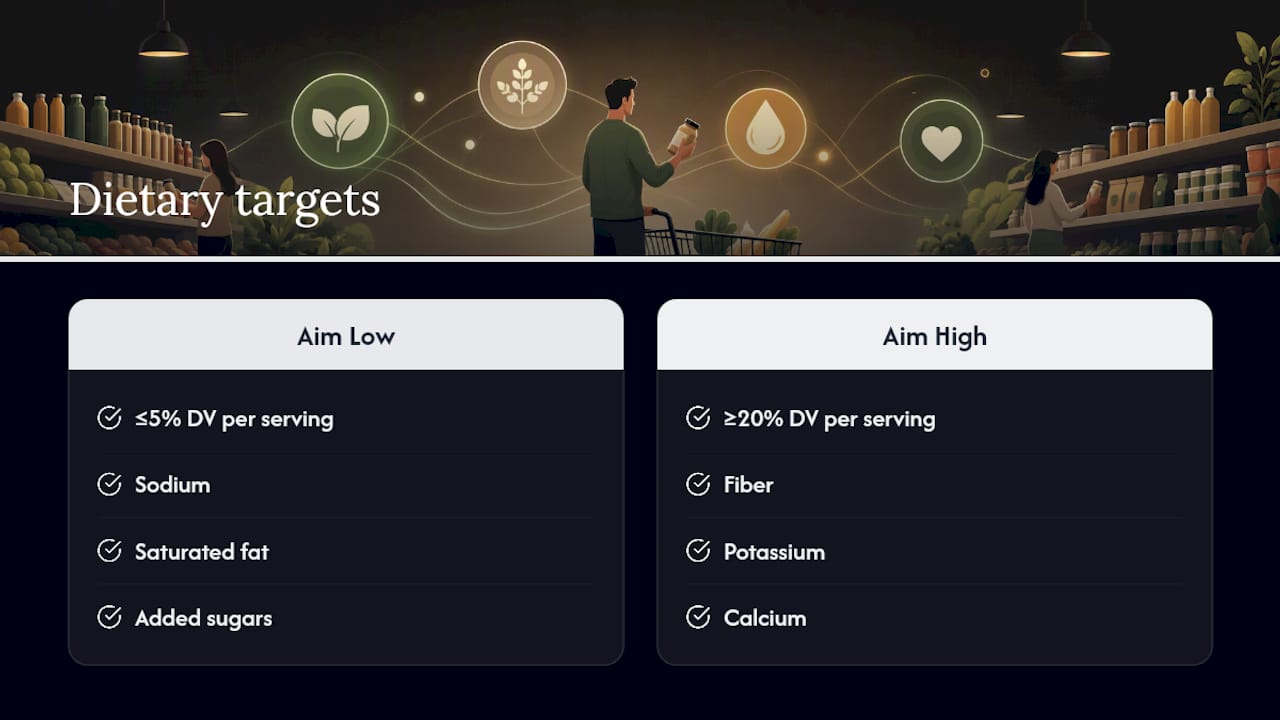
The FDA’s own guidance boils the practical use of %DV down to a simple rule: 5% DV or less per serving counts as low, and 20% DV or more counts as high. Aim low on sodium, saturated fat, and added sugars. Aim high on fiber, potassium, calcium, and vitamin D.
For sodium specifically, %DV alone can undersell how much salt you’re getting, since salt is roughly 40% sodium by weight. If you’re managing blood pressure or kidney function, look at the actual milligram number on the sodium line instead of relying on the percentage, and keep the commonly cited 2,300 mg daily sodium ceiling in mind as you total up a day’s meals.
How Do I Read the Ingredients List and Spot Allergens?
Ingredients are listed in descending order by weight, so whatever sits first makes up the largest share of the product. If sugar or a sugar derivative is one of the first three ingredients, that food is, by definition, mostly sugar, no matter what the front of the package claims.
Sugar and salt hide under a lot of aliases, and food companies aren’t obligated to make them easy to spot:
- Sugar aliases: cane syrup, corn syrup, dextrose, fructose, maltose, barley malt, honey, agave nectar.
- Salt aliases: sodium chloride, monosodium glutamate, sodium nitrite, disodium phosphate.
Manufacturers sometimes list several sugar sources separately, cane sugar, corn syrup, and honey, say, rather than combining them, which keeps each individual ingredient lower on the list even though the combined sugar weight is substantial. Read the full list, not just the first line, if sugar content matters to you.
Allergens get separate, mandatory treatment under the Food Allergen Labeling and Consumer Protection Act, which requires a “contains” statement declaring any of the nine major allergens: milk, fish, crustacean shellfish, tree nuts, peanuts, wheat, eggs, soybeans, and sesame. That statement usually sits directly below or beside the ingredients list, in bold or a clearly separated line.
Are Front-of-Package Claims the Same as Nutrition Facts?
No, and this is where a lot of shoppers get misled. Front-of-package claims like “low fat,” “reduced sodium,” or “good source of fiber” are voluntary and selective by design, a manufacturer can highlight one favorable trait while staying quiet about a less flattering one on the same product.
The Nutrition Facts panel, on the other hand, is regulated and standardized. Terms like “low fat,” “reduced,” and “good source” do carry specific legal thresholds when they’re used, but that doesn’t stop the rest of the packaging from being pure marketing. Front-of-package badges and traffic-light icons in particular can be misleading shortcuts that skip past the nuance the actual panel provides. Always cross-check a front claim against the panel and ingredients list before trusting it.
How Can I Use Labels to Compare Products in the Store?
Comparing two products fast doesn’t require a nutrition degree, just a consistent order of operations:
- Check the serving size on both products first, comparisons only work if you’re looking at equal portions.
- Compare calories for that same standardized serving.
- Scan %DV for sodium, saturated fat, and added sugars, aiming for the low end (5% or under) on all three.
- Look for higher fiber and relevant micronutrients like calcium, iron, or potassium where they matter for your goals.
- Skim the ingredients list for added sugars and sodium sources hiding past the first few items.
Two quick examples: swap a granola bar with 12 grams of added sugar for one with 4, and you’ve cut roughly a teaspoon of added sugar without changing your snack routine at all. Or compare two jars of pasta sauce, one might carry 480 mg of sodium per serving, the other 220, same shelf, same price range, very different %DV.
Pro Tip: Keep a mental “top three” checklist, sodium, added sugars, fiber, and you’ll cut comparison time in half without needing to read every single line.
Why Labels Differ Between Manufacturers (a Behind-the-Scenes View)
Manufacturers in freeze-dried candy production see firsthand why labels vary so much between brands. Ingredient-splitting isn’t always deceptive, sometimes it just reflects the actual recipe, but it does change how the list reads. Dual-column formatting kicks in for products likely eaten in one sitting, and rules differ by country entirely, which is why compliance has to be built around the specific market a product ships to, not assumed from one country’s standard. A labeling requirements checklist walks through those distinctions for manufacturers navigating this.
What Do Expiration and Best-By Dates Actually Tell You?
“Best by,” “use by,” and “sell by” dates get treated as interchangeable warnings, but they mean different things, and none of them function as a hard safety cutoff for most shelf-stable foods.
“Best by” or “best if used by” is a quality marker, the manufacturer’s estimate of when flavor, texture, or crunch starts declining, not a signal that the food turns dangerous the next day. A bag of freeze-dried candy or a box of crackers past its best-by date is very likely still perfectly fine to eat; it just might taste slightly less fresh.
“Use by” tends to carry more weight, especially on perishable items like dairy, deli meat, or fresh poultry, where bacterial growth becomes a genuine concern after the date passes. “Sell by” is aimed at retailers, telling stores when to pull stock from shelves, and it’s not really meant as consumer guidance at all, though plenty of shoppers treat it that way.
The one major exception is infant formula, where the date on the package is a legally enforced safety deadline, not a quality suggestion, because nutrient content in formula can degrade below labeled levels after that point.
For everything else, use your senses alongside the date. Smell, texture, and appearance tell you more about actual spoilage than a printed date ever will, especially for shelf-stable snacks and dry goods that can stay safe well past their printed window.
What Do Recycling Symbols and Sustainability Claims Really Mean?
Recycling symbols and sustainability language on packaging aren’t part of the regulated Nutrition Facts system at all, they run on a completely separate set of rules, and that separation catches a lot of shoppers off guard.
The chasing-arrows triangle with a number inside tells you what type of plastic resin the package is made from, not whether your local recycling program actually accepts it. Plenty of packages carry that symbol even in areas where the specific plastic type has nowhere to go but a landfill. It’s a material identifier, not a promise.
Claims like “eco-friendly,” “sustainably sourced,” or “made with recycled materials” are largely voluntary marketing language, similar in spirit to front-of-package nutrition claims. Some carry third-party certification behind them; plenty don’t, and there’s no single universal standard forcing every brand to prove sustainability claims before printing them.
If sustainability genuinely factors into your purchasing decisions, look for a specific, named certification rather than a vague green leaf icon or a generic phrase. A named standard with a verification body behind it means something. A leaf graphic a designer added because it looked nice does not.
Packaging materials also vary by product category and by country, so a compostable pouch in one market might be a standard plastic laminate in another, even for what looks like the same product on the shelf.
What Are the Rules for Country of Origin Labeling?
Country of origin labeling tells you where a food was grown, raised, or substantially transformed, and the rules genuinely differ by product category and by the country you’re shopping in, which makes this one of the more inconsistent corners of food labeling.
In the United States, mandatory country-of-origin labeling applies mainly to fresh meat, fish, shellfish, and certain produce, largely a legacy of the original Country of Origin Labeling law, though the scope has shifted over the years following trade disputes and legislative changes. Packaged and processed foods generally aren’t required to declare origin the same way fresh commodities are, which is why a can of soup might not tell you where any single ingredient came from.
Canada applies its own origin-labeling framework, and imported products sold there follow different disclosure rules than domestically produced goods, another reminder that “food label rules” isn’t one universal standard, it’s a patchwork that shifts at every border.
For shoppers who care specifically about where their food comes from, whether for supporting local agriculture, avoiding certain trade regions, or food safety concerns tied to specific countries, checking for an explicit origin statement matters more than assuming a lack of one means domestic production. Silence on origin usually just means the category isn’t required to disclose it, not that the product is local.
What Do “Organic” and “Non-GMO” Labels Actually Certify?
“Organic” and “Non-GMO” are two of the most visually similar label claims on a shelf, and they certify completely different things, a distinction that gets lost in the marketing noise around both.
A certified organic claim means a product met a defined set of agricultural standards, restrictions on synthetic pesticides, fertilizers, and specific farming practices, verified by an accredited certifying body. In the U.S., that verification shows up as the USDA Organic seal, a specific, regulated mark that can’t legally appear on a package without third-party certification behind it.
Non-GMO is a separate claim entirely. It addresses whether genetically modified organisms were used in producing the ingredients, nothing about pesticide use, farming method, or animal welfare. A product can be Non-GMO Project Verified, the most recognized third-party mark for this claim, while still using conventional, non-organic farming practices. Conversely, a certified organic product is generally also non-GMO by definition, since genetic modification isn’t permitted under organic standards, but the reverse isn’t true.
Both certifications rely on a visible seal from a real certifying body, not just text on the package. If you see the word “organic” or “non-GMO” with no accompanying mark from an actual certification program, treat it as a marketing claim rather than a verified standard, the same way you’d treat any other front-of-package claim.
A Few Honest Thoughts on Building the Label-Reading Habit
Nobody reads every line on every label forever, and trying to will burn you out fast. Pick one habit, checking added sugars, or scanning for your top allergen, and let it become automatic before adding another. Labels work best as a tool for better decisions, not a test you’re failing every time you buy something imperfect.
— Chadi
Need Help Meeting Labeling Requirements for Your Own Product?
If you manufacture packaged snacks, candy, or other consumer goods and the idea of getting Nutrition Facts panels, allergen statements, and ingredient lists right for every market you sell into sounds like its own full-time job, there are companies that handle this complex work for businesses including their own product lines.

Some companies offer private label, co-packing, and packaging services built for manufacturers and retailers who need compliant labeling without building that expertise in-house from scratch. These services target businesses producing packaged food who need a partner that understands how allergen declarations, ingredient ordering, and format rules apply across different markets. If that’s your situation, reaching out through the private label services page can give a sense of what compliant, ready-to-ship packaging might look like for a product line.
Where to Check the Official Rules Yourself
- FDA guidance on reading Nutrition Facts labels
- FDA allergen labeling requirements
- NIA/NIH guide to reading food and beverage labels
- FDA Food Labeling Guide (full PDF)
- Harvard T.H. Chan food label guide
Sources
- How to Understand and Use the Nutrition Facts Label | FDA
- Food allergies | FDA
- How to read food and beverage labels | NIA/NIH
FAQ
What Is Legally Required on a Food Label?
U.S. law requires a Nutrition Facts panel with serving size, calories, mandatory nutrients like fat, sodium, and sugars, a percent Daily Value column, an ingredients list ordered by weight, and a statement declaring any of the nine major allergens present.
What Isn’t Required on a Food Label?
Voluntary vitamins and minerals beyond vitamin D, calcium, iron, and potassium aren’t required, and neither are front-of-package claims, sustainability badges, or non-GMO seals, all of those are optional marketing additions layered on top of the regulated panel.
Are There New Food Labeling Requirements Coming?
Labeling rules do get updated periodically at the federal level, including past changes to serving sizes and the addition of the added sugars line, so it’s worth checking FDA guidance directly for the most current requirements rather than relying on outdated summaries.
What’s Not Included on a Food Label That People Often Assume Is?
A universal country-of-origin statement, mandatory sustainability certification, and a guaranteed freshness safety date beyond infant formula are not standard requirements, origin labeling and sustainability claims vary heavily by category and country rather than applying uniformly.
Can Space-man Help My Business With Compliant Labeling?
Some companies offer private label, co-packing, and packaging services to assist businesses in meeting labeling requirements on packaged food products across different markets.