

TL;DR:
- To ensure sustainable packaging for freeze-dried candy, brands should right-size packaging, verify barrier material performance, and run short pilot tests. Certifications, such as FSC and compostability standards, are essential before scaling production, alongside thorough performance testing of barrier and thermal qualities. A phased approach involving audits, pilot runs, and supplier vetting helps minimize risks and build reliable, eco-friendly packaging systems.
The fastest, lowest-risk path to sustainable packaging for freeze-dried candy is this: right-size your packaging first, select barrier materials verified by third-party standards, then run a short pilot before committing to a full rollout. That sequence alone prevents most costly mistakes.
Here’s your immediate action checklist:
- Run a packaging audit — measure current SKU dimensions, void fill, and carton utilization before spending a dollar on new materials.
- Request vendor LCAs and FDA food-contact statements — any supplier who hesitates on this is a red flag.
- Pilot 2–3 candidate materials on one SKU — validate barrier performance (WVTR/O2TR) with a 4-week accelerated shelf test before scaling.
- Collect certifications upfront — FSC for fiber-based components, BPI or ASTM D6400/D6868 for compostable claims, and supplier COAs for everything else.
- Contact a co-packer like Space-man to confirm machinery compatibility before ordering materials in volume.
Table of Contents
- Why does eco packaging matter for freeze-dried candy specifically?
- What materials actually work for freeze-dried foods?
- How do you test and validate eco packaging before scaling?
- What operational changes does an eco-packaging rollout actually require?
- How do you choose suppliers and eco-aware co-packers?
- What does a realistic rollout timeline look like?
- Key Takeaways
- The part most brands get wrong about green packaging
- Space-man can help you pilot eco packaging for freeze-dried candy
- Useful sources for eco packaging standards and testing
Why does eco packaging matter for freeze-dried candy specifically?
Sustainability matters for freeze-dried candy only when product protection is preserved. Moisture and oxygen are the enemies of freeze-dried texture. A pouch that composts beautifully but lets in humidity will destroy your product and your reviews.
The business case is real, though. According to FSC, many consumers now actively seek out sustainable packaging. Retailers are responding: extended producer responsibility (EPR) legislation is expanding across US states, and buyers at major grocery chains increasingly ask for documented sustainability credentials before listing a product.
Greener packaging also affects your bottom line in ways that aren’t obvious. Lighter, right-sized shipments reduce dimensional weight charges, which adds up fast on high-volume candy SKUs. Damage rates drop when packaging fits the product properly. And eco-conscious shoppers respond to visible sustainability signals on shelf.
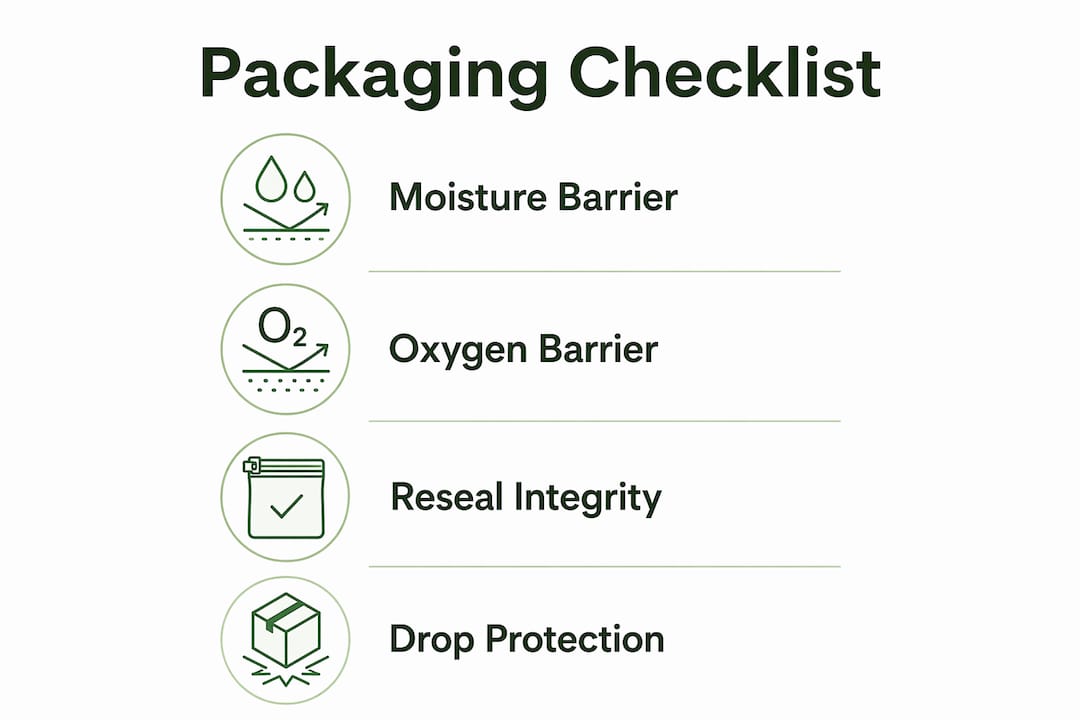
For freeze-dried candy specifically, your packaging checklist needs to cover four performance areas: WVTR (moisture vapor transmission rate), O2TR (oxygen transmission rate), resealable barrier pouches for retail, and thermal performance for summer transit.
What materials actually work for freeze-dried foods?
Choose materials that deliver required barrier performance first, then layer in recycled content or compostability that is verifiable by third-party standards. Circularity is the goal, but it cannot come at the cost of shelf life.
| Material | Barrier Performance | Eco Credentials | Key Limitation |
|---|---|---|---|
| Aluminum/film laminates | Excellent WVTR/O2TR | Recyclable where accepted | Metallized layers block most recycling streams |
| High-barrier paper/foil laminates | Good to excellent | FSC-certifiable fiber | Foil layer complicates end-of-life |
| Recyclable mono-polymer pouches | Good (PE or PP) | Curbside recyclable in many US markets | Lower barrier than foil; verify for your shelf-life target |
| Certified compostable pouches | Moderate | BPI/ASTM D6400 certified | Requires industrial composting; check local availability |
| Molded pulp / mycelium secondary | N/A (secondary only) | Home compostable | Custom molds add lead time and tooling cost |
| Thermal liners (bio-based) | Excellent for cold chain | ISTA-certified recyclable options | Higher unit cost than EPS |
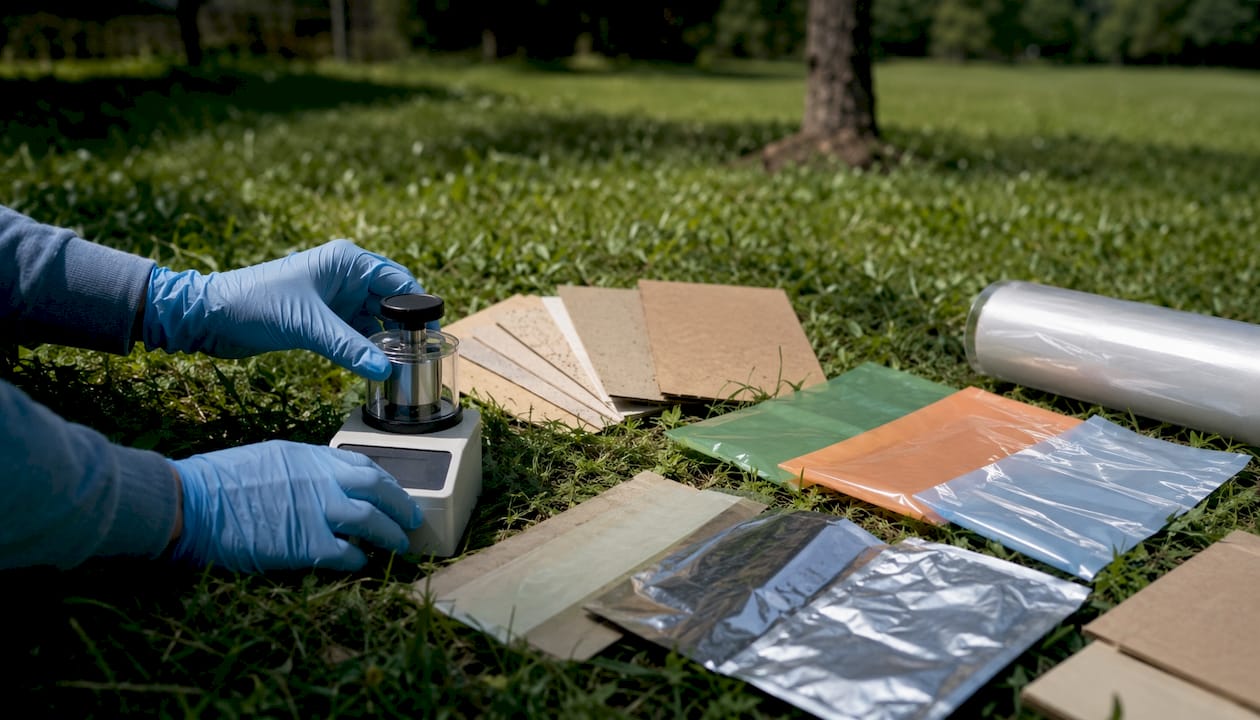
Mycelium-based packaging can match EPS foam’s protective and insulating properties while being home-compostable, making it a strong option for secondary protection in gift or display boxes.
have demonstrated EPS-level cushioning performance in real-world shipping scenarios.
Pro Tip: “Home compostable” on a label does not mean your customer’s city accepts it. Check municipal composting infrastructure in your top three shipping zip codes before printing that claim on your pouch.
For sustainable snack packaging, the sweet spot right now is a mono-polymer high-barrier pouch with recycled content, paired with FSC-certified secondary boxes. You get documented circularity without sacrificing the barrier specs freeze-dried candy demands.
How do you test and validate eco packaging before scaling?
Validate barrier and handling performance with a 4-week accelerated shelf protocol plus standard ISTA-style drop and impact tests before committing to volume. Skipping this step is where brands lose money.
Step-by-step pilot protocol:
- Select 3 candidate materials and produce 30 filled units per material (plus 10 control units in your current packaging).
- Store samples at 40°C / 75% relative humidity for 4 weeks — standard accelerated aging for shelf-stable foods.
- Measure WVTR and O2TR at week 0, week 2, and week 4 using a calibrated transmission rate instrument.
- Conduct reseal cycle tests (minimum 10 open/close cycles per pouch) and check for zipper failure or delamination.
- Run ISTA 2A or equivalent drop tests from 30 inches on filled, sealed units.
- Perform sensory checks at week 4: texture, crunch, color, and off-odor evaluation by a trained panel.
Data capture template:
| Sample ID | Material | WVTR (g/m²/day) | O2TR (cc/m²/day) | Weight Change (%) | Reseal Integrity | Drop Test Result | Sensory Pass/Fail |
|---|---|---|---|---|---|---|---|
| — | Mono-PE pouch | — | — | — | — | — | — |
| — | Compostable film | — | — | — | — | — | — |
| — | Foil laminate | — | — | — | — | — | — |
| CTL | Current pack | — | — | — | — | — | — |
Acceptance gates: Any material showing more than 2% weight gain, failed reseal at cycle 5 or earlier, or sensory failure at week 4 gets rejected. Pass all three gates before moving to production trials.
What operational changes does an eco-packaging rollout actually require?
A packaging audit and right-sizing deliver the largest sustainability gains and often the fastest ROI. Do that before buying premium materials.
“Switching to a smaller standard carton for a single SKU often outperforms a custom eco-box upgrade on both cost and sustainability metrics. Right-sizing is unglamorous, but it works.” — Right-size packaging guidance
Your audit should capture: SKU dimensions vs. current box inner dimensions, void fill volume per shipment, packaging cost per unit, damage rate by carrier zone, storage density, and carton utilization percentage. Minimalist packaging that removes unnecessary void fill reduces both material spend and dimensional weight charges simultaneously.
Machinery compatibility is where rollouts stall. Paper-backed tapes and compostable films often require adjusted tension and sealing temperatures on automated case sealers. Test new tape materials on your exact equipment before ordering a pallet. Pouch-forming specs, fill tolerances, and zipper-seal settings may all need tweaking for compostable films, which behave differently from conventional polyethylene under heat.
Run small production batches through your line or your co-packer’s line, track throughput and reject rates, and only then calculate the true cost delta. For a practical overview of reducing packaging waste at the operational level, the process is more iterative than most brands expect.
How do you choose suppliers and eco-aware co-packers?
Pick partners who provide transparent documentation and are willing to run joint pilots. A supplier who can’t produce a COA within 48 hours of your request is telling you something.
Questions to ask every supplier and co-packer:
- Can you provide FDA food-contact compliance statements for each material?
- Do you have FSC chain-of-custody certification for fiber components?
- Can you share BPI or ASTM D6400/D6868 certificates for any compostable materials?
- What are your standard MOQs and sample lead times?
- Do you have LCA summaries or environmental product declarations available?
- Can you run ISTA-equivalent drop and thermal tests, or do you work with a certified lab?
- What are your return and recall procedures for out-of-spec materials?
Trust signals to require before purchase: third-party compostability certificates (BPI or TÜV), FSC chain-of-custody documentation, ISO 22000 or GMP food-safety certification for converters, and documented drop/thermal test results from a recognized lab.
Red flags: vague “eco-friendly” claims with no certification numbers, refusal to share COAs or test data, inconsistent supply timelines, or materials that your production team flags as incompatible with existing sealing equipment.
What does a realistic rollout timeline look like?
A three-phase rollout over 8–12 weeks minimizes risk and keeps production stable. Trying to switch all SKUs at once is how brands end up with a warehouse full of packaging that fails on line.
“Stagger pilots across SKUs. It isolates packaging variables, limits disruption to fulfillment, and gives you clean data on what actually caused any performance issue.” — Chadi, Space-man
Phase 1 — Audit and vendor selection (weeks 1–3): Complete the packaging audit, shortlist 2–3 material candidates, request COAs and FDA statements, confirm machinery compatibility with your co-packer.
Phase 2 — Pilot and testing (weeks 4–8): Run the 4-week accelerated shelf protocol on your chosen SKU. Conduct drop tests. Evaluate sensory results. Set a go/no-go gate at week 8.
Phase 3 — Scale (weeks 9–12): If the pilot passes all acceptance gates, place a production order. Roll out to additional SKUs sequentially, applying lessons from Phase 1.
Pro Tip: Keep your current packaging running in parallel during Phase 2. If the pilot fails a gate, you have zero fulfillment disruption while you iterate.
Key Takeaways
Barrier performance comes first, circularity second, and no material should reach your production line without a validated 4-week shelf test and documented supplier certifications.
| Point | Details |
|---|---|
| Audit before you buy | Measure SKU dimensions, void fill, and carton utilization before selecting new materials. |
| Barrier specs are non-negotiable | Verify WVTR and O2TR for every candidate material before committing to a pilot. |
| Certifications to collect | Require FDA food-contact statements, FSC (fiber), and BPI/ASTM D6400 (compostables) from every supplier. |
| Three-phase rollout | An 8–12 week audit-to-scale timeline keeps production stable and gives clean pilot data. |
| Space-man as a pilot partner | Space-man offers co-packing and packaging services for freeze-dried candy, including pilot runs with machinery compatibility checks. |
The part most brands get wrong about green packaging
The conventional wisdom says: find a certified compostable pouch, slap a green label on it, and call it sustainable. That’s not wrong exactly, it’s just incomplete in a way that costs money.
The brands that actually succeed with eco packaging transitions are the ones that treat it as an operations project first and a marketing project second. They audit before they buy. They test on their actual production line, not in a lab that doesn’t reflect their fill speeds or sealing temperatures. They ask for LCAs and actually read them, because a compostable film manufactured with high-emission processes and shipped from overseas can have a worse lifecycle footprint than the conventional film it replaces.
The other thing worth saying plainly: rightsizing is boring, and it consistently outperforms premium material swaps on both cost and environmental impact. A smaller carton that fits your product without void fill beats a custom mycelium insert every time on ROI, especially in the first 12 months of a sustainability program. Start there. The fancier materials can come in Phase 3.
Space-man can help you pilot eco packaging for freeze-dried candy
If you’ve read this far and you’re thinking “I need a co-packer who actually understands freeze-dried candy packaging,” that’s exactly what Space-man does. Based in Canada and serving North American brands, Space-man offers private-label, co-packing, and packaging services specifically for freeze-dried candy and shelf-stable consumer food products, including small-volume pilot runs to test new materials before you commit to scale.
Cross-border lead times and US retailer spec confirmations are part of the conversation from day one. Request a pilot quote or sample kit directly through Space-man’s co-packing page, and bring your current packaging specs so the team can flag compatibility issues before they become production problems.
Useful sources for eco packaging standards and testing
- FDA food-contact guidance: FDA indirect and direct food-contact materials — the primary US authority for food-contact compliance statements.
- FSC certification: Forest Stewardship Council — chain-of-custody and fiber sourcing verification for paper and cardboard components.
- BPI compostability: Biodegradable Products Institute — the leading US certifier for ASTM D6400/D6868 compostable materials.
- ISTA testing protocols: International Safe Transit Association — drop, vibration, and thermal test standards for shipping validation.
- Sustainable packaging options overview: EcoEnclose — practical supplier examples and retailer/EPR compliance guidance for US brands.
- Thermal liner alternatives: TemperPack — ISTA-certified recyclable and compostable thermal solutions for cold-chain shipments.
- Operator sustainability guide: Wild Foodz 2026 sustainability guide — practical implementation notes for food service operators navigating sustainability transitions.
- LCA requests: Ask suppliers for Life Cycle Assessment summaries or environmental product declarations before purchase. LCA methodology overview — useful background on what LCA data actually tells you and what to watch for in supplier-provided summaries.
- Space-man blog: Eco packaging for food businesses — practical guides on sustainable packaging options for freeze-dried candy and consumer food brands.