

TL;DR:
- Co packing in Canada involves third-party facilities handling product packaging, labeling, and production under specific compliance standards.
- Proper preparation, clear contracts, and meticulous label control are essential to avoid costly disputes and regulatory penalties.
- Partnering with certified co-packers like Space-man offers integrated production and compliance support for brands scaling in the Canadian market.
Thinking that co packing Canada is as simple as finding a facility with open floor space and signing on the dotted line? A lot of entrepreneurs find out the hard way that it’s not. Between bilingual labeling requirements, the new 2026 front-of-package nutrition rules, and contracts that can quietly put you on the hook for reserved capacity fees, the difference between a smooth co-packing partnership and a costly mess usually comes down to preparation. This guide covers what the good ones know before they start.
Table of Contents
- Key takeaways
- What co packing services in Canada actually cover
- Canadian food labeling compliance for co-packed products
- Contractual risks in Canadian co-packing agreements
- Truthful origin claims and CFIA enforcement
- How to choose the right co-packer in Canada
- My honest take on co-packing in Canada
- Scale your product with Space-man’s co-packing services
- FAQ
Key takeaways
| Point | Details |
|---|---|
| Compliance is non-negotiable | Canadian co-packed products must meet CFIA and Health Canada labeling rules, including bilingual text and 2026 FOP symbols. |
| Contracts set the tone | Poorly written co-packing agreements cause most production disputes. Define quality standards, forecasts, and capacity terms upfront. |
| Origin claims carry real risk | CFIA has issued financial penalties since April 2025 for misleading “Canadian” origin labels. Documentation is your protection. |
| Certifications matter | Look for GMP and HACCP-certified facilities to protect product quality and regulatory standing. |
| Label version control saves money | Controlled artwork sign-offs before production runs prevent expensive reworks and compliance failures. |
What co packing services in Canada actually cover
Co-packing, short for contract packaging, is when a third-party facility handles the packaging of your product under your brand. But the scope of what co packing services Canada providers offer varies more than most people expect.
At the basic end, you have repacking: moving product from bulk into retail-ready units. From there, services expand into kitting (bundling multiple SKUs into one retail package), labeling, display prep, and in some cases, light manufacturing or formulation support. The range of co packaging solutions available in Canada means you can find partners who handle a single step in your supply chain or the whole thing from production through to fulfillment.
Geography matters here too. Canada is a large country with distinct distribution hubs, and co-packers in strategic locations like Vancouver, Toronto, and Winnipeg often couple their services with warehousing, logistics, and order fulfillment under one roof. That consolidation reduces lead times and simplifies your logistics considerably. If you are shipping to retail chains across multiple provinces, proximity to major distribution centers can quietly save you real money.
When evaluating co packing companies Canada has to offer, certifications should be near the top of your checklist:
- GMP (Good Manufacturing Practice): Confirms the facility follows sanitary production standards.
- HACCP (Hazard Analysis Critical Control Points): Required for food safety management in Canada.
- SQF or BRC certification: Higher-tier food safety standards preferred by many large retailers.
- Temperature and allergen controls: Especially relevant for food and candy producers.
Pro Tip: Ask co-packers for their most recent third-party audit report. A facility that is hesitant to share that documentation is a facility worth reconsidering.
Canadian food labeling compliance for co-packed products
This is where things get serious fast. Canada’s labeling rules are among the most detailed in the world, and non-compliance is not a minor inconvenience.

Food labeling in Canada is mandatory in both English and French for all retail products. That means your ingredient list, allergen declarations, nutrition facts panel, and net quantity statements must all appear in both languages, formatted correctly, and in the right font sizes. There is no shortcut here, and the rules apply whether your product is made in Canada or imported.
The regulatory picture involves two authorities. Health Canada oversees safety and nutrition, while CFIA enforces label accuracy and packaging regulations. A co-packer with no experience navigating both can leave your brand exposed. It is worth checking how your shortlisted partners handle label review and whether they have experience working within these frameworks directly.
Then there is the 2026 change that caught a lot of brands off guard. Starting January 1, 2026, prepackaged foods high in saturated fat, sugars, or sodium are now required to display a front-of-package (FOP) nutrition symbol. This applies to a wide range of snack, candy, and convenience products. If your product crosses the thresholds, that symbol must appear on your packaging or you are not in compliance.
Here is a snapshot of what the core labeling requirements look like in practice:
| Label element | Requirement | Risk if missing |
|---|---|---|
| Bilingual text | All core info in English and French | CFIA enforcement, recall risk |
| FOP nutrition symbol | Required if nutrient thresholds are met (2026) | Non-compliance penalties |
| Allergen declarations | Clear, standardized language required | Health risk, legal liability |
| Manufacturer/distributor name and address | Must be present for traceability purposes | Regulatory violation |
“Without clear version control, systemic label errors can cause expensive production delays.” Source: Food in Canada
Label version control is the practical answer to this. Controlled label artwork with mandatory sign-offs before each production run is not bureaucratic overkill. It is the difference between catching an error before printing and discovering it after 10,000 bags are sealed. Build this into your workflow with your co-packer from day one.
Pro Tip: Use a dedicated label management document that tracks every version, change date, and approval signature. Share it with your co-packer and require written confirmation before any new run begins. You can find a deeper breakdown of these requirements in this guide to Canadian food labeling requirements.
Contractual risks in Canadian co-packing agreements
Here is something you will not read on most co-packer websites: most co-packing disputes in Canada do not happen because someone acted in bad faith. They happen because the contract left too many things ambiguous.
The most common problem areas include quality standards, order forecasting, capacity allocation, and inventory ownership. If your contract says products must meet “acceptable quality,” that phrase will mean something different to you than it does to the co-packer when a batch comes out wrong. Defining quality in measurable, specific terms, things like acceptable defect rates, fill weights, and seal integrity standards, is the only way to make those clauses enforceable.
Here is how to approach the key areas of a co-packing contract:
- Quality acceptance standards: Define what “acceptable” means with numbers, not adjectives. Specify reject criteria, testing methods, and who bears the cost of non-conforming batches.
- Forecast-to-order logic: Pre-agreeing on forecasting provisions helps both parties align on production schedules and avoids capacity fees triggered by sudden order changes.
- Capacity commitments: Get written confirmation of how your runs are prioritized, especially during peak seasons when co-packing facilities fill up fast.
- Inventory ownership and risk: Clarify who owns raw materials and finished goods at each stage. If there is a production delay or a recall, you need to know exactly where liability sits.
- Exit and termination terms: Define minimum notice periods, transition support obligations, and what happens to your tooling, artwork, or custom packaging materials if you leave.
Pro Tip: Have a lawyer with food industry experience review your co-packing agreement before signing. Generic contract templates miss the nuances of Canadian food manufacturing relationships. The cost of a review is far less than the cost of a dispute.
For more on co-packing arrangements in Toronto and how these contract elements play out in practice, that resource goes deeper on the scaling side.
Truthful origin claims and CFIA enforcement
If your product says “Made in Canada” or implies Canadian origin in any way, you need solid documentation to back it up. This is not a gray area anymore.
Since April 2025, CFIA has issued financial penalties totaling $47,000 for non-compliant country-of-origin claims on food products. The penalties account for factors like compliance history and whether negligence was involved. And with co-packing operations, the complexity increases because your product may be assembled in Canada using ingredients sourced internationally.
“Accurate country-of-origin claims require co-packing operations to align labeling with ingredient sourcing records; failure to comply risks CFIA enforcement.” Source: Canada.ca
Here is what you need to have in place if you are making any origin-related claim:
- Ingredient sourcing records: Know where every ingredient comes from and document it. Your co-packer should be able to provide certificates of origin for inputs.
- Production location records: Maintain clear records showing where packaging, assembly, and manufacturing occurred.
- Label review against sourcing data: Before finalizing any label copy referencing Canadian origin, cross-check it against your actual sourcing documentation.
- Co-packer traceability agreements: Your contract should require the co-packer to maintain and share traceability records on request.
The financial penalties are one thing. The reputational damage from a public CFIA enforcement notice is another. CFIA enforces origin claims by aligning co-packing workflows with documentary evidence, which means your internal record-keeping system needs to match what is on your label.
How to choose the right co-packer in Canada
Choosing the right co-packing partner is one of the most consequential decisions a food brand makes. Picking a co-packer is not purely a production decision. It is a compliance and brand integrity decision governed by Canadian labeling law.
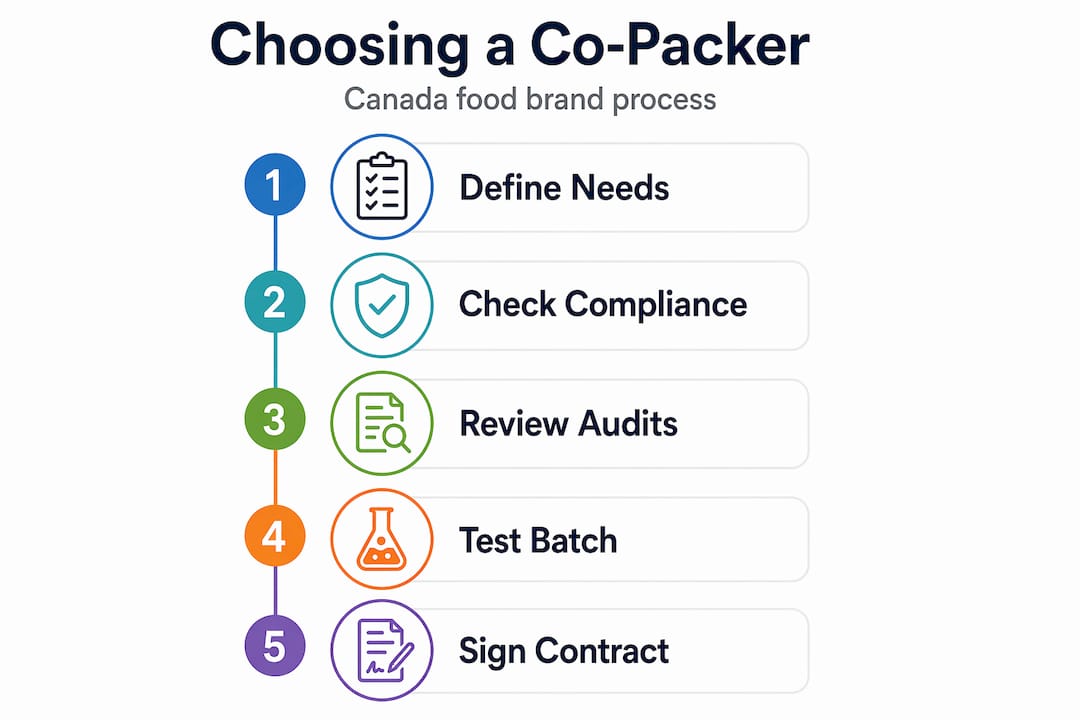
Here is a practical comparison of what to look for versus what to watch out for:
| What a strong co-packer looks like | Red flags to watch for |
|---|---|
| Current HACCP or SQF certification on file | Vague or outdated audit documentation |
| Experience with bilingual Canadian labeling | No in-house label review process |
| Clear capacity and lead time commitments | Evasive answers about production scheduling |
| Proactive communication on compliance changes | No awareness of 2026 FOP labeling rules |
| Transparent pricing with no hidden minimums | Opaque fee structures or verbal-only agreements |
Once you have found a partner that checks those boxes, the ongoing relationship matters just as much as the selection process. Successful co-packing partnerships center on transparency, adherence to standards, and proactive problem-solving. Build in regular check-ins, share your sales forecasts early, and do not wait until a run is scheduled to flag a label change.
For food entrepreneurs thinking about how co packing options Canada offers can integrate with retail distribution, check out this updated breakdown of snack distribution regulations for 2026.
Pro Tip: Start with a pilot run before committing to a long-term volume agreement. A smaller first order reveals how a co-packer actually operates under real production conditions, not just how they present in a sales meeting.
My honest take on co-packing in Canada
I have seen a pattern repeat itself more times than I can count. A brand owner finds a co-packer, feels good about the tour, and signs an agreement that looks fine on the surface. Then the first production run has an issue, and suddenly nobody can agree on what “agreed quality” actually meant, or whose responsibility it is to fix a label error discovered mid-run.
What I have learned is that the problems almost never start at the production level. They start at the contract and process-setup level. Most co-packing issues emerge from initial contract structures, and by the time a dispute surfaces, both sides are already frustrated.
The other thing people consistently underestimate is label version control. I cannot stress this enough. Every label change, no matter how minor it seems, needs to go through a documented sign-off before it hits the production floor. One small update to an allergen statement that does not get confirmed in writing can trigger a full product recall. That is not hypothetical.
My contrarian take on compliance: stop treating it as a legal obligation you fulfill reluctantly and start treating it as a competitive advantage. Retailers, particularly national chains, increasingly audit their suppliers’ compliance histories. A brand with clean documentation, verified origin claims, and up-to-date labeling is a brand that gets to stay on the shelf.
Work with co-packers the way you would work with a serious business partner. Be honest about your volume projections. Share your growth plans. Ask hard questions early, because that is far less uncomfortable than asking them after something goes wrong.
— Chadi
Scale your product with Space-man’s co-packing services
After reading all of this, you might be wondering if there is a Canadian co-packer that already has the compliance infrastructure built in. That is exactly what Space-man was designed for.

Space-man is a Canadian freeze-dried candy manufacturer and distributor that also offers private label and co-packing services for consumer goods brands looking to scale efficiently. From bagging and packaging to full private label production, Space-man’s operations are built around the compliance requirements that matter most to Canadian retail: bilingual labeling, accurate ingredient documentation, and traceability. Whether you are launching a new snack brand or scaling an existing product line for retail distribution, Space-man’s integrated approach means you get production capability and compliance support under one roof. Reach out to explore what a partnership could look like for your brand.
FAQ
What is co packing in Canada?
Co packing in Canada refers to a contract arrangement where a third-party facility packages your product under your brand. Services range from labeling and kitting to full production runs with warehousing and fulfillment.
What are the labeling rules for co-packed food products in Canada?
All retail food products in Canada must carry bilingual (English and French) labeling, accurate allergen declarations, and starting January 2026, a front-of-package nutrition symbol if nutrient thresholds are met.
How do I avoid CFIA penalties for origin claims?
Maintain detailed ingredient sourcing records and production documentation that match any “Made in Canada” or origin-related claim on your label. CFIA has issued penalties since April 2025 for misleading origin claims.
What should a co-packing contract in Canada include?
A strong contract defines quality acceptance standards in measurable terms, forecasting and order flexibility provisions, capacity commitments, inventory ownership, and clear exit terms to prevent disputes.
Is co packing a good option for small Canadian food brands?
Yes, co packing Canada options work well for small and growing brands that want to scale production without building their own facility. The key is choosing a certified partner with clear compliance processes and a well-structured agreement from the start.