

The fastest way to build consumer loyalty isn’t a bigger discount or a flashier rewards app. It’s making value visible and easy to grab, fast. Consistency in the product and service you deliver comes first, then a rewards structure people can actually understand, personal touches that don’t feel creepy, and numbers you check every month. Skip any of the four and the whole thing stalls out.
TL;DR:
- Making rewards instantly visible and easy to understand significantly increases customer trust and redemption rates, which are critical to loyalty programs’ success.
- Focusing on product consistency and swift, personal customer service are the most cost-effective ways to boost repeat purchases and customer retention.
- Simple, transparent reward systems with cash-like benefits and instant redemption options outperform complex points or tiered programs that lack clarity and speed.
- Personalization based on purchase behavior and clear data collection are more effective than elaborate AI efforts that may erode trust if not transparent or opt-in.
- Tracking key KPIs like retention rate, redemption rate, and customer lifetime value provides actionable insights, especially when running quick pilot tests to refine loyalty strategies.
Table of Contents
- Why Building Consumer Loyalty Actually Pays Off
- Core Strategies to Build and Sustain Consumer Loyalty
- Designing a Loyalty Program People Actually Feel Good About
- Personalization, Data, and Where AI Actually Helps
- Measuring Loyalty: The KPIs That Actually Tell You Something
- A 30/60/90 Day Plan for Building Consumer Loyalty
- What Candy and Snack Brands Can Learn From Loyalty Done Right
- Turn Loyalty Rewards Into Something Worth Keeping
- Where This Article’s Research Came From
- Sources
Why Building Consumer Loyalty Actually Pays Off
Loyalty isn’t a warm feeling. It’s a financial lever, and a fairly blunt one.
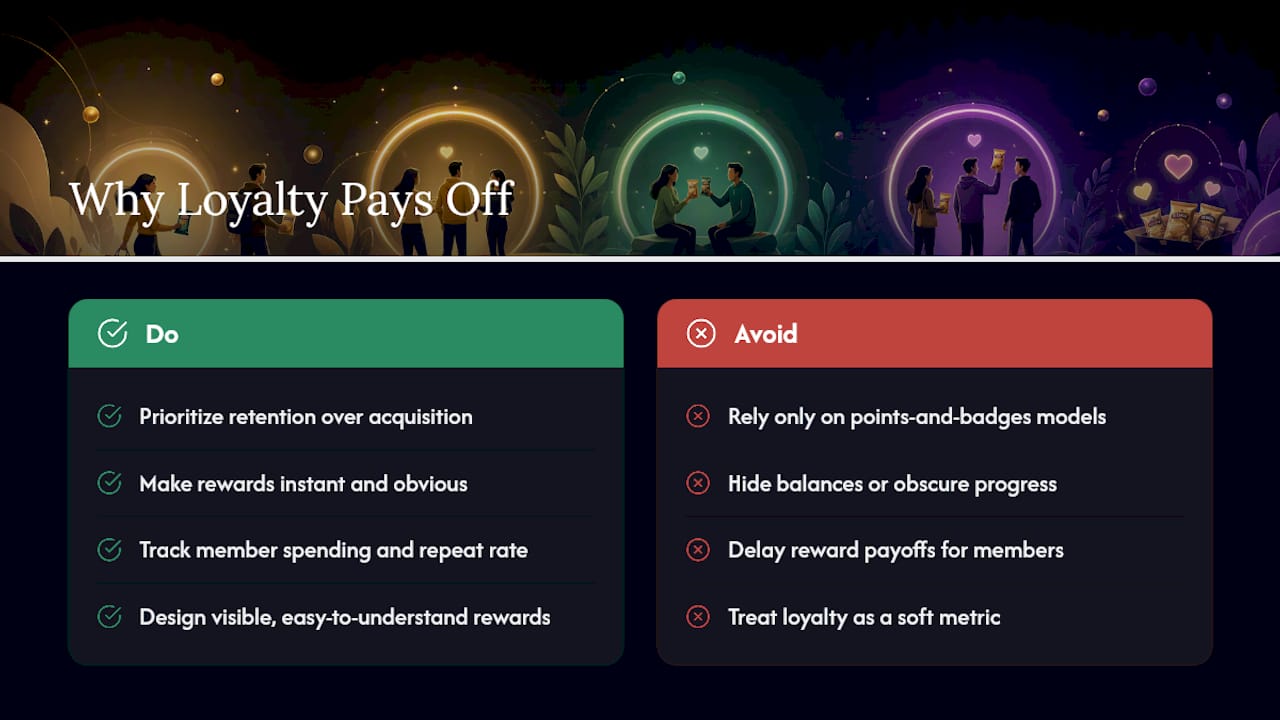
Retention costs less than acquisition, full stop. Keeping an existing customer buying is cheaper than chasing a new one through ads, and it compounds: a loyal customer’s lifetime value climbs every time they come back without you paying for another click. Salesforce’s guidance puts a number on part of this. Members of a loyalty program are more likely to keep buying from a brand than non-members, and they tend to spend more per order.
Here’s the twist most owners miss: loyalty programs still rank as a top driver of repeat purchases behind price, product value, and quality, but the traditional points-and-badges model is losing its grip. Deloitte’s research found that a lot of programs suffer from two specific problems: customers can’t tell what they’ve earned, and even when they can, the payoff takes too long to matter.
The gap that’s costing you customers: Deloitte found the biggest complaint isn’t stingy rewards; it’s that people can’t see what they’ve earned or how close they are to using it. A program nobody can track is a program nobody trusts.
That’s the whole game now. Fewer people bother checking their rewards balance than they did five years ago, but the ones who do stick around expect it to be instant and obvious. Loyalty, in other words, hasn’t gotten less important. It’s gotten less forgiving.
Core Strategies to Build and Sustain Consumer Loyalty
Not every tactic here deserves equal attention right now. Some are foundational and cheap. Others are advanced plays you add once the basics are humming. Here’s the priority order, with a KPI attached to each one so you know if it’s working.
- Nail product value and consistency first. If the candy tastes different from batch to batch, or the ice cream sandwich arrives melted twice in a row, nothing else on this list matters. Quick step: audit your last 90 days of returns and complaints for patterns. KPI to watch: repeat purchase rate.
- Make customer service fast and human. People forgive a lot when someone actually helps them quickly; Zendesk’s research on loyalty ties fast, empathetic support directly to retention. Quick step: set a target first-response time under a few hours and hold your team to it. KPI: customer satisfaction score or first-response time.
- Build a rewards mechanic a five-year-old could explain. If your customer can’t describe how to earn and redeem in one sentence, redesign it. Quick step: write your program rules in one paragraph, then cut it in half. KPI: redemption rate.
- Personalize the obvious stuff before the clever stuff. Send offers based on what someone actually bought, not generic blasts. Quick step: segment your email list by last purchase category this week. KPI: click-through and conversion on targeted sends.
- Build community around the brand, not just the product. User-generated content and public reviews do more for trust than any ad copy you’ll write. Quick step: start reposting customer photos and tagging them. KPI: engagement rate and review volume.
- Run a referral program with a real incentive. People trust a friend’s recommendation over your Instagram feed every time. Quick step: offer a flat credit for both referrer and new customer. KPI: referral-attributed new customers per month.
- Consider a subscription model for your best sellers. Recurring revenue and recurring engagement in one move. Quick step: pilot with your single top-selling SKU before expanding. KPI: subscription retention rate month over month.
- Set up proactive retention triggers. Don’t wait for someone to churn silently. Quick step: flag any customer who hasn’t ordered in 60 days and send a personal check-in offer. KPI: win-back rate.
- Add experiential or tiered rewards once the basics work. Early access, member-only drops, or a VIP tier give your best customers a reason to stay best customers. Quick step: pick one small perk (early access to a new flavor) and test it with your top 5% of buyers. KPI: tier upgrade rate and spend per tier.
Low-cost plays here are numbers 1, 2, 3, and 6. They cost time and attention more than budget. Numbers 5, 7, 8, and 9 take more infrastructure, whether that’s a subscription platform, a CRM with automation, or staff time to manage community content.
Pro Tip: Start with whichever tactic fixes your worst customer complaint right now. If people are confused about how rewards work, fix the mechanic before you build a referral program on top of a broken foundation.
Shopify’s guidance on brand loyalists makes an important distinction here: a loyalty program on its own doesn’t create emotional attachment to a brand. It’s an on-ramp. The program gets someone to buy again; the experience, the community, and the small human touches are what turn a repeat buyer into someone who’ll defend your brand in a comment section.
Designing a Loyalty Program People Actually Feel Good About
Program structure matters more than program generosity. A stingy program with instant, obvious payoff will beat a generous one buried in fine print.
Points-based programs are familiar and easy to build, but they’re the most prone to the visibility problem Deloitte flagged. Tiered programs (bronze, silver, gold, whatever you want to call them) work well for creating aspiration and status, but only if tier benefits are spelled out clearly and don’t take forever to reach. Subscription models sidestep the redemption problem entirely, since the value is baked into every delivery. Experiential rewards (early access, members-only products, invites to something) create the strongest emotional pull but need the most operational lift.
Whatever structure you pick, follow these rules for speed to value:
- Make rewards feel cash-like: a $5 credit beats “500 points” every time, because customers can do math on a dollar amount instantly.
- Offer instant, low-friction redemption. If someone has to jump through five steps to use a reward, they won’t.
- Show progress constantly. A visible bar or running balance beats a mystery point total a customer has to log in and dig for.
And the mistakes that quietly kill programs:
- Points that expire without warning. Nothing erodes trust faster than a customer discovering their balance vanished.
- Rules so opaque that customers can’t tell what qualifies for points and what doesn’t.
- Redemption processes with too many steps, especially anything that requires calling customer service just to cash in a reward.
On privacy: give people a real choice in how their data gets used for personalization, and say so plainly. EY’s loyalty study notes that when personalization or automation feels opaque, it erodes the same trust it was supposed to build.
Pro Tip: If you’re choosing between a complex tiered system and a dead-simple flat discount program, start with the simple one. You can always add complexity once people trust the basic mechanic.
Personalization, Data, and Where AI Actually Helps
Unified customer data is the foundation everything else sits on. Before you get fancy with AI, capture the basics: purchase history, channel preference (email versus text versus app), and how someone actually redeems rewards when they do.
Acoustic’s research on lasting loyalty argues that durable loyalty comes from behavior, not point balances: relevance, timing, channel fit, proactive retention, and what they call compounding intelligence, meaning your understanding of a customer gets sharper with every interaction instead of resetting each time.
Cheap experiments worth running before you invest heavily in tech:
- Product recommendations based on last purchase, sent through whichever channel that customer actually opens.
- A one-click channel preference survey (“email or text?”) that immediately improves open rates.
- A simple “you’re close to your next reward” reminder triggered automatically.
AI earns its place when it makes things faster and clearer: automated reminders about expiring rewards, next-best-offer suggestions that actually reflect purchase history, or a redemption process that gets simpler instead of more confusing. EY’s data is blunt about the flip side: AI that adds a layer of unpredictability, like a reward recommendation nobody asked for, erodes trust faster than no personalization at all.
Guardrails that keep this from backfiring: opt-in controls that are actually easy to find, clear notifications before anything changes, and letting customers pick their own reward type instead of assigning one for them.
Measuring Loyalty: The KPIs That Actually Tell You Something
Track five numbers and you’ll know whether any of this is working.
- Retention rate: the percentage of customers still buying after a defined period. This is your headline number.
- Repeat purchase rate: how many customers make a second purchase, and how fast.
- Customer lifetime value (CLV): total revenue expected from a customer relationship, which should climb as loyalty efforts take hold.
- Redemption rate: the share of earned rewards actually claimed. A low number here means your program has a visibility or friction problem, not a generosity problem.
- Net Promoter Score (NPS): a rough gauge of whether customers would recommend you, useful as a leading indicator before the revenue numbers move.
| KPI | What it tells you | Healthy signal | Red flag |
|---|---|---|---|
| Retention rate | Are customers coming back | Rising or stable quarter over quarter | Sudden drop after a program change |
| Repeat purchase rate | Speed of return visits | Shortening time between purchases | Lengthening gaps |
| CLV | Long-term value per customer | Steady upward trend | Flat or declining despite more members |
| Redemption rate | Program usability | Most earned rewards get claimed | Rewards piling up unused |
| NPS | Word-of-mouth potential | Climbing or holding high | Sudden dip after a policy change |
Run a simple pilot-versus-control comparison when you launch something new: give one group the new perk, hold another back, and compare retention after 60 to 90 days. When you report this to finance, lead with CLV and retention rate. Those are the two numbers that translate directly into revenue leadership already cares about.
A 30/60/90 Day Plan for Building Consumer Loyalty
You don’t need a year-long transformation project. You need three sprints.
- Days 1 to 30: Audit your existing customer data and fix the obvious redemption friction. Define a pilot cohort (your top 10 to 20% of customers by frequency works well). Look specifically for where people drop off in your current rewards flow.
- Days 31 to 60: Launch a minimum viable version of your program or improvement. Set up basic automation for retention triggers, like a win-back email for anyone who’s gone quiet. Train frontline staff on how the new mechanic works so they can explain it in one sentence.
- Days 61 to 90: Analyze your pilot cohort against everyone else. Cut or fix whatever underperformed. Double down on whatever moved retention or redemption, and scale it to your full customer base.
Resource checklist: you need a way to segment customers (even a spreadsheet works at small scale), a basic email or text automation tool, and someone on staff who owns the redemption experience end to end.
Pro Tip: Space-man’s own 30/60/90 implementation guide breaks this down further if you want a more detailed version of this exact plan.
What Candy and Snack Brands Can Learn From Loyalty Done Right
Food and candy brands have an advantage most industries don’t: you can turn a reward into something people literally hold in their hands and photograph. A member-only flavor drop, a private-label SKU only available to repeat customers, or a small seasonal treat tucked into an order does more for emotional attachment than another 10% off code ever will.

Shopify’s practitioner data backs this up: subscriptions and limited drops raise purchase frequency and create what they call fan moments, the kind of thing customers post about without being asked. Packaging plays a bigger role in this than most owners give it credit for. A thoughtfully designed package turns a routine reorder into something that feels like a gift, and that feeling is exactly what keeps people opening your emails instead of deleting them.
For anyone weighing whether private label fits into a loyalty strategy, understanding what private label actually offers retailers is a good place to start before committing budget to it. And if community and reviews are part of your plan, Wild Foodz’s writing on customer reviews in hospitality makes a solid case for why public feedback loops matter just as much in food as they do in restaurants.
— Chadi
Turn Loyalty Rewards Into Something Worth Keeping
If you’ve read this far, you already know rewards that feel generic don’t move the needle. The fix isn’t a bigger discount code. It’s a physical product your best customers can’t get anywhere else. Private label and co-packing services let candy, snack, and treat brands build exactly that: a limited-run bag, a member-only flavor, or a seasonal drop with branding on it, made without needing their own manufacturing setup.
Picture a small batch of freeze-dried candy in a bag that only your top-tier members ever see. That’s the kind of fan moment this article keeps coming back to, and it’s one you can actually produce without building a factory. If that sounds like something worth exploring for your own loyalty program, take a look at Space-man’s private label and co-packing services and see what a member-exclusive product could look like for your brand.
Where This Article’s Research Came From
The claims about visibility gaps and delayed payoff in loyalty programs come from Deloitte’s reshaping customer loyalty research, worth reading if you want the full picture on why so many programs underdeliver. EY’s loyalty market study digs deeper into where AI helps versus hurt. Salesforce’s loyalty guidance covers the business case with hard numbers. Shopify’s brand loyalist framework is the best resource on turning program members into advocates, and Acoustic’s behavioral loyalty piece makes the strongest case for why points alone won’t get you there.
Sources
- Reshaping customer loyalty programs | Deloitte Insights
- 2026 EY loyalty market study
- How to create brand loyalists: 5 ways to build lasting customer loyalty - Shopify
- How to build lasting customer loyalty — Acoustic
- What is Customer Loyalty? How to Build & Measure | Salesforce