

Finding new ways to draw customers and stand out is a constant challenge for Canadian candy shops. With the growing popularity of specialty treats, freeze dried candy offers an easy way to spark curiosity and excitement among snack lovers. Understanding what sets freeze dried candy apart and clearing up common misconceptions is the first step toward confidently expanding your product line with these flavorful, crunchy sweets.
Table of Contents
- Freeze Dried Candy Basics And Misconceptions
- Product Types And Private Label Options
- Supplier Evaluation And Sourcing Process
- Safety Standards And Legal Compliance
- Cost, Risks, And Common Mistakes To Avoid
Key Takeaways
| Point | Details |
|---|---|
| Understanding Freeze Drying | Freeze dried candy undergoes sublimation, preserving intense flavors and creating a unique, light texture compared to traditional candy. |
| Addressing Misconceptions | Clarify common myths about freeze dried candy, such as the misconception that it uses heat or alters nutritional value significantly. |
| Private Label Advantages | Private labeling freeze dried candy allows retailers to differentiate their offerings and build customer loyalty with unique products. |
| Supplier Evaluation | Select suppliers based on quality, reliability, and compliance with food safety regulations rather than price alone to ensure consistent product availability. |
Freeze dried candy basics and misconceptions
Freeze dried candy is fundamentally different from regular candy, and understanding how it’s made helps you sell it confidently to customers. The process removes moisture through sublimation—ice transforms directly to vapor without melting—which preserves the candy’s intense flavor while creating a light, crunchy texture.
Here’s what makes freeze dried candy unique:
- Intense flavor concentration: The moisture removal focuses taste, making flavors punch harder than the original candy
- Novel texture: Lightweight and airy with a satisfying crunch, unlike anything customers experience with traditional sweets
- Structural integrity: The candy maintains its shape and appearance while becoming completely different in feel and taste
- Extended shelf life: Lower moisture content means longer storage without quality degradation
The magic happens because freeze drying uses rapid freezing and pressure reduction rather than heat. Traditional drying methods apply warmth, which can melt or damage delicate candy structures. Freeze drying creates tiny air pockets where water molecules once lived, resulting in that distinctive light texture.
Here’s how freeze dried candy compares to traditional methods:
| Aspect | Freeze Dried Candy | Traditional Candy |
|---|---|---|
| Drying Process | Sublimation, no heat | Heat-based or air drying |
| Flavor Preservation | Highly concentrated | Often diluted or changed |
| Texture | Light and crunchy | Chewy or dense |
| Shelf Life | Extended, low moisture | Shorter, more moisture |
| Structural Integrity | Shape maintained | Potentially altered |
Common Misconceptions to Address
Many retailers and customers hold incorrect beliefs about freeze dried candy. These myths can actually hurt your sales if you don’t address them head-on.
Myth 1: Freeze drying uses heat
Incorrect. The process actually requires extreme cold. Customers sometimes think “drying” means heating, like sun-drying fruit. Clarify that freeze drying is the opposite—it’s a cold process that preserves delicate flavors better than any heat-based method.
Myth 2: The nutritional value changes dramatically
Not significantly. Freeze drying removes water, but the candy’s nutritional profile remains largely consistent. You’re not adding mystery ingredients or stripping away nutrients. For Canadian customers concerned about ingredient transparency, this is reassuring.
Myth 3: It tastes “weird” or artificial
Actually, freeze dried candy tastes more like the original flavor source than regular candy. A freeze dried strawberry tastes intensely strawberry-like. Many customers are pleasantly surprised by the authenticity.
Myth 4: It’s just expensive candy for novelty
While freeze dried products do command premium pricing, customers get real value—better flavor, unique texture, and longer shelf stability. Position it as a specialty product worth the cost.
Understanding these basics transforms how you talk to customers about why freeze dried candy deserves shelf space alongside traditional sweets.
Pro tip: Create a small tasting station where customers sample regular versus freeze dried versions of the same candy type. One bite shifts perception instantly—let the product do your sales pitch.
Product types and private label options
Freeze dried candy comes in far more variety than most Canadian retailers realize. Beyond basic fruit shapes, the category includes gummies, taffies, chocolates, and specialty blends that appeal to different customer segments and price points.
Here’s what’s available in the wholesale market:
- Fruit-based candies: Freeze dried strawberries, raspberries, and mixed fruit bites that taste intensely fruity
- Gummy varieties: Gummy bears and fruit chews that transform into crunchy, airy versions of their chewy counterparts
- Chocolate options: Malt balls, caramel puffs, and chocolate-coated freeze dried fruits for premium positioning
- Functional candies: Vitamin-infused gummies and specialty blends targeting health-conscious customers
The real opportunity lies in customization. Flexible private label services allow you to develop unique products that competitors can’t replicate—custom flavor blends, branded packaging, and even specialty formulations tailored to your customer base.
Why Private Label Makes Sense for Your Shop
Private labeling turns freeze dried candy into a competitive advantage. Instead of selling generic wholesale products, you’re offering something customers can’t find anywhere else.
Private label gives you control over branding, packaging, and product specifications. You can create a signature blend that becomes your shop’s identity, build customer loyalty, and capture higher margins than standard wholesale items.
The process works like this: You choose product types and flavor profiles. The manufacturer handles production and packaging with your branding. You receive finished goods ready for your shelves.
Many Canadian retailers worry about minimum order quantities. Most manufacturers offer flexible options for smaller shops, making private label accessible even if your store volume isn’t massive.
Private label freeze dried candy transforms your retail space from a commodity seller into a specialty destination with unique offerings.
Getting Started with Custom Products
Start simple. Choose one or two popular candy types—maybe gummy bears in an exclusive flavor blend, or fruit chews in a combination you define.

Work with your supplier to test samples before committing to full production runs. This prevents expensive mistakes and ensures the final product matches your vision. Once you nail the formula, scaling becomes straightforward.
Branding matters. Custom packaging with your shop’s name and logo creates shelf presence and builds brand recognition among repeat customers.
Pro tip: Start with a single private label SKU (stock-keeping unit) focused on your best-selling candy type, test customer response for 4-6 weeks, then expand to complementary products once you’ve proven the concept works for your market.
Supplier evaluation and sourcing process
Finding the right freeze dried candy supplier isn’t about grabbing the cheapest quote. You’re building a relationship that affects your inventory, cash flow, and customer satisfaction for years to come.
Start by defining what matters most to your business. Quality consistency, reliable delivery, competitive pricing, and strong communication all rank differently depending on your shop’s priorities.
Here’s what to evaluate:
- Product quality: Request samples and test them yourself. Check for color consistency, texture uniformity, and flavor intensity across batches
- Pricing structure: Compare per-unit costs, minimum order quantities, and whether volume discounts apply as your business grows
- Delivery reliability: Ask about lead times, shipping options, and their track record with Canadian retailers
- Financial stability: A supplier’s ability to stay in business matters. Research their company history and customer reviews
- Communication style: Can you easily reach someone when problems arise? Response time during sourcing matters tremendously
The Evaluation Framework
Supplier evaluation requires defining clear criteria and assessing operational capabilities through performance metrics. Don’t rely on a single conversation or email exchange.
Request references from other Canadian retailers they supply. Ask specific questions: How consistent are shipments? Have they handled rush orders? What happened when there were quality issues?
Venture beyond the initial pitch. Many suppliers offer their best terms upfront, then change them after the first order. Build contingency into your selection process by evaluating at least two viable suppliers before committing.
Visit their facility if possible, even virtually. See their production setup, quality control measures, and how they handle inventory. This reveals operational maturity that conversations alone won’t show.
Making Your Decision
Don’t choose purely on price. The cheapest supplier often means inconsistent quality, missed deliveries, or hidden fees that appear later.
Balance cost with reliability. A supplier 10% more expensive but with zero delivery delays saves you from angry customers and emergency restocking costs.
Start with a smaller trial order before committing to annual volume. This tests everything: product quality, packaging accuracy, communication responsiveness, and whether they deliver when promised.
The best supplier isn’t the one with the lowest price, but the one who consistently delivers what they promise without surprises.
Pro tip: Negotiate a 30-day trial period where you can order smaller quantities at agreed-upon unit prices; this proves their reliability before you commit to larger minimum orders that lock your cash into inventory.
Safety standards and legal compliance
Selling freeze dried candy in Canada means navigating food safety regulations that protect consumers and your business from liability. Skip the compliance details and you’re risking fines, product seizures, or worse—a recall that destroys your reputation.
Canadian food retailers must understand their legal responsibilities before stocking any wholesale product. The rules differ slightly depending on whether you’re selling packaged products from established manufacturers or handling your own production.
Understanding Canadian Food Regulations
Canada’s food safety framework requires all food products to meet strict safety standards. Your suppliers must have documented food safety plans based on HACCP principles (Hazard Analysis and Critical Control Points), which identify potential contamination risks and control them.
When sourcing wholesale freeze dried candy, verify that your supplier complies with Canadian food safety requirements. Ask for documentation proving they follow established protocols.
Key compliance areas include:
- Proper labeling: Product labels must list ingredients, allergens, and nutritional information in both English and French
- Allergen declarations: If freeze dried candy contains or was processed near common allergens, this must be clearly marked
- Safe manufacturing practices: The facility must meet hygiene standards and handle products safely
- Traceability: Suppliers must track products from production to distribution in case of recalls
What Your Supplier Must Provide
Food manufacturers must comply with comprehensive safety regulations ensuring products are safe. Request these documents from any potential supplier:
- Certificate of analysis showing product safety testing results
- Proof of food establishment licensing
- Documentation of their food safety plan
- Insurance coverage for food product liability
Don’t assume a supplier is compliant because they’re well-known. Always request verification. Many retailers get caught off-guard when products don’t meet labeling requirements or contain undeclared allergens.
Your Responsibilities as a Retailer
Stocking freeze dried candy doesn’t make you responsible for manufacturing, but you are responsible for selling safe products. Store items properly, check expiration dates, and understand what’s in everything you sell.
Keep records of your suppliers and product batches. If there’s ever a recall, you need to identify affected inventory quickly. Organized record-keeping saves time and demonstrates due diligence if regulators ask questions.
Non-compliance isn’t just about avoiding fines—it’s about protecting the customers who trust your shop and your business’s future.
Pro tip: Request a Certificate of Analysis and food safety documentation from every potential supplier before your first order, then store these documents digitally organized by supplier and date—this takes 30 minutes but protects your business completely.
Cost, risks, and common mistakes to avoid
Sourcing wholesale freeze dried candy looks profitable until hidden costs surface and poor decisions drain your margins. Understanding where money actually goes—and where things go wrong—separates successful retailers from frustrated ones who abandon the category.
Profit margins on freeze dried candy are solid when you avoid the pitfalls that sink most newcomers. The key is knowing what costs to expect and which mistakes to sidestep before they hurt your bottom line.
Understanding True Costs
Wholesale freeze dried candy costs more per unit than traditional candy, but you also price it higher. That’s fine, except when retailers underestimate associated expenses and realize margins aren’t what they expected.
Beyond the product cost per unit, factor in:
- Storage requirements: Freeze dried candy needs cool, dry storage. Humidity ruins the texture and flavor
- Packaging and labeling: Custom packaging costs more than generic boxes
- Shrinkage and waste: Some products get damaged during handling or storage
- Working capital: Money sits in inventory longer if products don’t move quickly
- Delivery fees: Shipping wholesale quantities from suppliers can be substantial
Many retailers calculate unit cost but forget to build these operational costs into pricing. A product costing you $3 wholesale doesn’t have a $9 retail price—account for everything first.
This summary shows key costs and risks to consider with freeze dried candy sourcing:
| Cost/Risk Factor | Impact on Retailer | Mitigation Strategy |
|---|---|---|
| Storage Environment | Requires low humidity | Invest in proper storage |
| Packaging Expenses | Custom designs add cost | Compare packaging options |
| Inventory Shrinkage | Damaged goods reduce profit | Handle carefully, track losses |
| Supplier Reliability | Impacts delivery and quality | Trial orders, track performance |
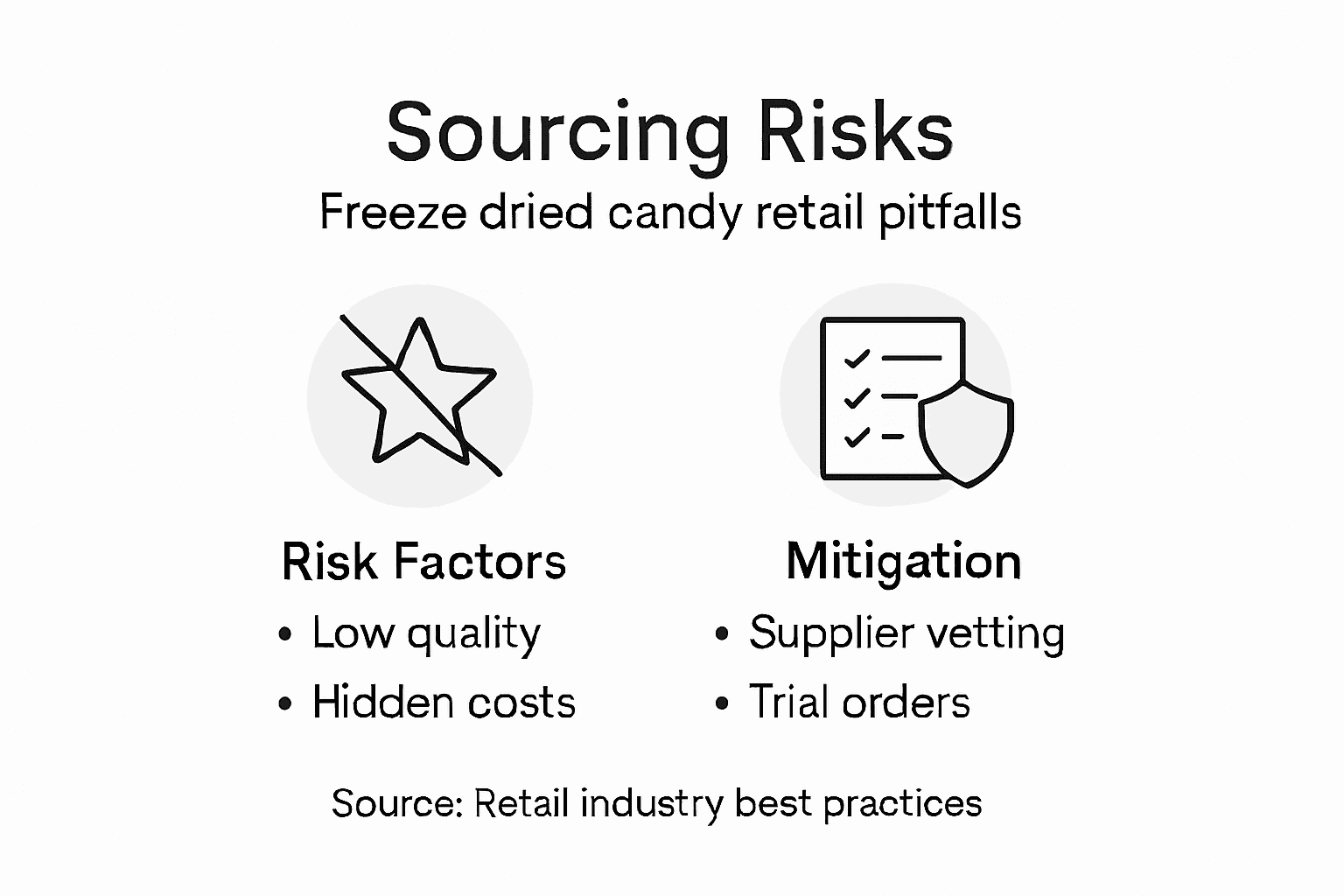
Common Sourcing Mistakes
Three mistakes repeatedly hurt retailers sourcing freeze dried candy for the first time.
Mistake 1: Choosing suppliers based only on price. The cheapest supplier often delivers inconsistent quality, misses shipments, or sends products damaged from poor packaging. You end up with excess inventory and angry customers.
Mistake 2: Underestimating shelf space reality. You stock freeze dried candy expecting customers to flock to it. Instead, it sits. Products spoil, and you’ve tied up cash that could’ve gone elsewhere. Start with smaller inventory to test demand first.
Mistake 3: Ignoring food safety compliance. Lack of knowledge on food safety law compliance creates serious liability. One recall or product issue and your entire business suffers reputational damage.
Managing Risk
Start small. Order smaller quantities from multiple suppliers instead of betting everything on one relationship. This spreads risk and lets you compare quality without massive financial exposure.
Test customer demand before scaling. Many retailers add freeze dried candy expecting immediate success, then get stuck with slow-moving inventory. A 30-day trial period reveals whether customers actually want these products in your market.
Keep detailed records of suppliers, batches, and sales. If problems arise, you can trace them quickly and respond professionally.
The freeze dried candy category is profitable when you account for all costs upfront and avoid betting your inventory on unproven demand.
Pro tip: Order a small test shipment from your chosen supplier (minimum viable order), sell through it completely within 4-6 weeks tracking actual margins, then scale only if profit expectations matched reality.
Unlock Premium Opportunities with Wholesale Freeze Dried Candy from Spaceman
Sourcing wholesale freeze dried candy can feel overwhelming with so many factors like supplier reliability, food safety compliance, and product quality in play. If you want to skip common pitfalls and offer your customers the unique flavor and texture that only freeze dried candy delivers, Spaceman has your back. Our Wholesale Freeze Dried Candy & Treats – Spaceman collection offers carefully crafted products that meet the highest standards for Canadian retailers. We also provide flexible private labeling and packaging solutions that help turn your freeze dried candy offerings into exclusive bestsellers.

Don’t let sourcing challenges hold your business back from tapping into this exciting market. Explore our Bulk Unbranded Freeze Dried Candy & Treats – Spaceman to start small with low-risk orders or jump straight into custom branded products designed specifically to grow your shop’s identity. Visit https://space-man.ca now to discover how our expertise and comprehensive service can elevate your inventory with easy ordering, consistent quality, and food safety you can trust. Act now to stay ahead in the growing freeze dried candy market.
Frequently Asked Questions
What is freeze dried candy and how is it made?
Freeze dried candy is created through a process called sublimation, where moisture is removed without heat, preserving the candy’s intense flavor and creating a light, crunchy texture.
How does freeze dried candy differ from traditional candy?
Freeze dried candy is made using sublimation, resulting in highly concentrated flavors and an airy, crunchy texture, while traditional candy is often chewy or dense due to heat-based drying methods.
What should I consider when sourcing freeze dried candy for my retail shop?
When sourcing freeze dried candy, consider factors like product quality, pricing structure, delivery reliability, and the supplier’s communication style to ensure a positive partnership.
Are there any misconceptions about freeze dried candy I should be aware of?
Yes, common misconceptions include beliefs that freeze drying uses heat, that the nutritional value changes significantly, and that the candy tastes artificial. In reality, freeze dried candy preserves flavors well and often maintains a similar nutritional profile as the original product.