

TL;DR:
- Most snack brands overlook machine quality, which directly impacts product texture and shelf life. Proper freeze-drying equipment ensures consistency, prevents batch failures, and upholds food safety standards. Selecting the right industrial system is essential for scaling or private label success in freeze-dried candy.
Most snack entrepreneurs spend months perfecting their candy formula, sourcing premium ingredients, and designing eye-catching packaging. Then they wonder why their freeze-dried product comes out sticky, chewy, or with a shelf life that falls apart within weeks. The ingredients are rarely the problem. The machine is. For Canadian retail and online brands exploring private labeling or co-packing for freeze-dried candy and snack lines, understanding what equipment actually drives results is the single most important decision you will make before launch.
Table of Contents
- How freeze-dried food is made: The process in a nutshell
- What does a freeze-drying machine actually do?
- Types of freeze-drying machines for food production
- Key machine features: What matters most for commercial freeze-dried snacks
- Why equipment choices make or break private label freeze-dried snack brands
- Ready to launch your freeze-dried snack brand? Spaceman makes it easy
- Frequently asked questions
Key Takeaways
| Point | Details |
|---|---|
| Freeze-drying needs the right machine | Product quality and business scalability come down to equipment, not just recipes. |
| Industrial tray dryers boost private label scale | Commercial machines with tray systems are essential for reliable, repeatable snack and candy production. |
| Vacuum and condenser make or break quality | Strong vacuum and condenser performance ensure consistent drying and longer shelf life. |
| Small-scale is rarely enough for brands | Home machines suit hobbyists, but business growth requires industrial-grade features. |
| Expert process control is essential | Automation and technical know-how help deliver shelf-stable, defect-free products for your market. |
How freeze-dried food is made: The process in a nutshell
Before you can choose the right equipment or partner with a co-packer, you need to understand what freeze-drying actually does to food. The process, formally called lyophilization, removes moisture by turning ice directly into vapor without ever passing through a liquid stage. That trick is called sublimation, and it is what gives freeze-dried candy its signature crunch and dramatically extended shelf life compared to fresh or even dehydrated products.
The freeze-drying process explained breaks down into three distinct stages, and each one depends on the machine performing its role precisely:
- Freezing. The product is cooled to well below zero, typically between minus 40°C and minus 80°C, depending on the food. This solidifies all the moisture inside the product into ice crystals.
- Primary drying (sublimation). The chamber pressure drops dramatically via a vacuum pump. Under low pressure, ice skips the liquid phase and converts directly to vapor. This stage removes roughly 95% of total moisture.
- Secondary drying. The temperature rises slightly and the vacuum continues, driving out the remaining bound moisture. This is what gets products to the safe water activity levels needed for long-term shelf stability.
As EnWave explains, “freeze-dried (lyophilized) food is produced by freezing the product, then placing it under vacuum so ice sublimes directly into water vapor (primary drying), followed by secondary drying to remove remaining bound moisture.”
If any stage is rushed or poorly controlled, the results show up fast. Incomplete primary drying leaves pockets of ice that collapse the product structure during secondary drying, producing sticky, mushy candy instead of the crispy puffed texture customers expect. The machine, not the recipe, is what prevents this.
For snack and candy brands, the freeze drying process for snacks has a direct line to product quality, consumer reviews, and your ability to stand behind a consistent, branded product. Every batch must hit the same benchmarks. That repeatability comes from machinery.
What does a freeze-drying machine actually do?
Think of a freeze-drying machine as three systems working in tight coordination. Each one handles a different part of the moisture-removal challenge, and if one underperforms, the other two cannot compensate.
The essential components of a commercial freeze-drying machine are a refrigerated freezing system, a vacuum system (which includes both a chamber and a pump), and a condenser or ice trap that captures outgoing water vapor so it cannot re-enter the product. According to NIRAS, “a freeze-drying machine for food typically includes: a refrigerated/freezing system, a vacuum system (vacuum chamber + pump), and a condenser/ice trap that captures vapor so it does not return to the product.”
Here is a practical breakdown of how those components work together in a commercial setting:
| Machine component | Function | Why it matters for snack brands |
|---|---|---|
| Freezing system | Drops product to target freeze temp | Determines crystal size and texture outcome |
| Vacuum chamber | Creates low-pressure environment | Enables sublimation without melting |
| Vacuum pump | Maintains and sustains low pressure | Affects drying speed and energy cost |
| Condenser/ice trap | Captures exiting moisture as ice | Prevents reabsorption and failed batches |
| Shelf/tray heating system | Supplies controlled heat during drying | Governs drying uniformity across batches |
| Digital control panel | Monitors temperature and pressure | Enables repeatable cycles for consistent output |
For snack and candy producers, the what is a freeze dryer machine question often gets answered in terms of size, but the internal configuration matters just as much. Home units run one or two small trays. Commercial units run dozens of large shelves simultaneously, with automated controls that monitor every variable in real time.
Understanding what equipment is used to freeze-dry food also means understanding maintenance. The condenser fills with ice over every cycle and must be defrosted and checked regularly.
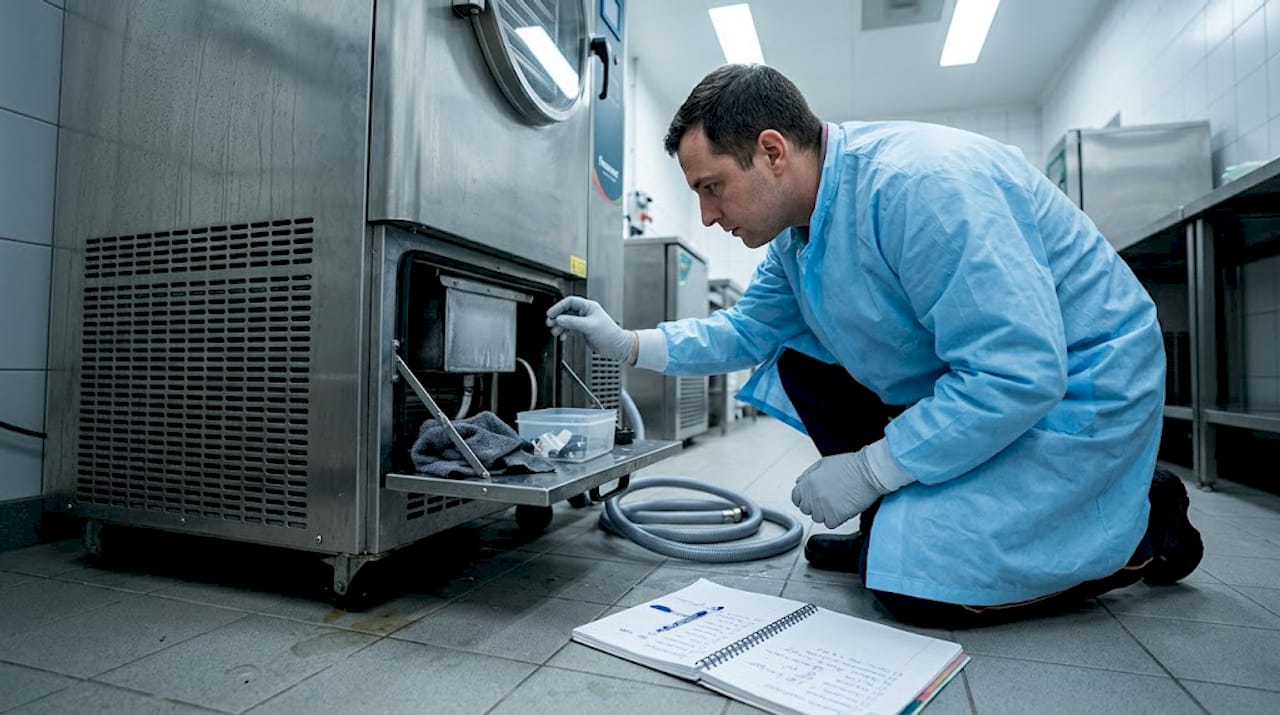
Pro Tip: Clean and inspect the ice trap after every production run. A clogged or poorly maintained condenser is one of the most common causes of inconsistent batch quality in small commercial operations. Neglect it and your product gets inconsistent. Consistent maintenance equals consistent product.
Types of freeze-drying machines for food production
Not all freeze-dryers are built for the same job, and picking the wrong type is one of the most expensive mistakes a snack brand can make. The differences between machine classes are significant, and they directly affect whether you can deliver a retail-ready product at volume.
There are three main categories you will encounter:
- Home or countertop units. These small machines handle two to four trays and are designed for personal or hobbyist use. Capacity is typically under five pounds per batch. Cycle times are long, automation is minimal, and they are not built for the daily production runs that retail supply chains demand.
- Laboratory or research units. Slightly larger and more precise, these machines are designed for R&D, sample testing, and small-scale development. They are accurate but expensive per unit of output, and they are not configurable for bulk snack or candy runs.
- Industrial or commercial tray freeze-dryers. These are purpose-built for food production at scale. They run multiple large shelves, feature automated process controls, and can handle the batch consistency that private label and retail supply requires.
Hudson Valley Lyomac notes that “a practical methodology for operators is to pick the freeze-dryer based on product form (bulk solids/particles vs liquids vs vials), because tray configuration and shelf spacing affect heat transfer and uniform sublimation.” For candy and snack producers dealing with irregular shapes like gummies, sour belts, or coated chocolates, tray layout and shelf spacing have a direct impact on how evenly each piece dries.
| Machine type | Batch capacity | Best use case | Private label viability |
|---|---|---|---|
| Home countertop | 2 to 5 lbs | Personal, testing | Not viable |
| Lab or research unit | 5 to 20 lbs | R&D and samples | Very limited |
| Industrial tray system | 50 to 500+ lbs | Retail and wholesale | Fully viable |
As EnWave points out, “when people ask ‘what machine freeze dried food,’ they usually mean ‘which freeze-dryer type’” and the answer for consumer brands is almost always the industrial tray system.
The comparison between a freeze dryer vs food dehydrator is also worth understanding. Dehydrators use heat to evaporate moisture, which breaks down color, flavor compounds, and texture. Freeze-dryers preserve all three because sublimation works at low temperature. That quality difference is exactly why private label freeze-dried candy commands higher retail prices than dehydrated snacks.
For brands considering private label snack production, the machine category chosen by your co-packing partner is a legitimate question to ask before signing any production agreement.
Key machine features: What matters most for commercial freeze-dried snacks
Once you have narrowed down to industrial-class equipment, the details inside the machine category are what separate reliable production from costly batch failures. There are four technical factors that drive outcomes most directly for snack and candy operations.
Condenser capacity. This is the single most important variable in a commercial freeze-dryer. A condenser with insufficient capacity will saturate before the drying cycle ends, causing moisture to reverse course and reabsorb into the product. For high-sugar candy, that means stickiness, clumping, and failed product. For a private label brand, it means returned inventory.
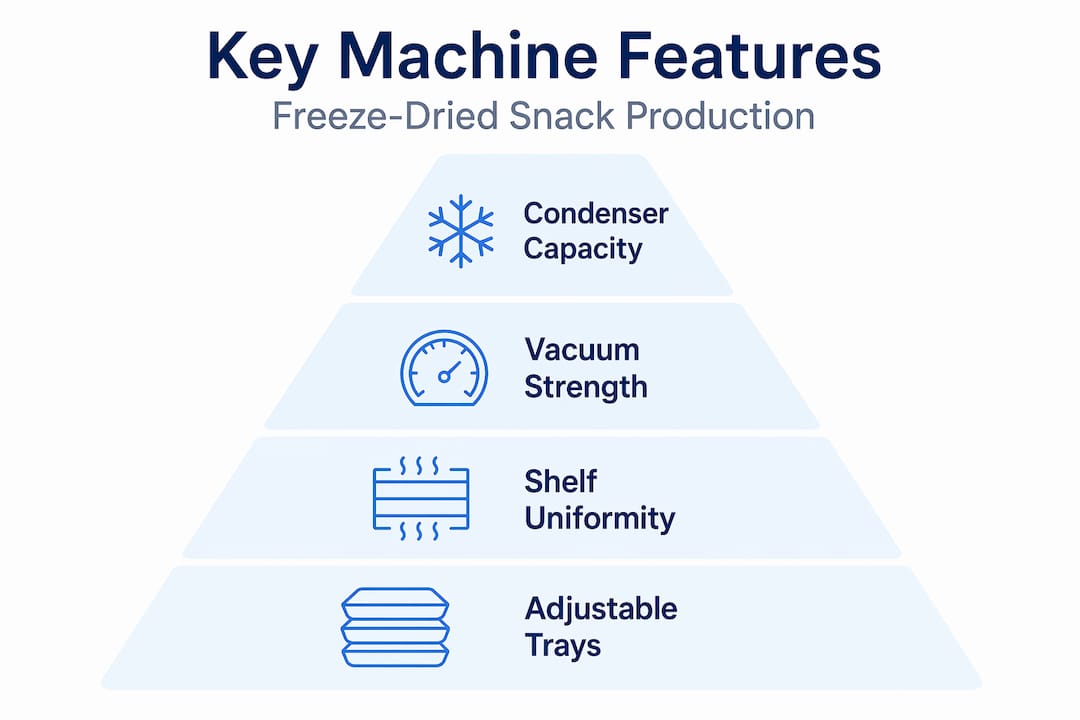
Vacuum strength and stability. The vacuum pump must maintain consistent low pressure throughout the entire primary drying phase, which can run anywhere from eight to thirty hours depending on the product. Pressure fluctuations slow sublimation, extend cycle time, and can cause uneven drying across the tray. Both condenser performance and vacuum quality are critical because they govern how efficiently moisture is removed and how repeatable the drying conditions are.
Shelf temperature uniformity. Heat applied to shelves during drying must be consistent from edge to center across every tray. Uneven heating creates hot spots, which risk over-drying some product while under-drying other pieces in the same batch. Industrial systems use heated plates in direct contact with trays to achieve the precision needed.
Automated monitoring and digital controls. Modern commercial freeze-dryers log temperature, pressure, and time automatically throughout each cycle. This data serves two purposes: it allows operators to catch problems in real time, and it creates the batch records that food safety compliance often requires. For branded consumer products in Canada, that documentation trail matters.
Here is what to look for when evaluating a machine or a co-packing partner’s equipment:
- Condenser temperature rated below minus 50°C for reliable vapor capture
- Vacuum levels reaching below 100 mTorr (milliTorr) for effective sublimation
- Shelf temperature control with plus or minus 1°C accuracy
- Automated data logging for HACCP and food safety compliance
- Accessible ice trap with easy defrost cycle for fast turnaround between batches
Pro Tip: For snack and candy producers running multiple SKUs, adjustable shelf spacing is a feature worth prioritizing. It lets you run thicker candy pieces like gummy bears and thinner products like fruit slices in the same machine without compromising sublimation efficiency on either.
Studies on commercial lyophilization show that condenser and vacuum performance directly determine cycle reproducibility. Brands that lock in consistent cycle parameters report fewer batch rejections and lower production costs per unit over time. That margin difference compounds quickly at scale.
Why equipment choices make or break private label freeze-dried snack brands
Here is something the snack industry does not say enough: most failed product launches are not flavor failures. They are process failures that trace directly back to the wrong machine or an undertrained operator running a capable machine incorrectly.
Brand owners in the freeze-dried space spend enormous energy on branding, packaging design, and flavor development. Those things matter. But if the machine your co-packer uses cannot hold a stable vacuum, your cotton candy will be chewy by the time it reaches the retailer’s shelf. No amount of great branding fixes a bad texture.
The deeper issue is that freeze-dried candy and snacks are inherently process-sensitive products. The margin between a perfect crispy puff and a sticky, shelf-unstable failure is measured in pressure points and temperature tolerances. A recipe cannot save a batch that came out of an underpowered condenser or a machine that skipped secondary drying because of a faulty control relay.
We have seen brands start on home units or borrowed equipment. There is nothing wrong with that for testing. But the jump from twenty-unit hobby runs to retail orders of five hundred bags per SKU is not just a volume problem. It is a consistency problem that only commercial-grade machinery solves. That is why successful freeze-dried snack retail strategies always include a serious audit of production equipment before scaling distribution.
The brands that grow reliably in this category treat their machinery configuration as a competitive advantage, not a background detail. Process controls, maintenance logs, and validated cycle parameters are what let you promise a retailer the same product in January as you delivered in July. That promise is what earns reorders.
Failing to prioritize technical investment early does not just create quality problems. It creates liability. Moisture pockets in shelf-stable products can support microbial growth. Regulatory action on a poorly produced private label product falls on the brand name on the bag, not the machine manufacturer. The equipment decision is a food safety decision, full stop.
Ready to launch your freeze-dried snack brand? Spaceman makes it easy
Understanding the machine behind freeze-dried candy is the first step. Accessing commercial-scale production without buying your own freeze-dryer is the second.

Our private label and co-packing services give Canadian retail and online brands direct access to commercial-grade freeze-drying production without the capital investment of owning industrial equipment. We handle the full process cycle, from consistent batch production to packaging and labeling under your brand, so you can focus on growing your customer base. If you are just getting started, our freeze-dried candy starter pack gives you a low-risk entry point with a variety of products ready for retail display or online fulfillment, with the quality that comes from proper commercial-scale production.
Frequently asked questions
What are the essential parts of a freeze-drying machine?
The essential parts are a refrigerated freezing system, a vacuum chamber and pump, and a condenser that traps water vapor as ice so moisture cannot re-enter the product.
Why do industrial freeze-dryers use tray systems?
Tray systems allow for efficient, uniform heat transfer during sublimation and make it practical to scale batch sizes for bulk snack and candy production runs.
What does the condenser do in a freeze-drying machine?
The condenser traps water vapor as ice during the drying cycle, preventing it from returning to the product and ensuring complete, consistent moisture removal across the entire batch.
How does machine quality affect freeze-dried food results?
Better condenser and vacuum systems produce more consistent drying conditions, reducing the risk of moisture pockets, batch failures, and product that does not meet shelf-stability standards.