

More than 60 percent of american food manufacturers rely on advanced freeze drying methods to keep products fresh and flavorful. This specialized technology stands out as it preserves nutrition, taste, and structure better than old-fashioned drying techniques. If you have ever wondered how food stays perfectly crisp and shelf-stable for months, understanding the science behind freeze dryer machines can help you see how modern preservation safeguards both quality and value.
Table of Contents
- Freeze Dryer Machine Definition And Key Concepts
- Main Types Of Freeze Dryer Machines Explained
- How Freeze Dryers Work Step-By-Step
- Core Applications In Food And Candy Industry
- Benefits, Costs, And Potential Drawbacks
Key Takeaways
| Point | Details |
|---|---|
| Freeze Dryer Concept | A freeze dryer machine, or lyophilizer, removes moisture through sublimation, preserving product integrity without altering nutritional content. |
| Types of Freeze Dryers | Various configurations exist, including laboratory and industrial models, each tailored for specific processing scales and applications. |
| Process Stages | The freeze drying process includes freezing, primary drying (sublimation), and secondary drying (desorption), maintaining controlled conditions for optimal preservation. |
| Applications and Benefits | This technology is ideal for food preservation, offering nutrient retention, extended shelf life, and easy rehydration, although equipment costs can be high. |
Freeze Dryer Machine Definition and Key Concepts
A freeze dryer machine, also known as a lyophilizer, represents a sophisticated piece of food processing and preservation equipment designed to remove moisture from products through a unique scientific process. According to research from ajer.org, this specialized machine operates on the principle of sublimation, directly transforming water from a solid ice state into a gaseous state without passing through the liquid phase.
The fundamental mechanism of a freeze dryer involves three critical stages of moisture extraction. As explained by jetir.org, the lyophilization process includes:
- Freezing Stage: The product is rapidly frozen at extremely low temperatures
- Primary Drying (Sublimation): Ice is directly converted to vapor under low pressure
- Secondary Drying (Desorption): Remaining bound water molecules are removed
What makes freeze dryers truly remarkable is their ability to preserve the original structural integrity of sensitive products. Unlike traditional high-temperature drying methods that can degrade nutritional content and alter taste, freeze drying maintains the product’s essential characteristics. This makes the technology invaluable across multiple industries, including food processing, pharmaceuticals, and scientific research, where maintaining the original qualities of biological materials is paramount.
Main Types of Freeze Dryer Machines Explained
Freeze dryers come in multiple configurations designed to meet diverse industrial and research needs. According to pharmaguideline.com, there are three primary types of freeze dryers: tray-style, rotary, and manifold freeze dryers. Each type operates using a similar core mechanism involving a vacuum pump and condenser, which removes moisture through condensation at temperatures between 20 and 80 degrees Celsius.
Research from nasandry.com reveals a broader categorization of freeze dryers based on scale and application:
- Laboratory Freeze Dryers: Compact bench-top units for research and small-batch processing
- Pilot-Scale Freeze Dryers: Intermediate machines for scaling and process optimization
- Industrial Freeze Drying Machines: Large-scale systems for continuous, high-volume production
- Home and Specialty Freeze Dryers: Smaller units for personal or small business use
Each type of freeze dryer is engineered to address specific operational requirements.
 While laboratory units focus on precision and small sample preservation, industrial machines prioritize high-volume throughput and automated processes. The best freeze dryer guide can provide more nuanced insights into selecting the right equipment for specific applications, whether you’re working in food processing, pharmaceuticals, or advanced research disciplines.
How Freeze Dryers Work Step-by-Step
Freeze drying is a sophisticated moisture removal process that transforms products through precise scientific principles. According to jetir.org, the lyophilization process operates at unique temperature and pressure conditions below water’s triple point, enabling direct transformation of water from solid to gas without passing through a liquid state.
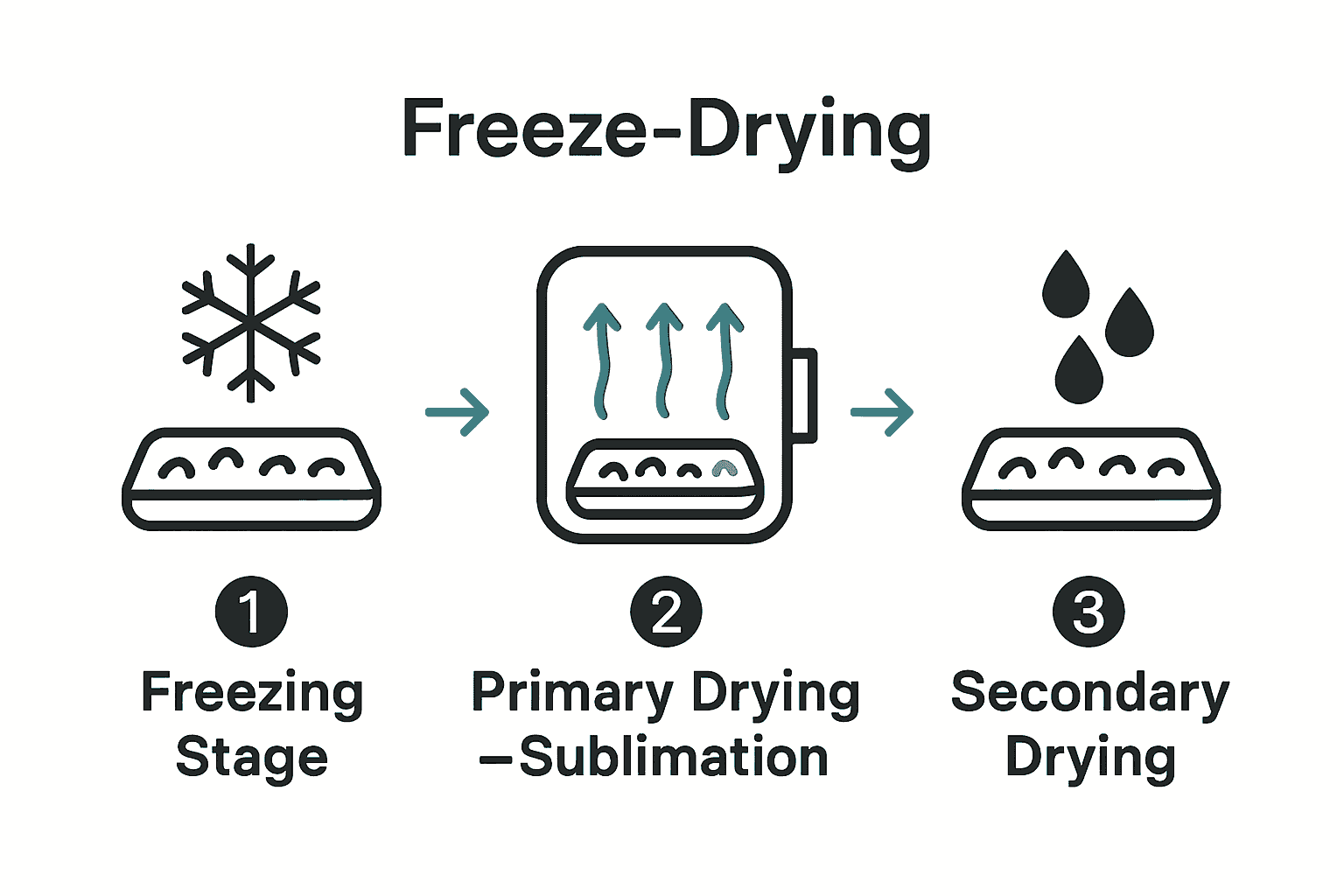
The freeze drying process involves three critical stages:
- Freezing Stage: Products are rapidly cooled to extremely low temperatures, typically well below zero
- Primary Drying (Sublimation): Frozen water is transformed directly into vapor under low pressure
- Secondary Drying (Desorption): Remaining molecular water is removed, ensuring complete product preservation
This methodical approach allows for remarkable product preservation, particularly for sensitive materials like pharmaceuticals and biological samples.
 By maintaining extremely controlled environmental conditions, freeze dryers can stabilize products that would typically degrade under traditional drying methods. For those looking to dive deeper into the intricacies of this process, our process of freeze drying guide offers comprehensive insights into the technical nuances of this remarkable preservation technique.
Core Applications in Food and Candy Industry
Freeze drying has revolutionized food preservation techniques, offering unprecedented quality retention for sensitive food products. According to ajer.org, this technology serves as a superior food dehydration method, particularly for products vulnerable to traditional high-temperature drying processes that can compromise nutritional composition.
The unique advantages of freeze drying in the food industry include:
- Nutrient Preservation: Maintains original nutritional profile
- Texture Retention: Prevents shrinkage or toughening of food products
- Flavor Protection: Keeps original taste and aroma intact
- Extended Shelf Life: Dramatically increases storage duration
Research from sienotech.com highlights that freeze-dried products offer remarkable rehydration capabilities due to microscopic pores created during the sublimation process. For candy manufacturers and food producers looking to explore this innovative preservation technique, our guide to freeze drying candy machines provides comprehensive insights into transforming traditional food processing methods.
Benefits, Costs, and Potential Drawbacks
Freeze drying technology presents a complex landscape of advantages and considerations for businesses and manufacturers. According to research from jetir.org, this preservation method offers numerous significant benefits that make it an attractive option across multiple industries.
Key advantages of freeze drying include:
- Minimal Chemical Decomposition: Preserves product integrity
- Low-Temperature Processing: Protects heat-sensitive materials
- Enhanced Product Stability: Extends shelf life dramatically
- Simplified Aseptic Handling: Enables more sterile processing
- Rapid Reconstitution: Easy to restore original product characteristics
However, the technology is not without its drawbacks. Initial equipment costs can be substantial, with industrial-grade freeze dryers representing a significant capital investment. Operating expenses, including electricity and maintenance, can also be considerable. The process requires specialized technical knowledge and precise environmental controls, which might pose challenges for smaller businesses. For those interested in understanding the nuanced economics of freeze drying, our guide to understanding bulk freeze dried candy offers comprehensive insights into making informed decisions about this preservation technology.
Discover the Power of Freeze Drying for Your Products
The challenge with traditional drying methods is that they can damage the texture, flavor, and nutritional value of your valuable goods. The article highlights how freeze dryer machines use sublimation to preserve the original qualities of sensitive products, from food to pharmaceuticals. If you want to maintain product integrity while extending shelf life, understanding the science behind the freeze-drying process is just the start.
At Space Man, we specialize in freeze dried candy manufacturing and distribution across Canada. We solve the common pain points of moisture removal and product degradation with state-of-the-art freeze drying technology. Along with private labeling, co-packing, and packaging services, we offer comprehensive solutions tailored to your needs.
Ready to elevate your product quality and stand out in the marketplace

Explore how our freeze drying expertise can transform your offerings. Visit Space Man now to learn more about our services and place your orders with confidence. Don’t miss the chance to harness the benefits of advanced freeze drying technology today.
Frequently Asked Questions
What is a freeze dryer machine?
A freeze dryer machine, also known as a lyophilizer, is equipment designed to remove moisture from products through a process called sublimation, preserving their original structure and nutritional content.
How does the freeze drying process work?
The freeze drying process involves three stages: freezing the product at low temperatures, primary drying where ice is converted to vapor under low pressure, and secondary drying to remove remaining water molecules.
What are the main types of freeze dryers available?
The main types of freeze dryers are tray-style, rotary, and manifold, along with categorization based on scale like laboratory, pilot-scale, industrial, and home freeze dryers.
What are the benefits of using freeze drying in food preservation?
Freeze drying helps maintain the nutritional profile, texture, flavor, and extends the shelf life of food products by removing moisture without high-temperature processing.