

TL;DR:
- High-barrier resealable pouches offer top moisture and crush protection for freeze-dried candies.
- Sustainability trends favor paper-based packaging, but barrier performance must be verified in Canada’s climate.
- Custom branding enhances shelf appeal, but packaging should be tailored individually for each product type.
Choosing the wrong packaging for freeze-dried or exotic candy is not just a branding problem, it is a freshness problem, a regulatory problem, and sometimes a shipping disaster. Canadian retailers are navigating a market where consumer expectations around presentation, ingredient integrity, and sustainability are all rising at once. This guide walks you through every major packaging format on the market, explains how each performs for fragile or specialty products, and gives you a practical framework for making the smartest choice for your candy business in 2026.
Table of Contents
- How to evaluate packaging for candy: Key criteria for 2026
- Top packaging options for candies: Freeze-dried & exotic snack focus
- Sustainable and compliant packaging in Canada
- Comparison table: Choosing the right packaging option for your candy
- Why the best candy packaging is rarely one-size-fits-all
- Seamless packaging solutions for Canadian candy retailers
- Frequently asked questions
Key Takeaways
| Point | Details |
|---|---|
| Prioritize protection | Choose high-barrier packaging for delicate or freeze-dried candies to preserve texture and freshness. |
| Sustainability matters | Eco-friendly packaging choices can help with new Canadian regulations and attract environmentally aware buyers. |
| Customization boosts branding | Custom-printed and unique packaging formats make your brand memorable and support premium positioning. |
| Match format to sales channel | E-commerce usually demands more durable packaging than in-store displays or boutique retail. |
How to evaluate packaging for candy: Key criteria for 2026
Before exploring specific packaging options, it is crucial to clarify the main factors that influence a retailer’s decision. Not all candy packaging is created equal, and what works perfectly for gummy bears may completely fail for airy, crunchy freeze-dried varieties.
The core criteria every retailer needs to weigh:
- Moisture protection: Freeze-dried candies are extremely porous. Even a brief exposure to humidity can turn a crispy product soft and unappetizing. High-barrier packaging is non-negotiable here.
- Crush resistance: Expanded, fragile snacks break apart in transit if packaging allows pressure. This is a shelf-quality issue and a return-rate issue.
- Contamination prevention: Resealable closures, tamper-evident seals, and food-grade materials keep your product safe from production to checkout.
- Shelf life: Barrier properties directly determine how long a product stays fresh. Oxygen transmission rate (OTR) and moisture vapor transmission rate (MVTR) are the two numbers that matter most.
- E-commerce durability: Ship-safe packaging must survive drops, compression, and temperature swings in transit across Canadian provinces.
- Branding and visibility: Clear windows, matte finishes, and custom print options all communicate premium quality before a shopper even reads the label.
- Sustainability compliance: Canada’s evolving EPR (Extended Producer Responsibility) regulations and plastic-related levies are pushing retailers toward lighter and more recyclable formats.
The 2026 market is clearly moving in one direction. Premiumization drives resealable, high-barrier pouches to the forefront while e-commerce demand requires durable ship-safe formats, and sustainability pressure is accelerating interest in paper-based alternatives. Understanding these shifts helps you invest in packaging that stays relevant not just today, but through the next product cycle.
Pro Tip: When reviewing any new packaging supplier, ask for OTR and MVTR data sheets for each material. These numbers tell you exactly how well a film protects against oxygen and moisture, which is the real measure of freshness performance.
For a broader breakdown of formats, the guide on essential candy packaging types is a great starting point before you commit to any specific material. If you are looking at differentiating your line visually, the resource on custom food packaging covers brand-forward design decisions worth reviewing early in your planning.
Top packaging options for candies: Freeze-dried & exotic snack focus
With selection criteria in mind, let’s look at the most effective packaging options available for today’s candy specialists. Each format has a distinct profile of strengths and limitations.
1. High-barrier resealable pouches (Mylar and foil-based)
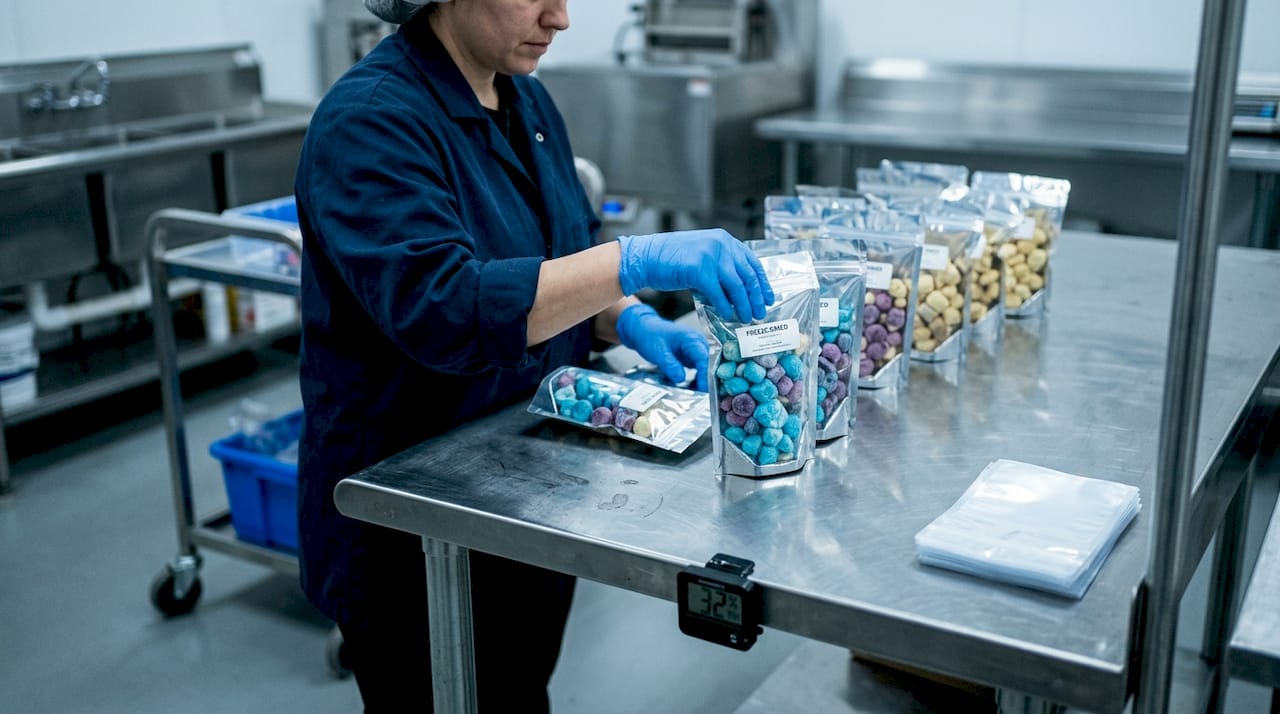
These are the gold standard for freeze-dried candy. Multi-layer Mylar or foil pouches offer extremely low OTR and MVTR, meaning they lock out both oxygen and moisture with genuine effectiveness. Resealable zippers add consumer convenience and support repeat use. The main trade-off is cost. These pouches cost more per unit than standard poly bags, but the shelf-life benefits almost always justify the investment for premium or specialty products. Clear windows on one panel also allow consumers to see the product, which boosts impulse purchase rates dramatically.
2. Paper-based stand-up pouches
The sustainable option with serious curb appeal. Paper stand-up pouches made with kraft or coated paper finishes communicate a natural, artisan brand identity that resonates strongly with health-conscious or eco-aware shoppers. The limitation is barrier performance. Standard paper pouches without an inner plastic layer or coating will not protect moisture-sensitive products adequately. Many newer formats use a hybrid construction with a thin inner barrier, but you need to verify specs carefully. These work best for lower-moisture candy formats where the branding benefit outweighs some loss of barrier strength.
3. Rigid containers and tubes
For high-value, ultra-fragile freeze-dried candy, rigid packaging is sometimes the right call. Rigid containers eliminate crush risk entirely, which matters a lot when your product expands to twice its original volume during freeze-drying and shatters easily under pressure. The downside is weight and shipping cost. Rigid formats are bulkier and heavier than flexible pouches, which adds up fast if you are shipping e-commerce orders across Canada. Best used for gifting SKUs, premium retail displays, or in-store impulse buys where the format itself elevates perceived value.
4. Flexible plastic bags
Standard poly bags or OPP (oriented polypropylene) bags are the most affordable format, widely available, and suitable for candies with less demanding freshness requirements. For everyday penny candy, gummies, or hard-coated products with natural moisture resistance, these work well. For freeze-dried candy, however, they fall short. High-sugar and low-fat candies lose 90 to 95% of their moisture during freeze-drying, creating an expanded and fragile structure that requires more than a basic poly bag to survive shipping or retail shelf life.
5. Custom printed packaging
Custom printing is not a format by itself, it is a feature layer you apply on top of any of the above. But it is worth treating it as its own priority because its impact on sales is real and measurable. Custom printed packaging tells your story, signals product category, and creates shelf differentiation in a crowded specialty snack aisle. For freeze-dried and exotic candy brands, visual identity is often what drives the first purchase. After that, product quality drives the repeat.
“Packaging is frequently the first physical interaction a customer has with your brand. In the specialty candy category, where novelty is a core selling point, that first impression often determines whether the product gets picked up at all.”
For detailed material comparisons, the resource on plastic packaging for freeze-dried candy covers the film types in depth. The overview of candy packaging pouches is equally useful for matching pouch styles to product types. And if you are exploring rigid formats, the guide on custom candy box options walks through custom box design considerations.
Pro Tip: For freeze-dried candy sold through e-commerce, consider a two-layer approach. Use a high-barrier inner pouch for freshness, then place it inside a printed outer box for branding and crush protection. This adds cost but dramatically reduces damage rates and return requests.
Sustainable and compliant packaging in Canada
Many retailers are prioritizing sustainability, so let’s look at what that means for candy packaging in the Canadian market specifically.
The paper versus plastic trade-off is real but manageable. Paper-based packaging appeals strongly to today’s consumer and supports brands that want to position themselves as environmentally responsible. However, paper has inherent limitations in humid environments. Canada’s climate varies dramatically, from the dry prairies to the wet coast of British Columbia and the humid summers of Ontario and Quebec. A recyclable kraft pouch may be viable in some regions, but its barrier performance compared to Mylar in humid Canadian conditions is a genuine concern for moisture-sensitive products.
What retailers need to consider:
- Recyclable packaging: Mono-material flexible films (all-polyethylene or all-polypropylene structures) are increasingly available and recyclable through select drop-off programs, though curbside recycling for flexibles remains limited in Canada.
- Biodegradable packaging: Some compostable formats exist, but they often have lower barrier performance and shorter shelf life for the packaging material itself. Always confirm industrial versus home compostability, since most Canadian municipalities only support industrial composting.
- EPR compliance: Extended Producer Responsibility programs are now active or being expanded in British Columbia, Ontario, Quebec, and other provinces. These programs require producers and importers to take responsibility for end-of-life packaging. Choosing lighter-weight packaging or formats with better recyclability can reduce your EPR fees over time.
- Plastic tax incentives: Federal and provincial plastic levies are creating real cost pressure to reduce virgin plastic use. Lightweighting (using thinner films that still meet barrier requirements) and incorporating recycled content are two practical strategies.
“Sustainability in candy packaging is not about switching to paper and calling it done. It is about finding the right barrier-to-environmental-impact ratio for each specific product and each specific market.”
Pro Tip: Always print your packaging’s recyclability instructions clearly on the label. Shoppers who want to do the right thing will notice, and it signals that your brand is paying attention to the full product lifecycle.
For a deep look at eco-friendly options, the article on biodegradable candy packaging covers the trade-offs in detail. The guide to plastic packaging for candy shops helps you understand which plastic formats currently have the best recyclability profiles in Canada.
Comparison table: Choosing the right packaging option for your candy
To help you choose at a glance, compare the benefits of each option in this summary table. Scores are rated on a scale of 1 to 5, where 5 is the strongest performance. Scores reflect typical performance, and specific products may vary.
| Packaging type | Protection (moisture and crush) | Sustainability | Branding potential | Cost efficiency | Best for |
|---|---|---|---|---|---|
| High-barrier resealable pouch (Mylar/foil) | 5 | 2 | 4 | 3 | Freeze-dried, exotic, e-commerce |
| Paper-based stand-up pouch | 3 | 5 | 5 | 3 | Low-moisture candy, premium retail |
| Rigid container or tube | 5 | 2 | 5 | 2 | Gift sets, high-value fragile candy |
| Flexible plastic bag (OPP or poly) | 2 | 2 | 3 | 5 | Everyday candy, bulk, low-risk formats |
| Custom printed box (folding carton) | 3 | 3 | 5 | 3 | POS display, gifting, multi-unit packs |
As premiumization reshapes the market and e-commerce grows, the high-barrier resealable pouch continues to dominate for specialty candy. Paper pouches are the fastest-growing format in premium retail. Rigid containers remain niche but important for gift-ready or collector-style products. For a complete breakdown of format categories, visit the candy packaging types overview to match your product range to the right starting point.
Why the best candy packaging is rarely one-size-fits-all
Here is an uncomfortable truth that does not get said enough in the packaging industry: most retailers underinvest in packaging strategy by trying to find one universal format and applying it across every product they sell. It almost never works, especially in the freeze-dried and exotic candy category where products have wildly different structures, moisture sensitivities, and consumer expectations.
We have seen candy businesses launch with a single standard pouch across their whole product line, only to discover that their saltwater taffy stays fine while their freeze-dried watermelon gets soft within two weeks. The product was fine. The packaging was wrong for that specific product, and it cost them shelf space, customer trust, and reorders.
The retailers who stand out in 2026 are the ones treating packaging as a product-by-product decision rather than a category-wide policy. They might use a high-barrier Mylar pouch for freeze-dried lines, a kraft stand-up pouch for their artisan hard candy, and a rigid tube for a premium seasonal gift SKU. That kind of deliberate packaging architecture takes more upfront planning but pays off in customer retention and brand perception.
Agility also matters here. The freeze-dried candy market is still evolving fast. New exotic flavors and formats are hitting the market regularly, and each one may need a different packaging solution. Locking yourself into a single supplier or format prematurely limits your ability to respond. Build relationships with flexible suppliers, keep some packaging SKUs as off-the-shelf options for speed, and reserve custom branded packaging investments for your proven bestsellers.
The “set-and-forget” approach to packaging is a liability in this market. Review your packaging choices at least annually, test new formats with small runs, and pay attention to what your customers are saying about presentation and freshness. Packaging feedback is product feedback in disguise.
Seamless packaging solutions for Canadian candy retailers
Spaceman has everything Canadian candy retailers need to package, brand, and scale specialty products with confidence.
Whether you are a candy shop adding freeze-dried varieties to your lineup or a distributor managing multiple SKUs across provinces, Spaceman’s private label packaging services handle production, bagging, and custom branding so you can focus on growing your business. If you are ready to test the retail floor, the display kit for distributors is a turnkey solution that ships shelf-ready. New to the category? Start with the starter pack wholesale to test multiple flavors and packaging formats before committing to volume. Every option is designed with freshness, compliance, and Canadian retail in mind.
Frequently asked questions
What is the most protective packaging for freeze-dried candies?
High-barrier resealable pouches made with Mylar or multi-layer films offer the best protection, as freeze-dried candy loses 90 to 95% of its moisture and becomes highly fragile and porous without strong moisture and oxygen barriers.
Are paper pouches a good option for exotic snack packaging in Canada?
Paper pouches look premium and support sustainability goals, but recyclable kraft pouches have lower barrier performance than Mylar in Canada’s humid regions, so always verify the barrier rating before committing.
How can candy packaging help my brand stand out?
Custom printed packaging creates strong shelf impact and communicates your brand story at the point of sale, especially when paired with trending materials like matte laminates or paper finishes.
What packaging options help reduce plastic taxes in Canada?
Lightweight recyclable films and paper-based alternatives can lower your EPR fees and plastic levy exposure, but EPR and plastic taxes require you to balance cost savings against actual barrier performance for each specific product.