

Trying to grow a specialty food business in Canada often means juggling production headaches and chasing packaging trends. The search for reliable co-packing and private labeling solutions can determine whether your next product launch succeeds or stalls. Specialty food co-packers offer a way for Canadian retailers to access custom production, advanced packaging, and compliance expertise without heavy upfront investment. This overview clarifies how co-packers operate, what sets them apart, and how these partnerships can help you expand efficiently.
Table of Contents
- What Are Specialty Food Co Packers?
- Types Of Co Packing Services Available
- The Co Packing Process Explained
- Food Safety, Legal, And Regulatory Compliance
- Evaluating Costs, Risks, And Common Pitfalls
- Choosing The Right Co Packing Partner
Key Takeaways
| Point | Details |
|---|---|
| Understand Co-Packers | Specialty food co-packers offer tailored production and packaging solutions, allowing businesses to scale without hefty upfront investments. |
| Evaluate Fit | Assess co-packers based on product specialization, packaging capabilities, and proximity to your distribution hub to ensure efficiency. |
| Prioritize Compliance | Ensure your co-packer adheres to Canadian food safety regulations and properly manages labeling to protect your brand’s reputation. |
| Clarify Costs and Risks | Be aware of hidden costs, minimum order quantities, and quality consistency issues to avoid surprises and protect your investment. |
What Are Specialty Food Co Packers?
Specialty food co-packers are manufacturing partners who produce and package food products for other companies, from small artisan brands to established retailers looking to expand their product lines. Unlike general manufacturers, these specialized facilities focus on custom production runs, private labeling, and unique packaging solutions tailored to your exact specifications. Think of them as an extension of your business—they handle the production complexity while you focus on sales, marketing, and customer relationships.
Here’s what makes co-packers different from traditional manufacturers. Co-packers work with multiple clients simultaneously, which means they’ve already invested in equipment, expertise, and quality control systems. This shared infrastructure saves you enormous capital upfront. Instead of building your own facility and hiring specialized staff, you gain access to proven processes, experienced teams, and often formulation assistance. They may manufacture competing product lines from different companies, which is actually an advantage—it keeps them lean, efficient, and constantly improving their operations. Co-packers handle everything from manufacturing to packaging, allowing you to scale production without scaling overhead.
For Canadian retailers specifically, partnering with a co-packer solves several real problems. You can test new product categories without committing to huge inventory investments. You gain access to specialized equipment for freeze-dried candies, custom bagging, or unique packaging formats that would be prohibitively expensive to buy yourself. A quality co-packer also brings compliance expertise—they understand food safety regulations, labeling requirements, and quality standards across different provinces. This matters tremendously when you’re trying to expand into new markets. The relationship works best when the co-packer understands your brand values and can consistently deliver products that match your customer expectations.
When evaluating co-packers, consider three critical factors: the product type they specialize in, their actual packaging capabilities, and their location relative to your distribution hub. Some facilities excel with frozen products, others with shelf-stable items. Some offer basic bagging while others provide custom box design and branding services. Proximity reduces transportation costs and makes quality checks more practical. The right co-packer becomes a competitive advantage, not just a vendor.
Pro tip: Request small test batches from potential co-packers before committing to full production runs—this reveals their actual quality consistency, communication responsiveness, and ability to handle your specific product requirements without expensive surprises down the road.
Types of Co Packing Services Available
Co-packing services run the full spectrum from basic packaging operations to complete manufacturing solutions. The specific services available depend on the facility’s equipment, expertise, and capacity, so understanding what each type offers helps you match your business needs with the right partner. Most co-packers provide customized combinations of these services rather than rigid one-size-fits-all packages.
The most common co-packing services include full-service manufacturing, where the co-packer handles product formulation, manufacturing, and packaging from raw materials to finished goods. This works well if you have a recipe or concept but lack production infrastructure. Private labeling is another popular option where the co-packer manufactures a standard product and applies your custom label, branding, and packaging. This is perfect for retailers wanting to develop their own house brands without massive capital investment. Contract packagers also provide packaging and labeling services for products you’ve already manufactured, handling everything from filling containers to applying labels and creating point-of-sale displays. Custom bagging and portioning services allow you to take bulk products and divide them into consumer-ready sizes with your branding. For specialty items like freeze-dried candies, some co-packers offer specialized processing combined with custom packaging solutions designed for your specific product characteristics.
Beyond basic packaging, progressive co-packers offer value-added services that set them apart. Product development assistance helps refine your recipes, achieve consistent quality, and navigate food safety regulations specific to Canadian provinces. Minimum order requirements vary significantly—some facilities handle small test batches of 500 units while others require 5,000 unit minimums. Quality control and testing services ensure every batch meets your standards and regulatory requirements before shipment. Some co-packers also manage confidentiality agreements and provide detailed product specification documentation, which matters when you’re protecting proprietary formulations or brand secrets. Understanding different packaging types helps you communicate clearly with potential partners about your specific needs and constraints.
When comparing co-packing options, create a simple matrix of your requirements: product type, volume needs, packaging format, timeline, and budget. Some facilities specialize in frozen products while others excel with shelf-stable items. Some have state-of-the-art automation while others offer flexibility with smaller runs. Location matters too—Canadian retailers benefit from working with local or regional co-packers who understand provincial food safety regulations and can provide faster turnaround on quality checks. Don’t assume all co-packers offer everything; ask specifically about equipment, capacity for your product type, and their experience with similar items.
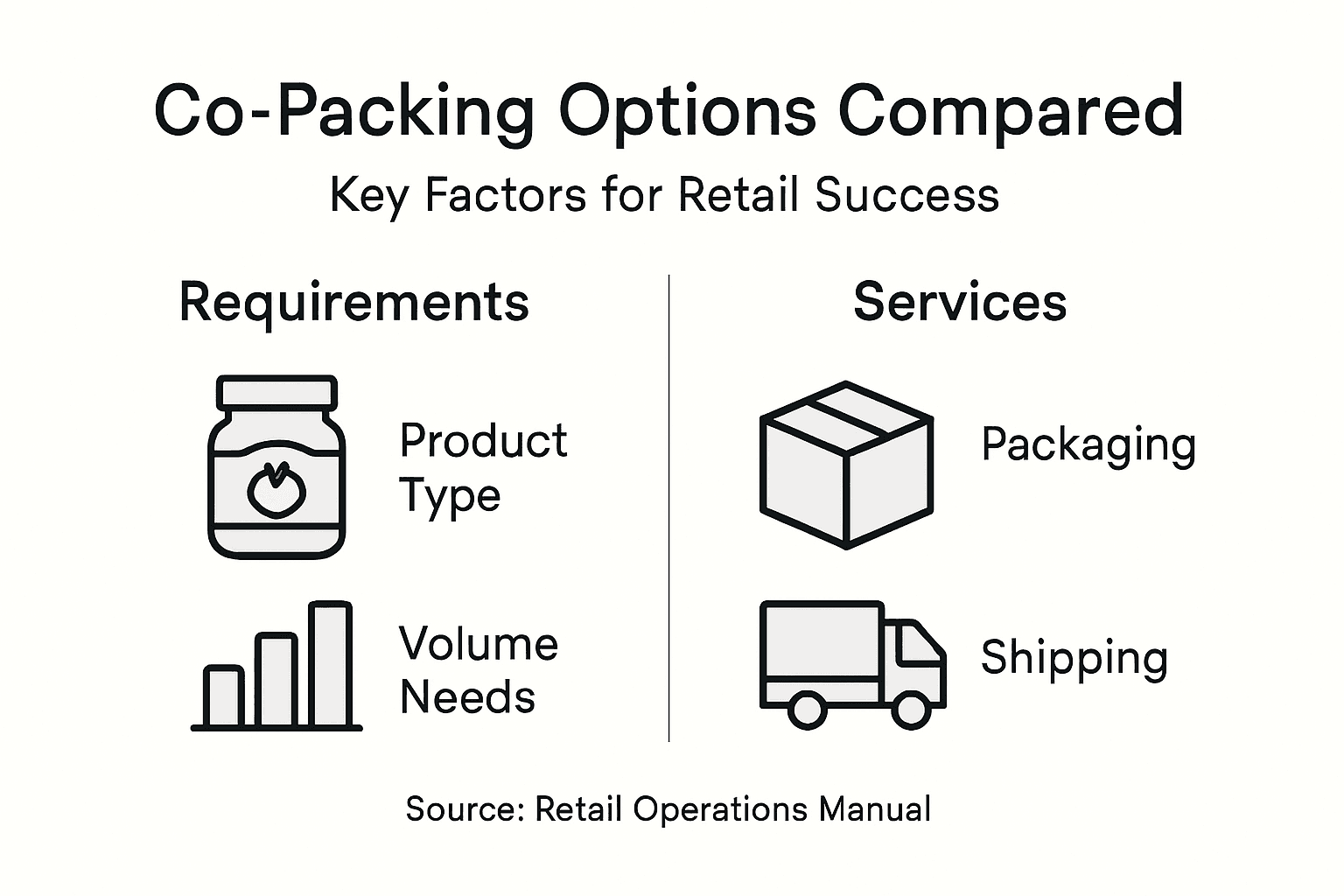
Here’s a quick comparison of co-packing service types and their typical business impacts:
| Service Type | Typical Scope | Best For | Business Impact |
|---|---|---|---|
| Full-Service Manufacturing | Recipe to finished product | Small brands, startups | Eases production setup |
| Private Labeling | Standard product, custom label | Retailers, house brands | Accelerates brand launch |
| Contract Packaging | Labeling & repackaging only | Established manufacturers | Adds retail flexibility |
| Custom Portioning/Bagging | Splitting bulk into consumer packs | Bulk product sellers | Enables new formats |
| Specialty Processing | Freeze-drying, unique techniques | Niche product creators | Accesses advanced methods |
Pro tip: Create a detailed request for proposal (RFP) that specifies your product type, desired volume, packaging specifications, timeline, and any special requirements—this forces clarity in your own mind and helps co-packers give accurate quotes rather than generic estimates.
The Co Packing Process Explained
The co-packing process starts long before your product hits a retailer’s shelf. Understanding how it works helps you communicate effectively with potential partners and avoid surprises down the road. Think of it as a carefully choreographed dance between your vision and their manufacturing expertise.
Here’s how the process typically unfolds. First comes the planning phase where you submit your product specifications, recipe, desired packaging format, and volume requirements to the co-packer. They evaluate whether they can handle your product type with their current equipment and capacity. Next, you’ll sign a co-packing agreement that outlines everything: your product formula, quality standards, manufacturing location, order methods, delivery schedules, and pricing. Co-packing agreements specify compliance with product specifications and quality control standards to ensure consistency batch after batch. This contract protects both parties and removes ambiguity. Once the agreement is finalized, the co-packer may request trial runs or test batches to validate processes, refine formulations, and ensure your product meets Canadian food safety regulations. This is where you discover whether their actual output matches what you envisioned.
The actual manufacturing and packaging phase involves receiving raw materials, processing them according to your specifications, quality testing at multiple checkpoints, and final packaging with your branding. The timeline varies dramatically depending on product complexity and order volume. A simple freeze-dried candy repackaging job might take two weeks from order to delivery, while custom formulation and packaging could require six to eight weeks. Throughout production, a quality control team monitors parameters like weight, appearance, seal integrity, and label accuracy. You typically receive samples before full production runs ship, giving you final approval. Documentation matters tremendously here—co-packers maintain detailed records of each batch for traceability and compliance purposes.
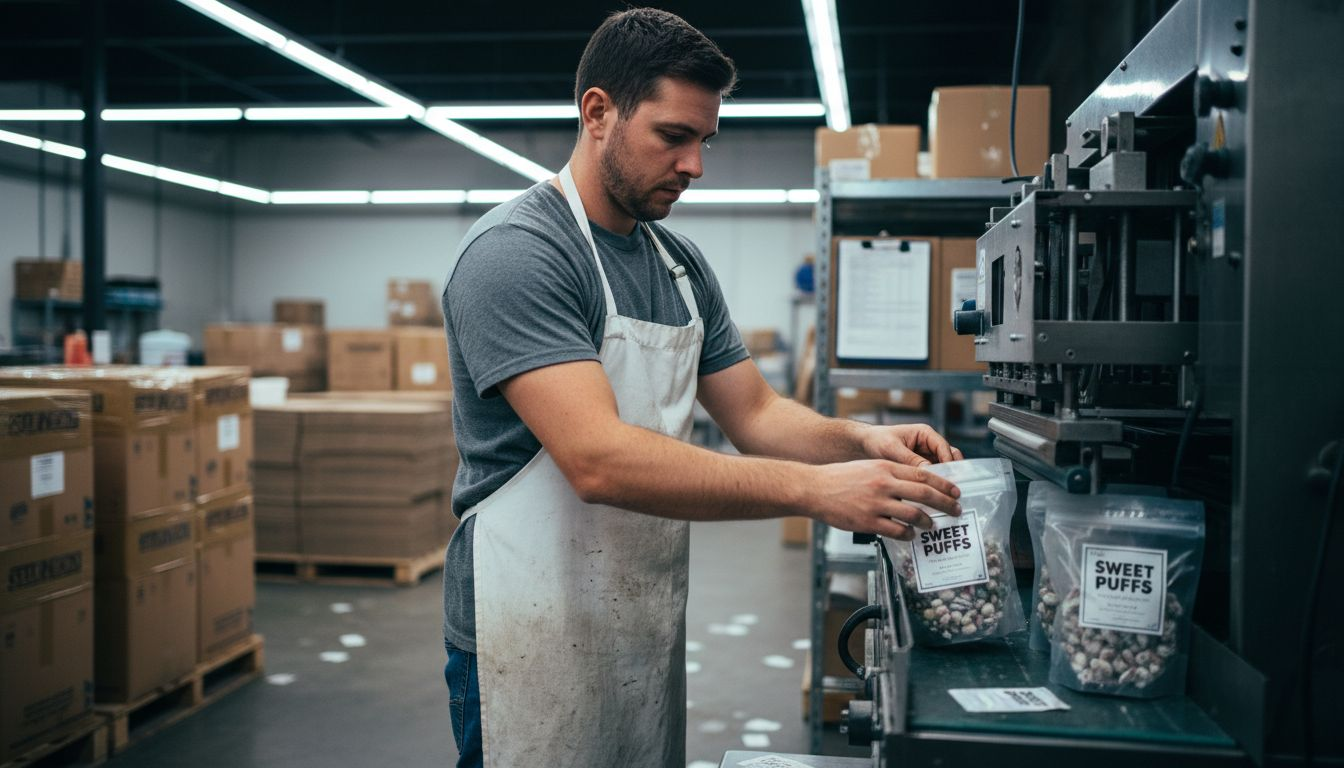
After production, the co-packer handles storage and arranges shipment to your distribution hub or directly to retailers. The entire relationship depends on clear communication from day one. Misunderstandings about packaging specifications, label placement, or delivery timelines create costly delays. Many successful retailers maintain quarterly check-ins with their co-packing partners to review performance, discuss growth plans, and address any quality concerns before they become problems. The co-packer isn’t just a vendor—they’re an extension of your brand, so treating them as a strategic partner rather than just a transaction pays dividends.
Pro tip: Visit the co-packer’s facility in person before signing any agreement—you’ll learn far more from observing their actual operations, meeting the team, and seeing their quality control standards firsthand than you ever will from a phone call or email.
Food Safety, Legal, and Regulatory Compliance
When you partner with a co-packer, their food safety practices become your responsibility. A single contamination incident or regulatory violation reflects on your brand, not theirs. This is why understanding the compliance landscape matters deeply before signing any agreement. Canadian food safety standards are strict, and your co-packer must meet them consistently or you face serious consequences.
Canada’s food safety framework operates through multiple layers of oversight. Health Canada and the Canadian Food Inspection Agency (CFIA) establish baseline requirements that apply across the country, while provincial health departments add their own standards. Your co-packer must comply with the Safe Food for Canadians Regulations, which cover everything from facility sanitation and employee training to temperature controls and allergen management. Understanding food safety regulations in Canada helps you ask the right questions during facility tours and contract negotiations. Specifically, you should verify that your co-packer maintains current CFIA licensing, has documented hazard analysis processes, and conducts regular testing for pathogens. They should also maintain clear records of all ingredient sources and suppliers. If they can’t demonstrate these practices, walk away. Your liability doesn’t disappear just because someone else made the product.
Beyond food safety, labeling compliance carries significant weight. Labels must clearly identify the product, list all ingredients in descending order by weight, disclose allergens prominently, include nutritional information according to Health Canada standards, display the product’s identity and net quantity, and provide manufacturer contact information. Many specialty food retailers overlook this because they assume the co-packer handles it. Wrong. You remain legally responsible for accuracy. Mislabeled products that reach consumers can trigger recalls, which cost thousands of dollars and destroy customer trust. Your co-packing contract should specify that you’ll review and approve all label artwork before production runs begin. Get it in writing. Additionally, ISO 22000 food safety management systems represent a globally recognized standard that demonstrates your co-packer’s commitment to systematic hazard control and continuous improvement. Ask whether your potential partner holds this certification or works toward it.
The liability question matters too. Most co-packing agreements include indemnification clauses where the co-packer agrees to cover damages resulting from their manufacturing failures. However, you’re typically still liable to consumers if something goes wrong, then you recover costs from the co-packer. This is why insurance becomes critical. Verify that your co-packer maintains product liability insurance and names you as an additional insured party. You should also carry your own product liability coverage. The combination protects both parties and ensures that a worst-case scenario doesn’t bankrupt your business. Documentation is your best defense—keep records of every approval you gave, every test result the co-packer provided, and every communication about quality standards.
Pro tip: Request a copy of your co-packer’s most recent CFIA inspection report and any third-party audit certifications before finalizing any agreement, then ask them directly about findings or non-compliances and how they addressed them.
Evaluating Costs, Risks, and Common Pitfalls
Co-packing looks attractive on paper until you discover hidden costs or realize your partner isn’t equipped to handle growth. Most retailers underestimate both the financial and operational challenges when first partnering with a co-packer. Understanding the real costs and common mistakes helps you avoid expensive surprises.
Let’s talk money first. Co-packing fees typically include per-unit production costs, setup fees for custom runs, packaging material charges, and labeling costs. But here’s where retailers get trapped: minimum order quantities. Many co-packers require 5,000 to 10,000 unit minimums, which means significant upfront investment before you know if a product will sell. Storage fees apply if your co-packer holds finished inventory between shipments. Shipping costs add up quickly, especially if your co-packer is located far from your distribution hub. You might also pay for formula development, trial runs, or custom packaging artwork. Add these together and a product you thought cost 50 cents to produce suddenly costs 75 cents. The solution is brutal honesty during initial quotes. Ask for itemized pricing that breaks down every charge. Request pricing at multiple volume levels so you understand the cost curve. Compare at least three co-packers, but don’t choose based on price alone. The cheapest option often means hidden quality issues.
Risk management becomes critical when your manufacturing happens outside your facility. Supply chain disruptions in packaging and manufacturing create ripple effects through your entire business. What happens if your co-packer suddenly closes, experiences equipment failure, or loses key staff? Your product availability disappears. This is why contract terms matter tremendously. Specify what happens if they miss deadlines, how you handle quality failures, and what notice period applies if either party wants to exit. Diversification helps too. If a product generates significant revenue, consider maintaining relationships with backup co-packers who can step in during emergencies. Quality inconsistency is another common pitfall. One batch meets your standards perfectly while the next batch has seal issues or color variations. This happens because co-packers serve multiple clients simultaneously, and staff attention wanes. Establish clear quality metrics in writing and require monthly performance reports. Request samples from every production run before full shipment, not just the first one.
Communication breakdowns create most disputes. You mention wanting smaller package sizes but the co-packer interprets this as reducing fill weight. Suddenly you’re selling 30 percent less product than expected. Prevent this through detailed written specifications with photos or sample units. Include timelines in your contract that specify turnaround times for approvals, samples, and final delivery. Meet with your co-packing partner quarterly to review performance metrics, discuss growth plans, and address concerns before they escalate. The co-packer relationship requires ongoing attention. You can’t sign an agreement and disappear for six months expecting perfect execution.
The following table summarizes key cost and risk factors to evaluate before choosing a co-packer:
| Factor | Why It Matters | How to Assess |
|---|---|---|
| Minimum Order Quantity | Sets upfront commitments | Ask for sample batch options |
| Setup & Artwork Fees | Affects final price per unit | Obtain itemized quotes |
| Storage & Shipping | Impacts total logistics cost | Check facility location |
| Quality Consistency | Safeguards your brand | Require batch samples |
| Backup Capacity | Reduces supply chain risk | Look for alternate partners |
Pro tip: Build a comparison spreadsheet of at least three potential co-packers that includes unit pricing at different volumes, minimum orders, setup fees, lead times, certifications, and storage costs, then calculate your actual cost per unit including all hidden fees before making a final decision.
Choosing the Right Co Packing Partner
Selecting a co-packing partner is one of the most consequential decisions you’ll make for your retail business. This isn’t a transaction you complete once and forget about. You’re building a relationship that directly impacts product quality, costs, growth capacity, and ultimately your reputation with customers. A wrong choice costs thousands in wasted inventory and damaged brand trust. A right choice multiplies your ability to compete.
Start by defining your specific needs with brutal clarity. What product types do you need manufactured? Freeze-dried candies require different equipment than liquid products or baked goods. What packaging formats matter to you? Bulk bags, portioned sachets, custom boxes? What volume do you need today and what’s your growth projection for the next 18 months? What’s your budget per unit including all hidden fees? Do you need product development assistance or just packaging services? Write these requirements down before contacting any potential partner. This forces you to think clearly and helps co-packers give accurate quotes. When evaluating candidates, verify their specialization in products similar to yours. A co-packer excellent at freeze-dried items might struggle with temperature-sensitive products. Ask about their equipment specifics, production capacity, and whether they’ve worked with other brands in your category. Comprehensive co-packing directories list detailed information about producer equipment, capacity, and quality control systems, which helps you compare options systematically based on actual production capabilities rather than marketing promises.
Beyond technical capability, assess their business stability and communication style. How long have they operated? Do they have consistent management or high staff turnover? Are they responsive when you call with questions or do emails go unanswered for days? Request references from existing clients and actually call them. Ask how they handle problems, whether quality remained consistent over time, and if they’d work with the co-packer again. Visit the facility in person. You’ll learn more from observing their operations for an hour than from a dozen phone calls. Pay attention to cleanliness, organization, staff engagement, and whether their safety protocols are visible and enforced. Some Canadian retailers overlook regional co-packers, but proximity offers real advantages. Shorter distances mean lower shipping costs, faster turnaround on samples, and easier relationship management. Understanding different packaging types also helps you communicate your specific packaging needs clearly during facility tours.
Finally, evaluate their flexibility and growth mindset. Will they accommodate your small starting volume, or do they insist on large minimums that don’t make sense for your business? If your product suddenly needs a 400 percent production increase, can they scale? Do they invest in newer equipment or rely on aging machinery? Are they willing to collaborate on formula refinement or do they take a hands-off approach? The best co-packing partners see your success as their success. They proactively identify problems, suggest improvements, and invest in the relationship. These partners become genuine competitive advantages as you scale.
Pro tip: Create a weighted scoring matrix that evaluates potential co-packers on capability (30%), pricing transparency (25%), quality standards (20%), communication responsiveness (15%), and growth flexibility (10%), then score each candidate objectively rather than relying on gut feel alone.
Unlock Your Retail Growth with Expert Specialty Food Co-Packing
Navigating the complex world of specialty food co-packers can feel overwhelming when you face challenges like high minimum orders, inconsistent quality, and strict Canadian food safety regulations. You want a partner who truly understands your brand, handles custom packaging, and helps you scale efficiently without hidden costs or surprises. At Spaceman, we specialize in freeze dried candy manufacturing and co-packing services tailored to the unique needs of Canadian retailers. Whether you need private labeling, custom bagging, or help bringing innovative products to market, our experienced team is ready to support your growth with proven expertise and transparent pricing.

Explore our range of Bulk Unbranded Freeze Dried Candy & Treats – Spaceman to see the quality you can expect from a trusted co-packer and manufacturer. Don’t risk your brand with unknown partners. Visit our website today and take the next step toward effortless production and packaging solutions designed to keep your business ahead of the curve.
Frequently Asked Questions
What services do specialty food co-packers provide?
Specialty food co-packers offer a range of services, including full-service manufacturing, private labeling, contract packaging, custom portioning, and specialized processing. They cater to various needs from product formulation to packaging, ensuring that you can scale without significant upfront investment.
How can partnering with a co-packer benefit my retail business?
Partnering with a co-packer allows you to focus on sales and marketing while they handle production and packaging. This can lead to cost savings, access to specialized equipment, and expertise in meeting food safety regulations, thereby facilitating faster market entry and growth.
What should I consider when choosing a co-packer?
When choosing a co-packer, consider factors such as their specialization in your product type, packaging capabilities, minimum order requirements, quality control processes, and location relative to your distribution needs. These aspects can significantly impact your production efficiency and costs.
How does the co-packing process work?
The co-packing process involves several steps: submitting product specifications, signing an agreement, conducting trial runs for quality validation, manufacturing, and finally packaging your product. Clear communication throughout this process is crucial to avoid misunderstandings and ensure quality results.
Recommended
- Understanding Custom Packaging for Bakeries: What You Need to Know – Spaceman
- 7 Creative Food Packaging Design Ideas for 2025 – Spaceman
- Understanding the Benefits of Private Labeling – Spaceman
- Understanding Sustainable Candy Packaging: Key Concepts – Spaceman
- 7 Delicious Examples of Thai Fusion Meals