

TL;DR:
- Lyophilization is a low-temperature dehydration process that freezes a product and removes water by sublimation, preserving its structure and stability. It is widely used in pharmaceuticals to maintain product integrity and in food products to extend shelf life up to 25 years. The process involves three stages: freezing, primary drying, and secondary drying, each requiring precise temperature and pressure controls to avoid product damage.
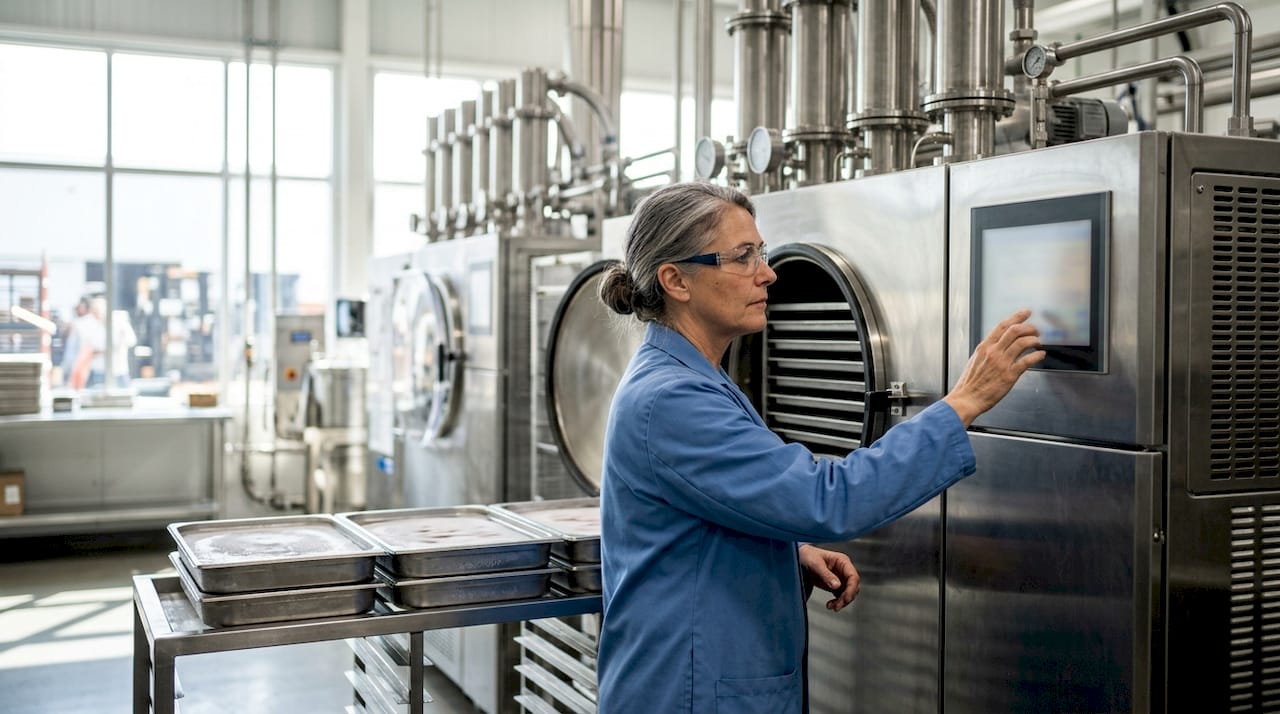
Lyophilization is defined as a low-temperature dehydration process that freezes a product, then removes water by sublimation under vacuum, preserving its molecular structure and long-term stability. Known colloquially as freeze drying, the process is the gold standard for stabilizing biologics, vaccines, injectable drugs, and shelf-stable food products. Unlike heat-based drying methods, lyophilization operates well below the freezing point of water, which means heat-sensitive compounds survive intact. A complete lyophilization overview covers the full scope of how this technology extends shelf life across industries, but this article goes deeper into the parameters, trade-offs, and technical decisions that actually matter on the production floor.
What are the stages of the lyophilization process?
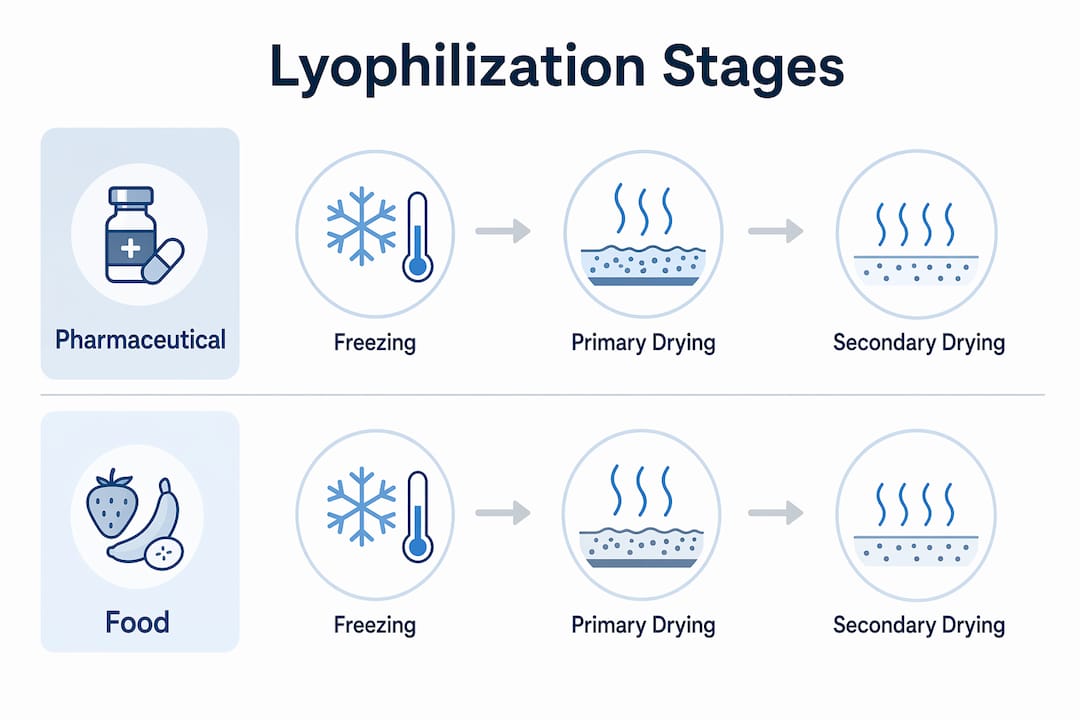
The lyophilization process explained at its core involves three sequential stages: freezing, primary drying, and secondary drying. Each stage has distinct temperature and pressure targets, and getting any one of them wrong can ruin an entire batch.
Freezing
The product is cooled to between -40°C and -55°C, converting free water into ice crystals. The rate of freezing is not arbitrary. Slow freezing forms larger ice crystals, which create larger pores in the dried cake. Larger pores improve reconstitution speed, which is useful in injectable drug products, but they can also weaken the structural integrity of fragile biologics. Fast freezing does the opposite: smaller crystals, denser cake, slower reconstitution. Choosing the right freezing rate is a product-specific decision, not a default setting.
Annealing is a technique used during this stage where the product temperature is briefly raised and then lowered again. This promotes crystal growth uniformity and reduces batch-to-batch variability. It is particularly common in pharmaceutical lyophilization where consistency is a regulatory requirement.
Primary drying
Primary drying removes approximately 95% of free water by sublimation, converting ice directly to vapor without passing through a liquid phase. This happens under vacuum pressures of 50–200 mTorr, which lowers the energy barrier for sublimation. The shelf temperature must stay below the product’s collapse temperature (Tc). Exceeding the collapse temperature causes irreversible structural damage, denaturation, and batch failure. This is the most time-consuming stage and often the rate-limiting step in the entire cycle.
Pro Tip: Map your product’s collapse temperature using differential scanning calorimetry (DSC) or freeze-drying microscopy before designing your primary drying ramp. Guessing Tc is how batches get ruined.
Secondary drying
Secondary drying targets the remaining 0.5–3% of bound water that did not sublimate during primary drying. Shelf temperatures rise to +20°C to +40°C to desorb this tightly bound moisture. Residual moisture above the target range accelerates degradation and reduces shelf life. The full lyophilization cycle, across all three stages, typically runs 24–48 hours or longer depending on product load, fill volume, and formulation.
| Stage | Temperature Range | Pressure | Key Goal |
|---|---|---|---|
| Freezing | -40°C to -55°C | Atmospheric | Ice crystal formation |
| Primary drying | Below collapse temp (Tc) | 50–200 mTorr | Sublimation of free water (~95%) |
| Secondary drying | +20°C to +40°C | Low vacuum | Desorption of bound water (0.5–3%) |
How does lyophilization differ between pharmaceutical and food applications?
The goals of lyophilization in pharmaceuticals versus food are related but not identical. Both industries want to remove water and extend shelf life. The methods they use and the outcomes they prioritize diverge significantly.
Pharmaceutical lyophilization
Pharmaceutical lyophilization focuses on molecular stability, sterility of the manufacturing environment, and potency retention. Biologics stabilized by lyophilization can be stored at room temperature for 2–5 years without cold chain requirements, which is a major logistical and cost advantage. Vaccines, monoclonal antibodies, and peptide injectables are common candidates. The process must meet Good Manufacturing Practice (GMP) standards, and every cycle parameter is validated and documented for regulatory submission.
Food industry lyophilization
Food lyophilization prioritizes nutrition retention, texture preservation, flavor integrity, and shelf life extension for consumer products. Lyophilized food products can last up to 25 years when stored properly, which is why the technology is used heavily in emergency preparedness, military rations, and premium retail snacks. The freeze drying of fruits, vegetables, meats, and confections preserves color, taste, and nutritional profile far better than conventional dehydration. Cycle times in food applications are often shorter than in pharma because the tolerance for residual moisture is slightly higher and sterility requirements differ.
Key differences between the two industries:
- Regulatory burden: Pharma requires GMP validation and regulatory filing; food follows food safety standards like HACCP.
- Packaging: Pharma products are typically vialed under nitrogen or in sealed ampoules; food products use airtight containers with oxygen absorbers to maintain quality.
- Shelf life: Food lyophilization achieves up to 25 years; pharmaceutical products target 2–5 years at room temperature.
- Cycle economics: Food manufacturers run higher throughput with less stringent cycle documentation; pharma runs validated, fully documented cycles.
| Factor | Pharmaceutical | Food |
|---|---|---|
| Primary goal | Molecular stability, potency | Texture, flavor, nutrition |
| Shelf life | 2–5 years | Up to 25 years |
| Regulatory standard | GMP, FDA/EMA filing | HACCP, food safety codes |
| Packaging format | Vials, ampoules | Airtight bags, cans |
| Cycle documentation | Full validation required | Process monitoring |
What are the critical technical challenges in lyophilization?
Lyophilization is not a set-it-and-forget-it process. Several technical factors can derail a cycle, degrade product quality, or create safety risks that are not immediately obvious.
The collapse temperature is the most consequential parameter in primary drying. Surpassing Tc during primary drying irreversibly damages product structure, causing the dried cake to collapse, lose porosity, and fail reconstitution tests. This is particularly catastrophic in biologics where protein denaturation is permanent. Tc is product-specific and must be characterized experimentally, not estimated from literature values for similar compounds.
A less obvious risk is microbial dormancy. Lyophilization preserves microorganisms in a dormant state rather than killing them. Rehydration or improper storage can reactivate microbial growth. This is a critical distinction for food safety professionals: freeze drying is not sterilization. For food products, pre-cooking or post-processing treatments are required to address pathogen risk before the product reaches the consumer.
Energy consumption and cycle duration are the operational Achilles heel of traditional lyophilization. Vacuum microwave dehydration and similar technologies are reducing drying times from days to minutes while maintaining comparable product quality. These innovations are gaining traction in food manufacturing where throughput pressure is high and energy costs are a real constraint.
Pro Tip: During cycle development, use process analytical technology (PAT) tools like pressure rise testing or tunable diode laser absorption spectroscopy (TDLAS) to monitor sublimation rate in real time. Relying on shelf temperature alone is not sufficient for cycle control.
Additional technical considerations worth building into your cycle design:
- Fill volume and vial geometry affect heat and mass transfer rates; thinner fills dry faster.
- Excipient selection in pharma formulations (e.g., mannitol, sucrose, trehalose) protects protein structure during freezing and drying.
- Incomplete secondary drying leaves residual moisture that accelerates chemical degradation, even when the product looks visually acceptable.
What practical applications and future trends shape lyophilization use?
Lyophilization has moved well beyond its pharmaceutical origins. The technology now underpins a wide range of consumer and industrial applications, and the next wave of innovation is focused on speed and energy efficiency.
In pharmaceuticals, lyophilized products include monoclonal antibodies, live attenuated vaccines, diagnostic reagents, and peptide therapeutics. The ability to store these products without refrigeration opens up distribution in regions with limited cold chain infrastructure. This is not a minor convenience. It is a public health advantage with real-world impact on vaccine access in lower-income markets.
In food and retail, freeze-dried snacks, fruits, and confections have grown into a mainstream consumer category. The shelf life of freeze-dried food makes it attractive for retailers, emergency preparedness brands, and premium snack manufacturers alike. Freeze-dried candy, in particular, has become a high-margin retail product with strong consumer demand across North America.
Emerging trends reshaping the field include:
- Continuous lyophilization: Moving away from batch processing toward continuous manufacturing to improve throughput and reduce cycle variability.
- Advanced cycle modeling: Software-based simulation tools that predict optimal cycle parameters before running a single physical batch, reducing development time.
- Vacuum microwave dehydration: A competing technology that cuts drying time dramatically while maintaining product quality, particularly relevant for food manufacturers.
- Real-time monitoring integration: PAT tools integrated with lyophilizer control systems to enable adaptive cycle adjustments based on live sublimation data.
Packaging remains the final line of defense for any lyophilized product. Moisture ingress after drying reverses everything the process achieved. Airtight packaging with oxygen absorbers and moisture barriers is the standard for both food and pharmaceutical products.
Key Takeaways
Lyophilization preserves sensitive products by removing water through freezing, sublimation, and desorption, with cycle design, collapse temperature control, and packaging integrity determining whether the process succeeds or fails.
| Point | Details |
|---|---|
| Three-stage process | Freezing, primary drying, and secondary drying each require distinct temperature and pressure controls. |
| Collapse temperature is critical | Exceeding Tc during primary drying causes irreversible product damage and batch failure. |
| Not a sterilization method | Lyophilization induces microbial dormancy; pre-cooking or post-processing is required for food safety. |
| Industry applications differ | Pharma targets molecular stability over 2–5 years; food targets texture and flavor over up to 25 years. |
| Packaging determines shelf life | Airtight containers with oxygen absorbers are required to maintain quality after drying. |
Why lyophilization still surprises even experienced professionals
The most common mistake I see from professionals new to lyophilization is treating it as a solved problem. The physics are well understood. The equipment is mature. So the assumption is that running a cycle is mostly procedural. It is not.
Every product has its own collapse temperature, its own optimal freezing rate, and its own residual moisture target. A cycle that works perfectly for a sucrose-stabilized monoclonal antibody will fail on a different protein with a different excipient profile. The variables interact in ways that are not always predictable from first principles. That is why cycle development still requires experimental characterization, not just literature lookup.
The sterilization misconception also comes up more than it should, especially in food manufacturing. Professionals who understand that lyophilization is a preservation method, not a kill step, design better processes and avoid serious food safety gaps. The USU Extension guidance on this point is worth reading if your team works with raw or minimally processed food inputs.
What excites me about the current moment in lyophilization is the convergence of real-time monitoring tools and cycle modeling software. The industry is moving toward adaptive cycles that respond to actual sublimation data rather than fixed ramp-and-hold programs. That shift will reduce cycle times, improve batch consistency, and lower energy costs simultaneously. The technology is not there yet at scale, but the direction is clear.
— Chadi
Space-man’s freeze-dried packaging and co-packing services
Space-man works with food manufacturers and consumer goods brands that need professional packaging and co-packing solutions built specifically for freeze-dried products.
Freeze-dried goods require packaging that maintains the low moisture environment the lyophilization process created. Space-man’s private label and co-packing services cover bagging, sealing, and labeling for retail-ready freeze-dried products across Canada. Whether you are scaling a new freeze-dried snack line or need a reliable co-packing partner for an existing product, Space-man brings the production infrastructure and packaging expertise to get it done right. Reach out to discuss your project requirements.
FAQ
What is lyophilization in simple terms?
Lyophilization is a freeze-drying process that removes water from a product by first freezing it, then sublimating the ice under vacuum. The result is a dry, shelf-stable product that retains its original structure, flavor, and nutritional profile.
How long does a lyophilization cycle take?
A full lyophilization cycle typically runs 24–48 hours or longer, depending on product type, fill volume, and formulation. Pharmaceutical cycles tend to run longer than food cycles due to stricter residual moisture targets.
Does lyophilization kill bacteria?
Lyophilization does not kill bacteria. It places microorganisms in a dormant state. Rehydration or improper storage can reactivate microbial growth, which is why pre-cooking or post-processing is required for food safety.
What is the collapse temperature in lyophilization?
The collapse temperature (Tc) is the maximum product temperature allowed during primary drying. Exceeding Tc causes the dried cake to collapse irreversibly, resulting in batch failure and degraded product quality.
How does lyophilized food last so long?
Lyophilized food lasts up to 25 years because removing water lowers water activity to a level that inhibits microbial growth and chemical degradation. Proper airtight packaging with oxygen absorbers is required to maintain that stability over time.