

TL;DR:
- Starting a protein bar business requires thorough market research, production planning, and regulatory compliance. Small brands succeed by targeting specific niches and building strong identities before expanding. Launching with two or three flavors through direct-to-consumer channels and reliable co-packing partners increases chances of long-term success.
Starting a protein bar business means building a food brand from scratch: recipe development, FDA compliance, production planning, branding, and sales strategy all have to work together. The protein bar category is one of the most competitive shelves in the health food market, yet smaller brands consistently carve out loyal audiences by moving faster and targeting tighter niches than large consumer packaged goods companies. This guide covers every major step, from your first market research survey to your first wholesale order, so you can launch with clarity instead of guesswork.
How to start a protein bar business: market research first

Market research is the foundation of every successful protein bar launch. Skip it, and you are essentially guessing what flavor to make and who will buy it. Do it well, and you know exactly which gap you are filling before you spend a dollar on ingredients.
Start by mapping the major consumer segments actively buying protein bars:
- Athletes and gym-goers who prioritize high protein content and clean ingredient lists
- Busy professionals who want a convenient meal replacement with balanced macros
- Diet-focused consumers following keto, vegan, or gluten-free eating patterns
- Parents looking for lower-sugar snack options for active kids
Each segment has different price tolerance, flavor preferences, and purchasing habits. A bar designed for competitive CrossFit athletes will look very different from one aimed at office workers grabbing lunch on the go.
Once you know your segment, analyze what is already on the shelf. Buy ten bars in your target category and eat them all (yes, this is the fun part). Note the protein sources, sweeteners, textures, and price points. Look for the gaps. Maybe every bar in the “keto” section uses the same two protein sources and tastes nearly identical. That is your opening.
Use surveys, Reddit communities, and small focus groups to validate your assumptions before committing to a recipe. Online survey tools and Instagram polls cost almost nothing and can tell you whether your target customer actually cares about the feature you plan to build your brand around.
Pro Tip: Run a 10-person taste test with your target demographic before finalizing any recipe. Their feedback on texture and sweetness will save you months of reformulation later.
What are the production options for protein bars?
Production is where most protein bar startups hit their first wall. The two main paths are in-house manufacturing and co-packing, and each has real trade-offs.
| Factor | In-house manufacturing | Co-packing |
|---|---|---|
| Upfront cost | High (equipment, facility, permits) | Low to moderate (MOQ deposits) |
| Control | Full control over recipe and process | Limited; depends on co-packer capabilities |
| Scalability | Slow; limited by your own capacity | Faster; co-packer absorbs volume increases |
| Expertise required | High; you manage food safety and QA | Moderate; co-packer handles production |
| Best for | Established brands with capital | Early-stage startups testing the market |
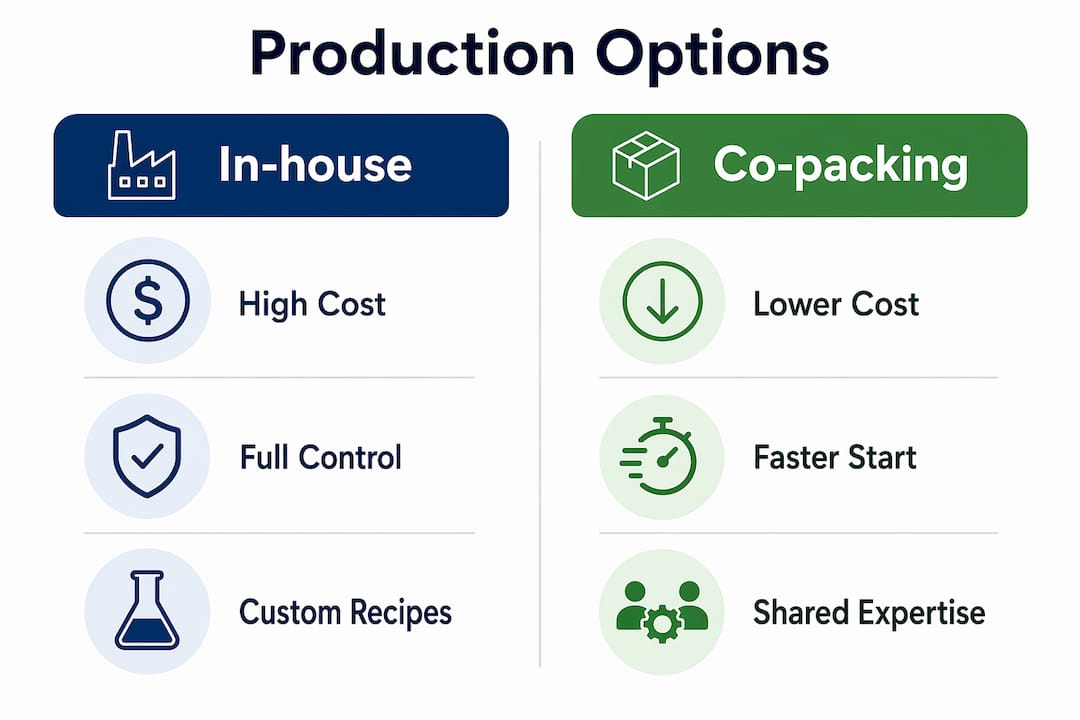
Most founders starting a protein bar company choose co-packing first. It lowers the barrier to entry significantly. The catch is that protein bars require specialized production capabilities, and not every food contract manufacturer can handle them. Protein interactions, moisture migration, and coating adhesion all behave differently under industrial conditions than they do in your kitchen.
Recipe development is its own challenge. Bench recipes often fail at scale because texture systems respond differently to high-speed industrial pressure. A bar that holds together perfectly in a home oven can crumble, crack, or turn rubbery when run through commercial cutting and wrapping equipment. Pilot trials are non-negotiable before you commit to a production run.
Shelf-life stability is another design challenge that founders underestimate. Bars that taste great on day one can become dry, stale, or hard within weeks if the moisture balance is off. Ingredient selection, including your choice of binders, fats, and humectants, directly affects how the bar holds up through distribution cycles.
Founders often overestimate margins because they do not account for the true cost of specialized proteins, functional fibers, premium inclusions, and high minimum order quantities. Build a detailed cost model before you fall in love with your recipe.
Pro Tip: Budget for at least two or three scale-up trials with your co-packer. Issues like dough consistency, cutting defects, and coating failures almost never appear in home-scale prototypes. You can also review equipment planning considerations to understand what food production infrastructure actually costs.
How to ensure legal compliance and labeling for protein bars
Legal compliance is not optional, and the FDA does not grade on a curve. Launching a protein bar business requires formal registration and FDA compliance, including Good Manufacturing Practices and accurate labeling on every unit you sell.
Here is what you need to address before your first sale:
- Business entity formation. Register as an LLC or corporation at the state level. This separates your personal assets from business liability.
- FDA facility registration. Any facility that manufactures, processes, or packs food for U.S. sale must register with the FDA under the Food Safety Modernization Act (FSMA).
- Good Manufacturing Practices (GMPs). These federal standards govern facility hygiene, equipment sanitation, employee training, and record-keeping. Your co-packer should already follow them, but verify.
- Nutrition facts panel. Must follow FDA format exactly, including serving size, calorie count, and all required nutrients.
- Ingredient list. Listed in descending order by weight, with no exceptions.
- Allergen declarations. The Food Allergen Labeling and Consumer Protection Act (FALCPA) requires clear disclosure of the nine major allergens: milk, eggs, fish, shellfish, tree nuts, peanuts, wheat, soybeans, and sesame.
- Health claims. Any claim like “high protein” or “supports muscle recovery” must be substantiated and compliant with FDA definitions. Unsubstantiated claims invite warning letters.
Local health department inspections may also apply depending on your state and production setup. Keep traceability records for every ingredient lot. If a recall happens, you need to know exactly where every ingredient came from. For a deeper look at what goes on a label, the FDA labeling requirements guide covers the specifics in plain language.
How to build a brand that makes your protein bar stand out
A great recipe with a forgettable brand will lose to a decent recipe with a great brand every single time. Strong brand identity and storytelling focused on a specific lifestyle or dietary niche are as critical as the formula itself.
Your brand needs to answer one question instantly: “Who is this for?” A bar called “ProMax 3000” says nothing. A bar called “Trail & True” with earthy packaging and a story about backcountry hiking says everything to a very specific buyer.
Effective marketing channels for a new protein bar brand include:
- Instagram and TikTok for visual storytelling, recipe content, and user-generated posts
- Influencer partnerships with micro-influencers in fitness, nutrition, or lifestyle niches (smaller audiences, higher trust)
- SEO and content marketing through a brand blog covering topics your target customer searches for
- Email marketing to convert first-time buyers into repeat customers
For sales channels, start narrow and expand. Direct-to-consumer through your own website gives you full margin and direct customer feedback. Gyms, yoga studios, and specialty health food stores are natural first retail partners because their customers already match your demographic. Broad retail placement in grocery chains is a later-stage move, not a launch strategy.
Launching with two or three core flavors lets you gather real customer feedback before committing to a full product line. This approach also keeps your inventory and production costs manageable in the early months. For more on building a brand that sells, the branding and storytelling guide offers practical frameworks that apply directly to food brands.
Pro Tip: Pick one dietary or lifestyle niche and own it completely before expanding. Brands that try to appeal to everyone at launch end up resonating with no one.
What are the best sales and distribution strategies for a new brand?
Sales strategy determines whether your protein bar business grows or stalls after the initial launch excitement fades. The most effective approach combines multiple channels while keeping operations manageable.
- Direct-to-consumer (DTC) online. Your own e-commerce store gives you the highest margin and the most customer data. Start here. Use platforms like Shopify to set up quickly and run paid social ads to drive initial traffic.
- Subscription models. Monthly bar subscriptions reduce churn and improve cash flow predictability. Offer a small discount in exchange for commitment.
- Gym and studio partnerships. Approach local gyms, CrossFit boxes, and yoga studios about stocking your bars at the front desk. These placements build brand credibility and put your product in front of your exact customer.
- Specialty retail. Health food stores and natural grocery chains are receptive to local brands with clean labels and compelling stories. Bring samples, a sell sheet, and your margin math.
- Wholesale and regional distributors. Once you have proven demand, regional distributors can place your bars in dozens of stores without you managing each relationship. The trade-off is lower margin per unit.
Smaller innovative brands gain ground by adapting faster than large consumer packaged goods companies. That speed is your advantage. When a trend like high-fiber bars or adaptogen-infused snacks emerges, you can reformulate and relaunch in months while a large brand takes years. Use that flexibility. For a broader view of which snack formats are moving in retail right now, the 2026 retail snack guide is worth reviewing before you pitch any buyer.
Key Takeaways
Starting a protein bar business requires market validation, specialized production planning, FDA compliance, a niche-focused brand, and a multi-channel sales strategy executed in that order.
| Point | Details |
|---|---|
| Market research first | Identify your niche and validate demand before spending on recipe development. |
| Choose production wisely | Co-packing lowers startup costs but requires a manufacturer with protein bar expertise. |
| Compliance is non-negotiable | Register your business, follow FDA GMPs, and label every product accurately before selling. |
| Brand beats recipe alone | A clear lifestyle story and niche identity drive loyalty in a crowded health food market. |
| Start small, then scale | Launch with two or three flavors and two or three sales channels before expanding. |
What I’ve learned watching protein bar brands launch and fail
I have watched a lot of food brands launch with enormous enthusiasm and collapse within 18 months. The pattern is almost always the same: the founder fell in love with the product and skipped the business fundamentals.
The most common mistake is treating recipe perfection as the finish line. Successful founders act as storytellers, and the brands that survive are the ones where the founder spent as much energy on brand identity as on macros. A bar with 20 grams of protein and a forgettable name will lose to a bar with 18 grams and a brand people feel something about.
The second mistake is underestimating production complexity. Protein bars are not brownies. They are engineered food products with moisture dynamics, protein interactions, and shelf-life variables that require real food science expertise. Founders who treat their first co-packer like a simple outsourcing vendor end up with batches that fail quality checks or bars that go stale in transit.
My honest advice: validate before you invest. Make 50 bars. Sell them at a farmers market or to coworkers. See if people come back for more. That signal is worth more than any business plan spreadsheet. The snack business startup guide covers the foundational steps in more detail if you want a broader framework before committing.
— Chadi
Space-man’s co-packing and packaging services for food startups
Launching a protein bar brand is a lot easier when you have the right production partner from day one.
Space-man offers private label, co-packing, and packaging services designed for consumer goods brands at every stage, from early-run startups to growing operations ready to scale. Whether you need compliant packaging design, bagging support, or a co-packing partner who understands the realities of food production, Space-man’s team works with you to get your product shelf-ready and distribution-ready. If you are serious about starting your own protein bar, working with an experienced production partner removes the guesswork from your most expensive decisions.
FAQ
How much does it cost to start a protein bar business?
Startup costs vary widely depending on your production model. Co-packing arrangements have lower upfront costs than in-house manufacturing, but minimum order quantities, packaging design, and regulatory compliance still require meaningful capital before your first sale.
Do I need FDA approval to sell protein bars?
Protein bars do not require pre-market FDA approval, but your facility must be FDA-registered and your production must follow Good Manufacturing Practices. Labels must also comply with FDA nutrition facts and allergen declaration requirements.
How do I find a co-packer for protein bars?
Look specifically for co-packers with documented experience producing protein or nutrition bars, not general food manufacturers. Protein bars require specialized production capabilities, so verify their equipment and ask for references from similar product categories.
How many flavors should I launch with?
Launching with two or three core flavors is the most practical approach. It keeps production costs manageable and lets you gather real customer feedback before committing to a broader product line.
What is the best sales channel for a new protein bar brand?
Direct-to-consumer through your own website is the best starting point. It gives you the highest margin, full customer data, and the flexibility to test pricing and messaging before approaching retail buyers.
Recommended
- How to Start a Snack Business: Your Step-by-Step Guide – Spaceman
- Private Label Freeze-Dried Candy: A Brand-Ready Business Model for 202 – Spaceman
- How to Start a Freeze-Dried Candy Brand: A Step-by-Step Guide – Spaceman
- How to Launch Your Own Freeze-Dried Candy Brand in Canada (Without a F – Spaceman