

The fastest path to lower food costs starts with five moves: weigh what you’re throwing out, fix your ordering pars, right-size portions, repurpose kitchen trim into stocks and specials, and set up donation or composting for what’s left. Restaurants that track waste consistently can cut food costs by 2% to 6%, and most of that comes from decisions you can make this week, not a capital project.
TL;DR:
- Tracking waste categories for one to two weeks, using simple tools, can reveal waste costs and diversion rates that inform effective reduction strategies.
- Yield tracking and batch discipline significantly reduce prep loss and overproduction, cutting disposal rates from nearly 100% to around 25.5%.
- Offering smaller portions, flexible side options, and promoting to-go boxes can notably decrease plate waste without major menu changes.
- Accurate inventory management, including strict FIFO and smaller, more frequent deliveries, minimizes spoilage from over-ordering and damage.
- Surplus food can often be repurposed through freeze-drying or packaging into sellable items, creating new revenue streams instead of waste.
Table of Contents
- What Is the Best Way to Start Reducing Food Waste in Restaurants?
- How Do You Cut Prep Loss and Overproduction in the Kitchen?
- What Menu and Service Changes Reduce Plate Waste?
- How Should Restaurants Manage Inventory to Prevent Spoilage?
- Can Restaurants Donate Surplus Food Safely?
- Which Composting Option Fits a Small Restaurant?
- How Do You Get Kitchen and Service Staff to Actually Follow Waste Rules?
- What Tools Help Restaurants Track Waste Without Slowing Down Service?
- How Can Packaging and Co-Packing Help Restaurants Recover Surplus Value?
- How Do Supplier and Delivery Problems Contribute to Restaurant Food Waste?
- What Regulations and Incentives Apply to Restaurant Food Waste?
- What Are the Best Ways to Get Customers Involved in Reducing Waste?
- Author’s 30-Day Starter Plan
- Turn Surplus Into Something You Can Sell
- Sources
- FAQ
What Is the Best Way to Start Reducing Food Waste in Restaurants?
You can’t fix what you don’t measure, and most restaurants have never actually measured their waste. They guess. They eyeball the trash cans. Meanwhile, the foodservice industry generated 12.5 million tons of surplus food in 2024, with more than 85% of it landfilled or incinerated and less than 1% donated. That gap between what’s wasted and what’s recovered is where your money is sitting.
A waste audit doesn’t need to be complicated. Track four categories for one to two weeks: prep loss (trim, peels, mis-cuts), overproduction (batch-cooked food that never sold), plate waste (what customers leave), and expired stock (anything tossed for spoilage or date issues). The EPA’s source-reduction framework recommends exactly this kind of comparison between what you buy and what actually gets used.
You don’t need fancy software for this. A cheap kitchen scale, some masking tape and a marker for labeling bins by category, and a shared spreadsheet with columns for date, station, category, weight, and estimated cost will do the job.
- Log weight and category for every waste event during service
- Assign a dollar value using your last invoice cost per item
- Total weekly waste cost and divide by covers served
- Track diversion rate: the percent of waste sent to donation or compost instead of landfill
Pro Tip: Pilot the audit on a single station or one meal period first, like your lunch line or your prep cook’s station, before rolling it out kitchen-wide. A focused pilot exposes your biggest leak fast and gives you a quick win to point to when you ask the rest of the team to buy in.
Set a baseline target: kilograms wasted per cover, weekly dollar cost of waste, and diversion rate. Revisit monthly.
How Do You Cut Prep Loss and Overproduction in the Kitchen?
Most kitchens lose money in two places nobody watches closely: the cutting board and the steam table. Yield tracking fixes the first problem. Batch discipline fixes the second.
- Track yield on your top five ingredients. Compare the weight you buy against the weight you actually plate, and route the difference (trim, skins, bones, off-cuts) into stocks, sauces, or a rotating “chef’s special” rather than the trash.
- Batch in waves instead of one big push. Cook two thirds of your projected volume before service, then finish the rest based on how the rush is actually going.
- Size batches by daypart, not by a flat daily number. Tuesday lunch and Friday dinner are not the same animal.
- Evaluate pre-portioned or value-added supplier cuts for high-volume proteins if your net cost per served portion (after labor and trim loss) comes out lower than doing it in-house.
An academic model of restaurant waste management found that redesigning prep and reuse pipelines can push disposal rates down dramatically, from a full 100% of a given waste stream to roughly 25.5% once recycling and reuse pipelines were built in. That’s not a small kitchen tweak. That’s a redesign of how trim moves through your operation.
What Menu and Service Changes Reduce Plate Waste?
Plate waste is the most visible kind of food waste and, oddly, the one restaurants fix last. Customers leaving half a plate behind is a portion problem, a menu problem, or both.
- Offer a smaller default portion size on your top three “always comes back half-eaten” dishes, with a larger size available on request
- Make sides optional or swappable instead of bundling three starches nobody asked for
- Pull your POS return data monthly and flag dishes with consistently high plate waste, then adjust the recipe, portion, or pricing
- Train servers to ask about portion preference before the order goes to the kitchen, not after the plate comes back
- Normalize offering a to-go box, quietly and without making it a whole production
None of this requires a menu overhaul. It requires looking at what actually comes back to the dish pit and being honest about the pattern.
How Should Restaurants Manage Inventory to Prevent Spoilage?
Spoilage is usually an ordering problem wearing a storage costume. If you’re over-ordering based on gut feel instead of your POS daypart data, you’re going to throw food away no matter how good your storage discipline is.
- Pull sales data by day of week and daypart, then set day-specific par levels instead of one flat weekly par
- Adjust pars weekly based on actual sell-through, not last month’s guess
- Label everything with a clear received-and-use-by date and enforce strict FIFO rotation, first in, first out, no exceptions for the newer case that’s easier to reach
- Check every delivery against your order before it goes into storage; short-dated or damaged product should never make it to the walk-in unnoticed
- Move to smaller, more frequent deliveries for high-spoilage items like fresh herbs, seafood, and dairy if your current order size regularly outlasts its shelf life
Local sourcing can also tighten this cycle, since shorter supply chains mean fresher product arriving closer to when you’ll actually use it, which cuts the spoilage window on both ends. The FDA’s storage and labeling guidance is worth a look if your team is still confused about the difference between a sell-by date and a genuine safety cutoff, because a lot of “expired” food gets tossed over a label, not actual spoilage.
Can Restaurants Donate Surplus Food Safely?
Yes, and most operators overestimate the legal risk while underestimating how easy the logistics actually are.
- Separate what’s donatable from what isn’t. Untouched, properly stored food that hasn’t crossed the temperature danger zone is usually donatable; anything served tableside or held past safe time and temperature limits should go to compost instead.
- Line up a food-rescue partner ahead of time. Most regional food banks and rescue organizations will set a recurring pickup schedule once you commit to a rhythm.
- Package and chill donations properly before pickup: sealed containers, labeled with contents and date, refrigerated until the driver arrives.
- Keep simple records of what you donated and when, both for your own tracking and because documentation supports your legal protection.
The Bill Emerson Good Samaritan Food Donation Act protects operators who donate in good faith from liability, provided the food was safe when donated. That protection is exactly why the less-than-1% donation rate across the industry is so frustrating. The legal cover already exists. Most restaurants just haven’t set up the pickup.
Which Composting Option Fits a Small Restaurant?
You’ve got four real paths: a commercial hauler, a municipal organics program if your city runs one, an on-site digester, or a direct farm partnership where a local grower takes your scraps for their compost pile.
- Weigh one week of pre-consumer scraps before committing to a bin size or pickup frequency, so you’re not paying for capacity you don’t need or running out mid-week
- Place small countertop bins at the point of waste, next to the cutting board and the dish pit, not across the kitchen where nobody bothers walking scraps over
- Run quick weekly compliance checks to catch contamination (plastic gloves, wrappers) before a hauler rejects a load
- Start with pre-consumer scraps only; adding post-consumer plate waste later once staff habits are solid
A farm partnership often costs less than a commercial hauler if you’re near enough to make pickup logistics simple, but a municipal program usually wins on convenience if your city already runs one.
How Do You Get Kitchen and Service Staff to Actually Follow Waste Rules?
Systems fail without people. You can build the best par-level spreadsheet in the world and it won’t matter if nobody updates it.
- Appoint a waste champion, ideally a sous chef or shift lead who already has credibility with the line
- Build a five-minute waste-reduction segment into new-hire onboarding, not a one-time training buried in month three
- Run short micro-trainings during pre-shift, five minutes, one topic, not a full staff meeting
- Post a visible weekly dashboard (waste cost, diversion rate) where the whole team sees it, not just management
- Tie small recognition or incentives to hitting KPI targets, a shift drink, a shout-out, whatever fits your culture
Pro Tip: Frame every change as making the shift easier, not adding a chore. “This stops us from running out of the trim we need for family meal” lands a lot better with a line cook than “corporate wants us to reduce waste.”
Culture change sticks when it’s framed as efficiency, and the National Restaurant Association’s own guidance backs this up: naming a champion and building waste KPIs into daily routine produces more durable results than a one-time policy memo.
What Tools Help Restaurants Track Waste Without Slowing Down Service?
You’ve got three tiers here, ranging from free to genuinely automated. Manual audits with a scale and a clipboard cost nothing but staff time and work fine for a small independent. Digital scales with mobile logging apps speed up data entry and cut the friction that kills most manual tracking programs within a month. Above-bin capture systems, cameras or smart scales mounted right at the waste station, log weight and category automatically with almost no staff effort.
- Look for POS integration so waste data connects directly to your sales numbers, not a separate spreadsheet nobody checks
- Prioritize daypart forecasting features if over-ordering is your main issue
- Choose tools with automated par suggestions if your manager doesn’t have time to recalculate pars weekly by hand
Run any new tool as a 4 to 8 week pilot on one station before rolling it out kitchen-wide. Operators who track waste by stage this way often see return on investment within 4 to 8 months, depending on your baseline waste level and how quickly staff adopt the new habit.
How Can Packaging and Co-Packing Help Restaurants Recover Surplus Value?
Freeze-drying and small-batch packaging aren’t just candy-shop tools. They’re a legitimate way to extend the life of surplus product that would otherwise hit the compost bin, and turn it into something sellable.
- A batch of overproduced dessert or fruit prep can sometimes be freeze-dried or repackaged into a shelf-stable retail or take-home item instead of getting tossed at close
- Pilot private-label packaging on a single high-volume item before committing to a full retail line
- Check whether your current portioning already generates a consistent surplus stream worth packaging, rather than starting from scratch
If you’re weighing whether this route makes sense for your kitchen, Space-man’s guide on reducing food waste naturally walks through the repurposing logic step by step.
How Do Supplier and Delivery Problems Contribute to Restaurant Food Waste?
A lot of waste never touches your kitchen. It happens before the delivery truck even shows up, and most operators never trace it back that far.
Inconsistent case sizes are a common culprit. If your supplier only sells romaine in 24 count cases and you need 18, that extra six heads either gets used in a dish that wasn’t planned or it sits until it wilts. Ask your rep about split cases or smaller pack sizes for anything that doesn’t move fast.
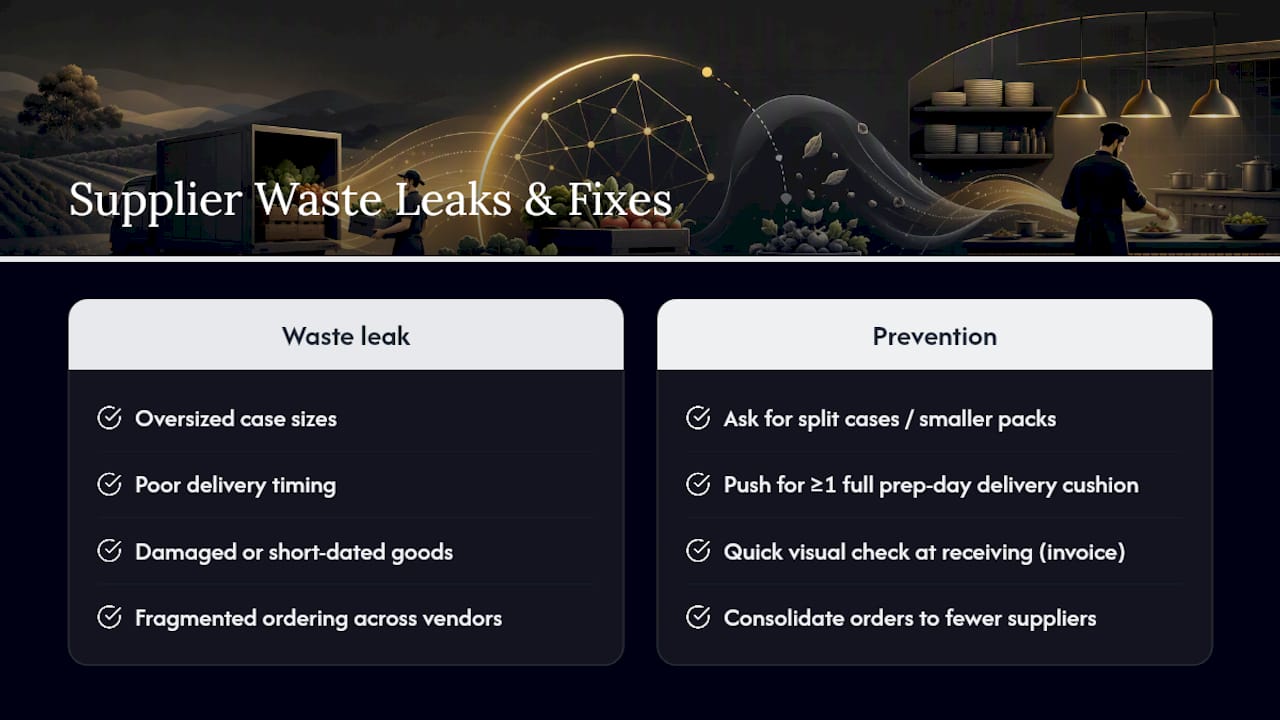
Delivery timing matters more than most managers think. A produce delivery that arrives Thursday morning for a Friday dinner rush gives you almost no buffer if something’s off, cutting your usable shelf life before the product even hits your walk-in. Push for delivery windows that give you at least one full prep day of cushion.
Damaged or short-dated product slipping through receiving is the third leak. Every delivery should get a quick visual check against the invoice before it goes into storage, not after a cook discovers a bruised case mid-prep. A five-minute receiving checklist catches this before it becomes waste.
Finally, consider consolidating orders with fewer, more reliable suppliers rather than splitting purchases across several vendors chasing marginal price differences. Fewer deliveries mean fewer chances for case-size mismatches and timing gaps, and it usually improves your relationship with the rep enough that they’ll flex on pack sizes when you ask.
What Regulations and Incentives Apply to Restaurant Food Waste?
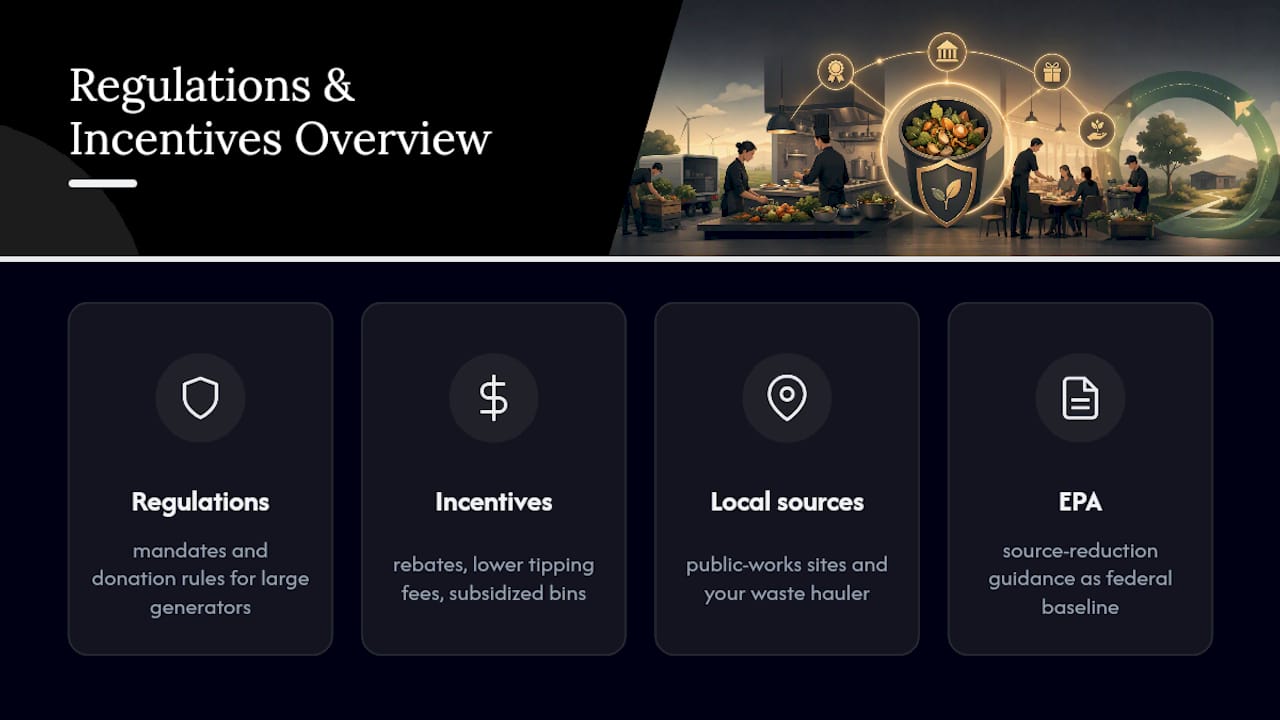
Requirements vary widely depending on where you operate, so treat this as a starting framework rather than a compliance checklist. A growing number of cities and states have organics-diversion mandates that require restaurants above a certain size or waste volume to compost or recycle food scraps rather than landfill them. Some jurisdictions also run food-recovery hierarchy laws that require large generators to donate edible surplus before it can be discarded at all. Check your specific city and state requirements directly, since thresholds and enforcement differ block by block, let alone state by state.
On the incentive side, several municipal and utility programs offer rebates or reduced tipping fees for restaurants that divert organics from the regular waste stream. Others provide free or subsidized compost bins to get small operators started. Your local public works or sanitation department website is usually the fastest way to find what’s actually available where you operate. It’s also worth asking your waste hauler directly. Some negotiate lower rates for accounts that separate organics, since diverted material often costs the hauler less to process than mixed trash.
The EPA’s source-reduction guidance is a useful federal baseline even where local rules are still catching up, and it’s a good document to reference if you’re building an internal compliance checklist from scratch.
What Are the Best Ways to Get Customers Involved in Reducing Waste?
Customers waste food too, and a surprising amount of that is on you to prevent, not them to fix.
Offering a genuinely smaller portion option at a proportionally lower price point does two things at once: it cuts plate waste and it opens up a lower price tier that can bring in budget-conscious diners who’d otherwise skip the entree entirely. Frame it as a choice, not a downgrade. “Lighter portion” reads a lot better on a menu than “small.”
A short, low-key awareness line on the menu or table tent, something like noting that you box leftovers on request or that your kitchen composts food scraps, normalizes the behavior without turning dinner into a lecture. Diners generally respond well to seeing that a restaurant is thoughtful about this, as long as it’s mentioned once and not repeated on every page of the menu.
Training servers to make a to-go box feel like standard service rather than an awkward ask matters more than any signage. A server who says “Want me to box the rest of that?” instead of waiting for the customer to bring it up will get a lot more leftovers saved. Small plates, shareable formats, and build-your-own options also cut waste by letting the table order closer to their actual appetite instead of three full entrees split four ways.
Author’s 30-Day Starter Plan
Week one: run the audit. Week two: fix your worst par levels. Week three: adjust one chronic-waste menu item and set up a compost or donation pickup. Week four: measure your diversion rate and food cost percentage against your baseline, and you’ll have your first real number to show for it.
— Chadi
Turn Surplus Into Something You Can Sell
Here’s an option most waste-reduction guides never mention: instead of just cutting surplus, you can package it. Space-man works with foodservice operators and manufacturers on co-packing, pouch packaging, and commercial freeze-drying, the kind of small-batch services that can turn a consistent overproduction stream into a shelf-stable retail or take-home item instead of a compost bin entry.

If your kitchen regularly ends service with unsold desserts, fruit prep, or other freeze-dryable product, that’s a candidate for a packaged line rather than a write-off. Space-man’s own retail line of freeze dried candy and treats shows what a packaged small-batch product can look like on a shelf, and the private-label program lets you put your own restaurant’s name on a version of it. If that sounds like a fit for your surplus stream, reach out through the private label and co-packing page to ask what a pilot run would look like for your kitchen.
Sources
- Restaurants & Foodservice | ReFED
- Prevent Wasted Food Through Source Reduction | EPA
- Working to reduce food waste | National Restaurant Association
- How to prevent food waste in restaurants | Orbisk
FAQ
What Is the 30/30/30 Rule for Restaurants?
There’s no single standardized “30/30/30 rule” recognized across the food-waste industry, and definitions vary depending on the source. If you’ve seen it referenced, treat it as informal shorthand rather than an established framework, and rely instead on measured KPIs like kilograms wasted per cover and weekly waste cost.
What Are Five Ways to Reduce Food Waste in a Restaurant?
Run a waste audit to find your biggest leak, set day-specific ordering pars based on POS data, repurpose kitchen trim into stocks or specials, offer flexible portion sizes, and set up a donation or composting pickup for what can’t be sold. Tracking these consistently can cut food costs by 2% to 6%.
What Are Eight Ways to Reduce Food Waste?
Beyond the core five, add FIFO labeling discipline in storage, batch-in-waves cooking to avoid overproduction, and staff training with a designated waste champion. Together these address the four major waste categories: prep loss, overproduction, plate waste, and expired stock.
How Do I Know If My Restaurant’s Food Waste Is a Real Cost Problem?
Run a two-week audit tracking weight and dollar value of waste by category, then compare your weekly waste cost against your total food cost percentage. Most operators are surprised to find waste sitting at several percentage points of food cost once they actually weigh it instead of guessing.
Can Freeze-Drying or Packaging Help Reduce Restaurant Food Waste?
Yes, for certain surplus items like desserts and fruit prep, freeze-drying or small-batch packaging can extend shelf life and turn what would be discarded into a sellable retail or take-home product. Space-man offers commercial freeze-drying and co-packing services for operators looking to pilot this approach.