

TL;DR:
- Freeze drying removes water by freezing products and sublimating ice under vacuum, preserving nutrients, flavor, and texture. The process involves three stages: freezing, primary sublimation, and secondary drying, each requiring precise control for optimal results. It offers long shelf life and high nutritional retention but demands significant energy, making it ideal for high-value products needing superior quality.
A freeze dryer works by freezing food or other products solid, then using a powerful vacuum to convert that ice directly into vapor, skipping the liquid phase entirely. This process, known industrially as lyophilization (from the Greek for “solvent-loving”), preserves up to 97% of a product’s original nutrition, color, and flavor. That level of retention is simply not possible with heat-based drying. From pharmaceutical labs to home kitchens, and from Harvest Right home units to industrial systems built by WAVE, freeze drying technology has become one of the most effective preservation methods available today.
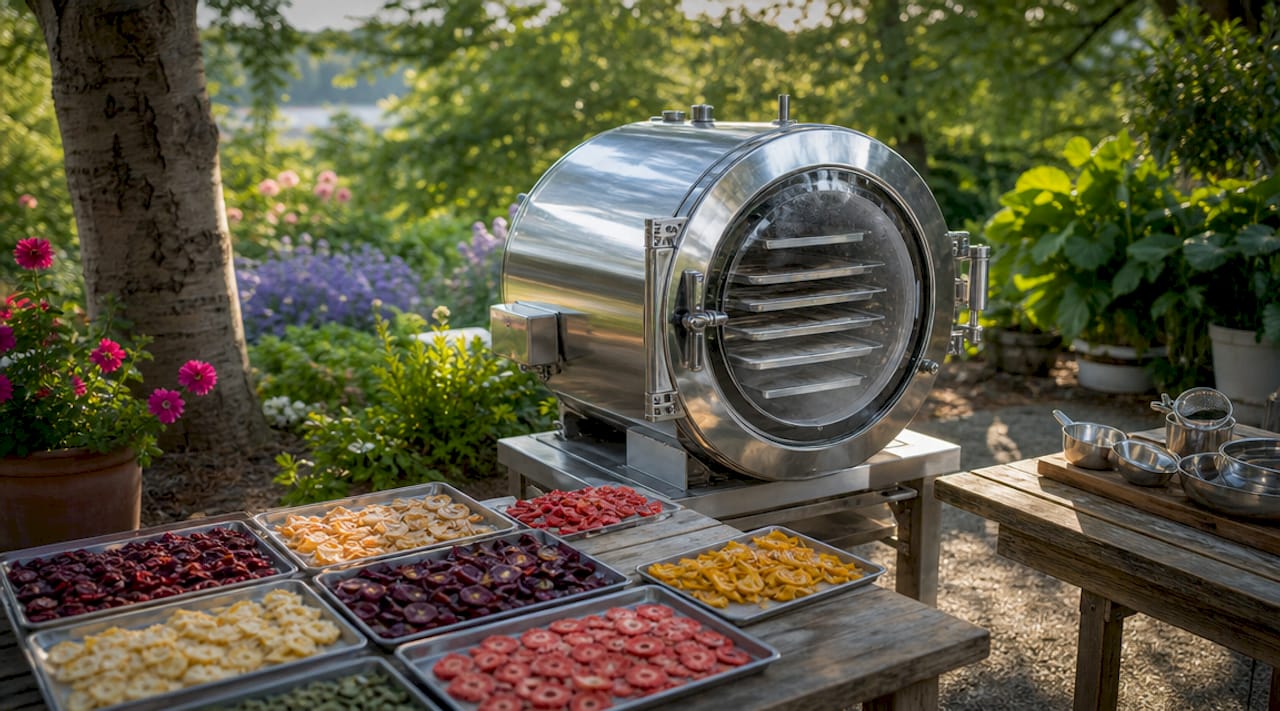
How a freeze dryer works: the three phases explained
Understanding freeze dryer mechanics starts with the three core phases every machine runs through: freezing, primary drying, and secondary drying. Each phase has a specific job, and skipping or rushing any one of them degrades the final product.
Phase 1: freezing
The product is first frozen to temperatures between negative 30°C and negative 80°C. At this stage, all the moisture inside the product turns to ice. What most people do not realize is that the speed of this freezing matters enormously. Rapid freezing produces smaller ice crystals, which protect the product’s microstructure and result in better texture after rehydration. Slow freezing creates larger crystals that can rupture cell walls, which actually speeds up drying later but leaves the product with a coarser texture. For high-value food products, rapid freezing is the clear choice.
Phase 2: primary drying (sublimation)
Once frozen solid, the chamber pressure drops to between 0.05 and 0.5 mbar using a vacuum pump. At this pressure, heated shelves gently warm the product just enough to trigger sublimation. The ice converts directly to water vapor without ever becoming liquid. That vapor travels to a cold condenser inside the machine, where it refreezes and is collected. Primary drying removes roughly 90 to 95% of the total moisture in the product. This phase is the longest, and careful temperature control is non-negotiable. Too much heat causes the product to melt and collapse, ruining both texture and rehydration ability. Too little heat drags the cycle out unnecessarily.
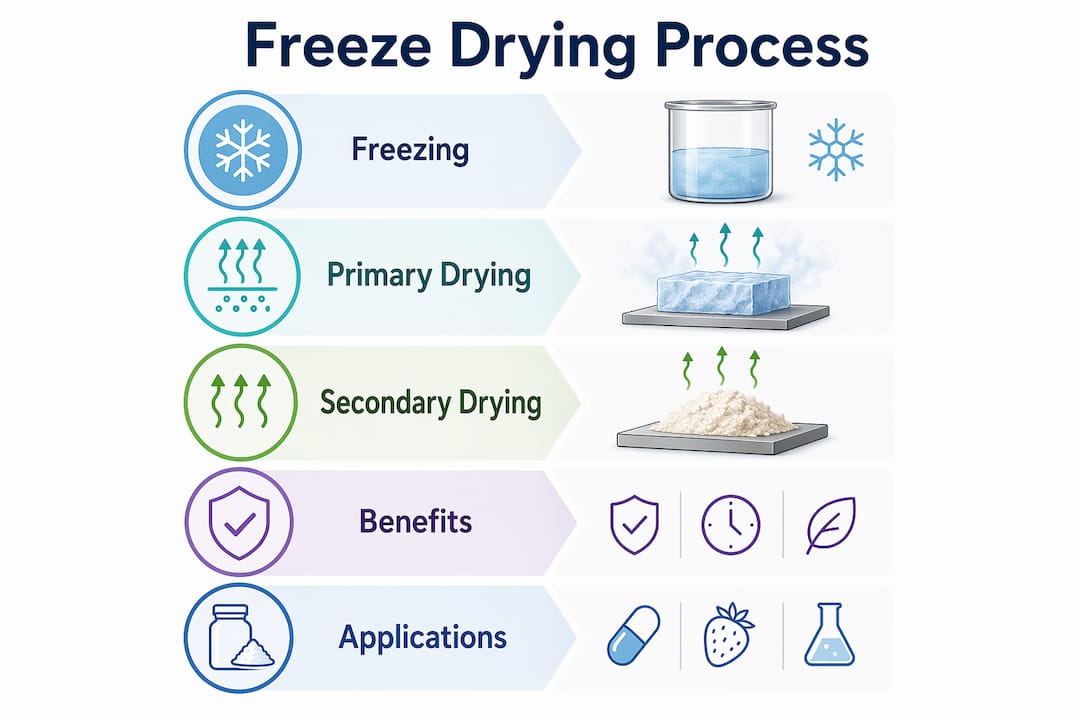
Phase 3: secondary drying
After primary drying, a small amount of bound moisture still clings to the product at the molecular level. Secondary drying raises the shelf temperature further to drive off this residual water. The result is a final moisture content of 1 to 3%, which is what enables shelf lives exceeding 25 years under proper storage conditions. Full freeze drying cycles typically run 12 to 24 hours depending on the product’s moisture content and thickness. That is a significant time investment, but the quality payoff is hard to match.
Pro Tip: Pre-freeze your product in a separate freezer before loading it into the freeze dryer. This shortens the machine’s freezing phase and reduces total cycle time, saving both energy and wear on the equipment.
What benefits does freeze drying offer over other preservation methods?
The freeze drying process is not just a different way to remove water. It produces a fundamentally different product compared to heat-based dehydration.
The most cited advantage is nutritional retention. Freeze drying preserves up to 97% of a food’s original nutrition, while conventional heat drying degrades heat-sensitive vitamins, enzymes, and antioxidants significantly. For consumers focused on nutrient-dense diets, that gap is meaningful. Freeze-dried strawberries still taste and look like strawberries. Heat-dried strawberries taste like leather.
Shelf life is the other major differentiator. Properly packaged freeze-dried food can last up to 25 years in storage, compared to one to five years for most dehydrated products. The key is the moisture level. Freeze drying achieves 1 to 3% residual moisture, while dehydration typically leaves 10 to 20%. Lower water activity means fewer conditions for microbial growth or oxidation.
Here is a direct comparison of the two methods:
| Factor | Freeze drying | Heat dehydration |
|---|---|---|
| Moisture content | 1 to 3% | 10 to 20% |
| Nutritional retention | Up to 97% | Moderate to low |
| Shelf life | Up to 25 years | 1 to 5 years |
| Texture after rehydration | Near-original | Shrunken, chewy |
| Energy cost per kg water removed | High (15+ kWh) | Low (approx. 1.3 kWh) |
The one honest downside is energy. Freeze drying consumes 15 or more kWh per kilogram of water removed, compared to roughly 1.3 kWh for vacuum microwave drying. That cost is real, and it is why freeze drying makes the most economic sense for high-value products where quality justifies the expense. For a deeper look at how these two methods stack up, the freeze dryer vs. dehydrator guide from Space-man breaks it down clearly.
How to operate and optimize a freeze dryer effectively
Knowing how freeze dryers function is one thing. Getting consistent, high-quality results from one is another. These practical points apply whether you are running a Harvest Right home unit or a commercial system.
Preparation matters more than most people expect:
- Cut products to a uniform thickness of no more than 1 to 1.5 centimeters. Uneven thickness means uneven drying, and thicker pieces will still hold moisture when thinner ones are done.
- Pre-freeze products before loading to reduce machine cycle time and energy draw.
- Avoid overloading trays. Airflow around the product affects how efficiently vapor escapes during sublimation.
During the cycle:
- Monitor the vacuum pressure and shelf temperature sensors throughout the run. A pressure spike mid-cycle can indicate the product is releasing moisture faster than the condenser can handle.
- Do not open the chamber during primary drying. Introducing ambient air breaks the vacuum and forces the machine to restart that phase.
- Watch for melt-back, which happens when shelf temperature rises too fast before the product is fully frozen. This is one of the most common causes of poor texture in finished freeze-dried products.
After the cycle:
- Package immediately after the cycle ends. Oxygen absorbers in thick Mylar bags without windows are the gold standard for maintaining low water activity during long-term storage. Windowed bags look great on shelves but allow light degradation over time.
- Label every batch with the freeze date and moisture test result if you have a water activity meter.
Pro Tip: If you are freeze drying meat or other protein-rich products, make sure any raw proteins are cooked to safe temperatures before or after the cycle. Freeze drying preserves bacteria in a dormant state but does not sterilize food. Rehydrating raw freeze-dried meat without a kill step is a food safety risk.
For more on freeze drying meat at home, Space-man has a dedicated guide covering the full process.
What industries and applications benefit most from freeze drying technology?
Freeze drying is not a niche technology anymore. Its applications span industries that have very little in common except one shared requirement: preserving product quality over time.
Food and beverage is the most visible sector. Freeze-dried fruits, vegetables, and proteins appear in everything from camping meal kits to premium snack aisles. The process is especially well-suited for protein-rich foods because it preserves protein structure and solubility better than heat-based methods. That makes it a natural fit for functional foods, protein powders, and high-performance nutrition products.
Pharmaceuticals rely on lyophilization to stabilize vaccines, biologics, and injectable drugs that would degrade in liquid form. The same principle applies: removing water without heat keeps fragile molecular structures intact.
Home food storage has grown significantly as units from brands like Harvest Right have made the technology accessible to individuals. Home users freeze dry full meals, garden harvests, and emergency food supplies. The investment in a home freeze dryer is substantial, but for serious long-term storage, no other method comes close to the shelf life and quality it delivers.
Emerging trends in 2026 include hybrid drying systems that combine freeze drying with microwave or infrared energy to cut cycle times significantly. Modular micro-plants are also gaining traction, allowing smaller food businesses to run freeze drying operations without the capital cost of a full industrial setup. These developments are making the technology more accessible and economically viable for mid-sized producers.
Key takeaways
Freeze drying works through three precisely controlled phases: freezing, sublimation under vacuum, and secondary drying, producing a shelf-stable product that retains up to 97% of its original nutrition and lasts up to 25 years.
| Point | Details |
|---|---|
| Three-phase process | Freezing, primary drying via sublimation, and secondary drying are all required for quality results. |
| Nutritional superiority | Freeze drying retains up to 97% of nutrition, far outperforming heat-based dehydration methods. |
| Shelf life advantage | Final moisture of 1 to 3% enables storage of up to 25 years with proper Mylar and oxygen absorber packaging. |
| Energy cost is real | Freeze drying uses 15 or more kWh per kilogram of water removed, making it best suited for high-value products. |
| Packaging is non-negotiable | Immediate sealing in oxygen-absorber Mylar bags after the cycle is critical to maintaining product stability. |
Why freeze drying still surprises me after years in the industry
I have worked with freeze-dried products long enough to know that most people underestimate two things: how good the results can be, and how unforgiving the process is when you cut corners.
The science is elegant. You are essentially pulling water out of a product without ever letting it get wet again during the process. The structure stays intact, the flavor compounds stay locked in, and what you end up with is something that rehydrates almost perfectly. That is not marketing language. That is just what the physics produces when you run the process correctly.
What I find underappreciated is the packaging step. People obsess over cycle settings and then store their product in a bag that lets in light and oxygen. All that careful work undone in three months. Thick Mylar, oxygen absorbers, no windows. That is the rule, and it is not optional.
The energy cost is the honest limitation I always bring up. Freeze drying is not the right tool for every product. For bulk commodity drying, the economics do not work. But for high-value products where texture, nutrition, and shelf life are the selling points, nothing else competes. The growing interest in modular systems and hybrid drying is exciting because it starts to address that cost barrier without sacrificing the quality that makes freeze drying worth doing in the first place.
— Chadi
Scale your freeze-dried product line with Space-man

Space-man is a Canadian freeze-dried candy manufacturer with the infrastructure to help businesses grow without the overhead of building their own production line. Whether you are launching a new brand or scaling an existing one, Space-man’s private label and co-packing services cover everything from production to bagging and packaging. If you want to test the market before committing to a full run, the freeze-dried candy starter pack gives you 40 bags of variety product ready to sell. Space-man handles the freeze drying. You handle the brand.
FAQ
What is freeze drying in simple terms?
Freeze drying is a preservation process that removes moisture from a product by freezing it solid and then using a vacuum to convert the ice directly into vapor. The result is a lightweight, shelf-stable product that retains its original structure, flavor, and nutrition.
How long does a freeze drying cycle take?
A full freeze drying cycle typically takes 12 to 24 hours depending on the product’s moisture content, thickness, and the machine being used. Thicker or wetter products require longer cycles to reach the target moisture level of 1 to 3%.
Is freeze-dried food actually nutritious?
Freeze-dried food retains up to 97% of its original nutritional content, making it one of the most nutrition-preserving methods available. Heat-based drying degrades heat-sensitive vitamins and enzymes significantly, which freeze drying avoids entirely.
Can freeze drying kill bacteria in food?
Freeze drying does not sterilize food. It lowers water activity to a level that inhibits bacterial growth, but bacteria remain in a dormant state and can reactivate when the product is rehydrated. Proteins and meats should be cooked to safe temperatures before or after the process.
What is the best way to store freeze-dried food?
Seal freeze-dried products immediately after the cycle in thick Mylar bags with oxygen absorbers, avoiding bags with windows. Stored this way in a cool, dark location, freeze-dried food can remain stable for up to 25 years.