

Freeze-dried candy and snacks can realistically hold 1–5 years of shelf life, but only if the packaging barrier, water activity, and oxygen control are locked in before the product ships. Those three variables are the difference between a confident label claim and a costly recall. Under ideal conditions (foil barrier pouch, oxygen absorber, cool dry storage), hard candies reach roughly 5 years, gummies land in the 1–3 year range, and chocolate-based items often cap out at 6–12 months without additional packaging intervention.
Quick shelf-life reference by packaging assumption:
| Assumption | Realistic shelf life |
|---|---|
| Foil barrier pouch + oxygen absorber, stored under cool dry conditions | 1–5 years depending on product type |
| Standard poly bag, ambient retail display, no O₂ control | 3–6 months before quality degradation |
Key controls to get right first:
- Water activity (aw) at or below 0.3 for most freeze-dried candy types
- Residual moisture under 3% for hard and gummy formats
- Headspace oxygen below 2% at seal
- Foil barrier pouch with verified seal integrity
Key Takeaways
Packaging barrier and water activity control are the two variables that determine whether a freeze-dried candy claim of 1–5 years is defensible or just optimistic.
| Point | Details |
|---|---|
| Shelf life varies by product type | Hard candy reaches up to 5 years; gummies 1–3 years; chocolate-based items 6–12 months without special packaging. |
| Foil barrier pouch is the baseline | Target OTR below 0.05 cc/m²/day with an oxygen absorber; standard poly bags do not support multi-year claims. |
| Register and document before scaling | FDA Food Facility Registration and a PCQI-backed food safety plan are required before commercial shipment. |
| Validation must precede the label claim | Run accelerated and real-time studies with aw, headspace O₂, and organoleptic checks; document acceptance criteria in batch records. |
| Space-man for turnkey or co-pack support | Space-man offers private-label, co-packing, and packaging services for brands launching long-shelf-life freeze-dried snacks. |
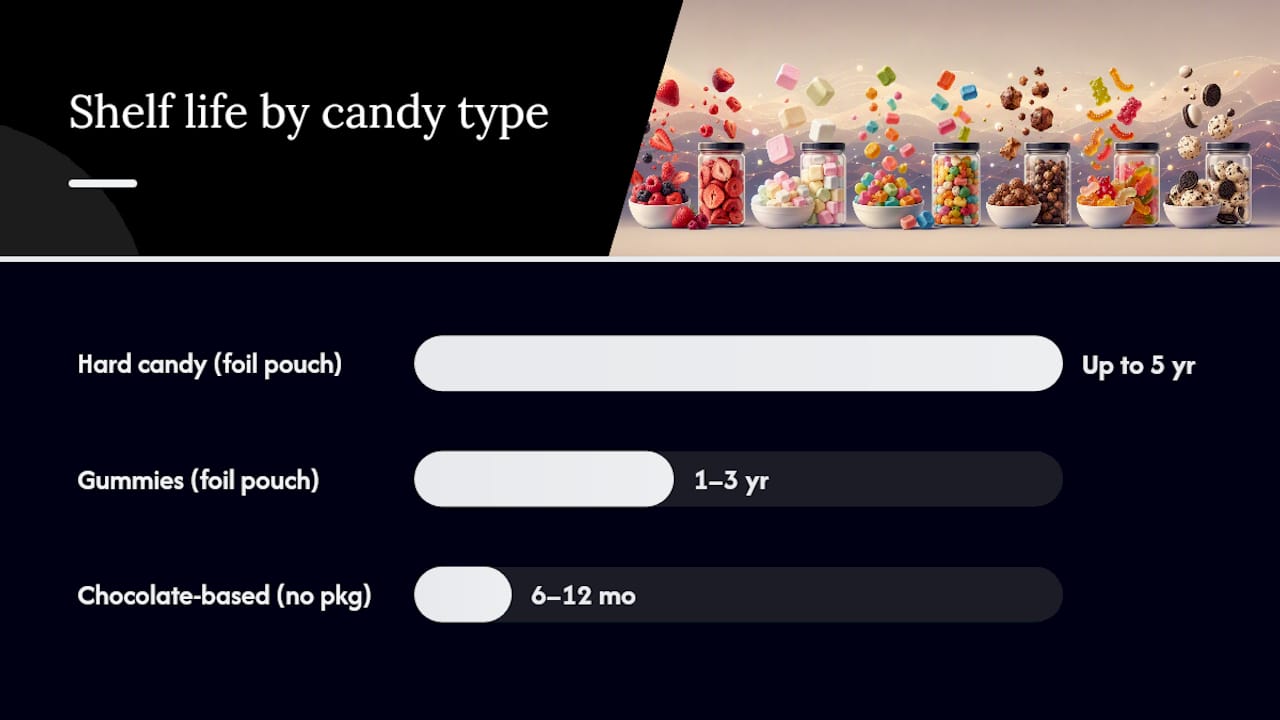
Table of Contents
- What shelf life can you actually promise by product type?
- What actually determines real shelf life?
- Which packaging systems actually deliver multi-year stability?
- US food-safety and regulatory checklist for scaling freeze-dried candy
- How to validate and document shelf life properly
- Co-packing and private-label checklist: what to nail down in writing
- Storage and distribution rules that protect shelf life in the real world
- What brands consistently underestimate about shelf life
- Space-man offers private-label and co-packing for long-shelf-life freeze-dried snacks
- Sources
What shelf life can you actually promise by product type?
Shelf-life claims on labels need to be defensible, not aspirational. The table below reflects typical bands under documented packaging assumptions, not best-case marketing copy.
Fat content is the biggest variance driver. Any inclusion with dairy, nuts, or cocoa butter shortens the window because lipid oxidation runs independently of moisture control. Hygroscopic ingredients like gelatin-based gummies pull moisture aggressively, so their band is tighter than hard candy even under identical packaging.
For emergency preparedness or long-term storage channels, buyers expect documented validation behind any claim beyond 2 years.
What actually determines real shelf life?
Packaging and moisture control are the headline factors, but the full picture has five levers. Miss any one of them and the others can’t compensate.
- Water activity (aw) and residual moisture: aw above 0.4 triggers microbial growth and texture collapse. Target aw ≤ 0.3 and residual moisture ≤ 3% for most formats. Measured with a calibrated aw meter and Karl Fischer titration.
- Oxygen exposure: Lipid oxidation and color degradation accelerate sharply above 2% headspace O₂. Measured by headspace gas analyzer at seal and at scheduled intervals.
- Packaging barrier: Oxygen transmission rate (OTR) and water vapor transmission rate (WVTR) of the pouch material set the ceiling on everything else. A foil barrier pouch with OTR below 0.05 cc/m²/day is the standard for multi-year claims.
- Temperature: Every 10°C rise roughly doubles the rate of most degradation reactions. Warehouse and retail storage above 77°F meaningfully compresses shelf life, especially for chocolate-based items.
- Ingredient chemistry: Fat content, sugar type, and inclusions (nuts, dairy, cocoa) each introduce independent degradation pathways that packaging alone cannot stop.
Pro Tip: Process repeatability and batch records often matter more than equipment size. A freeze dryer that hits the same endpoint moisture and temperature profile on every cycle, with documented records to prove it, produces more consistent shelf life than a larger machine running variable cycles. Buyers should judge suppliers on process control and documentation, not just capacity.
Which packaging systems actually deliver multi-year stability?
Foil barrier pouches combined with oxygen absorbers or nitrogen flush are the only packaging systems that reliably support multi-year shelf-life claims for freeze-dried candy. Everything else is a compromise.
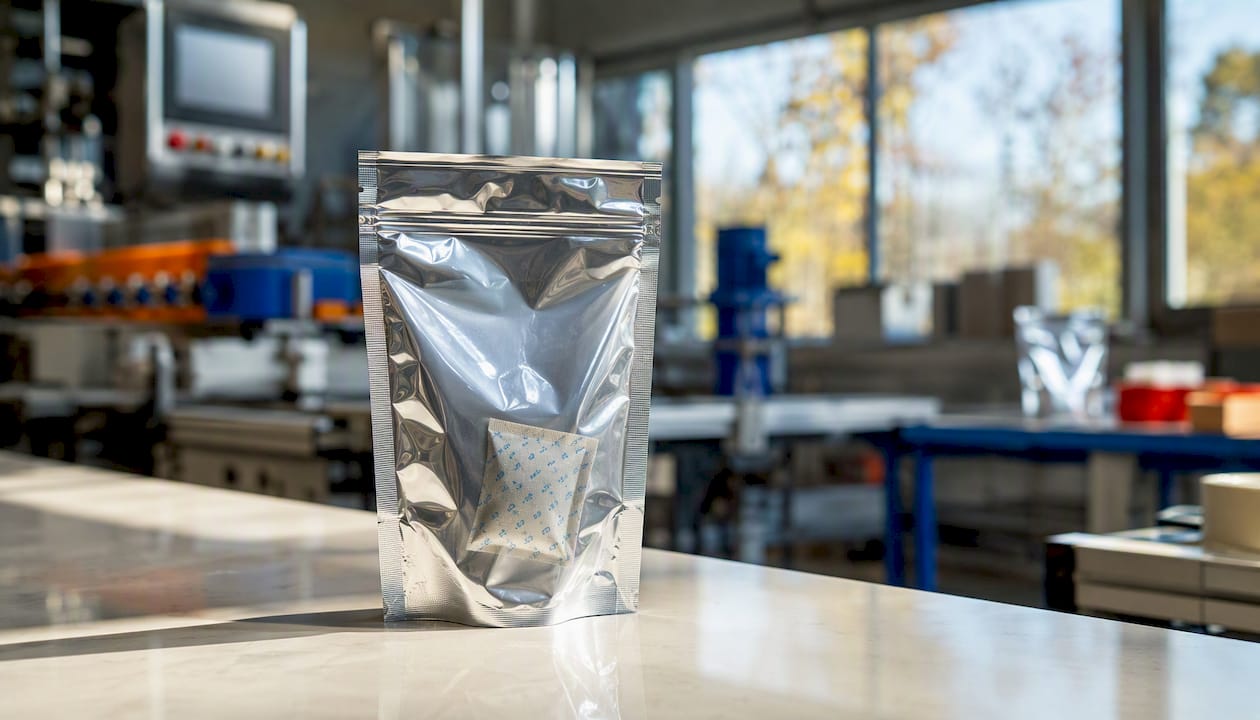
Oxygen absorbers are generally more reliable than nitrogen flush for retail pouches because they actively scavenge residual O₂ after sealing. Nitrogen flush is faster on a fill line but leaves a small residual O₂ fraction unless combined with an absorber.
Fill weight versus headspace matters too. Overfilled pouches reduce the absorber’s effective volume; underfilled pouches increase headspace and the O₂ load the absorber must handle.
Pro Tip: Before running a full production lot, pull 10 sealed pouches from the pilot run and test seal integrity with a vacuum decay or dye-penetration test. A single pinhole in a foil pouch defeats every other control in the system. Catching seal failures at pilot scale costs almost nothing compared to a field return.
US food-safety and regulatory checklist for scaling freeze-dried candy
Regulatory obligations shift the moment production moves off a cottage-scale exemption. Commercial freeze-drying typically triggers stricter FDA and health-department expectations than cottage operations, and confirming registration early avoids expensive retrofits later.
| Requirement | What to confirm | Document to obtain |
|---|---|---|
| FDA Food Facility Registration | Register before first commercial shipment; update when adding candy categories or repacking steps | FDA registration confirmation number |
| FSMA Preventive Controls (PCQI) | Assign a PCQI-qualified person; document hazard analysis and preventive controls plan | Food Safety Plan (HARPC) |
| Pasteurization / ingredient controls | Verify egg, milk, gelatin, and nut ingredients are pasteurized or treated | Supplier Certificate of Analysis (CoA) |
| Supplier CoA policy | Require lot-level CoAs for all microbiologically susceptible inputs | CoA on file per lot |
| Lot-code and traceability | Assign lot codes at initial packing; confirm ownership with co-packer in writing | Batch records, lot-code log |
| Labeling responsibilities | Confirm who owns label content, claims, and allergen statements | Signed labeling agreement |
Candy manufacturers, packers, and holders must all register, and registration responsibilities shift when new candy categories are added or a third party repacks the product.
The FDA inspection guide for miscellaneous food products states that ingredients such as eggs, milk, gelatin, and nuts must be pasteurized or otherwise treated, and that manufacturers should verify supplier guarantees and batch records for microbiologically susceptible raw materials. This applies directly to freeze-dried candy formulations that include any of these inputs.
FDA Miscellaneous Food Products Inspection Guide, Vol. 1
How to validate and document shelf life properly
Two components are non-negotiable: water activity/residual moisture testing and a formal shelf-life study (accelerated, real-time, or both). Seal and headspace oxygen testing support both.
- Establish baseline at production: Measure aw, residual moisture %, and headspace O₂ on a minimum of 10 units per lot within 24 hours of sealing.
- Run accelerated shelf-life testing (ASLT): Store samples at elevated temperature and humidity (typically 104°F/40°C, 75% RH) and test at 4, 8, and 12 weeks. Map results to real-time equivalents using the Q10 factor for your product type.
- Run parallel real-time study: Store samples at target conditions (65°F, <50% RH) and test at 3, 6, 12, and 24 months. This is the only study that fully validates a multi-year claim.
- Test at each timepoint: aw, residual moisture %, headspace O₂ ppm, peroxide value (for fat-containing items), and organoleptic evaluation (color, texture, flavor, aroma).
- Set acceptance criteria in advance: Define pass/fail thresholds before testing begins. Typical targets: aw ≤ 0.3, headspace O₂ ≤ 2%, peroxide value ≤ 10 meq/kg for chocolate-based items.
| Test | Lab method | Approximate cost (per sample) | Who typically pays |
|---|---|---|---|
| Water activity | Chilled-mirror dewpoint (AQUALAB) | $25 | Brand (toll) / Processor (turnkey) |
| Residual moisture | Karl Fischer titration | $50 | Brand (toll) / Processor (turnkey) |
| Headspace O₂ | Headspace gas analyzer | $30 | Brand or co-packer per contract |
| Peroxide value | AOCS Cd 8b | $60 | Brand |
| Organoleptic panel | Internal trained panel | Minimal | Brand |
Document acceptance criteria, test results, and any out-of-spec corrective actions in the technical file. Batch records should reference the shelf-life study lot numbers so any future audit can trace a label claim back to its validation data.
Co-packing and private-label checklist: what to nail down in writing
Toll processing gives brands more control over raw materials and packaging choices; turnkey supply speeds time to shelf but bundles procurement decisions. Either way, registration, preventive controls, and labeling responsibilities must be assigned explicitly in the contract.
The company that assigns the lot code and performs initial packing typically holds the most operational control over traceability, so clarify this in writing before the first production run.
Red flags that suggest a co-packer lacks adequate process control:
- They cannot provide batch records or process logs from previous production runs on request.
- They have no documented PCQI or food safety plan and describe their QA as “we follow good practices.”
- They cannot specify the OTR and WVTR of the packaging material they use or have no seal-integrity test data.
Contract essentials: MOQ and pilot-run minimums, lead times, recipe and formula transfer terms, change-control procedures for ingredient or packaging substitutions, indemnity language tied specifically to ingredient or packaging failures, and written confirmation of who owns the label claim and any shelf-life validation data.
Storage and distribution rules that protect shelf life in the real world
Every step in the supply chain that exceeds those conditions chips away at the validated shelf life.
- Keep pallets off concrete floors and away from exterior walls; both conduct temperature and moisture.
- Use humidity-controlled transit for any shipment crossing climate zones or moving through summer heat corridors.
- At retail, avoid placing freeze-dried snack displays near refrigerated cases (condensation risk) or under direct HVAC vents.
- Enforce first-in/first-out (FIFO) rotation at every warehouse and retail location; lot codes make this auditable.
- For long-lasting healthy treats in emergency or preparedness channels, store cases in a climate-controlled environment and document storage conditions in the lot record.
Pro Tip: At receiving, pull 3–5 pouches per pallet and run a quick visual seal inspection plus a headspace O₂ spot check. A compromised shipment caught at receiving costs a fraction of what a consumer complaint or field return does. It takes about 15 minutes and requires only a handheld headspace analyzer.
Retailers and distributors handling freeze-dried snacks for retail display should also avoid stacking heavy cases on top of foil pouches. Seal stress from compression is a real failure mode that rarely shows up until the product is already on shelf.
What brands consistently underestimate about shelf life
The technical specs in this guide are real and necessary. But after working through the production side of freeze-dried candy, the single most common mistake isn’t a packaging choice or a testing gap. It’s treating shelf-life validation as a post-launch task.
Brands that launch with a “we’ll validate later” mindset end up with label claims that outrun their data. A retailer or distributor asking for documentation six months after launch is not a hypothetical. It happens. And when it does, the brand that has a complete technical file, signed batch records, and a real-time study already running is in a completely different position than the one scrambling to backfill.
Process repeatability is the foundation. A co-packer who can show you consistent endpoint moisture data across 20 production lots is worth more than one with a newer freeze dryer and no records. The equipment matters less than the discipline behind it.
Space-man offers private-label and co-packing for long-shelf-life freeze-dried snacks
If you’re a brand or retailer ready to launch a freeze-dried candy SKU with documented shelf life and a clean regulatory file, Space-man offers private-label, co-packing, and packaging services built for exactly this.
Space-man handles bagging, sealing, and label support for brands that need speed, and works with buyers who want more control over their own formulas and packaging specs. Pilot runs are available so you can validate shelf life before committing to full production volumes. Whether you need a turnkey SKU or just the co-packing and packaging side of the operation, the services are designed for brands that take shelf-life documentation seriously.
Contact Space-man directly through the private-label and co-packing services page to discuss your product type, target shelf life, and packaging requirements.
Sources
- Miscellaneous food products inspection guide, Vol. 1 | FDA
- How long does freeze-dried candy last? | Candy Floss Magazine
- Freeze-dried-fruit
- FDA registration for candy & confectionery | FDA Registration Assistance