

TL;DR:
- Freeze drying removes moisture by sublimation, preserving nutrients and structure much better than dehydrating. Dehydrating uses heat to evaporate water, which degrades nutrients and alters texture but is faster and more affordable. Proper packaging ensures long shelf life for both methods, with freeze drying providing up to 25 years of preservation and dehydration lasting 1 to 5 years.
Freeze drying removes moisture by turning ice directly into vapor under vacuum, a process called sublimation, while dehydrating removes moisture by applying heat to evaporate water at atmospheric pressure. That single mechanical difference drives every other gap between the two methods: nutrient retention, texture, shelf life, and rehydration quality. Understanding the difference between freeze drying and dehydrating helps you make smarter choices about how you preserve, store, and enjoy food. Whether you are stocking an emergency pantry, making snacks, or just curious about how your favorite freeze dried candy gets its crunch, this breakdown covers everything you need.
What is the difference between freeze drying and dehydrating?
Freeze drying and dehydrating both remove water from food, but they do it in completely different ways. Freeze drying uses sublimation under vacuum, bypassing the liquid phase entirely. Dehydration relies on heated air to evaporate water at normal atmospheric pressure. That difference in physics is what makes the two methods produce such different results.
The sublimation process in freeze drying keeps food at very low temperatures throughout. Because the food never gets hot, its cellular structure stays largely intact. Dehydration, by contrast, applies heat that shrinks cells, alters proteins, and drives off volatile compounds responsible for flavor and aroma.
Water activity is the key metric for food safety and shelf life. Freeze drying drives water activity down to levels that stop microbial growth almost entirely. Dehydration reduces water activity too, but not as completely, which is why dehydrated foods typically need more careful storage conditions.
How does freeze drying work?
Freeze drying, technically called lyophilization, runs through three distinct stages. Each stage serves a specific purpose, and skipping or rushing any one of them compromises the final product.
-
Freezing. The food is frozen solid, typically to temperatures well below 0°F. Controlled freezing rates matter here. Freeze too fast and you get very small ice crystals that are harder to sublimate. Freeze too slowly and large crystals can puncture cell walls. Precise control of freezing rate and shelf temperatures is what separates a quality freeze dried product from a mediocre one.
-
Primary drying (sublimation). The chamber pressure drops below the triple point of water, roughly 0.006 atmospheres. At that pressure, ice converts directly to vapor without passing through a liquid phase. A condenser captures the vapor. This stage removes the bulk of the water, typically around 95% of total moisture. The food looks almost dry at this point, but it is not shelf stable yet.
-
Secondary drying (desorption). Secondary drying removes bound water that primary drying cannot reach. Without it, residual moisture of 5–10% remains, which causes staling, caking, and shortened shelf life. After secondary drying, final moisture content drops to roughly 1–3%, which is where long-term stability begins.
The result is a porous, lightweight product that holds its original shape and color. That porous structure is also why freeze dried foods rehydrate so quickly. Water has a direct path back into the cell structure.
Pro Tip: If you are using a home freeze dryer, place it in a room kept between 45°F and 80°F with good ventilation. Operating outside that range forces the machine to work harder and reduces efficiency significantly.
How does dehydrating work?
Dehydrating food is the older and simpler of the two methods. A dehydrator or oven circulates hot air around the food, and that heat causes surface moisture to evaporate. As surface moisture leaves, moisture from deeper in the food migrates outward and evaporates in turn.
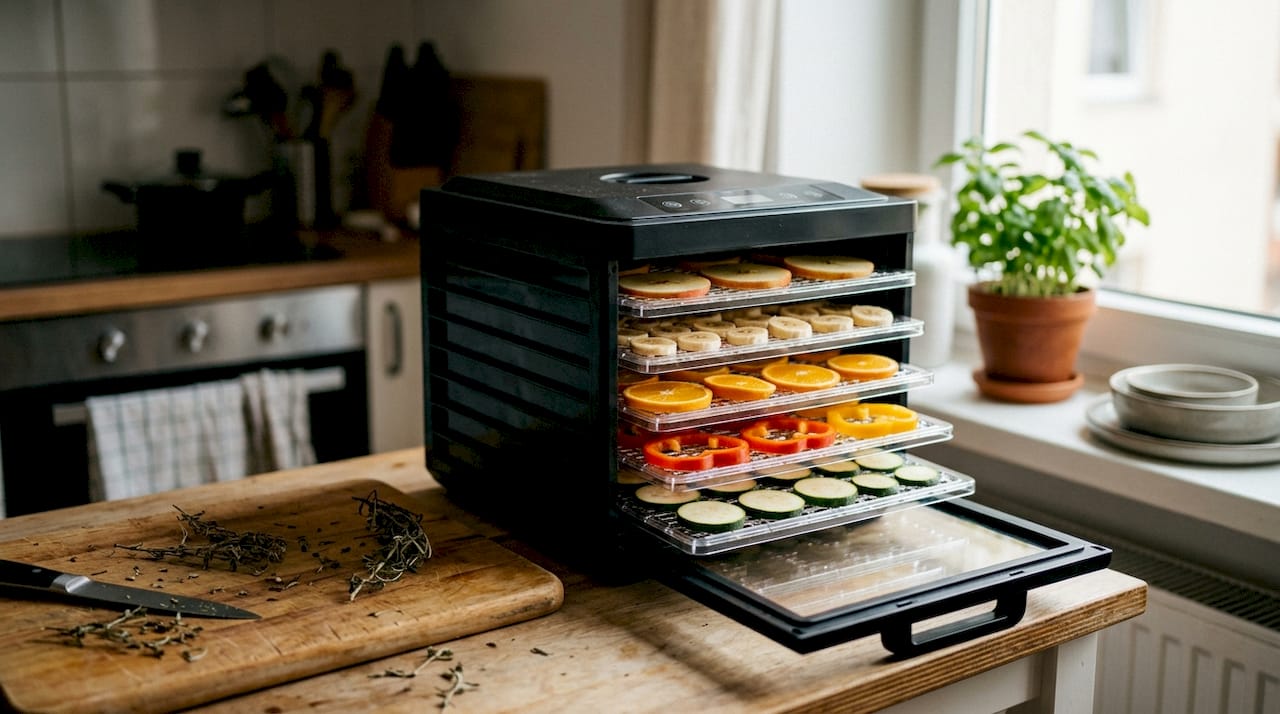
Typical dehydrators run at 130–160°F depending on the food type. Fruits and vegetables generally dehydrate at the lower end of that range. Meat requires higher temperatures and specific safety steps.
Here is what dehydrating does well and where it falls short:
- Speed and cost. A quality food dehydrator costs a fraction of a home freeze dryer. Drying times range from a few hours to about 12 hours for most foods, compared to 20–40 hours for freeze drying.
- Texture outcomes. Dehydration is the right choice when you want a chewy, concentrated result. Beef jerky, fruit leather, and dried mango chips all depend on the texture changes that heat causes. Dehydration produces chewy, concentrated flavors that freeze drying simply cannot replicate.
- Nutrient loss. Heat degrades heat-sensitive vitamins, particularly vitamin C and B vitamins. Dehydration retains roughly 60–75% of nutrients, compared to up to 97% for freeze drying.
- Residual moisture. Dehydrated foods typically retain 10–20% moisture. That is enough to support mold growth if storage conditions are poor.
- Meat safety. USDA guidance recommends thermal kill steps before drying meat, because dehydrator temperatures alone may not eliminate pathogens like Salmonella or E. coli throughout the product.
Pro Tip: For meat jerky, pre-cook strips in an oven at 275°F for 10 minutes before placing them in the dehydrator. This thermal kill step is not optional if food safety matters to you.
How do food quality, nutrients, texture, and shelf life compare?
This is where the two methods really separate. The table below lays out the key differences side by side.
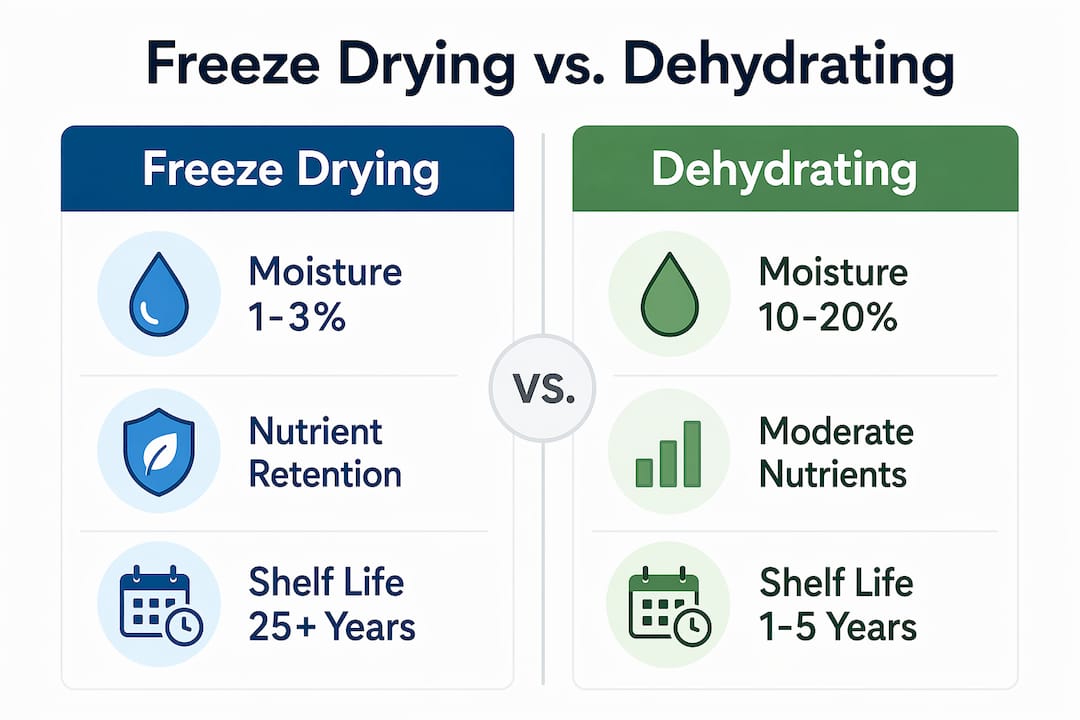
| Category | Freeze drying | Dehydrating |
|---|---|---|
| Moisture content | 1–3% | 10–20% |
| Nutrient retention | Up to 97% | 60–75% |
| Texture | Porous, original shape retained | Shrunken, chewy, or leathery |
| Shelf life | Up to 25+ years (proper packaging) | 1–5 years typically |
| Rehydration quality | Fully rehydrates, close to fresh | Partial rehydration, altered texture |
| Water activity | Very low, minimal microbial risk | Moderate, requires careful storage |
Freeze drying preserves up to 97% of nutrients and structure, with shelf life extending to 25 years or more under proper packaging. That is not a small gap. A dehydrated strawberry and a freeze dried strawberry start from the same fruit, but they end up as completely different products.
The rehydration difference is especially striking. Freeze dried food rehydrates quickly and maintains color, aroma, and flavor close to fresh. Dehydrated food rehydrates partially at best and never fully recovers its original texture. For emergency food storage or backpacking meals where you add water in the field, that distinction matters enormously.
Water activity also drives microbial safety. Freeze drying achieves lower water activity than dehydration, which means the risk of mold and bacterial growth is dramatically lower. Dehydrated foods with residual moisture of 10–20% can still spoil if packaging fails or humidity gets in.
For freeze dried candy specifically, the low moisture content and porous structure create that signature airy crunch. It is a texture dehydration cannot produce, no matter how long you run the machine.
What practical factors should you consider when choosing a method?
The right method depends on what you are making, how long you need it to last, and what your budget looks like. Neither method is universally better. They solve different problems.
- Budget. Home dehydrators start around $50–$100. Home freeze dryers cost several thousand dollars. If you are just getting started with food preservation, dehydrating is the obvious entry point.
- Energy use. Freeze drying equipment uses 3–5 times more energy than dehydrators. Over time, that adds up on your electricity bill.
- Time. Dehydrating most foods takes 4–12 hours. Freeze drying a full batch typically takes 20–40 hours. If you need to process food quickly, dehydrating wins on speed.
- Food type. Freeze drying works best for fruits, vegetables, dairy, eggs, and complete meals where you want to preserve nutrition and rehydration quality. Dehydrating excels for jerky, fruit leather, herbs, and chips where the texture change is part of the appeal.
- Storage goals. If you are building a long-term food supply, freeze drying is the clear choice. For snacks you will eat within a year or two, dehydrating is perfectly adequate.
- Packaging. Both methods require good packaging to reach their shelf life potential. Thick Mylar bags with oxygen absorbers are the standard for freeze dried foods. Dehydrated foods also benefit from airtight containers and oxygen absorbers, though they are more forgiving of minor packaging imperfections.
You can also explore the freeze dryer vs food dehydrator comparison for a deeper look at equipment choices and typical use cases.
Key Takeaways
Freeze drying outperforms dehydrating on nutrient retention, shelf life, and rehydration quality, but dehydrating wins on cost, speed, and specific texture outcomes like jerky and chips.
| Point | Details |
|---|---|
| Core process difference | Freeze drying uses sublimation under vacuum; dehydrating uses heated air evaporation. |
| Nutrient retention gap | Freeze drying retains up to 97% of nutrients; dehydrating retains roughly 60–75%. |
| Shelf life advantage | Freeze dried foods last up to 25+ years; dehydrated foods typically last 1–5 years. |
| Cost and speed tradeoff | Dehydrators are far cheaper and faster; freeze dryers deliver superior quality at higher cost and time. |
| Packaging matters for both | Mylar bags with oxygen absorbers extend shelf life for both freeze dried and dehydrated foods. |
My take on freeze drying vs. dehydrating for food enthusiasts
I have spent a lot of time thinking about food preservation, and the honest truth is that most people overcomplicate this decision. Freeze drying is the gold standard, full stop. The nutrient retention, the shelf life, the way a freeze dried strawberry actually tastes like a strawberry when you eat it. Nothing else comes close. But “gold standard” does not mean “right for every situation.”
If you are making beef jerky, you want dehydration. The chew, the concentrated flavor, the slightly leathery bite. Freeze dried jerky would be a completely different product, and not necessarily a better one for that purpose. Dehydrating herbs, making fruit chips for a road trip, or processing a big batch of tomatoes from your garden? Dehydrating is faster, cheaper, and perfectly suited to those jobs.
Where I see food enthusiasts go wrong is buying expensive equipment before they know what they actually want to make. Start with a dehydrator. Learn what your preservation goals really are. Do you care most about shelf life, nutrition, texture, or convenience? Once you can answer that clearly, the right method becomes obvious. And whatever method you choose, invest in proper packaging. A perfectly freeze dried product stored in a flimsy bag is a waste of time and money.
— Chadi
Space-man’s packaging and co-packing services for preserved foods
Choosing the right preservation method is only half the equation. How you package the finished product determines whether all that careful drying actually translates into long shelf life and consistent quality.

Space-man offers private label, co-packing, and packaging services designed for freeze dried and dehydrated food products. Whether you are a small producer looking to scale up or a retailer wanting a branded line of preserved foods, Space-man handles the packaging side so you can focus on the product itself. From proper moisture barriers to retail-ready presentation, the right packaging partner makes a real difference in what reaches the shelf and how long it stays good.
FAQ
What is the main difference between freeze drying and dehydrating?
Freeze drying removes moisture through sublimation under vacuum at low temperatures, while dehydrating uses heated air to evaporate water. This difference gives freeze dried foods far better nutrient retention, texture, and shelf life.
How long does freeze dried food last compared to dehydrated food?
Freeze dried foods can last up to 25 years or more with proper packaging. Dehydrated foods typically last 1–5 years under good storage conditions.
Does freeze drying preserve more nutrients than dehydrating?
Freeze drying retains up to 97% of nutrients because the process avoids heat. Dehydrating retains roughly 60–75% of nutrients due to heat exposure during drying.
Is dehydrating safe for meat?
Dehydrating meat requires a thermal kill step before drying. USDA guidance recommends heating meat to a safe internal temperature before placing it in the dehydrator to eliminate pathogens like Salmonella.
Can freeze dried food fully rehydrate?
Yes. Freeze dried food rehydrates quickly and returns close to its original color, flavor, and texture. Dehydrated food rehydrates only partially and does not recover its original structure. Learn more about long-term freeze drying storage and what affects rehydration quality.