

Co-packing is a handoff: you bring the product idea and the specifications, and a co-packer makes, packs and labels it for you. The process runs in a fixed order: specs, sample, contract, production run, quality checks, labelling and shipping. If you know that order before the first phone call, you avoid most of the expensive surprises. At Spaceman we make freeze dried candy in Canada and offer co-packing, pouch packaging, private label and commercial freeze drying, so this is the walk-through we’d give a friend who just said, “I want my own snack brand.”
TL;DR
- A co-packer processes and/or packages your product to your specifications. Some only pack, others handle formulation, production, packaging and labelling.
- The usual sequence: specs and a business plan, a sample, a written agreement, a production run, quality checks, then labelling and delivery.
- In Canada, where you sell decides the paperwork: an Alberta-only product and a product crossing provincial lines are regulated differently, and labelling rules changed on January 1, 2026.
- Your cost per unit depends on volume, packaging choices and how simple your process is, and processing is usually quoted per case or per pound.
- Your specification document is your best tool. The clearer it is, the smoother the run.
Table of Contents
- What co-packing actually is (and what it isn’t)
- The co-packing process, step by step
- The Canadian paperwork that shapes your process
- What drives the cost
- A note on “co-packing” in warehouses
- Promo: bring us your spec
- Perspective
- FAQ
- Sources
What co-packing actually is (and what it isn’t)
Alberta’s government defines co-packing as an established company processing other products to clients’ specifications. You will also hear it called co-manufacturing, co-processing or toll processing. It is different from private label, where the manufacturer owns the recipe and you put your brand on it.
The menu of services can be as short or long as you like. A co-packer might offer recipe development, production, packaging, labelling, warehousing, shipping, even marketing help, and you can buy one of those or several. The Manitoba government’s guide to using a co-packer puts the range simply: from packaging only to the entire formulation, production, packaging and labelling process.
For the shops and distributors reading this, here is what that means in practice. Say you run a candy shop and want a house-branded bag of freeze dried treats. Or you make granola, trail mix or spice blends and your hands are full just making them. Co-packing lets you skip buying a freeze dryer, a pouch filler and a clean production room. Food & Beverage Manitoba lists the advantages: no need to invest in facilities and full production equipment, trained personnel, reduced start-up time, and a co-packer who maintains the plant and equipment.
The co-packing process, step by step
Names vary from one company to the next, but the order holds. Here are the seven stages.
Step 1: Write your plan and your specifications
This is your homework, and it comes first. Alberta Agriculture’s co-packing guide says to have business and marketing plans outlining container size and type, units per period, your price to the buyer and your shelf price. Then write preparation and process instructions, plus specifications for ingredients, packaging materials, regulatory compliance and the finished product.
Perennia, a Nova Scotia agri-food organization, adds the rest of the brand developer’s checklist: costings, an ingredient and packaging sourcing plan, food safety plans, and a delivery and distribution path.
Where it goes wrong: vague specs. “Crunchy, fruity, not too sweet” is a mood, not a specification. Write weights per bag, pouch size, ingredient lists, allergen notes and what “finished” looks like. The same Alberta guide argues that knowing your own cost and quality drivers (yield, waste, bottlenecks) is what lets you manage a co-packer in the first place, since they deliver to the instructions you give them.
Step 2: Find a co-packer that fits your size and product
The selection criteria from Food & Beverage Manitoba are practical: experience making a similar product, capacity for your expected volumes, seasonality, confidentiality of trade secrets, and the right equipment. Size match matters too. Perennia warns that a co-packer that is too big may lose you in a capacity crunch, so you want a partner for whom your volume is a real order, not a rounding error.
Geography matters less than people think. Alberta’s guide notes shipping can cost as little as five to ten cents per unit, so a co-packer a few provinces away can be more cost-effective than a nearby one that doesn’t fit your product.
For dry, shelf-stable goods like candy, nuts, seeds, bites, granola, coffee beans and spices, the equipment question is concrete: do they run pouch packaging, and can they freeze dry if your product needs it? At Spaceman, dry food co-packing, pouch packaging, commercial freeze drying and confectionery and chocolate work all sit under one roof, and we make everything in Canada.
Step 3: Have the first conversation (and keep it confidential)
Most co-packers offer a no-cost initial consultation, according to both the Manitoba and Alberta guides. Come with your plan, your target volumes and your questions about experience and references.
If you have a secret recipe, sign a non-disclosure agreement before you share it. Alberta’s Business Basics for food processors notes that a confidentiality agreement drawn up by a lawyer can protect recipes and may stay in force up to two years after the co-packer stops packing for you. That is the moment to bring in a lawyer: contracts and confidentiality are legal documents, so have yours written or reviewed by one.
Step 4: Approve a sample before you sign
Manitoba’s guide recommends having the co-packer make a sample before you sign a manufacturing contract. Treat the sample as your pass/fail test: does it match the spec on taste, texture, colour, weight and seal? Write down what you approved. That approved sample becomes the benchmark every later run is judged against.
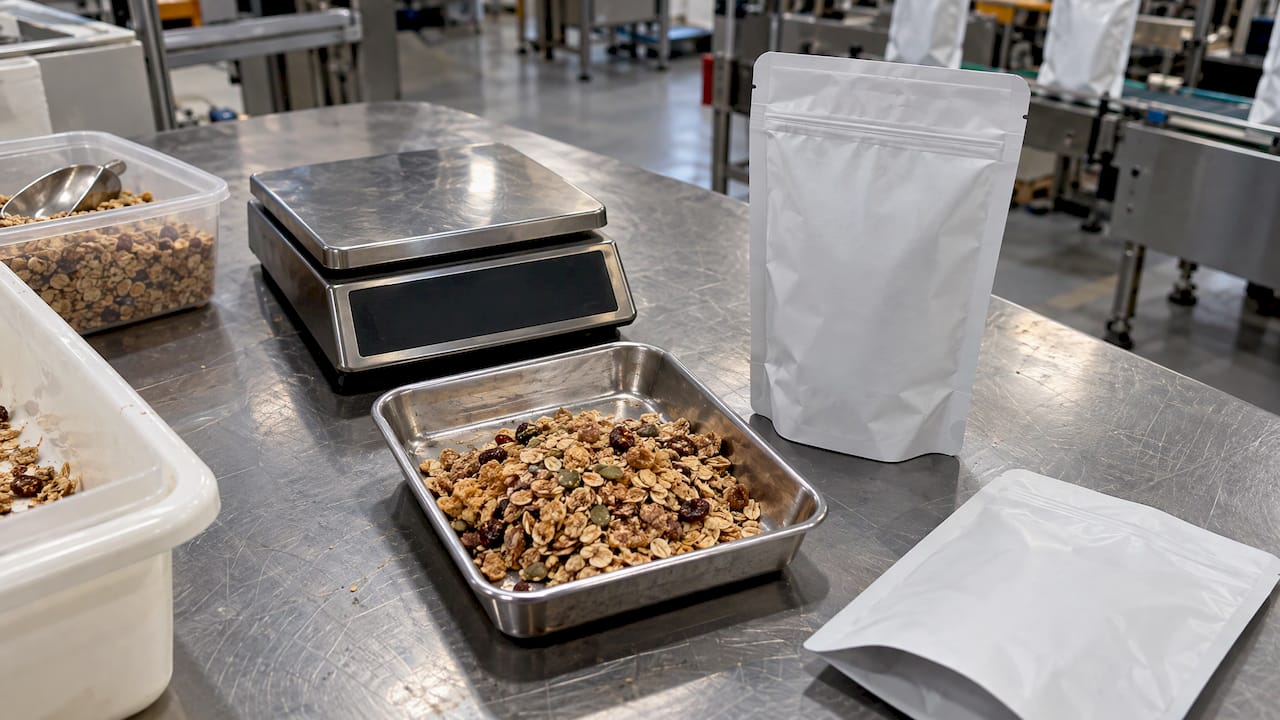
The legal guide for co-packing prepared for Western Economic Diversification Canada stresses agreeing on acceptable tolerance levels in the specifications, with clear rules for sampling, reviewing and rejecting product. “Within 2 grams of target weight” is a rule. “About right” is an argument waiting to happen.
Step 5: Sign the agreement
A co-packing agreement, according to that same legal guide, generally includes:
- the names of the parties and a description of the product
- a way to place orders and determine quantity and quality
- a price formula
- rules on forecasting, regulatory assurances, exclusivity, confidentiality and intellectual property
Perennia adds that the agreement should spell out the supplier’s quality and food safety assurances to meet CFIA requirements (the Canadian Food Inspection Agency, the federal food regulator) and any third-party certification schemes, and warrant that the product is free of defects against your specification. Manitoba’s guide also suggests clarifying storage terms and requesting a certificate of insurance naming you as an additional insured.
Step 6: The production run and quality checks
Now the actual work happens. Ingredients and packaging materials arrive (who buys them is a contract term, so settle it in Step 5), the line is set up, and the run starts. Quality checks follow your spec: weight, seal integrity, appearance and labelling. For a freeze dried or dry product, think of the pouch as part of the product: a poor seal turns a crunchy treat into a chewy disappointment.
Costs for this step are usually based on a per-case or per-pound basis, per Alberta’s Business Basics, which is why your case size and pouch format belong in the spec from day one.
Step 7: Labelling, storage and shipping
Finished pouches get cased, palletized and either stored or shipped to you or straight to your retailers. If you sell in more than one province, the labels need to be right before the product leaves the building, because a mislabelled pallet is a very large, very sad pile of snacks. More on that rule set next.
The Canadian paperwork that shapes your process
This part depends on where you sell, and it is where many first-time brand owners trip.
Licence or permit. Alberta’s fact sheet says food sold only within Alberta needs an Alberta Health Services permit, while a CFIA licence is needed if the food is sold in another province or exported. Other provinces have their own rules, so check yours.
Food safety and traceability. Under the Safe Food for Canadians Regulations, food moving between provinces or across borders must be manufactured, prepared, stored, packaged and labelled under sanitary conditions, and operators must control biological, chemical and physical hazards. Traceability labelling for consumer prepackaged food must include the common name, the name and principal place of business of the person by or for whom the food was made, and a lot code.
Who goes on the label. A CFIA question-and-answer report confirms that a small company using a co-packer may use “prepared for” on the label if it wants to be the contact for complaints and recalls, since the principal place of business is the company that takes legal ownership of the product.
The 2026 labelling change. The same report states that the new food labelling amendments applied in full from January 1, 2026. Labels using the former requirements are no longer compliant after that date, although product already imported, manufactured or packaged at retail before then can stay in the warehouse and on shelves. If your artwork predates 2026, have it re-checked before the next run.
Shelf life. Foods with an anticipated shelf life over 90 days generally don’t need a best-before date or storage information, as the same report explains for shelf-stable foods like many dry products, though traceability labelling still applies.
For deeper reading, we’ve written guides on food labelling in Canada, food packaging regulations and snack food certifications. Manitoba’s guide also points out that a co-packer can save you the time and money of dealing directly with food safety laws, insurance and extra certifications such as Kosher, organic or allergen-free.
What drives the cost
No two co-packing quotes look alike, and public Canadian price lists are rare, so here are the levers rather than a made-up number. A Quebec bottler’s September 2026 guide names three: volume (unit cost falls in tiers as batches grow), container choice, and process complexity. It reports typical beverage minimums of 5,000 to 50,000 units per run depending on the line. That is a beverage figure, so treat it as a sense of scale rather than a dry-goods price.
For dry goods the same logic applies:
- Volume: bigger runs spread setup time across more pouches.
- Packaging: pouch size, material and print choices change both the material cost and the line speed.
- Process: a product that needs freeze drying, mixing or portioning before bagging costs more to handle than one that only needs filling.
- Case or per-pound pricing: ask for quotes in the same unit so you can compare fairly.
We don’t publish co-packing prices, because they depend on your product, volume and packaging. The way to get a number is to send us your spec.
A note on “co-packing” in warehouses
If you searched this term and landed on warehouse content, there is a second meaning. In logistics, co-packing usually means assembling, kitting or bundling products (a shampoo plus a conditioner in one sleeve, say) rather than making food. This article is about food co-packing: making and packaging an edible product under Canadian food safety rules.
Promo: bring us your spec
If your product is a dry, shelf-stable food, such as candy, chocolate bites, nuts, seeds, granola, trail mix, coffee beans or spices, we can handle co-packing, pouch packaging, private label and commercial freeze drying. Our products are made in Canada with attention to food safety and compliance with Canadian regulations. Have a look at our co-packing and packaging services, or if you’re a retailer who just wants to stock the finished goods, browse our freeze dried candy and treats.

New to the whole idea? Our guide on co-packing in Canada for entrepreneurs is a good companion to this one.
Perspective
Most people think the hard part of co-packing is finding someone with a machine. It isn’t. The hard part is knowing exactly what you want, in writing, before anyone presses start.
We run contract manufacturing, bulk freeze drying and pouch packaging for dry goods, so we see the whole chain in one place: the product, the pouch and the label. That matters because those three decisions affect each other. A pouch format changes how a product is filled, and a label change can change the whole run.
Our advice to any shop owner or brand founder: start with the product spec and the sales channel. Decide whether you want a private label product or a co-packed recipe of your own, then work backwards to volumes and packaging. Do that homework and the process is pleasantly boring, which is exactly what you want from a production line.
Chadi
FAQ
How do I find a co-packer?
Start with your product type, expected volume and where you’ll sell, then look for a co-packer with experience making something similar and the right equipment. Ask for references and a sample, and check capacity and confidentiality terms. If your product is a dry, shelf-stable food, you can contact us through our services page.
How much does co-packing cost?
It depends on volume, packaging and how much processing your product needs. Alberta’s business guide says processing costs are usually based on a per-case or per-pound basis. Larger runs generally lower the unit cost, so quote several volumes side by side.
Do I need a licence to use a co-packer in Canada?
Where you sell decides it. Alberta’s fact sheet says an Alberta Health Services permit covers sales within Alberta, while a CFIA licence is needed for sales in other provinces or exports. Labelling is federally regulated wherever you sell, so confirm your setup with the relevant authority or a food regulatory adviser.
What is the difference between co-packing and private label?
In co-packing, the co-packer makes your product to your specifications. In private label, the manufacturer owns the recipe and you sell it under your brand. We offer both, so you can pick whichever matches your product.
Sources
- Copack Fact Sheet, Alberta Agriculture
- Using a Co-Packer, Government of Manitoba
- Co-Packing in the Food Industry: What to Know, Alberta Agriculture
- Co-packer partnership resource, Perennia
- Resource Guide for Co-packing, legal aspects
- Business Basics for Alberta Food Processors, Facilities
- Manufacturing, Food & Beverage Manitoba
- Safe Food for Canadians Regulations
- AFPA and CFIA question report, November 14, 2024
- Co-Packing in Quebec: Choosing a Bottler