

TL;DR:
- The top retail snacks in 2026 are high-demand categories like salty snacks, better-for-you bars, and confectionery, with strategic placement essential for boosting impulse sales. Corn and cheese snacks lead growth, especially when positioned near checkout in single-serve sizes, while properly timed seasonal and impulse displays prevent stockouts. Effective merchandising relies on placement, planogram design, and evolving assortments tailored to seasonal patterns and consumer demand.
The best snacks for retail stores are grab-and-go, high-demand products that combine strong consumer pull, healthy profit margins, and smart placement to drive impulse purchases. Salty snacks, better-for-you bars, and confectionery are the three categories generating the most consistent revenue in 2026, and the stores winning in this space are not just stocking the right products. They are placing them in the right spots. This guide breaks down the top retail snack options by category, with real sales data and merchandising tactics you can apply this week.
1. Best snacks for retail stores: corn and cheese salty snacks
Salty snacks are the backbone of any retail snack set, and the subcategory data for 2026 tells a clear story. Corn snacks grew 9.6% in dollar sales and 9.7% in unit sales, making them one of the fastest-growing snack segments on shelves right now. Cheese snacks also posted positive gains in both dollar and unit sales, confirming that the classic crunch is not going anywhere.
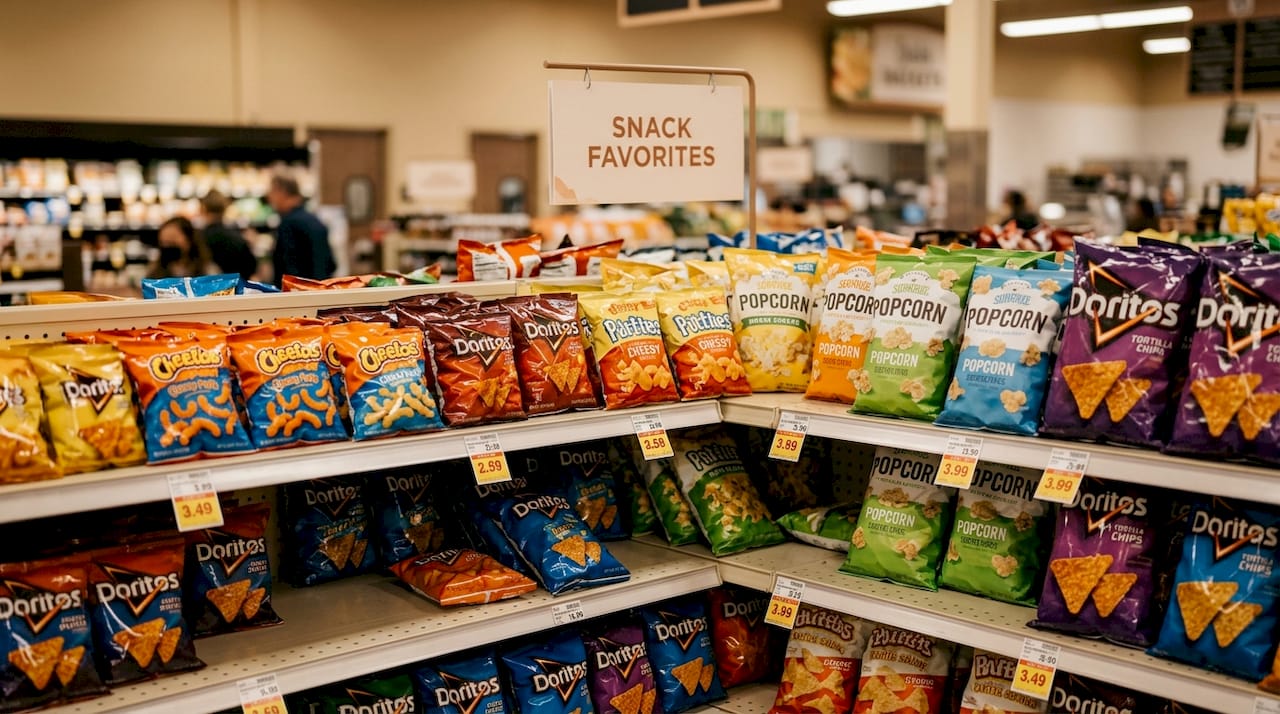
The broader salty snack category generated $7.82 billion in sales, though performance varies significantly across subsegments. Corn and cheese snacks are outpacing the category average, which means they deserve priority shelf space and checkout placement over slower-moving alternatives.
Popular options to stock include:
- Elote-flavored corn snacks and puffed corn varieties in single-serve bags
- Cheddar-dusted cheese puffs and baked cheese crisps
- Multipack corn chip assortments for grab-and-go cooler zones
- Spicy cheese snacks targeting Gen Z flavor preferences
Pro Tip: Stock corn and cheese snacks in compact, single-serve packaging near your checkout counter. Smaller pack sizes reduce the perceived cost barrier and convert browsers into buyers without any extra effort on your part.
2. Better-for-you bars and granola bars
Snack bars and granola bars are no longer a niche health-food play. Snack bars grew 8.2% in dollar sales in 2025, and better-for-you bars specifically grew nearly 15%. That gap between overall category growth and better-for-you growth tells you exactly where consumer attention is shifting.
The driver is functional snacking. Consumers are moving toward fewer total snack units but more intentional, protein-forward choices that function as a meal replacement. High-protein, low-carb bars from brands like RXBar, KIND, and Quest are pulling double duty as both snacks and lunch substitutes, which means your customer is buying one bar instead of two separate items. Stock accordingly.
Varieties worth carrying include:
- Protein bars with 15g or more of protein per serving (RXBar, Quest, Clif Builder’s)
- Granola bars with clean ingredient labels and low added sugar
- Oat-based bars with nut butter or dark chocolate for indulgent-but-healthy positioning
- Variety packs that let first-time buyers sample before committing to a full box
Pro Tip: Place a small variety-pack display near your coffee station or self-serve beverage area. Shoppers grabbing a morning coffee are already in a snack-receptive mindset, and a bar at eye level closes the sale before they even think about it.
3. Chocolate and non-chocolate confectionery
Confectionery is the category that keeps retail margins healthy, and the 2026 numbers are worth knowing. Chocolate candy totaled $28.4 billion in sales at a 51.7% category share, while non-chocolate candy reached $22.5 billion at 40.9% share. Non-chocolate novelty candy specifically grew 11% in dollar sales, which is the number to pay attention to.
Larger packaged chocolates are outperforming snack-sized options right now, partly because confectionery prices sit roughly 40% higher than 2019 levels. Shoppers who are spending more per item want to feel like they are getting more product. Value packs and share bags address this directly and maintain unit volumes even when per-unit prices are elevated.
Key confectionery trends shaping your assortment decisions:
- Sour and spicy non-chocolate formats are growing fast, driven by Gen Z preferences
- Freeze-dried candy formats are gaining serious shelf traction as a novelty and flavor-intensity play
- Nostalgic formats (gummies, wax bottles, candy buttons) are performing well across age groups
- Seasonal and holiday packaging drives significant incremental volume around key dates
Pro Tip: Rotate a small freeze-dried candy section near your register. The visual novelty of freeze-dried formats stops shoppers mid-stride, and the price point on single-serve bags makes the purchase feel low-risk. It is one of the easiest impulse wins in confectionery right now.
4. Impulse merchandising: why placement drives more sales than product selection
Product selection matters, but placement is what actually closes the sale. Items near the register consistently outperform the same products placed elsewhere in the store, making checkout zones the highest-value real estate in any snack merchandising strategy. This is not a new insight, but most stores still underutilize it.
The mechanics behind impulse buying come down to reducing friction. Compact, grab-and-go SKUs in near-POS displays shorten the decision window and lift sales by making the product easy to see, reach, and grab in one motion. A protein bar buried in a mid-aisle cooler sells far less than the same bar sitting in a countertop display at eye level.
Planogram design compounds this effect. Shoppers scan shelves left to right, and planograms built around that behavior place high-margin, high-velocity items at eye level in the natural scan path. This is not decoration. It is a decision engine that guides shoppers toward your best-margin products without requiring any staff involvement.
Here is a practical impulse merchandising framework for snack-heavy retail:
- Place your top three snack SKUs at eye level in the checkout zone, refreshed weekly
- Add a secondary impulse point near your coffee or foodservice station for morning traffic
- Use small-footprint countertop displays rather than floor-standing units to reduce clutter
- Rotate seasonal and better-for-you snacks into impulse zones every four to six weeks
- Keep displays fully stocked. An empty peg hook signals low quality, not high demand
“Impulse sales are driven more by execution and placement in high-attention zones than by simply offering more snacks.” — Food Concepts, Inc.
Pro Tip: If you have lost impulse snack sales to inflation-driven hesitation, add a second display point in a completely different part of the store. Retailers can recover impulse sales by creating multiple interruption moments rather than relying on a single checkout display.
5. Shelf-stable snacks that simplify your inventory
Shelf-stable snacks are the most operationally friendly category for retail managers, and they belong in every snack set. Nuts, trail mixes, roasted chickpeas, jerky, seaweed snacks, and single-serve nut butter packets require no refrigeration, maintain product quality over longer periods, and fit naturally into grab-and-go displays. For stores without dedicated cold storage near the checkout zone, these are your best friends.
The category also overlaps cleanly with the better-for-you trend. Jerky and protein-forward snacks like roasted chickpeas are showing sustained growth even when traditional salty snack segments face mixed results. Stocking these alongside corn snacks and cheese snacks gives you a shelf that covers both indulgent and functional snacking occasions without adding refrigeration complexity.
For practical stocking, check out Space-man’s breakdown of long shelf life snacks worth carrying for grab-and-go retail sets. The guide covers format selection and storage considerations that apply directly to convenience and specialty retail environments.
6. Seasonal and variety-bag strategies to prevent stockouts
Seasonal snack assortment is a timeline problem, and most retailers treat it like a single decision rather than a three-phase process. A three-phase merchandising arc matches snack formats to where shoppers are in the seasonal cycle, and the difference between getting it right and getting it wrong shows up directly in stockout rates and missed revenue.
Late-season safety stock in variety bags is particularly critical for peak moments like Halloween, when demand spikes faster than most replenishment cycles can handle. Stores that run out of variety bags on October 29th are not just losing that day’s sales. They are sending customers to a competitor who had the foresight to stock deeper.
| Season phase | Recommended snack format | Primary occasion |
|---|---|---|
| Early season | Seasonal-shaped single-serve snacks | Immediate consumption, novelty |
| Mid season | Party-bowl and share-bag formats | Gatherings and group snacking |
| Late season | Variety bags with deep safety stock | Peak demand days, gifting |
| Post season | Value packs and clearance bundles | Deal-seeking, pantry loading |
More than half of consumers report eating three or more snacks per day, which means your assortment needs to cover multiple dayparts and occasions, not just one. A store that stocks only afternoon snacks is leaving morning and evening sales on the table.
Key takeaways
The best snacks for retail stores combine high-demand categories like salty snacks and better-for-you bars with strategic checkout placement and a seasonal assortment plan that prevents stockouts at peak demand.
| Point | Details |
|---|---|
| Prioritize corn and cheese snacks | Both categories posted strong 2025 growth and belong near checkout in single-serve formats. |
| Stock better-for-you bars prominently | Better-for-you bars grew nearly 15% and perform best near coffee stations and checkout zones. |
| Use checkout zones as your top display | Items near the register consistently outsell the same products placed elsewhere in the store. |
| Plan snack assortment in three phases | Match seasonal formats to early, mid, and late season demand to avoid costly stockouts. |
| Add freeze-dried candy as a novelty driver | Freeze-dried formats generate impulse purchases through visual novelty and accessible price points. |
What I have actually learned about snack assortment after years in this space
Here is the thing most snack category guides will not tell you: the retailers who struggle with snack sales are almost never stocking the wrong products. They are stocking the right products in the wrong places and then wondering why velocity is low.
I have watched stores carry strong-performing protein bars and corn snacks and still underperform, simply because those products were buried in a mid-aisle section nobody walked through. Moving the same SKUs to a countertop display near the register changed the numbers within two weeks. No new products. No price changes. Just placement.
The other pattern I keep seeing is retailers who treat seasonal snack assortment as a single buy decision in August. They stock Halloween variety bags once, do not adjust depth as the season progresses, and then run out on October 28th. The three-phase approach changes this completely. It is not complicated, but it requires treating your snack set as something that evolves rather than something you set and forget.
My honest recommendation for 2026: build your snack assortment around three anchors. A strong salty snack presence in compact single-serve formats, a better-for-you bar section near a high-traffic secondary location, and a rotating impulse display near checkout that you refresh every four to six weeks. That combination covers the majority of snacking occasions your customers have, and it gives you a merchandising rhythm that is easy to maintain. Review your sell-through data monthly and let the numbers tell you when to rotate. The stores doing this consistently are the ones growing snack revenue without adding SKU complexity.
— Chadi
How Space-man can help you build a stronger snack set
If you are looking to differentiate your snack assortment beyond what every other store in your area is carrying, Space-man’s private label and co-packing services give you a direct path to branded, exclusive snack products without the manufacturing overhead.
Space-man specializes in freeze-dried candy manufacturing and distribution across Canada, with flexible packaging and bagging services designed for retail environments. The 72-bag display kit is built specifically for compact checkout and impulse zones, giving you a ready-to-merchandise snack display that fits the small-footprint format proven to drive impulse sales. For retailers who want a turnkey snack category addition that stands out on the shelf, this is worth a serious look.
FAQ
What snack categories sell best in retail stores?
Salty snacks, better-for-you bars, and confectionery are the top-performing retail snack categories in 2026. Corn snacks and cheese snacks lead salty snack growth, while better-for-you bars grew nearly 15% in dollar sales.
Where should snacks be placed in a retail store?
Checkout zones and secondary impulse points near coffee or foodservice stations generate the highest snack sales. Items placed near the register consistently outperform the same products placed elsewhere in the store.
Are healthy snacks worth stocking in a convenience or retail store?
Yes. Better-for-you and functional snacks, including protein bars and jerky, show sustained growth even when traditional salty snack segments face mixed results. Shelf-stable options like nuts and roasted chickpeas also simplify inventory management.
How do I prevent snack stockouts during seasonal peaks?
Use a three-phase seasonal assortment strategy: single-serve formats early in the season, party-bowl formats mid-season, and deep variety-bag safety stock late in the season to cover peak demand days like Halloween.
What is the best snack format for impulse purchases?
Compact, single-serve packaging in visible, easy-to-grab checkout displays drives the highest impulse conversion. Reducing the time and effort required to grab a product is the single biggest lever for impulse snack sales.