

TL;DR:
- Lyophilization removes water through sublimation in three stages: freezing, primary drying, and secondary drying. Proper control of temperature and pressure ensures product stability and long shelf life by maintaining specific parameters throughout the process.
Lyophilization is defined as a dehydration process that removes water by converting ice directly into vapor under vacuum, bypassing the liquid phase entirely through a mechanism called sublimation. This process, also known as freeze drying, preserves product structure, nutrients, and biological activity far better than conventional thermal drying. Understanding lyophilizer working principles is not optional for engineers and researchers who want repeatable, high-quality results. The three core stages are freezing, primary drying via sublimation, and secondary drying via desorption, each governed by tightly controlled temperature and pressure parameters.
What are the three main stages of the lyophilization process?
The lyophilization cycle runs in three sequential stages, and each one has a distinct job. Getting any stage wrong cascades into problems in the next.
1. Freezing
The freezing stage converts all free water in the product into ice. Temperature control here directly affects ice crystal size, which in turn determines how efficiently the product dries later. Controlled freezing promotes larger ice crystals and more porous structures, which speeds up primary drying. Rapid freezing creates small, dense crystals that slow vapor migration and extend cycle times. Most industrial protocols use controlled-rate freezing to hit this balance deliberately.
2. Primary drying (sublimation)
Primary drying is where the real action happens. The chamber pressure drops to 0.05–0.5 mbar, well below the triple point of water at approximately 0.61 mbar, which forces ice to sublimate directly into vapor without melting. Heated shelves supply the latent heat needed for sublimation, and a cold condenser captures the vapor before it reaches the vacuum pump. This stage removes 90–95% of total moisture. That figure explains why primary drying is the longest and most energy-intensive part of the entire cycle.
3. Secondary drying (desorption)

Secondary drying targets the residual bound water that sublimation cannot remove. Shelf temperatures rise to 20–40°C while the vacuum is maintained, driving desorption of water molecules still attached to the product matrix. This phase reduces final moisture content to 1–3%, which is the threshold for long-term shelf stability. Cutting this stage short is a common mistake that leads to premature product degradation in storage.
Pro Tip: Map your product’s eutectic or glass transition temperature before setting shelf temperatures for secondary drying. Exceeding that limit even briefly can collapse the product structure and ruin the batch.
How do the key components of a lyophilizer work together?
A lyophilizer is not a single machine. It is a coordinated system of four subsystems that must operate in sync. Understanding lyophilizer component coordination is what separates operators who troubleshoot fast from those who lose batches.
Process chamber and heated shelves
The process chamber houses the product and provides a controlled environment for all three drying stages. Hollow shelves circulate a thermal fluid, typically silicone oil, to deliver or remove heat with precision. The shelves must heat evenly across their surface to avoid hot spots that could push local product temperatures above critical limits.
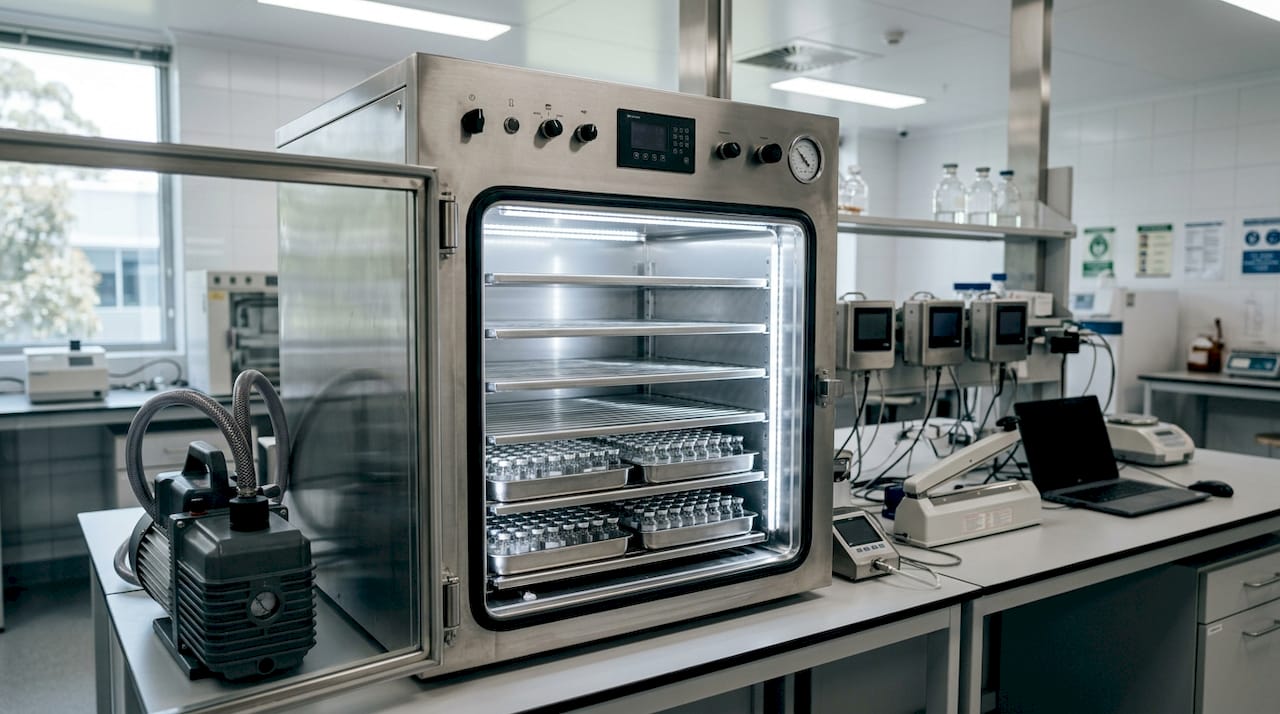
Refrigeration condenser (cold trap)
The condenser is the vapor sink of the system. It operates at temperatures from negative 50°C to negative 80°C or lower, creating a strong vapor pressure gradient that pulls sublimated water away from the product. Modern lyophilizers use cascaded refrigeration systems to reach these temperatures reliably. The condenser must be positioned and sized to handle peak vapor loads during primary drying without becoming saturated.
Vacuum system
The vacuum pump reduces chamber pressure to the micron range, enabling sublimation to occur. Without adequate vacuum, the chamber pressure stays above the triple point of water and the product melts rather than dries. Rotary vane pumps and dry screw pumps are both used in industrial systems, with the choice depending on solvent load and contamination risk.
Control and sensor system
Temperature sensors, pressure transducers, and programmable logic controllers manage every parameter across the full cycle. The control system adjusts shelf temperature ramp rates, monitors condenser load, and logs data for regulatory compliance in pharmaceutical applications. Without this layer, running a repeatable lyophilization cycle at scale is practically impossible.
Pro Tip: Install redundant pressure sensors in both the chamber and the condenser. A single sensor failure during primary drying can mask a vacuum leak and cost you an entire production run.
The four subsystems listed above work as a closed loop. The vacuum pulls vapor, the condenser captures it, the shelves supply heat, and the controls keep everything within bounds. A failure in any one subsystem stresses the others immediately.
What are the critical control parameters and challenges in lyophilizer operation?
Lyophilizer operation principles come down to managing three variables: pressure, temperature, and time. Get all three right and the process runs cleanly. Lose control of any one and the product suffers.
Vacuum pressure
Chamber pressure must stay below 0.61 mbar throughout primary drying to keep water in the solid-to-vapor transition zone. Most industrial processes target 0.05–0.5 mbar for a reliable sublimation rate. A vacuum leak that pushes pressure above the triple point causes partial melting, which destroys the porous structure the process is designed to create.
Shelf temperature and product temperature
Shelf temperature drives sublimation by supplying latent heat, but it cannot push the product above its eutectic temperature for crystalline products or its glass transition temperature for amorphous ones. Exceeding these limits causes melt-back or structural collapse, which degrades product quality and cannot be reversed. The shelf temperature profile must be validated for each specific formulation, not assumed from a generic protocol.
Condenser temperature differential
The condenser must stay 15–20°C colder than the product temperature to maintain efficient vapor capture. If the condenser warms up due to overload or refrigeration failure, sublimation slows dramatically and drying times increase. This differential is a non-negotiable operating parameter, not a guideline.
“The vapor pressure gradient is the engine of freeze drying. Vacuum pulls vapor away from the product, the condenser traps it, and shelf heat replenishes the energy lost to sublimation. Disrupt any part of that gradient and the process stalls or fails. Controlling all three simultaneously is what makes lyophilizer operation genuinely demanding.”
| Parameter | Target range | Risk if out of range |
|---|---|---|
| Chamber pressure | 0.05–0.5 mbar | Product melts above 0.61 mbar |
| Shelf temperature | Below eutectic/Tg | Collapse or melt-back |
| Condenser temperature | 15–20°C below product | Vapor backflow, slow drying |
| Secondary drying temp | 20–40°C | Residual moisture above 3% |
How does lyophilization preserve product quality better than conventional drying?
The freeze drying process preserves quality through one core mechanism: it never lets the product pass through the liquid phase. Conventional hot-air drying forces water out as liquid, which causes cell walls to collapse, proteins to denature, and volatile flavor compounds to evaporate. Freeze drying sidesteps all of that.
The practical benefits are well documented:
- Nutrient retention: Freeze drying preserves up to 97% of nutrients compared to conventional drying, which causes thermal degradation and shrinkage. That gap is significant for pharmaceutical biologics and functional food products alike.
- Structural integrity: The sublimation pathway leaves behind a porous, sponge-like matrix that rehydrates quickly and completely. Conventional drying collapses that matrix permanently.
- Flavor and color: Low thermal stress means volatile aromatic compounds and heat-sensitive pigments survive the process. This is why freeze-dried strawberries taste like strawberries and not cardboard.
- Shelf stability: Residual moisture at 1–3% combined with the absence of liquid water activity suppresses microbial growth and enzymatic reactions. Products sealed in moisture-barrier packaging achieve shelf lives measured in years, not months.
- Protein and enzyme preservation: Controlled energy input provides only the latent heat needed for sublimation, avoiding the thermal denaturation that destroys biological activity in heat-dried products.
The lyophilization process explained in full shows why pharmaceutical manufacturers use it for vaccines, antibodies, and probiotics where biological activity is non-negotiable. Food technologists use the same principles to produce products that retain sensory and nutritional value across long supply chains.
Why getting lyophilizer mechanics right matters more than most operators realize
I have seen a lot of freeze drying operations that treat the lyophilizer as a black box. Set the program, press start, and hope for the best. That approach works until it doesn’t, and when it fails, the root cause is almost always a parameter that nobody was watching closely enough.
The insight that changed how I think about this process is that understanding internal lyophilizer mechanisms is not just for engineers who build the machines. It is the foundation of good process development. If you know why the condenser temperature differential matters, you catch a refrigeration issue before it ruins a batch. If you understand ice crystal formation, you design a freezing protocol that cuts your primary drying time by hours.
The most common mistake I see is skipping or shortening secondary drying to save time. The product looks dry. The cycle data looks fine. But residual moisture sits at 4–5% instead of 1–3%, and the product fails stability testing three months later. Secondary drying is not optional. It is where long-term shelf life is actually built.
Pretreatment and controlled freezing are the other undervalued levers. Formulation adjustments that raise the eutectic temperature give you more headroom on shelf temperature during primary drying, which speeds up the cycle without risking collapse. Controlled-rate freezing that targets a specific crystal size is worth the extra time it takes. These are not advanced techniques. They are fundamentals that pay off every single cycle.
— Chadi
Space-man’s freeze drying and co-packing services for your next project
Space-man operates industrial freeze drying production in Canada with a focus on food and consumer goods. Whether you need co-packing support, private label packaging, or custom bagging for freeze-dried products, Space-man works with food technology professionals and distributors who need reliable, consistent output.
The same lyophilization principles covered in this article govern every batch Space-man produces. If you are developing a new freeze-dried product line or need a Canadian co-packing partner with real freeze drying expertise, Space-man is worth a conversation. Reach out through the private label and co-packing page to discuss your project requirements directly.
FAQ
What is the basic working principle of a lyophilizer?
A lyophilizer removes moisture by freezing the product and then applying vacuum pressure below 0.61 mbar, which causes ice to sublimate directly into vapor without passing through the liquid phase. The three stages are freezing, primary sublimation drying, and secondary desorption drying.
What chamber pressure is required during primary drying?
Primary drying requires chamber pressure in the range of 0.05–0.5 mbar to maintain sublimation conditions below the triple point of water. Pressure above 0.61 mbar causes the ice to melt rather than sublimate, damaging product structure.
Why does condenser temperature matter so much in freeze drying?
The condenser must stay 15–20°C colder than the product temperature to create the vapor pressure gradient that drives sublimation. If the condenser warms up, vapor migration slows and drying times increase significantly.
What moisture level does secondary drying achieve?
Secondary drying reduces residual moisture to 1–3% by desorbing bound water under elevated shelf temperatures of 20–40°C while maintaining vacuum. This moisture level is the threshold for long-term shelf stability in both food and pharmaceutical products.
How does freeze drying compare to conventional drying for nutrient retention?
Freeze drying preserves up to 97% of nutrients by avoiding the liquid phase and limiting thermal stress. Conventional hot-air drying causes thermal degradation, cell collapse, and significant nutrient loss by comparison.
Key takeaways
Lyophilizer working principles rely on maintaining vacuum pressure below 0.61 mbar, controlling shelf and condenser temperatures within defined limits, and executing all three drying stages completely to achieve 1–3% residual moisture and long-term product stability.
| Point | Details |
|---|---|
| Sublimation is the core mechanism | Chamber pressure below 0.61 mbar forces ice to convert directly to vapor, preserving product structure. |
| Three stages are non-negotiable | Freezing, primary drying, and secondary drying each serve a distinct function and cannot be skipped or shortened. |
| Condenser differential drives efficiency | The condenser must stay 15–20°C colder than the product to maintain vapor capture and sublimation rate. |
| Secondary drying sets shelf life | Reducing moisture to 1–3% through desorption is what enables years-long storage stability in sealed packaging. |
| Freezing protocol affects drying time | Controlled-rate freezing creates larger ice crystals and more porous structures, cutting primary drying cycle time. |