

TL;DR:
- Freeze-drying, or lyophilization, removes water from frozen food by sublimating ice directly into vapor under vacuum, preserving shape and nutrients. The process involves freezing, primary sublimation, and secondary drying, each crucial for moisture removal and product quality. Proper control of variables like pressure, temperature, and product thickness is essential to produce high-quality, shelf-stable, and nutrient-rich foods at home and industrial levels.
Freeze-drying, known in scientific circles as lyophilization, is a dehydration process that removes water from frozen food by converting ice directly into vapor under vacuum, completely skipping the liquid phase. This means your strawberry stays a strawberry in shape, color, and taste, not a shriveled, heat-damaged version of its former self. The freeze-drying process is used everywhere from NASA meal prep to pharmaceutical manufacturing, and increasingly in home kitchens thanks to machines like the Harvest Right home freeze dryer. Understanding how freeze-drying works step by step gives you a real appreciation for why freeze-dried candy, fruit, and meals taste so remarkably close to fresh.

How freeze-drying works: the core science explained
Freeze-drying works by exploiting a physical phenomenon called sublimation. Water normally transitions from solid to liquid to gas, but under the right conditions of low pressure and low temperature, ice skips the liquid stage entirely and converts straight to vapor. This is the entire foundation of the freeze-drying process, and it is what separates lyophilization from every other drying method on the market.
The science hinges on the triple point of water, which is the specific temperature and pressure at which water can exist as solid, liquid, and gas simultaneously. Freeze-drying operates below this triple point, at pressures typically around 0.05 to 0.5 mbar. At those conditions, ice sublimates without ever becoming liquid. The result is a dry, porous product that retains its original structure because no liquid ever moved through it to cause collapse or shrinkage.
This sublimation-based dehydration is what makes freeze-drying so different from hot-air drying or sun drying. Heat-based methods push water out as liquid first, which distorts cell walls, destroys heat-sensitive nutrients, and changes texture permanently. Freeze-drying leaves the cellular architecture intact, which is why a freeze-dried raspberry rehydrates back to something very close to fresh.
What are the main stages of the freeze-drying process?
The three-stage freeze-drying cycle outlined by SP Industries is the standard framework used across industrial and home systems alike: freezing, primary drying, and secondary drying. Each stage has a distinct physical purpose, and skipping or rushing any one of them compromises the final product.
Stage 1: freezing
The product is cooled to temperatures between -30°C and -80°C, depending on the food type and equipment. At these temperatures, the water inside the food forms ice crystals throughout the product’s structure. The freezing temperature directly affects ice crystal size. Slower freezing creates larger crystals, which can rupture cell walls and affect texture. Faster freezing creates smaller, more uniform crystals that leave a cleaner porous structure after sublimation. Industrial systems often use controlled-rate freezing to optimize this.
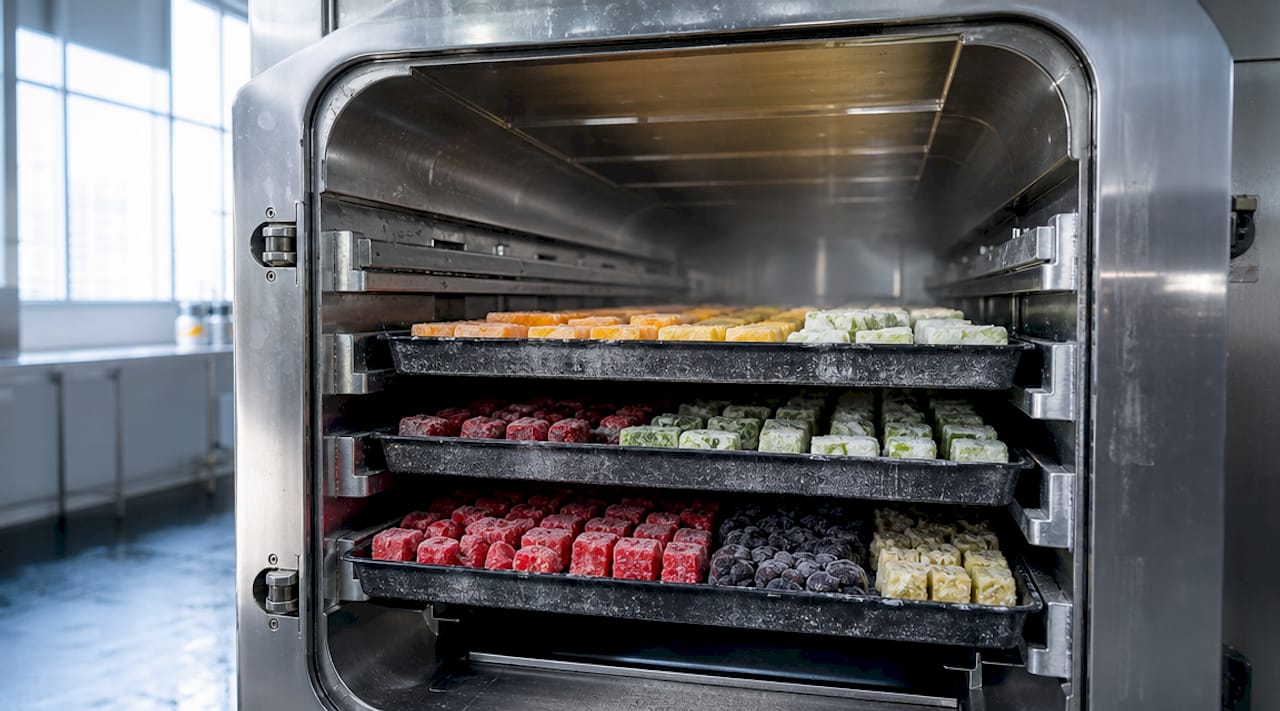
Stage 2: primary drying (sublimation)
Once frozen solid, the chamber pressure drops below the triple point and gentle heat is applied to the shelves. This is where the bulk of the water removal happens. Primary drying removes approximately 90 to 95% of the total water content through sublimation of free ice. The sublimated vapor travels to a condenser held at -50°C to -80°C, where it refreezes and is collected away from the product.
This stage is the longest and most energy-intensive part of the cycle. The heat input must be carefully balanced. Too much heat and the product melts or collapses. Too little and the cycle drags on unnecessarily. This is the precision challenge that makes freeze-drying both an art and a science.
Pro Tip: If you are using a home freeze dryer like the Harvest Right, avoid overloading trays. Thicker product layers extend primary drying time significantly and can result in uneven drying across the batch.
Stage 3: secondary drying (desorption)
After primary drying, the product looks dry but still holds 5 to 10% moisture as water molecules chemically bound to the product’s surface. Secondary drying raises the shelf temperature while maintaining low pressure to drive off this residual bound water through desorption. The goal is to reach a final moisture content of 0.5% to 3%, which lowers water activity to around 0.3 or below. At that level, microbial growth is effectively halted and shelf life extends dramatically.
Why does freeze-drying preserve food quality better than other methods?
The short answer is temperature. Freeze-drying never exposes food to the heat that destroys nutrients, breaks down enzymes, and alters flavor compounds. Conventional hot-air drying typically leaves 10 to 20% residual moisture and degrades heat-sensitive vitamins in the process. Freeze-drying achieves 0.5% to 3% moisture while preserving up to 97% of the original nutrient content.
Here is a direct comparison of how the two methods stack up:
| Factor | Freeze-drying | Hot-air drying |
|---|---|---|
| Final moisture content | 0.5% to 3% | 10% to 20% |
| Nutrient retention | Up to 97% | Significantly lower |
| Texture after rehydration | Close to original | Shrunken, tougher |
| Shelf life (sealed) | 20 to 25 years | 1 to 5 years |
| Flavor preservation | Excellent | Moderate to poor |
The texture advantage comes directly from sublimation skipping the liquid phase. When water leaves as vapor rather than liquid, the cell walls of the food never experience the mechanical stress of liquid movement. The result is a product that rehydrates quickly and evenly because the porous structure left behind absorbs water efficiently. You can see this in freeze-dried whole blueberries, which snap crisply when dry and plump back up beautifully when rehydrated.
The extended shelf life is a direct consequence of low water activity. When water activity drops below 0.3, bacteria, mold, and yeast cannot reproduce. This is why properly freeze-dried and sealed food can last decades without refrigeration, making it a favorite for emergency preparedness and space missions alike.
What operational factors affect freeze-drying quality?
Getting freeze-drying right requires controlling several interdependent variables simultaneously. A change in one parameter ripples through the entire cycle.
Vacuum pressure is the most critical variable. The chamber must stay consistently below the triple point pressure, typically in the 0.05 to 0.5 mbar range. Any pressure spike during primary drying can cause the ice to melt rather than sublimate, collapsing the product structure and trapping liquid inside.
Condenser temperature must stay cold enough to capture all sublimated vapor before it can re-enter the chamber. Industrial systems run condensers at -50°C to -80°C. If the condenser warms up or becomes overloaded, vapor pressure in the chamber rises and sublimation slows or stops.
Product thickness has a direct impact on cycle time. Thicker slices mean longer paths for vapor to travel out of the product. Primary drying alone can take 12 to 36 hours or more depending on product thickness and water content. Slicing food uniformly before loading is one of the simplest ways to reduce total cycle time.
Collapse temperature is a product-specific threshold that every serious freeze-dryer needs to know. Each food has a critical temperature above which its frozen matrix loses structural integrity during sublimation. Exceeding it causes the product to collapse into a dense, poorly dried mass. SP Industries notes that identifying collapse temperature for each product is the foundation of designing an efficient freeze-drying cycle.
Pro Tip: For home freeze-drying, pre-freeze your food in a standard chest freezer before loading it into the freeze dryer. This reduces the time the machine spends in the initial freezing stage and extends the life of your compressor.
How can food enthusiasts get started with freeze-drying at home?
Home freeze-drying has become genuinely accessible in the past decade. Machines like the Harvest Right medium home freeze dryer bring the core technology into a kitchen-sized footprint, though they still require a dedicated electrical circuit and a cool, dry operating environment.
A few practical points for getting started:
- Food preparation matters. Slice foods to a consistent thickness of about 0.5 to 1 cm. Thicker pieces extend cycle time and may not dry evenly. Remove pits, seeds, and excess fat before loading.
- Cycle times are long. Expect 24 to 48 hours per batch, sometimes longer for high-moisture foods like raw meat or full meals. Plan around this rather than fighting it.
- Packaging is not optional. Once freeze-dried, food is extremely hygroscopic and will absorb ambient moisture within minutes of exposure. Utah State University recommends sealing in thick Mylar bags with oxygen absorbers immediately after the cycle ends.
- Freeze-drying does not sterilize food. Bacteria survive the process in a dormant state. For foods like raw meat or eggs, proper cooking after rehydration is required for food safety.
- Energy costs add up. A home freeze dryer typically draws 1 to 2 kW continuously over a 24 to 48 hour cycle. Factor that into your cost-per-batch calculation, especially if you are freeze-drying for business purposes.
For a deeper look at how home freeze-drying compares to food dehydration in terms of cost and output, the freeze dryer vs food dehydrator breakdown covers the practical trade-offs clearly.
Key takeaways
Freeze-drying preserves food quality by removing water through sublimation under vacuum, achieving moisture levels of 0.5% to 3% that conventional drying methods cannot match.
| Point | Details |
|---|---|
| Sublimation is the core mechanism | Ice converts directly to vapor under vacuum, skipping the liquid phase entirely. |
| Three stages are all required | Freezing, primary drying, and secondary drying each serve a distinct purpose in moisture removal. |
| Nutrient retention reaches up to 97% | Low-temperature processing protects heat-sensitive vitamins and flavor compounds. |
| Packaging determines shelf life | Immediate sealing in Mylar with oxygen absorbers is required to maintain dryness after processing. |
| Freeze-drying does not kill bacteria | Rehydrated foods, especially meats, must be cooked to safe temperatures before eating. |
Why freeze-drying still surprises me after years in the industry
People often assume that if something looks dry, it is dry. That is the most common and costly mistake I see. A product can come out of a freeze dryer looking perfectly crisp and still hold 8% moisture because secondary drying was cut short. That extra moisture is invisible to the eye but very visible to mold six months later.
The other thing that consistently surprises people is how forgiving the flavor results are. I have seen freeze-dried candy come out of the process tasting more intensely of the original flavor than the fresh product did. The concentration effect during sublimation amplifies flavor compounds in a way that heat drying destroys. It is one of those happy accidents of physics that makes freeze-drying genuinely exciting to work with.
What I find most interesting right now is the democratization of the technology. Five years ago, freeze-drying was purely industrial. Today, a serious home cook or small food business can run their own cycles with a Harvest Right unit and produce shelf-stable products that rival commercial quality. The gap between industrial and home output is narrowing fast, and that opens up real opportunities for food entrepreneurs who understand the principles of freeze-drying well enough to control the process rather than just run it.
My honest advice: invest time in understanding your specific product’s collapse temperature and water content before you scale up. The physics does not care about your production schedule.
— Chadi
Explore Space-man’s freeze-dried products and services

Space-man produces freeze-dried candy in Canada and offers the full range of services for food entrepreneurs ready to take their products to market. Whether you are looking to launch your own branded line or need a reliable co-packing partner, Space-man’s private label and co-packing services cover everything from production to packaging. For those wanting to start selling right away, the 40-bag starter pack is a practical entry point to test the market with proven products. Space-man handles the science so you can focus on the business.
FAQ
What is freeze-drying in simple terms?
Freeze-drying is a preservation method that removes water from frozen food by turning ice directly into vapor under vacuum, without passing through a liquid stage. The result is a lightweight, shelf-stable product that retains its original shape, flavor, and nutrients.
How long does a freeze-drying cycle take?
Primary drying alone typically takes 12 to 36 hours depending on product thickness and water content, with secondary drying adding additional time. Most home freeze-dryer batches run between 24 and 48 hours total.
Does freeze-drying kill bacteria?
Freeze-drying does not kill bacteria. It preserves microorganisms in a dormant state, so foods like raw meat and eggs must be cooked to safe temperatures after rehydration.
How is freeze-drying different from regular dehydration?
Freeze-drying uses vacuum and low temperature to sublimate ice, achieving 0.5% to 3% final moisture and preserving up to 97% of nutrients. Hot-air dehydration uses heat, leaves 10% to 20% moisture, and degrades heat-sensitive vitamins and texture.
How should freeze-dried food be stored?
Freeze-dried food must be sealed immediately in thick Mylar bags with oxygen absorbers to prevent moisture reabsorption. Properly packaged, freeze-dried food can remain shelf-stable for 20 to 25 years in cool, dry storage.