

TL;DR:
- Freeze drying preserves food by sublimating frozen water into vapor while maintaining cellular structure and nutrient content. It does not kill microbes, so proper packaging and cooking are essential for safety, especially with meats and eggs. Although more time and costlier, freeze-dried products offer superior shelf life, flavor, and rehydration quality compared to traditional drying methods.
If you’ve ever bitten into a piece of freeze-dried fruit and wondered how something that light and crunchy was once a juicy strawberry, you’re already asking the right question. The freeze dry meaning goes well beyond “put food in a freezer.” It’s a precise, multi-stage process that removes water without heat, preserving flavor, texture, and nutrients in ways that conventional drying simply can’t match. Understanding how it works, and where its limits are, makes you a smarter consumer and a more informed buyer of the growing range of freeze-dried products on the market today.
Table of Contents
- Key Takeaways
- What the freeze dry meaning actually is
- Freeze drying in food preservation: benefits and trade-offs
- Safety: the most misunderstood part of freeze drying
- Practical tips for handling and storing freeze-dried foods
- My take on what most people get wrong about freeze drying
- Freeze-dried products done right, from the start
- FAQ
Key Takeaways
| Point | Details |
|---|---|
| Freeze drying defined | Food is frozen and water is removed via sublimation, skipping the liquid phase entirely. |
| Three-step process | Freezing, primary drying (sublimation), and secondary drying each play a distinct role in the result. |
| Superior quality retention | Texture, flavor, and nutrients are better preserved than with hot-air drying, though the process costs more. |
| Microbes survive the process | Freeze drying does not kill bacteria or pathogens. Safe water activity levels and cooking steps matter. |
| Packaging is everything | Freeze-dried foods reabsorb moisture rapidly, so sealing and storage conditions directly affect safety and shelf life. |
What the freeze dry meaning actually is
The simplest way to put it: freeze-drying preserves food by first freezing it solid, then removing the water through a vacuum-driven process that turns ice directly into vapor, with no liquid phase in between. That last part is the key. Most people assume drying food means applying heat until moisture evaporates. Freeze drying does something more interesting. It uses physics.
The process exploits a phenomenon called sublimation. When pressure drops below a specific threshold (called the triple point), frozen water skips its liquid phase and converts straight from ice to vapor. That means the food’s cellular structure stays intact throughout, which is why freeze-dried strawberries still look like strawberries rather than shriveled chips.
The three stages of freeze drying
Understanding the three-step freeze drying process makes it easy to see why the results are so different from other preservation methods.
-
Freezing. The food is brought down to temperatures typically between –30°F and –50°F. At these temperatures, water in the food crystallizes completely. The goal is a thorough, uniform freeze, because uneven freezing leads to uneven drying later.
-
Primary drying (sublimation). The chamber pressure drops below the triple point using a vacuum system. Controlled, gentle heat is applied, and the frozen water sublimates directly into vapor, which is then captured by a cold condenser. This stage removes roughly 90% of the food’s water content. It also takes the longest.
-
Secondary drying (desorption). A small amount of water remains chemically bound to the food’s surface. Slightly higher temperatures drive off this residual moisture, bringing water activity down to a level that prevents microbial growth and chemical degradation.
The entire cycle requires precise control of temperature and pressure throughout. Too much heat during primary drying causes the product to collapse, destroying the porous structure that makes freeze-dried food rehydrate so well.
Pro Tip: If you’re buying a home freeze dryer, know that cycle time matters as much as equipment specs. A slow, well-controlled cycle consistently outperforms a faster one that cuts corners on temperature management.
Freeze drying in food preservation: benefits and trade-offs
The reason freeze drying in food preservation has become so widely used comes down to one core advantage: it protects the things that make food worth eating in the first place.

Conventional hot-air drying uses high temperatures that degrade heat-sensitive vitamins, alter flavor compounds, and cause shrinkage by collapsing cell walls. Freeze drying avoids all of that. Because water exits as vapor without ever becoming liquid, the food’s structure stays largely intact. You get a product that looks, smells, and tastes close to the original, and rehydrates in minutes thanks to its porous interior.
Why shelf life is so impressive
Freeze-dried products typically reach water activity (aw) below 0.2, which is well under the safety threshold of 0.85 where microbial growth becomes a concern. At these levels, food stays shelf-stable at room temperature, without refrigeration or chemical preservatives. That’s a significant deal for emergency food supply, military rations, backpacking meals, and yes, freeze-dried candy.
Common freeze-dried foods
- Fruits: strawberries, raspberries, mangoes, bananas
- Vegetables: peas, corn, spinach
- Proteins: cooked chicken, beef crumbles, eggs (pre-cooked)
- Specialty snacks: candy, ice cream novelties, yogurt bites
How it compares to conventional drying
| Feature | Freeze drying | Hot-air drying |
|---|---|---|
| Nutrient retention | High | Moderate to low |
| Flavor preservation | Excellent | Reduced |
| Texture after rehydration | Close to original | Chewy or rubbery |
| Water activity (aw) | 0.08 to 0.33 | Variable |
| Processing time | Long (hours to days) | Shorter |
| Energy and cost | Higher | Lower |
| Shelf life (sealed) | Up to 25 years | 1 to 5 years |
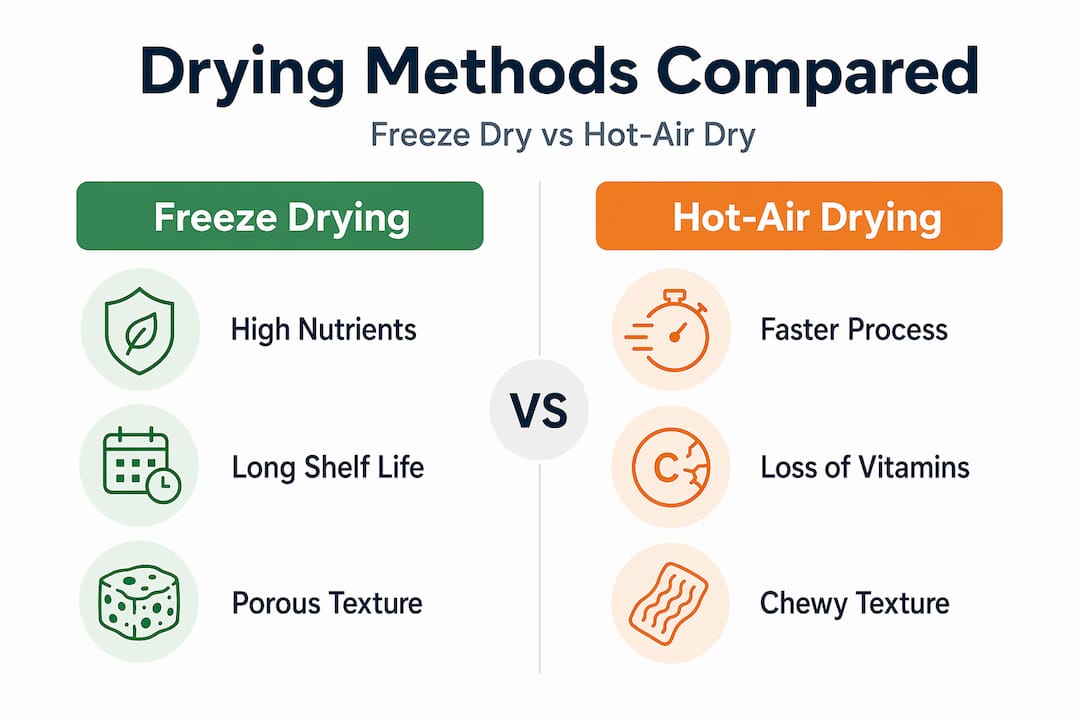
The trade-offs are real. Freeze drying takes more time and uses more energy than conventional methods. That cost gets passed on, which is why freeze-dried food benefits justify a higher price point when quality and longevity matter. You’re paying for a better result.
Safety: the most misunderstood part of freeze drying
Here’s something that surprises a lot of people. Freeze drying does not kill microbes. It preserves them. Bacteria, viruses, and other pathogens that were present on the food before the process remain viable afterward. The freeze dry food meaning does not include a kill step.
This has real consequences depending on what food you’re working with.
- Fruits and most vegetables are generally lower risk for harmful pathogens and are commonly eaten without cooking after freeze drying.
- Meats, poultry, eggs, and seafood must be fully cooked before or after freeze drying. Rehydrating raw freeze-dried chicken and eating it without cooking is a food safety risk.
- Water activity control is the primary safety mechanism. Safe water activity stays at or below 0.85, while freeze-dried foods typically sit between 0.08 and 0.33 when properly processed and sealed.
- Moisture uptake is a fast risk. Freeze-dried foods are hygroscopic, meaning they aggressively pull moisture from the air the moment they’re exposed to it. Water activity rises quickly, which is why packaging must be sealed immediately after processing.
Pro Tip: When buying freeze-dried products, check that the packaging is nitrogen-flushed or vacuum-sealed. Oxygen absorbers inside the package are a good sign too. These details protect water activity and extend real shelf life, not just the number printed on the label.
The kill-step misconception is one of the most important things to get right, especially as home freeze dryers become more accessible. People assume that because food looks and feels “preserved,” it’s automatically safe to eat without any cooking precautions.
Practical tips for handling and storing freeze-dried foods
You’ve got the freeze-dried food explanation down. Now here’s how to make sure the product you’re buying or making actually lives up to its potential.
- Seal immediately after opening or processing. Every second of air exposure raises water activity. Get product into airtight, moisture-proof containers fast. Mylar bags with oxygen absorbers are ideal for long-term storage.
- Store in a cool, dark place. Heat and light accelerate quality degradation even in sealed packages. A pantry or basement is better than a kitchen shelf above the stove.
- Check packaging integrity before purchase. Bulging, soft, or improperly sealed packaging is a red flag, regardless of what the expiration date says.
- Rehydrate with care. Use clean, cool or warm water. Avoid boiling water for delicate fruits, since it can compromise texture. For meats and eggs, follow rehydration with full cooking.
- Understand freeze-dried food shelf life before buying in bulk. Shelf life claims vary widely by product type and packaging quality. Knowing the difference saves you from stocking up on something that won’t actually last as long as promised.
For anyone storing larger quantities, reading up on freeze-dried storage strategies is worth the few minutes it takes. Small details like container material and storage temperature make a measurable difference over months and years.
My take on what most people get wrong about freeze drying
Freeze drying gets treated like a magic trick. You freeze the food, vacuum it dry, and somehow everything is preserved perfectly forever. That’s the version people see in marketing, and it’s incomplete in ways that matter.
What I’ve seen time and again is that the process only delivers on its promise when the packaging and cycle design are taken as seriously as the equipment itself. A freeze dryer without a well-engineered cycle is just expensive hardware. And a perfectly processed product that sits in flimsy packaging for six months has already lost half its value.
The physical process control required to avoid product collapse during primary drying is not intuitive. Most people don’t realize that running the drying cycle too warm destroys the porous structure that makes rehydration work. You end up with something that looks freeze-dried but performs like it was oven-dried.
On the safety side, the assumption that freezing kills bacteria is deeply ingrained. It doesn’t. Working with freeze-dried proteins without understanding that creates real risk. The water activity thresholds are what actually matter, and those are only maintained if packaging and storage are done correctly.
Freeze drying is an outstanding preservation method. But it rewards people who understand the details and punishes people who skip them.
— Chadi
Freeze-dried products done right, from the start
If the process behind freeze drying has you thinking about bringing a freeze-dried product to market, packaging quality is the first conversation to have, not the last.

Space-man offers private label, co-packing, and packaging services designed specifically for freeze-dried products. Whether you’re a retailer looking to launch your own line or a brand that needs reliable production support, Space-man handles the details that protect product quality and shelf life. From moisture-resistant packaging to bagging and fulfillment, the infrastructure is already in place. Reach out to explore what a partnership looks like for your specific product.
FAQ
What does freeze dry mean in simple terms?
Freeze drying means preserving food by freezing it and then removing water through sublimation under vacuum, so ice converts directly to vapor. The result is a lightweight, shelf-stable product that retains most of its original flavor and nutrients.
Does freeze drying kill bacteria?
No. Freeze drying preserves microbes rather than eliminating them. Meats and eggs should be fully cooked before or after the process to reduce the risk of foodborne illness.
How long do freeze-dried foods last?
Properly sealed freeze-dried foods can remain shelf-stable for up to 25 years because water activity below 0.2 inhibits microbial growth. Shelf life depends heavily on packaging quality and storage conditions.
Why do freeze-dried foods rehydrate so well?
The sublimation process leaves behind a porous microstructure where water once was. When you add water back, it fills those pores quickly and the food returns close to its original form, unlike hot-air dried foods that collapse during processing.
What is the difference between freeze drying and regular drying?
Regular drying uses heat to evaporate liquid water, which damages texture, color, and nutrients. Freeze drying removes water as vapor directly from ice, better preserving texture and flavor at the cost of longer processing time and higher energy use.