

To sell packaged food lawfully in the U.S., identify the regulating agency (FDA or USDA/FSIS), include the required label elements (statement of identity, net quantity, ingredient list, manufacturer contact, Nutrition Facts, and allergen information), and keep records that back up every declaration you print. Get those three things right and you have cleared the biggest hurdle. Miss any one of them, and even a beautifully designed label can pull your product off the shelf. The rest of this food labeling guide walks through exactly where each requirement lives and how to check your own label against it.
TL;DR:
- Accurate record keeping of formulations, lab tests, and supplier info is essential to defend label compliance and avoid inspection penalties.
- The product must be regulated by FDA for non-meat items or USDA if it includes meat, with process differences such as pre-approval versus self-certification.
- Labels must meet layout rules, with text size at least 1/16 inch and proper contrast to pass visual readability and aesthetic standards.
- Ingredient lists require descending order by weight and careful allergen declarations verified against regulatory requirements.
- Using outdated Nutrition Facts formats or neglecting label placement details can lead to reworking or removal from shelves.
Table of Contents
- What Must Appear on a Food Label?
- Who Regulates Your Product: FDA or USDA?
- What Changed on the Nutrition Facts Label?
- Design Rules That Trip Up Even Careful Manufacturers
- Your Step-by-Step Compliance Checklist
- What Records Should You Keep and When to Bring in a Reviewer
- Space-Man’s Take on Getting Labels Right the First Time
- Let Space-Man Handle the Packaging While You Handle the Recipe
- Where to Verify These Rules Yourself
- Sources
- FAQ
What Must Appear on a Food Label?
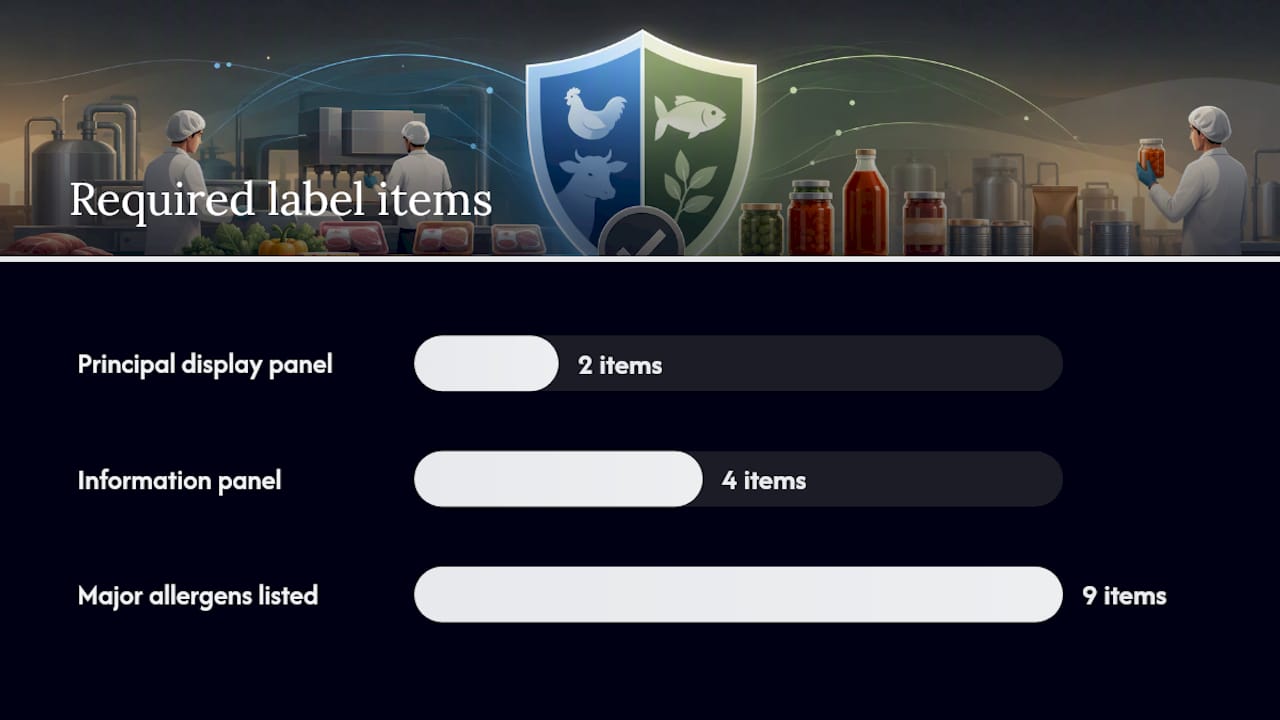
Every packaged food label splits into two zones, and regulators check both. The principal display panel (the front of the package, basically) needs a statement of identity, meaning the actual name of the food, plus the net quantity of contents in both metric and U.S. customary units. The information panel, usually the panel just to the right of the PDP, carries the ingredient list, the Nutrition Facts box, allergen declarations, and the manufacturer’s name and address.
The ingredient list has its own logic. Each ingredient gets listed by its common or usual name, in descending order by weight, the heaviest first. Sub-ingredients (the stuff inside a compound ingredient, like the specific oils in a “seasoning blend”) typically need parenthetical breakdowns unless a standardized exemption applies. This is one of the most common places manufacturers slip up, especially after a formulation change that nobody updates on the label.
Allergen declarations deserve their own careful pass. The major allergens to watch include:
- Milk, eggs, fish, and shellfish
- Tree nuts and peanuts
- Wheat, soybeans, and sesame
These typically appear either directly in the ingredient list (in parentheses after the ingredient) or in a standalone “Contains” statement right below it. If your product touches any of these, a dedicated review of your allergen labeling requirements is worth the twenty minutes it takes.
The full technical requirements for placement, format, and content live in 21 CFR Part 101, which is the binding text behind everything in this section.
Who Regulates Your Product: FDA or USDA?
Here’s the quick test: if your product is meat, poultry, or a processed egg product, it almost certainly falls under USDA’s Food Safety and Inspection Service (FSIS). Nearly everything else, including baked goods, candy, beverages, and dairy, falls under the FDA. The UC Davis food safety program lays this split out clearly, and it’s a good bookmark for anyone unsure which agency applies.
Borderline cases trip people up constantly. A frozen chicken pot pie is FSIS territory. A vegetarian pot pie with no meat is FDA. A soup with a small amount of chicken stock might tip either way depending on percentage thresholds, so confirm with the agency directly if you’re on the fence.
The bigger practical difference isn’t jurisdiction, it’s process. FSIS often requires label pre-approval before a product ships. FDA does not pre-approve labels at all; you self-certify and the agency enforces after the fact. That single distinction should shape your entire label workflow and timeline.
What Changed on the Nutrition Facts Label?
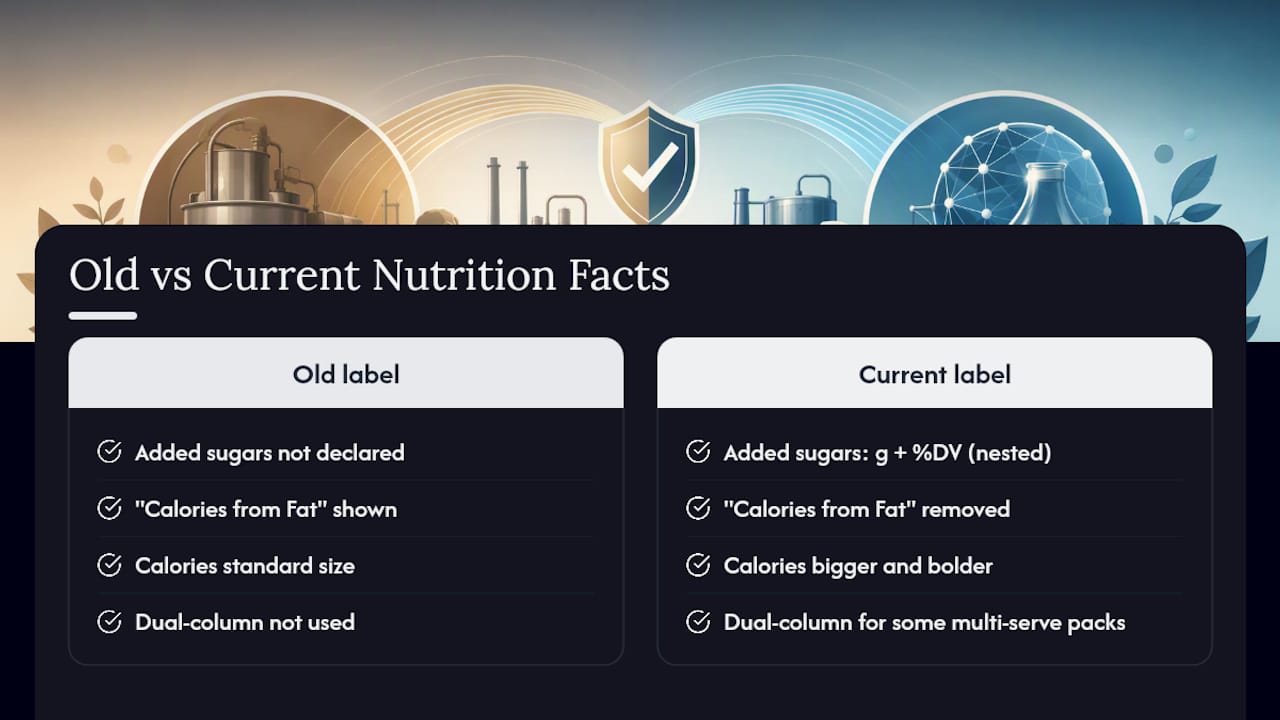
The FDA’s 2016 rule overhaul reshaped the Nutrition Facts box, and manufacturers still get caught using outdated formats. Two changes matter most: added sugars now require a declaration in both grams and percent Daily Value, nested under the Total Sugars line, and the old “Calories from Fat” line is gone entirely, replaced by a bigger, bolder “Calories” figure at the top of the panel. The FDA’s own summary of these changes is the cleanest reference if you need to double check formatting.
Quick fact: the compliance date that governs your label isn’t today’s date, it’s the date the product was actually labeled. FDA guidance on the compliance date and added sugars confirms that stickers or overlabels are acceptable in some cases before a full repackaging run, which can save a small manufacturer from scrapping inventory. Dual-column labeling (showing “per serving” and “per package” side by side) kicks in for certain multi-serving containers people commonly eat in one sitting, like a pint of ice cream.
Design Rules That Trip Up Even Careful Manufacturers
Regulators care about layout almost as much as content, and this is where a lot of otherwise-compliant labels get flagged; for a detailed discussion on food quality and standards in hospitality, see Explaining Food Quality Standards for Smarter Dining. The type size for mandatory information generally can’t go below 1/16 inch, measured using the lowercase letter “o” as the reference point. Contrast matters too. Pale gray text on a cream background might look elegant, but if an inspector can’t read it easily, that’s a problem.
A few specific violations show up over and over:
- Placing decorative artwork or promotional text between mandatory label elements
- Ingredient lists that aren’t actually in descending weight order after a recipe tweak
- Missing or incomplete manufacturer address (a PO box alone usually isn’t enough)
- Health-sounding claims that aren’t backed by the required substantiation
The Mississippi State Extension labeling guide breaks these design mechanics down with the kind of concrete measurements a printer actually needs.
Pro Tip: Before you approve a print plate, hold a printed proof at arm’s length under normal store lighting, not your studio lights. If you squint, so will your customer, and so will an inspector.
Your Step-by-Step Compliance Checklist
Treat this as a repeatable workflow, not a one-time project. Run through it for every new SKU.
- Determine jurisdiction. Confirm whether FDA or FSIS governs your product, and check if a standard of identity applies (things like “mayonnaise” or “chocolate” have legal definitions).
- Calculate nutrition values. Use verified recipe data or commission a lab test, then apply FDA’s rounding rules for calories, fat, and sugar.
- Build your ingredient and allergen declarations. Common or usual names, descending order by weight, allergens clearly flagged.
- Lay out the panels. Meet the type-size and placement rules before anything goes to print.
- Assemble your paper trail. Formulations, supplier specs, and lab reports all need a home.
- Review internally, then externally if needed. Bring in a third-party reviewer for complex or nutrient-content claims.
| Step | What You’re Checking | Common Failure Point |
|---|---|---|
| Jurisdiction | FDA vs FSIS, standard of identity | Assuming all “meat-adjacent” products are FSIS |
| Nutrition calculation | Rounding rules, added sugars | Using outdated pre2016 format |
| Ingredient/allergen list | Descending weight order | Forgetting sub-ingredient allergens |
| Layout | Type size, placement | Artwork crowding the info panel |
| Documentation | Formulations, lab reports | No retained records at all |
| Review | Internal plus external if complex | Skipping review on nutrient claims |
What Records Should You Keep and When to Bring in a Reviewer
Keep your formulations, supplier specification sheets, lab reports, and the actual calculations behind your Nutrition Facts numbers. The FDA doesn’t pre-approve labels, which means the burden of proof sits entirely with the manufacturer if a regulator ever asks questions, according to the FDA’s food labeling guidance.
Simple recipe math is usually fine for straightforward products. But if a nutrient claim drives your marketing (like “high protein” or “low sugar”), lab verification is the safer route, especially when ingredients have naturally variable nutrient content. A checklist for federal and state requirements is a good place to start organizing what you’ll need on file.
Space-Man’s Take on Getting Labels Right the First Time
Most manufacturers don’t fail label compliance because the rules are secret. They fail because nobody double-checks the label against the actual regulation before the print run ships. We’ve put together a downloadable five-step nutrition label checklist for exactly that reason. When private-label or co-packing work is handled, label compliance review is simply part of the process, not an afterthought bolted on at the end.
— Chadi
Let Space-Man Handle the Packaging While You Handle the Recipe
We offer Canadian private labeling, co-packing, and bagging or packaging services, and part of that engagement includes making sure your label actually holds up before it hits a shelf, not after a customer complaint or a compliance letter forces a reprint.

If you’re a smaller brand still figuring out formulation and packaging simultaneously, that combination saves real time. Grab our five-step checklist as a starting point, then reach out through our private label, co-packing, and packaging services page to get a label review folded into your production run. It’s a lot less painful than fixing a labeling mistake after a pallet’s already printed.
Where to Verify These Rules Yourself
Don’t take any single guide’s word for it, including this one. The binding legal text lives in 21 CFR Part 101. For plain-language explanations, the FDA’s Food Labeling Guide and interactive Nutrition Facts Label resources cover most day-to-day questions. Meat, poultry, and egg producers should start with FSIS labeling basics instead.
This article is general information, not a substitute for advice from a qualified lawyer. Consult a qualified legal professional about your own circumstances before acting on anything here.
Sources
- Regulations for processing and distribution: food labeling | UC Davis Extension
- Changes to the Nutrition Facts label | FDA
- eCFR :: 21 CFR Part 101 – Food Labeling
- Basics of Labeling | Food Safety and Inspection Service
FAQ
Does the FDA Pre-Approve Food Labels?
No. The FDA does not pre-approve labels before they go to market; manufacturers self-certify and the agency enforces after products are already selling, which puts documentation squarely on you.
What’s the Minimum Type Size for Nutrition Facts?
Mandatory label text generally can’t go below 1/16 inch, measured using the lowercase letter “o,” and it needs enough contrast to stay easily readable under normal lighting.
Do I Need a Lab Test for Nutrition Facts, or Can I Calculate Them Myself?
Careful recipe-based calculations are often acceptable for straightforward products, but lab verification is the safer choice when a nutrient claim is central to your marketing or your ingredients vary naturally in nutrient content.
How Do I Know if FDA or USDA Regulates My Product?
If your product contains meat, poultry, or processed eggs as a primary ingredient, USDA’s FSIS almost certainly regulates it; nearly everything else falls under FDA, though borderline products are worth confirming directly with the relevant agency.
Can I Use a Sticker to Update an Old Nutrition Facts Label?
Yes, in some cases. FDA guidance allows overlabeling with a compliant sticker before full repackaging, provided the sticker meets the same placement and readability rules as a printed label.
Does Space-Man Help With Label Compliance?
Yes. Private-label and co-packing services in Canada often include label review as part of the packaging process, which helps manufacturers catch formatting or allergen issues before a full print run ships.