

TL;DR:
- Freezing candy works best for low-moisture, low-fat types like hard candies and plain chocolates, while others like gummies and nut-filled bars degrade or spoil. Proper packaging, temperature stability, and slow thawing are essential to preserve texture and flavor, with most issues arising during the thawing process. For long-term storage, freezing compatible candies in airtight, moisture-resistant packaging at 0°F is the most effective method.
Freezing candy is a proven preservation method, but it works well for some types and ruins others entirely. Whether you stocked up on Halloween hauls, scored a bulk deal on chocolate bars, or just want to keep seasonal treats fresh longer, the answer to “can you freeze candy” depends almost entirely on what the candy is made of. Hard candies and plain chocolates handle freezing reasonably well. Gummies, caramels with dairy, and nut-filled bars do not. Food scientist Rich Hartel at the University of Wisconsin has studied confectionery stability for decades, and his work confirms that water activity and fat composition are the two factors that determine whether a candy survives a freeze-thaw cycle with its texture and flavor intact.
Which types of candy can you safely freeze?
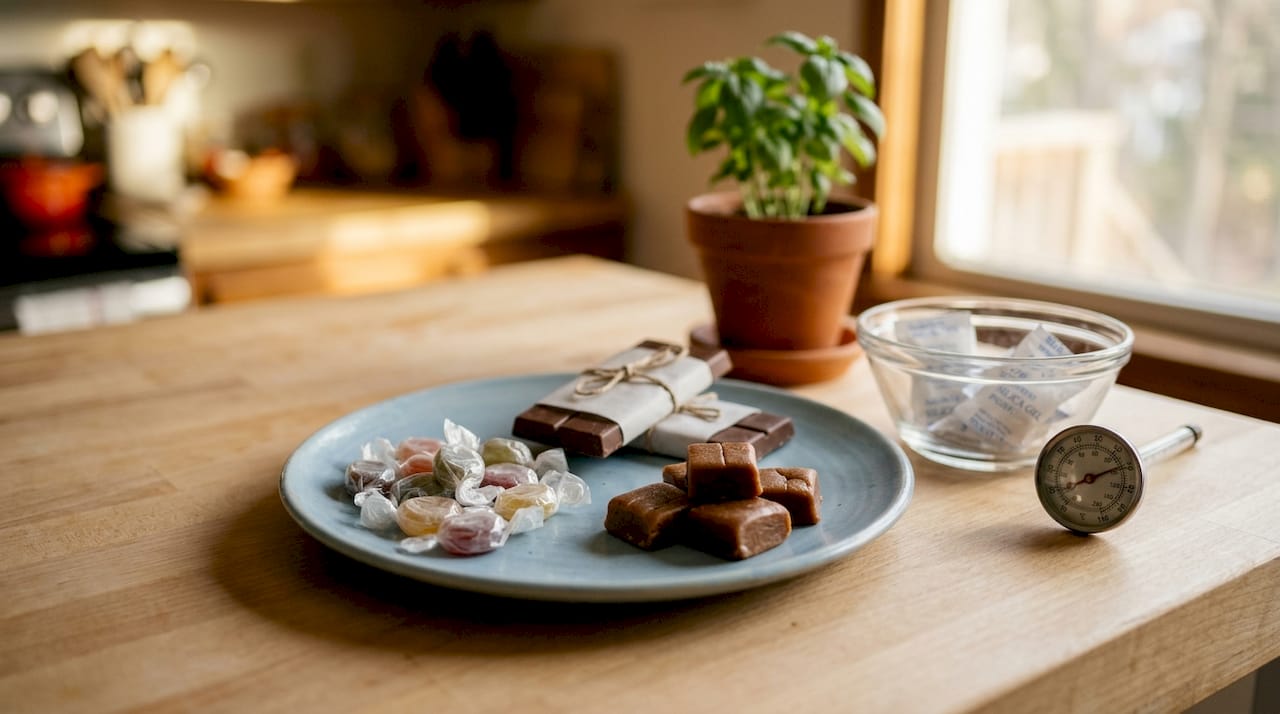
The short answer: low-moisture, low-fat candies freeze best. The longer answer involves understanding why certain ingredients fall apart at sub-zero temperatures.
Candy types that freeze well:
- Hard candies (lollipops, rock candy, butterscotch drops): low water activity means ice crystals cannot form inside the candy matrix, so they can last up to 12 months frozen with minimal quality loss
- Plain chocolate bars without fillings: safe for freezing if wrapped tightly, though expect some texture changes
- Non-dairy chewy caramels and toffees: the absence of dairy fat reduces the risk of rancidity and separation
- Plain nougats without nuts or chocolate coatings: stable structure tolerates cold storage
Candy types to avoid freezing:
- Gummies and jellies: gelatin and pectin networks collapse when ice crystals shear through their polymer structure, leaving a weepy, collapsed texture after thawing
- Chocolate bars with creamy, dairy, or ganache fillings: fat separation and microbial risk increase significantly
- Nut-filled candies: temperature cycling promotes lipid oxidation in the nut oils, causing rancidity even inside the freezer
- Candy-coated chocolates with sugar shells: moisture migration causes the shell to crack and dissolve
Here is a quick comparison to help you decide before you toss anything in the freezer:
| Candy type | Freeze safe? | Expected shelf life frozen |
|---|---|---|
| Hard candies | Yes | Up to 12 months |
| Plain chocolate bars | Yes, with care | 6 to 12 months |
| Non-dairy caramels | Yes | 6 months |
| Gummies and jellies | No | Texture collapses |
| Nut-filled chocolates | No | Goes rancid |
| Cream-filled chocolates | No | Fat separation, safety risk |
What actually happens to candy when you freeze and thaw it?
Freezing does not just make candy cold. It triggers a series of physical and chemical changes that can permanently alter texture, appearance, and flavor. Understanding these changes is the best reason to follow the storage rules closely.
Chocolate is the most sensitive. When chocolate freezes, its cocoa butter undergoes fat polymorphic changes, meaning the fat crystals shift from stable Form V to less stable forms. The result is fat bloom and texture shifts that give chocolate a grayish, streaky surface and a crumbly bite. This is not mold and it is not unsafe, but it does affect the eating experience. Cadbury Creme Eggs, for example, are a popular candidate for freezing before Easter ends, but their dairy cream filling makes them a poor choice because the filling separates and the chocolate shell blooms badly.
The other major culprit is condensation. When you pull frozen candy out of the freezer and unwrap it immediately, warm air hits the cold surface and moisture condenses on it. That moisture dissolves surface sugar, and when it evaporates, it leaves behind a white, grainy coating called sugar bloom. Sugar bloom is purely cosmetic, but it signals that the candy’s surface chemistry has been disrupted.
For gummies, the damage is structural rather than cosmetic. Ice crystals that form inside gelatin or pectin networks physically cut through the molecular chains. When the candy thaws, those broken networks release water in a process called syneresis, leaving you with a wet, sticky, collapsed gummy that bears little resemblance to what you started with.
Pro Tip: Temperature fluctuations are more damaging than a single freeze. If your freezer cycles between 10°F and 30°F repeatedly, moisture migrates through packaging and accelerates bloom, stickiness, and rancidity far faster than a stable 0°F environment.
How to freeze candy at home the right way
Getting the best way to freeze candy right comes down to three things: packaging, temperature consistency, and patience during thawing. Skip any one of these and you will likely be disappointed with the results.
-
Wrap each piece individually. Use plastic wrap first, then a layer of aluminum foil. This double barrier reduces moisture migration and prevents the candy from absorbing freezer odors. A chocolate bar stored next to last month’s leftover chili will taste exactly like you would expect.
-
Place wrapped candy in an airtight container or freezer bag. Squeeze out as much air as possible before sealing. Vacuum sealing with Mylar or foil pouches is the most effective method for long-term storage because it eliminates the oxygen that drives oxidation and rancidity.
-
Set your freezer to 0°F (minus 18°C) and keep it there. Consistent temperature is more important than the exact number. A freezer that fluctuates causes repeated freeze-thaw micro-cycles inside the packaging, which accelerates every quality problem mentioned above.
-
Arrange candy so pieces are not crushed. Hard candies are brittle when frozen and will shatter under pressure. Lay bags flat and avoid stacking heavy items on top.
-
Thaw slowly and keep the packaging sealed. Move candy from the freezer to the refrigerator and keep it sealed for at least 2 hours before opening. This gradual temperature change prevents condensation from forming on the candy surface.
-
Never thaw at room temperature while unwrapped. This is the single most common mistake. The rapid temperature jump pulls moisture from the air directly onto the candy surface, causing bloom, stickiness, and in dairy-containing candies, potential spoilage.
Pro Tip: Add a silica gel desiccant packet inside your airtight container before freezing. Silica gel absorbs residual moisture inside the container and significantly reduces the risk of sugar bloom during thawing.
For anyone curious about freeze-drying as an alternative preservation method, Space-man’s guide on what candy can be freeze dried covers a completely different process that removes moisture entirely rather than just lowering temperature.
Freezing vs. refrigeration vs. room temperature: which is best?
Knowing how to store candy also means knowing when freezing is actually the right choice versus simpler options.
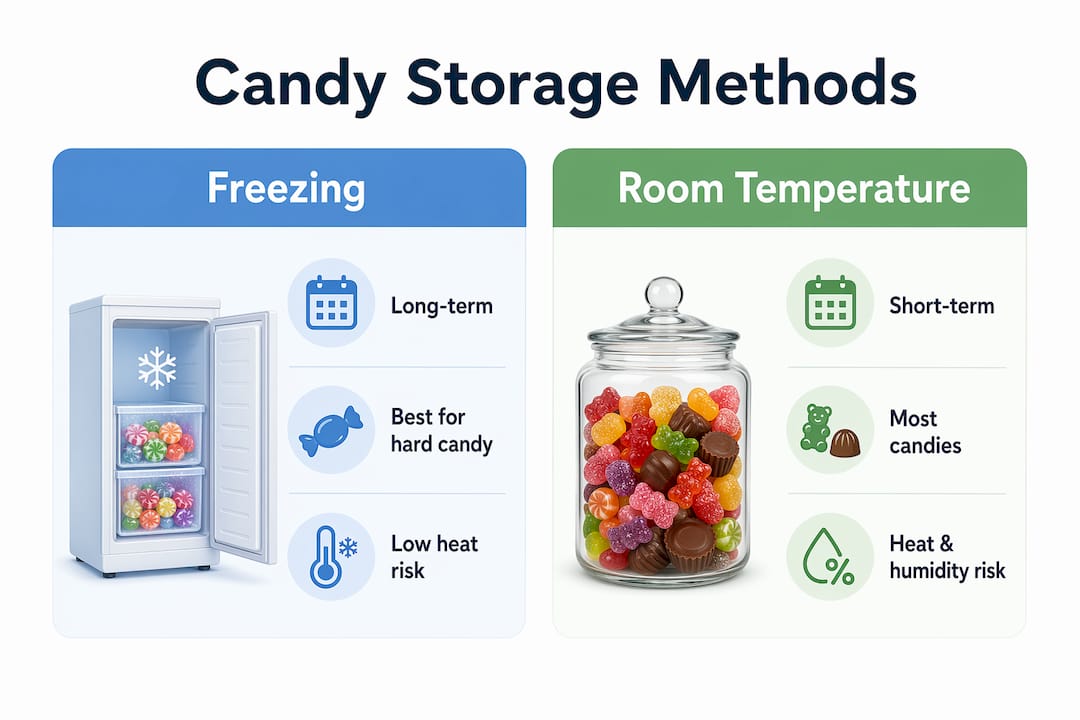
Room temperature storage works perfectly for most candies over short periods, typically up to a few weeks. The ideal conditions are 57 to 61°F (14 to 16°C) with low humidity, which is also the ideal storage temperature for chocolate. Most pantries and candy dishes fall outside this range in summer, which is when heat and humidity cause chocolate to bloom and hard candies to stick together.
Refrigeration is the option most people reach for instinctively, but it is generally the worst choice for candy. The refrigerator environment is humid, and moisture causes stickiness and sugar bloom on most candy types. Hard candies become tacky and clump together. Chocolate develops bloom from condensation every time you open the fridge door. Unless you are storing candy for only a day or two in an extremely well-sealed container, the refrigerator creates more problems than it solves.
Freezing is the right choice specifically for bulk storage and long-term preservation of freeze-compatible candy types. If you bought a case of plain chocolate bars on sale, or you want to preserve a seasonal candy like Cadbury Creme Eggs past their retail window (using the plain chocolate version, not the cream-filled ones), freezing at a stable 0°F extends shelf life to 6 to 12 months with acceptable quality outcomes.
| Storage method | Best for | Risk |
|---|---|---|
| Room temperature | Short-term, most candy types | Heat and humidity damage |
| Refrigeration | Almost nothing | Moisture, bloom, stickiness |
| Freezing | Bulk, long-term, select types | Texture and bloom if done wrong |
For a deeper look at how storage decisions scale from home to commercial settings, Space-man’s resource on candy storage solutions covers both contexts clearly.
Key takeaways
Freezing candy preserves quality only when the candy type is compatible and the packaging, temperature, and thawing process are all handled correctly.
| Point | Details |
|---|---|
| Freeze-safe candy types | Hard candies, plain chocolate bars, and non-dairy caramels tolerate freezing best. |
| Avoid freezing these | Gummies, nut-filled bars, and cream-filled chocolates degrade or go rancid when frozen. |
| Packaging matters most | Double-wrap in plastic and foil, then seal in an airtight container to block moisture. |
| Thaw slowly and sealed | Keep candy sealed in the fridge for at least 2 hours before opening to prevent bloom. |
| Refrigeration is not the answer | Fridge humidity causes stickiness and bloom faster than room temperature storage does. |
Why most people freeze candy wrong (and how to stop)
I have seen a lot of candy preservation mistakes, and almost none of them happen during the freezing step. The damage happens at the thawing stage, every single time. Someone pulls a bag of chocolate bars out of the freezer, rips it open on the counter, and then wonders why the chocolate looks gray and tastes flat an hour later. That is not a freezer problem. That is a patience problem.
The other mistake I see constantly is freezing everything without thinking about what is actually inside the candy. Nut-filled bars are a classic example. People assume that colder equals safer, but lipid oxidation in nut oils accelerates with temperature cycling, meaning a bag of peanut brittle that gets frozen and partially thawed twice will taste rancid faster than one stored at room temperature in a sealed container.
My honest recommendation: invest in proper moisture-barrier packaging before you freeze anything. Mylar bags, vacuum-sealed foil pouches, or even high-quality freezer bags with the air pressed out will do more for candy quality than any temperature trick. The right packaging materials are the difference between candy that comes out of the freezer tasting fresh and candy that comes out tasting like your freezer’s autobiography.
Freezing candy is a legitimate tool. It is just not a universal one. Respect the science, package it properly, and thaw it slowly. Do those three things and you will get genuinely good results.
— Chadi
Preserve your candy with professional-grade packaging

At Space-man, we work with candy at a professional level every day, from freeze-drying to co-packing to full private label production across Canada. One thing we know for certain: the packaging is where most preservation failures begin. Whether you are storing candy at home or managing bulk inventory for a retail operation, moisture-resistant, airtight packaging is the single biggest factor in shelf life. Our private label and co-packing services include vacuum sealing, nitrogen flushing, and barrier packaging options designed to keep candy fresh through storage, shipping, and temperature changes. If you are serious about candy preservation at any scale, we can help you get it right.
FAQ
Can you freeze chocolate candy bars?
Yes, plain chocolate bars can be frozen for 6 to 12 months if wrapped tightly and thawed slowly in the refrigerator while still sealed. Freezing may cause firmer texture, surface cracks, or whitish bloom, but these are cosmetic issues and do not affect safety.
Does freezing ruin gummy candy?
Freezing ruins gummies almost every time. Ice crystals shear through the gelatin or pectin network inside the candy, and when it thaws, the structure collapses and releases water, leaving a sticky, misshapen mess.
What is the best way to thaw frozen candy?
Move frozen candy from the freezer to the refrigerator and keep it completely sealed for at least 2 hours before opening. This slow thaw prevents condensation from forming on the candy surface, which is the main cause of sugar bloom and stickiness.
How long does candy last in the freezer?
Hard candies last up to 12 months frozen with proper packaging. Plain chocolate bars and non-dairy caramels hold quality for 6 to 12 months. Candy types incompatible with freezing, like gummies or nut-filled bars, should not be frozen regardless of duration.
Is refrigerating candy better than freezing it?
Refrigeration is generally worse than both room temperature and freezing for most candy types. The humidity inside a refrigerator causes sugar bloom on chocolate and makes hard candies sticky and clumped. Freezing at a stable 0°F is the better option for long-term storage of compatible candy types.