

Bubble wrap comes in various main types including standard, anti-static, foam-laminated, adhesive/cohesive, paper-backed, insulated/foil, flame-retardant, and recycled. It’s sold in rolls, sheets, bags, and mailers. The one-line rule: pick by fragility first, then surface risk, then ESD risk, then void-fill need, then recyclability.
Here’s the quick-match cheat sheet:
- Standard bubble wrap → general-purpose cushioning for most shipped goods
- Anti-static (pink) → electronics, PCBs, hard drives, anything ESD-sensitive
- Foam-laminated / PE-foam laminate → high-gloss or painted surfaces, furniture
- Paper-backed → wood furniture, frames, scratch-prone surfaces
- Cohesive / self-adhering → wrapping without tape (sticks to itself, not your product)
- Self-adhesive (peel-and-stick) → quick-wrap applications where tape is a nuisance
- Insulated/foil-coated → temperature-sensitive goods in short transit windows
- Flame-retardant → regulated storage environments and industrial shipments
- Recycled/eco-friendly → sustainability-focused operations and retail brands
Key Takeaways
Choosing the right bubble wrap type comes down to five factors: item fragility, surface sensitivity, ESD risk, void-fill need, and recyclability preference.
| Point | Details |
|---|---|
| Match type to risk | Anti-static for electronics, foam-laminated for gloss surfaces, paper-backed for furniture. |
| Bubble size drives protection type | Use 1/8"–3/16" for surface protection; 5/16"–1/2" for impact absorption and void fill. |
| Grade by load and handling | B1/lightweight for low-risk items; B3–B4/heavy-duty for fragile, heavy, or sharp-edged goods. |
| Combine sizes for full coverage | Layer small bubbles against the product and large bubbles outside to cover both surface and impact failure modes. |
| Verify specs before ordering | Ask suppliers for bubble diameter, film thickness in mils, layer count, and anti-static certification. |
Table of Contents
- What is bubble wrap and how is it made?
- How bubble wrap actually protects your products
- The main bubble wrap types explained by material and features
- Formats, bubble sizes, and industry grades
- How do you choose the right bubble wrap for your needs?
- What should you wrap with which bubble wrap?
- Storage, handling, and recycling in the U.S.
- Packaging pro tips from Space-man’s experience
- What I’d tell anyone choosing bubble wrap for ecommerce
- Sources
What is bubble wrap and how is it made?
Bubble wrap is an air-filled polymer film, typically low-density polyethylene (LDPE), designed to absorb impact and protect surfaces during shipping and storage. The name started as a brand in 1957 but is now used generically across the packaging industry.
Manufacturing follows three main steps. First, LDPE resin is melted and extruded into thin film. Second, one sheet is vacuum-formed over a roller with small cavities, trapping air pockets as a second flat sheet bonds over the top. That’s the classic single-layer (B1) construction. Third, optional treatments are applied: a foam laminate for extra surface cushioning, an anti-static coating for ESD protection, a foil layer for thermal insulation, or an adhesive backing for peel-and-stick use.
Layer count matters more than most buyers realize. A B1–B4 grade classification describes single- to multi-layer construction, where each added layer increases puncture resistance and load capacity. Film thickness, measured in mils, determines how much force a bubble can absorb before it collapses. Thicker film holds air longer under sustained pressure, which is why heavy-duty grades survive warehouse stacking where lightweight rolls would not.
How bubble wrap actually protects your products
Bubble wrap does two separate jobs, and confusing them is the most common packing mistake. Cushioning absorbs kinetic energy during drops and impacts. Surface protection prevents scratches, scuffs, and abrasion from contact. The same roll does not do both equally well.
The core protective properties to understand:
- Energy absorption (cushioning): Larger bubbles hold more air volume and absorb more impact energy. Best for drop protection and void fill.
- Surface protection: Smaller, denser bubbles create a gentler contact layer. The film itself acts as a barrier between your product and the box wall.
- Puncture resistance: Determined by film thickness and layer count. Multi-layer grades resist sharp edges that would pop single-layer film immediately.
- Flexibility and conformability: Thinner, single-layer wraps conform easily around irregular shapes. Heavier grades are stiffer and harder to wrap tightly.
- Thermal insulation: Foil-laminated wraps add a reflective barrier that slows heat transfer, useful for short transit windows with temperature-sensitive goods.
- Electrostatic behavior: Standard LDPE generates static charge. Anti-static formulations dissipate that charge before it can damage sensitive components.
Pro Tip: When packing painted or high-gloss surfaces, prioritize surface protection over cushioning. Use small-bubble or foam-laminated wrap directly against the finish, then add a larger-bubble layer outside for impact absorption. Reversing that order puts the rougher outer surface of the bubble film in contact with your gloss finish.
Consider the difference between a framed glass print and a circuit board. The print needs scratch prevention on the glass face and impact protection on the corners. A circuit board needs ESD protection first, then cushioning. Same fragility level, completely different material requirements.
The main bubble wrap types explained by material and features
Specialized bubble wrap types are engineered for specific risks, and choosing the wrong one can cause the exact damage you were trying to prevent.
Standard bubble wrap
General-purpose LDPE film with air-filled bubbles. No special coatings or treatments. Available in lightweight, medium, and heavy-duty grades. Works for most non-sensitive items: books, kitchenware, toys, and general retail goods. The default choice when ESD, surface sensitivity, and thermal protection are not concerns.
Anti-static bubble wrap
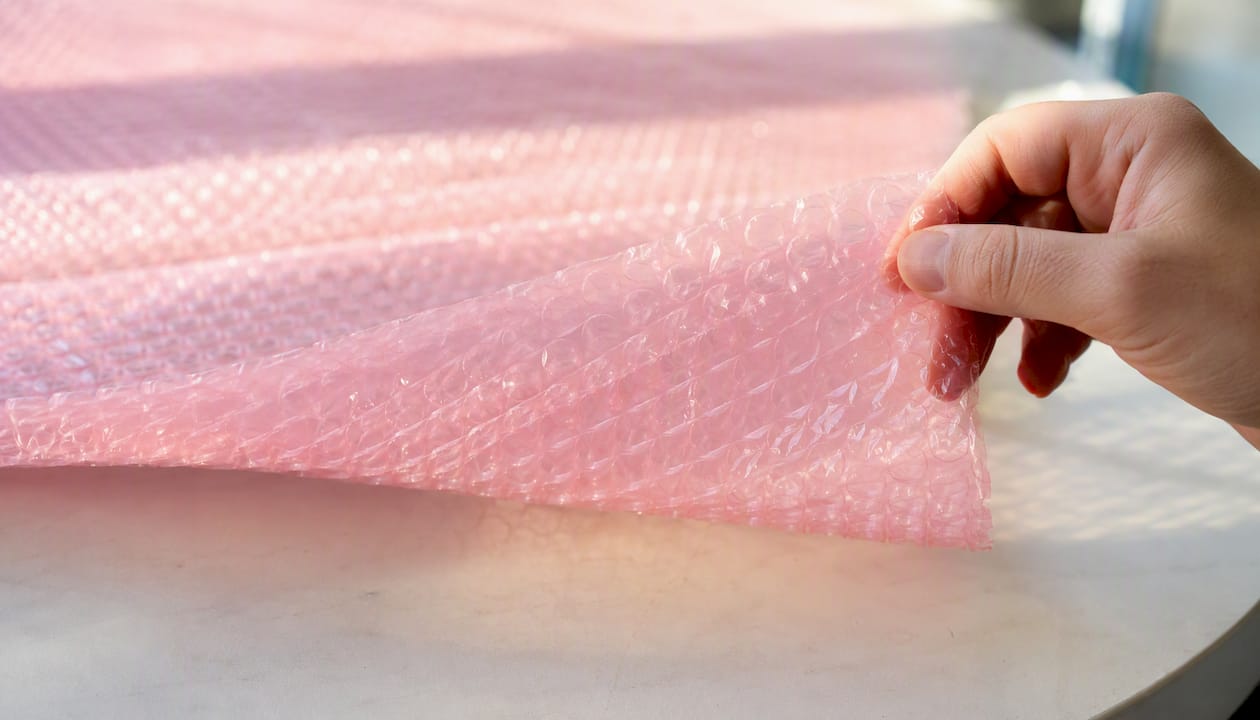
Tinted pink so it’s visually identifiable at a glance. The anti-static formulation dissipates electrostatic charge rather than building it up the way standard LDPE does. Specify this with your supplier for any ESD-sensitive product; never assume standard bubble wrap is safe for electronics. Use it for PCBs, hard drives, RAM, and other components where a static discharge would cause invisible but permanent damage.
Cohesive bubble wrap
Sticks to itself but not to your product or the box. No tape required. Particularly useful for wrapping irregularly shaped items quickly, since the wrap holds its position without slipping. A good fit for packing stations where speed matters and tape dispensers slow things down.
Self-adhesive bubble wrap
Has a peel-and-stick backing on one side. The adhesive bonds to the product surface, which eliminates tape entirely and keeps the wrap from shifting. Common varieties include self-adhesive bubble wrap for eliminating tape and foam-backed options for extra surface protection. Best for flat, smooth surfaces where repositioning is not needed.
Foam-laminated / PE-foam laminate
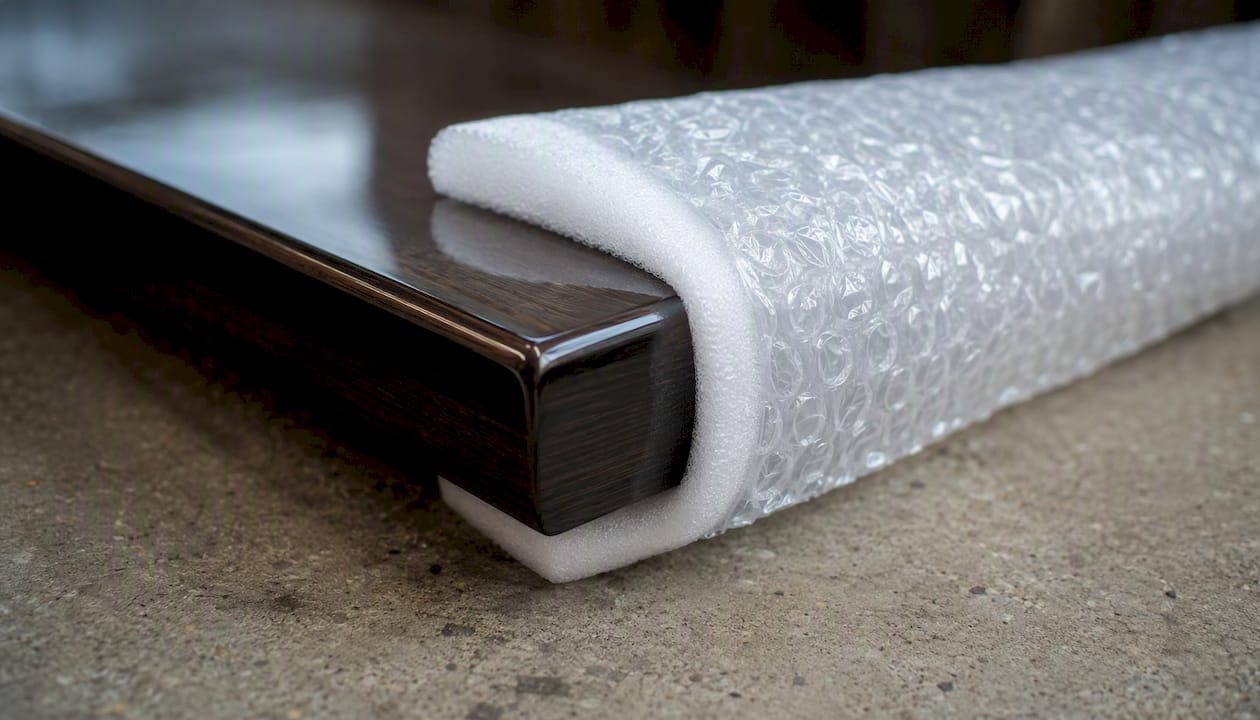
A layer of polyethylene foam bonded to one side of the bubble film. The foam side faces the product and provides a soft, non-abrasive contact surface. The bubble side faces outward and handles impact. This combination makes it the go-to for high-gloss furniture, lacquered wood, framed artwork, and automotive parts where scratches are unacceptable.
Paper-backed bubble wrap
Kraft paper laminated to one side of the bubble film. The paper layer adds rigidity, tear resistance, and a non-slip surface that grips furniture and frames without sliding. Designed specifically for wood furniture, mirrors, and large flat surfaces where standard film would shift during transit.
Insulated / foil-coated bubble wrap
A reflective foil layer bonded to the bubble film. The foil reflects radiant heat and the air bubbles provide a thermal break. Used for short-transit temperature-sensitive shipments: specialty foods, pharmaceuticals, floral arrangements, and cosmetics. Not a substitute for dry ice or gel packs in long-haul cold chain, but effective for same-day or next-day delivery windows.
Flame-retardant bubble wrap
Treated with flame-retardant additives to meet fire safety standards in regulated storage and industrial environments. Required in some warehouse and manufacturing settings where standard plastics cannot be used. Less common in general ecommerce but worth knowing if your operation falls under specific fire codes.
Recycled and eco-friendly options
Made from post-consumer or post-industrial recycled LDPE content. Performs comparably to virgin-film bubble wrap in most standard applications. An increasingly common choice for brands with sustainability commitments or customers who notice packaging materials. Pairs well with paper void fill and recycled corrugated for a fully recyclable outer pack.
Formats, bubble sizes, and industry grades
Rolls, sheets, bags, and mailers
Bubble wrap comes in four main formats, and the right one depends on your workflow as much as your product.
Rolls are the most versatile. Perforated rolls increase packing speed at stations where repeatable sheet lengths matter, while non-perforated rolls give you flexibility for irregularly sized items. Common roll widths include 12", 16", 24", and 48", with lengths scaled to warehouse throughput. Perforated rolls reduce cutting waste and keep packing consistent; continuous rolls are better when item sizes vary widely.
Pre-cut sheets eliminate the measuring step entirely. Good for high-volume operations packing the same product repeatedly.
Bubble bags and pouches are pre-formed sleeves that an item slides into. Fast to use, consistent protection, and no wrapping skill required. Best for small, uniform products.
Bubble mailers combine a paper or poly outer shell with a bubble-lined interior. They replace a box for lightweight, non-fragile items and reduce dimensional weight charges on small shipments.
Bubble sizes and what they actually mean
Typical bubble sizes map directly to use cases. Here’s how the standard dimensions break down:
| Bubble diameter | Best for | Protection type |
|---|---|---|
| 1/8" | Small items, delicate surfaces | Surface protection, light cushioning |
| 3/16" | Medium-weight products, general shipping | Surface protection + moderate cushioning |
| 5/16" | Larger items, moderate drop risk | Impact absorption, void fill |
| 1/2" | Heavy items, high drop risk, void fill | Maximum impact absorption |
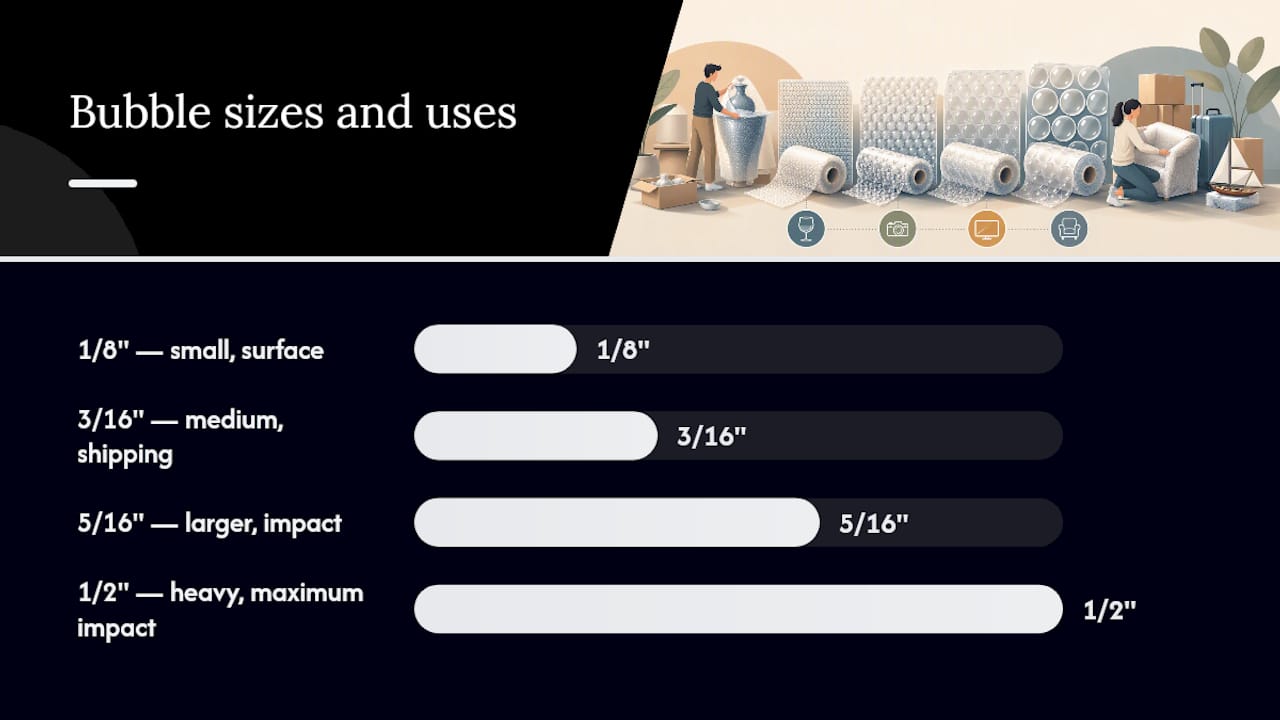
Many packers combine sizes in a single pack: 1/8" or 3/16" directly against the product for surface protection, then 1/2" outside for impact. That layering approach covers multiple failure modes without switching materials.
Industry grades: B1–B4 and weight classifications
Some manufacturers use a B1–B4 classification system based on layer count and film construction. B1 is single-layer, suited for lightweight items with no sharp edges. B2 adds a second film layer for better puncture resistance. B3 and B4 are multi-layer constructions for heavier, sharper, or more valuable goods where film failure is not an option.
The more common retail and professional classification uses three weight grades: lightweight (B1-equivalent, cost-efficient for low-risk items), medium (B2-equivalent, general shipping), and heavy-duty (B3/B4-equivalent, for fragile, heavy, or sharp-edged products). Bubble wrap is sold in these three primary weight grades to balance cost and protection based on load requirements.
How do you choose the right bubble wrap for your needs?
Work through this checklist in order. Each question narrows your options until the right type is obvious.
- How fragile is the item? Glassware, ceramics, and electronics need heavier grades (B3/B4 or heavy-duty). Books and soft goods can use B1/lightweight.
- Does the surface scratch easily? High-gloss, painted, or lacquered surfaces need foam-laminated or paper-backed wrap, not standard film.
- Is the item ESD-sensitive? Any electronics component needs anti-static (pink) bubble wrap. Standard LDPE is not safe for PCBs or drives.
- Does it need thermal protection? Short-transit temperature-sensitive goods need foil-insulated wrap. Long-haul cold chain needs additional refrigerant.
- How heavy is it, and does it have sharp edges? Heavy or sharp-edged items need multi-layer film (B3/B4). Single-layer film will puncture.
- How much void space is in the box? Large voids need larger bubbles (5/16" or 1/2") or complementary void fill. Small voids can use 3/16" wrap.
- What’s your packing-station workflow? High-volume, same-size items: pre-cut sheets or bags. Variable sizes: perforated rolls. Speed priority: cohesive or self-adhesive wrap.
- What are your sustainability requirements? Recycled-content options are available across most grades and sizes. Check recyclability at your local drop-off (more on that below).
Questions to ask your supplier before ordering: bubble diameter (exact measurement, not just “small” or “large”), film thickness in mils, layer count, tensile strength, recycled content percentage, and anti-static certification for ESD applications.
Red flags: vague grade claims with no film thickness stated, no bubble diameter listed, “anti-static” claims without a certification standard, and non-recyclable materials offered without an alternative.
What should you wrap with which bubble wrap?
Here are practical pairings for the most common shipping scenarios. For packing flat collectibles like comics, the same surface-protection logic applies: protective sleeves and careful layering prevent corner damage and surface scuffs.
| Product type | Bubble wrap type | Bubble size | Format |
|---|---|---|---|
| Smartphone / tablet | Anti-static | 1/8" | Sheet or pouch |
| PCB / hard drive | Anti-static | 3/16" | Sheet |
| Wine glasses / ceramics | Standard heavy-duty | 3/16" inside, 1/2" outside | Roll |
| High-gloss furniture | Foam-laminated | 3/16" | Roll |
| Wood furniture / frames | Paper-backed | 5/16" | Roll |
| Temperature-sensitive food | Insulated/foil | 3/16" | Sheet or bag |
| Books / soft goods | Standard lightweight | 3/16" | Sheet or bag |
| Void fill (large box) | Standard | 1/2" | Roll |
Quick packing recipes
Glassware for shipment: Wrap each piece in 3/16" standard bubble wrap for surface protection. Add a second layer of 1/2" wrap for impact cushioning. Place in a double-walled box with foam corner protectors at each end and kraft paper void fill to prevent shifting. No glass should contact another glass or the box wall directly.
Electronics (non-ESD-critical): One layer of 3/16" standard wrap for surface protection. Box with corrugated inserts to prevent movement. For ESD-sensitive components, swap to anti-static wrap and add an anti-static bag before wrapping.
High-gloss furniture panel: Foam-laminated wrap with the foam side against the finish. Secure with cohesive wrap over the top so no tape adhesive touches the surface. Add corner protectors before boxing.
Bubble wrap works best as part of a system. Pair it with plastic packaging choices for food-contact applications, and always use a corrugated outer box rated for the total shipment weight.
Storage, handling, and recycling in the U.S.
Storing bubble wrap correctly
- Keep rolls off concrete floors. Concrete wicks moisture, which degrades the film over time. Use pallets or shelving.
- Store away from direct UV light. Prolonged UV exposure embrittles LDPE and reduces cushioning performance.
- Maintain a stable temperature. Extreme heat softens the film and can cause bubbles to deflate prematurely; extreme cold makes the film brittle.
- Use FIFO (first in, first out) rotation for inventory. Older rolls should ship before newer stock.
- Cut rolls with a clean blade or dispenser, not scissors that drag and tear the film unevenly.
Recycling bubble wrap in the U.S.
Standard LDPE bubble wrap is technically recyclable but not accepted in most curbside programs. The practical route:
- Check the film for a #4 LDPE resin code before assuming it’s recyclable.
- Drop off clean, dry bubble wrap at plastic film recycling bins, available at most major grocery and home improvement retailers (Walmart, Target, Home Depot, Lowe’s).
- Do not mix contaminated wrap (food residue, tape, labels) with clean film. Contaminated film goes in the trash.
- For high-volume operations, contact a local film recycler directly for pickup programs.
- Reuse intact bubble wrap before recycling it. A roll that’s been used once for light-duty wrapping often has plenty of life left for a second pass.
Handling safety
Bubble wrap on smooth floors is a genuine slip hazard. Keep it off walkways. Popped bubbles create small plastic fragments; dispose of torn film promptly rather than letting it accumulate. For food-contact packaging operations, use only food-safe certified film and keep bubble wrap away from open product.
Packaging pro tips from Space-man’s experience
At Space-man, packaging isn’t theoretical. We handle freeze-dried candy, chocolates, and marshmallows that need to arrive intact and looking great, and we run co-packing and packaging services for other consumer goods manufacturers. That means we make real decisions about protective materials every week.
A few things we’ve learned that most guides skip:
When to double-layer: If an item has a fragile surface AND a drop risk, one layer of bubble wrap is a compromise, not a solution. Use 3/16" directly against the product and 1/2" outside. The cost difference is small; the damage-claim difference is not.
When to combine bubble sizes: Combining bubble sizes in a single pack is standard practice for good reason. Small bubbles wrap tightly around contours; large bubbles absorb the energy of a drop. Using only one size means you’re optimizing for one failure mode and ignoring the other.
Grade tradeoff: B1/lightweight is fine for padded mailers going to nearby destinations with minimal handling. The moment a shipment involves multiple carrier transfers, warehouse sorting, or heavy co-packed items, move to B2/medium at minimum. The extra cost per roll is a fraction of one damage claim.
Pro Tip: Before committing to a bubble wrap grade for a new product line, do a simple drop test. Pack the item as you would for shipment, drop the box from waist height onto a hard floor, and inspect. If the item moves inside the box or the wrap collapses, go up a grade or add void fill. This takes ten minutes and saves weeks of damage-claim headaches.
For ecommerce operations shipping delicate confections or retail display kits, the right packaging strategy pairs protective materials with presentation. Bubble wrap handles the transit; the outer packaging handles the unboxing experience.

Space-man’s packaging and co-packing services are available for consumer goods manufacturers who need reliable, repeatable protective packaging. Whether you’re scaling a product line or optimizing an existing packing process, the team at Space-man can help you select the right materials and build a workflow that reduces damage rates. Get in touch about co-packing and packaging services to discuss your requirements.
What I’d tell anyone choosing bubble wrap for ecommerce
Testing matters more than spec sheets. Every product has its own failure mode, and the only way to know if your wrap choice actually works is to simulate the worst-case handling your shipment will face. Pick your type based on the checklist above, then drop-test before you commit to a full roll order.
For recurring shipments, balance protection, cost, and sustainability together. The cheapest wrap that prevents damage is the right wrap. And if your product line is growing, it’s worth revisiting your grade choices every few months. What worked for 50 shipments a week may not hold up at 500.
Sources
These sources informed the factual sections, sizing recommendations, and grade explanations in this guide:
- Paper Mart buyers guide — bubble wrap infographic
- Find the best bubble size for your product — FoamBubble
- Different types of bubble wrap & what they’re used for — Hunter Industrial Supplies
- Types and applications of bubble wrap — MAC-GRAF
- Bubble wrap rolls | Cushioning & void fill protection — Omnipackagingsolutions